
Table of Contents
- What to Know Before You Buy an Emergency Power Station Online
- Portable Power Station for Home Emergency: Capacity and Wattage
- Solar Generator for Home Backup: Clean Energy Options
- Best Portable Power Station for Power Outages: Features That Matter
- Home Battery Backup System: Integration and Long-Term Care
- How to Choose When You Buy an Emergency Power Station Online
- Emergency Preparedness: Off-Grid and Backup Scenarios
- Conclusion: Securing Your Family's Emergency Power
Buy Emergency Power Station Online: 2026 Guide
Last Updated: July 26, 2026
When buying an emergency power station online, the sheer number of options can feel overwhelming. SHTF Prepper Club has spent years helping families navigate this decision, and we've learned that most people don't need the most expensive model, they need the right one for their specific situation. Portable power stations have become essential backup equipment for American households as families recognize the vulnerability of relying solely on the grid during outages.
Below, we'll walk you through exactly what matters when selecting an emergency power station, how to match capacity to your family's needs, and which features actually deliver value versus marketing hype.
What to Know Before You Buy an Emergency Power Station Online
Understanding your power needs before purchasing prevents costly mistakes. Most families chase the highest wattage without considering what they actually need to run.
Start with a realistic assessment. During a typical power outage, households prioritize essential devices: refrigerators, medical equipment, lighting, phone chargers, and basic heating or cooling. A modest power station handles these far better than an oversized unit gathering dust in the garage.
A single outage lasting 24 hours can spoil food, compromise medications stored in refrigerators, disable sump pumps (leading to basement flooding), and leave families in darkness. Portable backup power prevents these cascading failures. Beyond outages, families use emergency power stations for camping trips, RV adventures, and job site work, so your purchase serves multiple purposes if you choose wisely.
Key specs that matter fall into three categories: capacity (measured in watt-hours), output (measured in watts), and charging speed. Capacity tells you how long the unit runs. Output tells you what devices it can power simultaneously. Most guides emphasize capacity alone, but output is equally critical, a 2000Wh station with only 500W output cannot power a microwave, regardless of its storage.
Portable Power Station for Home Emergency: Capacity and Wattage
Understanding watt-hours and output wattage separates informed buyers from those who waste money. Watt-hours (Wh) measure total energy storage, like a fuel tank. Output wattage (W) measures how much power the station can deliver at once, like an engine size.
A 1000Wh station powering a 100W LED light runs for 10 hours. The same station powering a 500W microwave runs for 2 hours. Output wattage limits what devices work simultaneously. If your station outputs only 600W and you try to run a 1200W space heater, the unit shuts down.
Run time depends on both capacity and the device's power draw. A typical refrigerator uses 150-800W depending on compressor cycles. A modern laptop charger draws 65-100W. LED lighting uses 10-20W per bulb. A CPAP machine draws 60-80W. Calculating realistic run times requires knowing both your station's capacity and your devices' actual consumption.
A practical example: A 2000Wh station powering a 200W load (refrigerator on low mode, two LED lights, one laptop charger) runs for approximately 10 hours. The same station powering a 500W load runs for 4 hours. Most families find 2000-3000Wh adequate for essential devices during a 24-hour outage.
Solar Generator for Home Backup: Clean Energy Options
Solar panels extend your backup power from a finite resource into a renewable system. A solar generator combines a power station with solar panels, the station stores energy, the panels recharge it from sunlight.
During a multi-day outage, a power station alone depletes within 24-48 hours. Add solar panels, and you maintain indefinite backup as long as the sun shines. This distinction matters enormously for families in areas prone to extended outages from hurricanes, wildfires, or ice storms.
MPPT (Maximum Power Point Tracking) controllers optimize solar charging. Without MPPT, you lose 15-25% of the solar energy your panels generate. With MPPT, you capture 90%+ of available power. When you buy an emergency power station online with solar capability, confirm it includes an MPPT controller.
Solar panels add weight and bulk, so most families use portable 100-200W panels rather than permanent roof installations. A 200W solar panel paired with a 2000Wh station in full sun recharges the battery in 10-12 hours, far slower than wall power but invaluable during extended outages.
The trade-off is cost and complexity. A solar-ready power station costs more than a battery-only unit, and you must purchase panels separately. For families in stable climates with reliable grid power, solar adds unnecessary expense. For families in outage-prone areas, solar transforms a power station into a sustainable system.
Best Portable Power Station for Power Outages: Features That Matter
LiFePO4 batteries represent the modern standard for quality power stations. LiFePO4 (lithium iron phosphate) chemistry lasts 3,000-5,000 charge cycles, roughly 10-15 years of daily use. LiFePO4 stations maintain 80%+ capacity after 3,000 cycles, while older chemistries drop to 60-70% capacity.
Pure sine wave inverters separate reliable power stations from budget models. The inverter converts the battery's DC power to AC power for standard household devices. Pure sine wave inverters produce clean, steady power matching grid electricity. Modified sine wave inverters produce rougher power that damages sensitive electronics.
Always confirm pure sine wave inverters when buying online. Devices like medical equipment, laptops, and modern appliances require clean power. A modified sine wave station might power an LED lamp but could damage a CPAP machine or laptop charger.
AC outlets matter because most household devices use them. A station with only one or two AC outlets forces you to choose which device runs. Look for stations with at least 3-4 AC outlets. USB ports and USB-C PD (Power Delivery) outlets handle phone and tablet charging without consuming AC outlet capacity.
USB-C PD delivers 60-100W depending on the standard, allowing fast charging of laptops and tablets. DC outputs (12V cigarette lighter ports, Anderson connectors) power RV appliances and specialized camping gear. The best emergency power stations offer all three output types: AC outlets, USB, and DC.
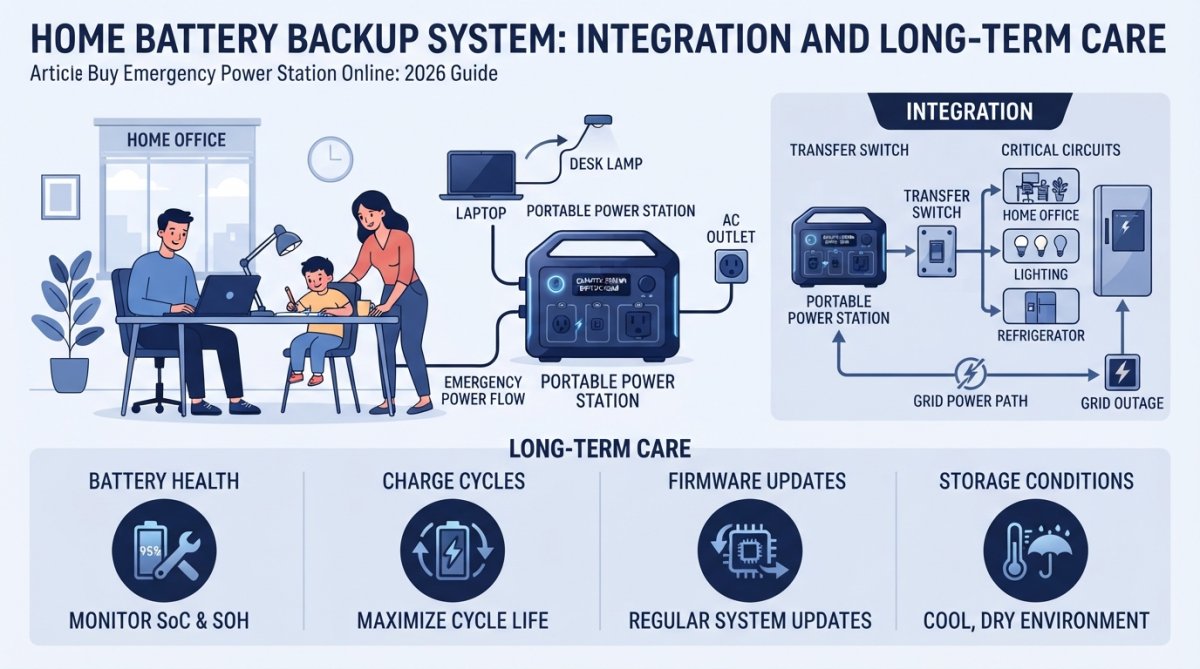
Home Battery Backup System: Integration and Long-Term Care
Connecting portable power to your home electrical panel requires professional installation and permits. Portable power stations are designed for temporary use, not permanent integration. An electrician can install a transfer switch that safely disconnects your home from the grid and connects to a power station during outages, but this requires a licensed electrician, local permits, and inspections.
For most families, hardwiring isn't practical. Instead, use the portable station to run essential circuits through extension cords or temporary connections.
Battery maintenance extends your station's lifespan significantly. LiFePO4 batteries last longest when stored at 50% charge in cool, dry conditions. If storing for winter, charge to 50%, disconnect the station, and store in a climate-controlled space.
Avoid deep discharges when possible. Recharge when the station reaches 20% remaining capacity. This practice extends cycle life by 20-30% compared to regular deep discharges. Heat accelerates battery aging, store stations in spaces that don't exceed 77°F (25°C). Check the battery management system (BMS) annually for error codes indicating problems.
How to Choose When You Buy an Emergency Power Station Online
Matching power capacity to family needs requires honest assessment, not worst-case fantasies. Create a realistic scenario: a 24-hour outage during mild weather. You need refrigeration, lighting, phone charging, and comfort. Calculate wattage:
- Refrigerator: 200W average (cycles on/off)
- Four LED bulbs: 16W total
- Laptop charger: 65W
- Phone chargers: 15W
Running refrigerator, lights, and chargers continuously totals roughly 280W. A 1000Wh station powers this for 3-4 hours. A 2000Wh station powers this for 7-8 hours. A 3000Wh station powers this for 10-12 hours.
Most families find 2000-3000Wh sufficient for essential devices during a 24-hour outage. If you live in an outage-prone area where outages exceed 24 hours regularly, or if you have medical equipment requiring continuous power, consider 5000Wh or larger.
Weight and portability constrain your choice. A 5000Wh station weighs 60-100 pounds and requires two people to move. A 2000Wh station weighs 30-50 pounds and fits in most closets. If you live in an apartment or small home, a 1000-2000Wh station is more realistic.
Power stations generate heat when charging or discharging. A station charging in your living room raises ambient temperature slightly. When discharging at high loads (1500W+), stations get warm, some reaching 140°F (60°C). Cooling fans produce 40-50 decibels during heavy discharge, roughly the sound of a quiet office.
| Scenario | Capacity Needed | Key Features | Best For |
|---|---|---|---|
| 24-hour home outage (essential devices only) | 2000-3000Wh | AC outlets, USB charging | Urban/suburban families |
| Extended outages (3+ days) | 5000Wh+ with solar | Solar input, MPPT controller | Outage-prone areas |
| Camping/RV trips | 1000-2000Wh | Lightweight, portable, USB-C | Frequent travelers |
| Medical equipment backup | 3000-5000Wh | Stable output, BMS protection | Families with CPAP, dialysis, etc. |
| Off-grid living | 10,000Wh+ with panels | High capacity, expandable | Full-time alternative power |
Emergency Preparedness: Off-Grid and Backup Scenarios
Power outage readiness requires more than buying a power station, it requires a plan. Identify which devices absolutely must run: medical equipment, refrigeration, heating/cooling, lighting, communications. Assign these to your power station.
Test your setup before an emergency. Charge the station fully, then run your essential devices for several hours. Note the discharge rate. If your station depletes faster than expected, you've discovered a problem before an actual outage.
Maintain a charging schedule. Many families buy a power station, charge it once, then forget it for months. Charge your station monthly, even if you don't use it. This keeps the battery healthy and ensures you're ready for emergencies.
A power station eliminates the need for gas generators, which are loud, smelly, and high-maintenance. Campers use portable power stations to run laptops, charge devices, power LED lighting, and operate small appliances. For families who camp frequently, a power station becomes the obvious choice once you've experienced both silent operation and generator noise.
Conclusion: Securing Your Family's Emergency Power
Family emergency preparedness isn't about preparing for apocalypse, it's about handling the outages that actually happen. Most American families experience at least one significant power outage every five years. A portable power station prevents thousands in food spoilage, medical complications, and discomfort.
When you buy an emergency power station online, you're investing in peace of mind and practical resilience. SHTF Prepper Club specializes in helping families identify exactly which gear actually matters for their situation. Our team has tested portable power stations extensively and curated solutions that balance real-world utility with reasonable cost.
Start with an honest assessment of your family's needs. A modest 2000Wh station with pure sine wave output, multiple AC outlets, and USB charging handles most home emergencies effectively. Add solar panels if you live in an outage-prone area. Test your setup before you need it. Maintain a monthly charging schedule.
Protecting your family from power outages doesn't require expensive whole-home backup systems or complex installations. A well-chosen portable power station provides immediate, practical protection. SHTF Prepper Club offers expert guidance and vetted equipment to help you select the right station for your family's specific situation, ensuring your household remains ready for emergencies without fear or complexity. Get started with SHTF Prepper Club and transform uncertainty into actionable emergency preparedness.
Frequently Asked Questions
What size emergency power station do I need for my family?
Family needs depend on which devices you want to run during an outage. A 2,000-3,000 Wh capacity typically powers essential items like WiFi routers, phone chargers, and small appliances for 8-12 hours. Calculate your needs by listing critical devices, their wattage, and daily run time. Larger households or those running medical equipment should consider 5,000+ Wh for extended emergencies.
Can a portable power station for home emergency replace a traditional generator?
Yes, portable power stations offer quieter, cleaner operation without fuel or exhaust, ideal for indoor use and family safety. However, they have lower output wattage than large generators and require recharging. For extended outages beyond 24 hours, combining a portable power station with solar panels or pass-through charging extends backup duration significantly.
How long does a solar generator for home backup take to recharge?
Recharge time varies by capacity and power source. Wall outlet charging typically takes 4-10 hours depending on wattage. Solar panel recharging depends on panel size, weather, and MPPT controller efficiency, usually 1-3 days for full capacity. Pass-through charging allows simultaneous device use and recharging, extending practical backup duration during emergencies.
What maintenance does a home battery backup system need?
LiFePO4 batteries require minimal maintenance but benefit from regular use and proper storage. Keep the unit in cool, dry conditions; avoid deep discharges below 20%; and run a full charge-discharge cycle monthly. Battery Management Systems (BMS) protect against overcharge and short circuits, extending cycle life to 3,000+ cycles, roughly 10+ years of reliable emergency backup.
This article was written using GrandRanker