
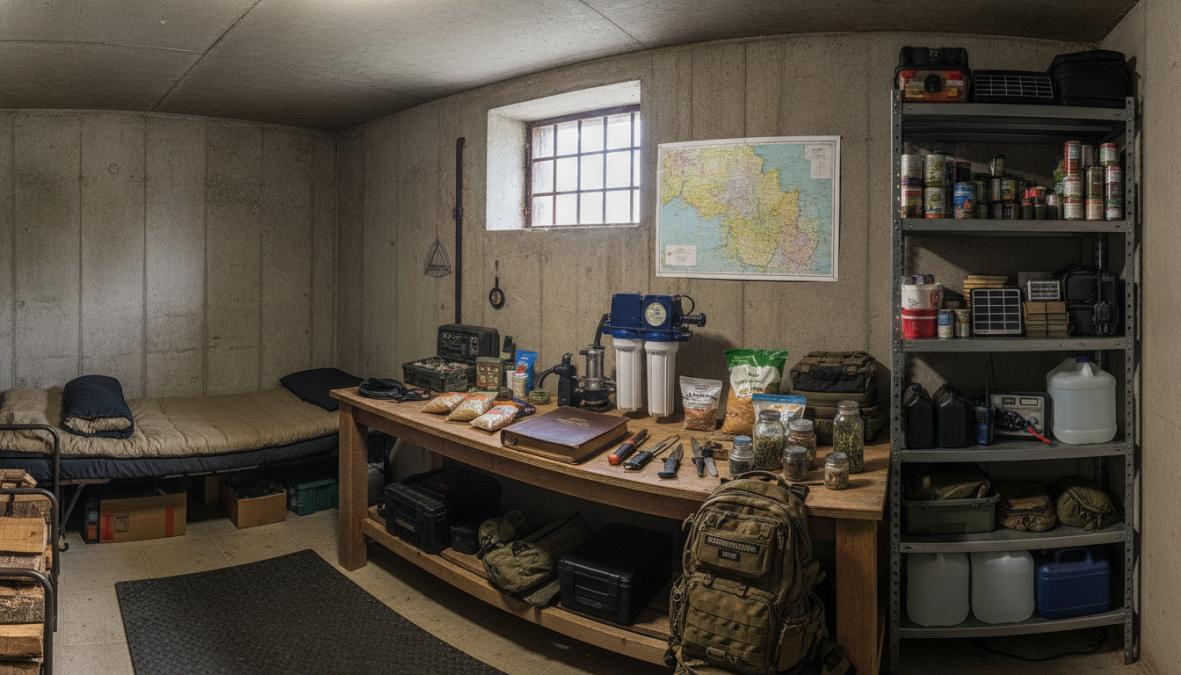
Table of Contents
- Understanding Societal Collapse: What You're Preparing For
- Emergency Preparedness Checklist: Essential Supplies and Systems
- Long-Term Food Storage Guide: Building Your Supply Chain
- Off-Grid Survival Skills: Practical Knowledge for Self-Sufficiency
- How to Build a Survival Community: Social Networks and Trust
- Psychological Preparation and Mental Resilience
- How to Prepare for Societal Collapse Without Fear: A Step-by-Step Approach
- Common Mistakes in Collapse Preparation and What to Ignore
How to Prepare for Societal Collapse: A Practical Guide
Last Updated: June 28, 2026
Preparing for societal collapse is practical household planning. Whether you're concerned about infrastructure failure, economic disruption, or supply chain breakdown, the fundamentals remain the same: build resilience through self-sufficiency, stockpiling, and community.
Understanding Societal Collapse: What You're Preparing For
Societal collapse means the systems you depend on, electricity grids, supply chains, financial institutions, emergency services, stop functioning reliably. Collapse can be gradual (economic degradation over years) or sudden (cyberattack, natural disaster, pandemic). Your preparation is insurance against known risks.
Threat Modeling and Risk Assessment
Before buying anything, identify which scenarios matter most to your household. A family in Florida faces different risks than one in rural Montana.
Start by listing realistic threats:
| Threat Type | Likelihood | Impact Duration | Primary Effect |
|---|---|---|---|
| Extended power outages | High | Days to weeks | Loss of refrigeration, heating, water pumps |
| Supply chain disruption | Medium | Weeks to months | Food, medicine, fuel shortages |
| Economic collapse | Medium | Months to years | Currency devaluation, bank closures, job loss |
| Civil unrest | Medium | Days to weeks | Safety risk, restricted movement |
| Infrastructure failure | Low | Weeks to months | Water treatment, sewage, transportation breakdown |
| Pandemic/illness surge | Medium | Months | Healthcare system overwhelm, isolation needs |
Honest assessment means acknowledging your actual vulnerabilities. If you live in an apartment, "bugging out to your rural homestead" isn't realistic unless you own that property.
Grid-Down and Infrastructure Failure Scenarios
When the electrical grid fails, everything connected to it becomes useless: water pumps, traffic lights, gas pumps, ATMs, and communication systems. The real danger isn't the first 72 hours, most people survive that on what they have. The danger is weeks 2-4, when supplies run out and no resupply arrives. This is why long-term food storage, water purification capability, and alternative power matter. Community also matters: neighborhoods that organize mutual aid survive better than isolated households.
Emergency Preparedness Checklist: Essential Supplies and Systems
An emergency preparedness checklist is a framework for the systems your household depends on.
Stockpiling Food and Water for Long-Term Survival
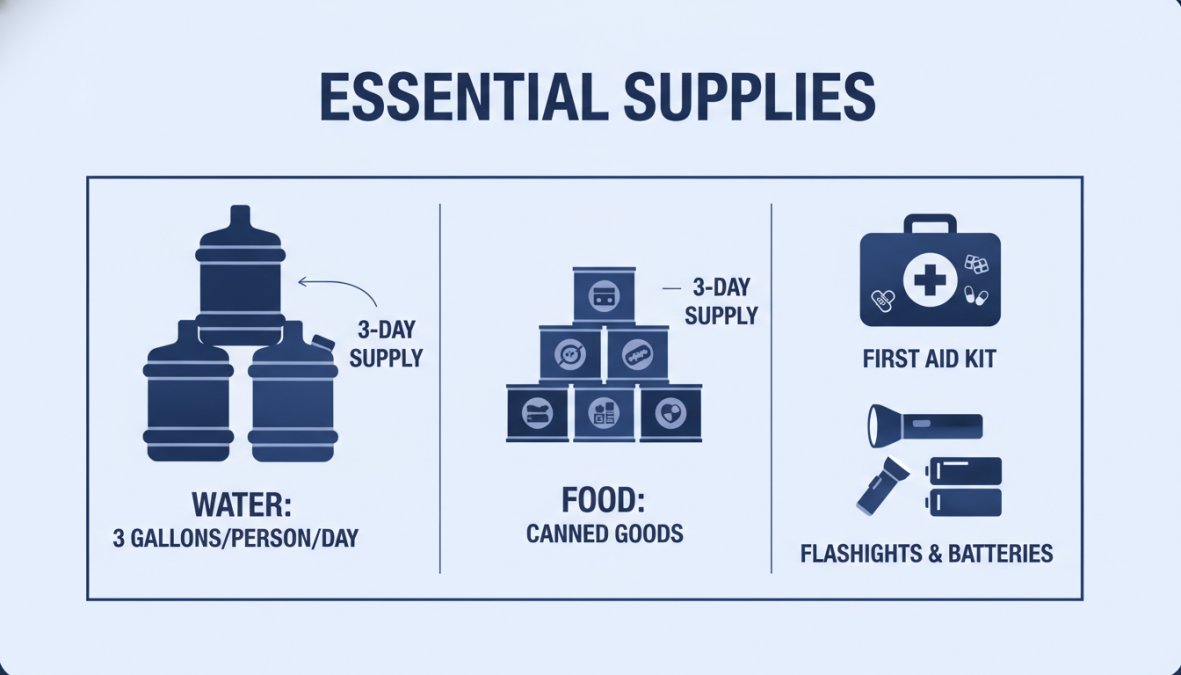
Water is your first priority. A human needs one gallon per day for drinking and basic hygiene. A family of four needs 120 gallons for a month.
Start with what you can afford:
- Store 2 weeks of water immediately (14 gallons per person minimum) in food-grade containers, rotated annually
- Add water purification capability: a high-quality filter like Sawyer or LifeStraw handles bacterial and parasitic contamination; boiling handles viruses
- Plan for long-term water access: a well, rain catchment system, or nearby water source you can access without electricity
Food storage breaks into three tiers:
Tier 1 (0-3 months): Rotate through your normal pantry. Buy extra of what you eat: canned vegetables, pasta, canned proteins, peanut butter, cooking oil, salt, sugar, dried beans.
Tier 2 (3-12 months): Freeze-dried meals, long-term food storage buckets, powdered milk, flour, oats, honey. These have 10-25 year shelf lives.
Tier 3 (1+ years): Seeds for gardening, sprouting supplies, and knowledge of food preservation (canning, fermenting, smoking).
Store food in cool, dark, dry places. Heat and light degrade nutrition.
Power, Safety, and First Aid Systems
When the grid fails, you lose lighting, heating, refrigeration, and communication charging.
Immediate power needs:
- Solar power banks and LED flashlights
- Batteries in multiple sizes stored in cool, dry conditions
- Manual hand-crank radio and phone charger
Heating and cooking:
- Wood stove or fireplace (if available)
- Propane camping stove with extra fuel stored safely outside
- Waterproof matches and lighters
Safety and security:
- First aid kit with personal medications
- Fire extinguishers in kitchen and bedroom
- Secure door locks and window coverings
Communication:
- Battery-powered or hand-crank radio for emergency broadcasts
- Fully charged mobile phones
- Paper maps of your area
First aid preparation goes beyond a basic kit. Take a wilderness first aid course. Learn how to treat wounds, recognize infection, manage pain without modern medicine, and stabilize injuries.
Long-Term Food Storage Guide: Building Your Supply Chain
Long-term food storage means thinking beyond the pantry. You're building a supply chain that doesn't depend on weekly grocery trips.
Shelf-life reality: Canned goods last 3-5 years reliably. Freeze-dried meals last 15-25 years. Dried beans and rice last 10-30 years if stored correctly (cool, dry, sealed, with oxygen absorbers). Honey and salt last indefinitely.
Storage conditions matter enormously. A basement stays cooler than a kitchen pantry. Temperature fluctuation degrades food faster than constant cool temperatures. Humidity causes mold. Light degrades nutrition.
Practical approach: Start with a 3-month supply of foods you actually eat. Every time you use something, replace it. This teaches you what you actually consume and prevents waste. Then build toward 6 months, then a year.
Include variety and comfort foods. A year of plain rice and beans will drive you mad. Include peanut butter, chocolate, coffee, and spices.
Off-Grid Survival Skills: Practical Knowledge for Self-Sufficiency
Supplies run out. Knowledge doesn't. The skills that matter most are the ones that let you produce or obtain resources without modern infrastructure.
Water Purification and Resource Management
Water purification without electricity means boiling, filtering, or chemical treatment. A practical approach combines methods:
- Collect water from whatever source is available (well, rain, stream, pond)
- Filter through cloth to remove large particles and sediment
- Boil for 1 minute (3 minutes at high altitude) to kill pathogens, OR use a quality filter, OR add purification tablets as backup
- Store in sealed containers away from light and heat
Rain catchment is the most reliable long-term water source. A 1,000-square-foot roof collects 600 gallons from one inch of rain.
Resource management means using what you have efficiently. In a grid-down scenario, you have finite fuel, food, and water. Take short showers instead of baths (uses 1/3 the water). Cook multiple meals at once and reheat rather than cooking fresh (saves fuel).
First Aid, Repair Skills, and Trade Knowledge
In a collapse scenario, professional repair services disappear. Basic repair skills become survival skills.
Learn these core competencies:
Basic carpentry: Patching walls, replacing boards, securing windows, building simple structures.
Plumbing basics: Fixing leaks, replacing washers, understanding your water system.
Electrical safety: Understand circuit breakers, replace outlets, and identify hazards.
Sewing and fabric repair: Knowing how to patch and mend extends the life of your clothing and gear.
Food preservation: Canning, drying, fermenting, and smoking preserve food without electricity.
Gardening: Growing food requires knowledge of your climate, soil, seeds, and pests.
Trade knowledge becomes valuable currency in a post-collapse economy. If you're the person who can fix things, treat wounds, or preserve food, you have use in a barter economy.
How to Build a Survival Community: Social Networks and Trust
The most overlooked aspect of collapse preparation is community. A household of four with six months of food and water can survive. A neighborhood of 50 households with the same resources survives much better.
Practical steps:
-
Know your neighbors by name. Have a conversation. Learn about their skills and vulnerabilities.
-
Identify key skills in your neighborhood. Who has medical training? Who can fix cars? Who gardens?
-
Discuss preparedness casually. Those interested become your core group.
-
Establish communication plans. If phone networks fail, how will you communicate? A neighborhood radio net? A physical meeting point?
-
Organize mutual aid. Start small: a neighborhood tool library, shared seeds, or a group buying club for bulk food storage.
-
Create redundancy in skills. If only one person knows how to purify water, that's a vulnerability. Teach others.
Psychological Preparation and Mental Resilience
Physical preparation (supplies, skills, community) gets attention. Psychological preparation doesn't, and it's equally important. Collapse is traumatic. Your normal life disappears. Uncertainty dominates.
Practical approaches:
Develop a coherent narrative about collapse. If you've thought through what collapse looks like and what your household will do, you're less likely to panic when it happens.
Practice stress inoculation. Take a camping trip without electricity. Spend a weekend without running water. These small challenges teach you that discomfort is survivable.
Maintain meaning and purpose. People survive extreme hardship when they believe their suffering serves something larger.
Plan for grief and loss. Collapse means losing things you value. Acknowledge this. Grief is appropriate.
Establish routines. Routines provide structure and predictability when everything else feels chaotic.
Maintain connection. Isolation kills people. Stay connected to your community, family, and purpose.
How to Prepare for Societal Collapse Without Fear: A Step-by-Step Approach
Fear-based prepping often fails. Sustainable preparation is practical, incremental, and grounded in realistic assessment.
Phase 1: Assess and Plan
Begin with an honest inventory of your household's vulnerabilities and resources.
Questions to answer:
- What's your household composition? (Age, health status, dependents, skills)
- What are your financial constraints?
- What's your living situation? (Apartment, house, rural property, urban, suburban?)
- What are your realistic threats?
- What resources do you already have? (Tools, skills, land, community connections)
Write this down. Specific answers beat vague intentions.
Create a timeline. Prioritize:
Month 1-2: Two weeks of water and food, basic first aid kit, important documents copies
Month 3-4: One month of food storage, water purification capability, basic tools, flashlights and batteries
Month 5-6: Three months of food, community relationships established, one practical skill learned
Month 7-12: Six months of food, alternative power source, more skills developed, community network strengthened
Phase 2: Build Your Foundation
Foundation preparation focuses on the basics: water, food, power, and safety.
Water system: Start with storage (2 weeks minimum, work toward 3 months). Add purification capability. Plan for long-term access.
Food system: Rotate through pantry stock. Add long-term storage. Learn preservation techniques.
Power system: Battery-powered lights and chargers. Propane cooking backup. Work toward solar power if feasible.
Safety system: First aid training and supplies. Secure doors and windows. Fire extinguishers.
Phase 3: Develop Skills and Community
After foundation preparation, shift focus to skills and relationships.
Skills development: Pick one skill to develop each quarter. Quarter 1: wilderness first aid. Quarter 2: food preservation. Quarter 3: basic carpentry. Quarter 4: gardening or water purification.
Community development: Attend neighborhood meetings. Get to know neighbors. Find people interested in preparedness. Start small mutual aid projects.
Knowledge preservation: Document what you know. Create a household manual with instructions for your systems, contact information, medical history, and important documents.
Common Mistakes in Collapse Preparation and What to Ignore
Most people preparing for societal collapse make predictable mistakes.
Mistake 1: Buying gear without understanding how to use it. A water filter is useless if you don't know how to operate it. Buy tools, then learn them.
Mistake 2: Preparing for the wrong scenario. Someone in a city apartment prepares for a rural retreat they'll never reach. Assess your actual risks.
Mistake 3: Neglecting community. A household with a year of food but no community relationships is vulnerable to theft, isolation, and psychological collapse.
Mistake 4: Buying expensive gear instead of learning skills. A $3,000 water filter is less valuable than the knowledge to purify water using boiling, cloth filtering, and chemical treatment.
Mistake 5: Preparing once and forgetting. Preparation is ongoing. Review quarterly. Rotate food. Practice skills.
Mistake 6: Ignoring mental health. Preparation should reduce anxiety, not increase it.
Mistake 7: Preparing alone. Isolation makes you more vulnerable. Build community.
What to ignore:
- Expensive tactical gear marketed to preppers
- Doomsday scenarios designed to sell products
- Preparedness that requires you to abandon your community
- Preparation that makes you paranoid or fearful
- Anyone claiming they have "the answer" to collapse
Preparing for societal collapse is fundamentally about building resilience in your household and community. It's not about fear or paranoia, it's about acknowledging real risks and taking reasonable steps to address them. The foundation is practical: water, food, power, and safety. The structure is skill-based: learning what you need to know. The strength is relational: building community trust before you need it.
Start with your foundation this month, develop one skill next month, and strengthen your community relationships the month after that. Consistency beats perfection. You don't need to be completely prepared, you need to be better prepared than you were yesterday.
Frequently Asked Questions
What are the first steps to prepare for societal collapse?
Start with threat modeling, identify realistic collapse scenarios relevant to your location and circumstances. Then create an emergency preparedness checklist covering food storage (at least 3 months), water (1 gallon per person daily), first aid supplies, and power alternatives. Next, assess your skills gaps and begin learning water purification, basic repairs, and food preservation. Finally, connect with local community members to build a support network before a crisis occurs.
How much long-term food storage do I actually need?
A practical long-term food storage guide recommends starting with a 3-month supply for your household, then expanding to 6-12 months as budget allows. Focus on calorie-dense, shelf-stable foods: grains, beans, canned proteins, oils, and powdered milk. Include foods your family actually eats to avoid waste. Many families find 25-year shelf-life emergency food kits helpful for supplemental storage, combined with rotating fresh supplies for regular consumption.
What skills matter most if societal collapse happens?
Off-grid survival skills include water purification, first aid, food preservation, basic carpentry and repair, gardening, and barter negotiation. Water purification is critical, learn multiple methods (boiling, filtration, chemical treatment). First aid becomes essential when medical infrastructure fails. Food preservation through canning, drying, or fermentation extends your supply chain. These skills reduce dependency on external systems and increase household resilience.
How do I build a survival community without seeming extreme?
Start by framing community building around emergency preparedness rather than collapse scenarios. Host neighborhood preparedness meetings, organize skill-sharing workshops (first aid, gardening), or create a neighborhood communication plan. Begin with trusted friends and family, then expand gradually. Focus on practical mutual aid, bartering goods, sharing resources, and supporting each other during supply chain disruptions. A strong local community is your most valuable asset during any crisis.
This article was written using GrandRanker