
Table of Contents
- What to Look for When Buying Portable Solar Power Kits
- Top Portable Solar Power Kits for Different Needs
- Best Portable Solar Panels for Camping and Outdoor Adventures
- Solar Power for RV and Van Life: Complete Kit Solutions
- Emergency Solar Power Kit Setup: Real-World ROI and Payback Period
- Compatibility Matrix: Third-Party Inverters, Batteries, and Expansion
- Legal Requirements and Permitting for DIY Solar Kits
- How to Choose the Right Kit: Decision Framework
Buy Portable Solar Power Kits: Complete 2026 Buyer's Guide
Last Updated: July 22, 2026
When you buy portable solar power kits, you're investing in energy independence for camping, off-grid living, or emergencies. Battery technology, inverter efficiency, and solar panel design have all improved substantially since 2024. Below, we'll show you how to evaluate portable solar power kits based on your actual power needs, budget, and use case.
What to Look for When Buying Portable Solar Power Kits
Choosing the right system requires understanding three core variables: how much power you need, how fast you need to recharge, and what battery chemistry serves your use case best. Most buyers focus only on wattage and end up with either oversized, expensive systems or undersized ones that can't handle their actual loads.
Wattage, Battery Capacity, and Inverter Type
Battery capacity is measured in watt-hours (Wh). A 1000Wh battery can theoretically power a 100W device for 10 hours, or a 500W device for 2 hours. The inverter converts stored DC power into AC power for standard outlets. A 1000W inverter handles most small appliances; a 2000W inverter manages larger loads like power tools.
The critical insight: inverter surge capacity matters more than continuous wattage. When a refrigerator or air compressor starts, it draws 2-3 times its rated power for a split second. A system with 2000W continuous rating but 4000W surge capacity handles this spike without shutting down.
LiFePO4 (lithium iron phosphate) batteries have become standard because they offer 3000-5000 charge cycles versus 300-500 for older lithium-ion chemistry. This means a LiFePO4 system outlasts traditional lithium by 5-10 years. The per-cycle cost actually favors LiFePO4 over time despite higher upfront cost.
Solar Panel Efficiency and Portability
Solar panel efficiency ranges from 18% to 23% for monocrystalline panels, the standard in portable kits. Bifacial panels capture light from both sides and can achieve 25% higher output in ideal conditions, though this advantage disappears in cloudy weather. Foldable designs are essential for portability; a 200W panel unfolds to roughly 4 square feet but folds to briefcase size.
Weight matters for mobile applications. A 200W solar panel typically weighs 8-12 pounds. For van life or extended camping, this matters. For emergency backup at a fixed location, it's irrelevant. Match the panel weight and size to how you'll actually transport it.
(/products/preasion-5800psi-high-pressure-hand-pump-30mpa-four-stage-high-pressure-pcp-hand-operated-air-pump-8mm-quick-connector-air-pump-for-different-bike-tire-inflation) Needs]Charging Speed and Input Options
A system's charging speed depends on solar input wattage, AC charging speed, and whether it supports simultaneous dual charging (solar + AC). Most portable systems charge at 50-100W from solar, meaning a 1000Wh battery takes 10-20 hours in direct sun. Dual charging can cut that to 3-4 hours.
Input options should include AC wall charging, solar input, car charging, and ideally generator input. MC4 connectors are the industry standard for solar connections; proprietary connectors lock you into that brand's ecosystem.
Top Portable Solar Power Kits for Different Needs
BLUETTI AC200MAX with PV200 Solar Panel: Best for Off-Grid Living
The BLUETTI AC200MAX pairs a 2048Wh LiFePO4 battery with a 2200W pure sine wave inverter (4800W surge) and includes a 200W monocrystalline foldable solar panel. You can add battery modules to reach 8192Wh total capacity, making this system grow with your needs over time.
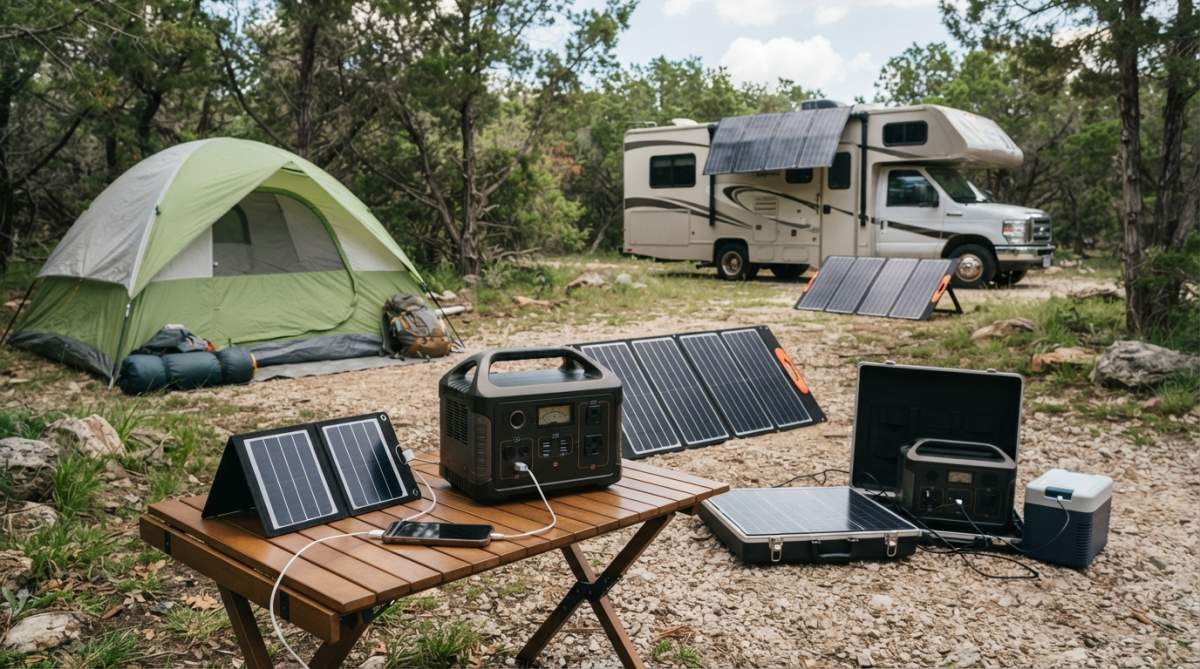
This kit includes 16 outlets, including a 30A NEMA TT-30 RV outlet. It accepts 900W of solar input simultaneously and supports dual AC + solar charging at 1400W combined. For off-grid living or extended RV trips, this flexibility is invaluable. The trade-off is weight and cost: the AC200MAX unit alone weighs 61.9 pounds.
EcoFlow DELTA 2 with 220W Bifacial Panel: Fastest Charging
The EcoFlow DELTA 2 charges from 0-80% in just 50 minutes using AC power, the fastest recharge of any portable system in its class. The 1024Wh LiFePO4 battery is half the BLUETTI's capacity, but charging speed often matters more than raw capacity for users with regular power access.
The 220W bifacial solar panel delivers up to 25% more energy than traditional panels in optimal conditions. The system supports 3-hour full recharge from two 220W bifacial panels in good sunlight. The X-Boost feature temporarily increases output to 2200W, allowing it to power appliances slightly above its rated capacity. At only 30 pounds, it's ideal for users who move frequently.
Jackery Explorer 1000 with SolarSaga 100W: Best Portable Solar Generator
The Jackery Explorer 1000 represents the sweet spot between capacity and portability for most users. The 1002Wh lithium-ion battery pairs with a 1000W inverter and includes a 100W monocrystalline foldable panel. The system is genuinely portable at 26.5 pounds.
This kit balances power, weight, and cost effectively for car camping and RV trips. The 1000W inverter handles most camping appliances: coffee makers, laptops, small power tools, and portable refrigerators. Solar charging takes roughly 10 hours with the included panel in direct sun, or 5-6 hours if you add a second panel.
Renogy Phoenix 300: Most Compact and Lightweight
The Renogy Phoenix 300 is the answer if you're constrained by space or weight. At 337Wh capacity and 5.3 pounds, this system fits in a backpack and handles essential devices during emergencies or light camping. The 200W pure sine wave inverter powers laptops, phones, small LED lights, and USB devices. For photographers, videographers, or emergency preparedness on a tight budget, this fills a specific need.
Best Portable Solar Panels for Camping and Outdoor Adventures
Monocrystalline vs. Bifacial Panel Technology
Monocrystalline panels deliver 18-23% efficiency and represent the standard for portable kits. They're reliable, proven, and less expensive than bifacial alternatives. A 200W monocrystalline panel weighs 8-10 pounds and folds to roughly 2 feet × 3 feet when packed.
Bifacial panels capture light from both surfaces, theoretically delivering 25% more energy. In practice, this advantage appears only when the back surface has reflective material beneath it (white sand, snow, or light-colored ground). In typical camping scenarios with dark ground or grass, bifacial panels perform only 5-10% better than monocrystalline. The premium cost ranges from 20-30% higher, making them worthwhile only if your environment supports back-surface reflection.
Foldable Design and Weather Resistance
All quality portable panels now use foldable designs with kickstands. When folded, a 200W panel occupies roughly 2.5 × 3 feet of space. Look for ETFE (ethylene tetrafluoroethylene) lamination on the panel surface; this material resists UV degradation and moisture better than standard glass. IP65 or IP67 ratings indicate dust and water resistance. Connection ports should use MC4 connectors, the industry standard that ensures compatibility with virtually all portable power stations.
Solar Power for RV and Van Life: Complete Kit Solutions
RV-Specific Features: NEMA TT-30 Outlets and High Wattage
The NEMA TT-30 outlet is the standard connection point for RV power pedestals at campgrounds. A portable power station with a 30A NEMA TT-30 outlet can feed directly into your RV's electrical panel, powering all internal systems as if you were plugged into shore power.
High wattage is critical for RVs because air conditioning units draw 1500-2000W when starting. A system with at least 2200W continuous output and 4800W+ surge capacity handles this without shutting down. The BLUETTI AC200MAX meets these requirements; most smaller systems do not.
RV-specific kits typically include 400-600W of solar panel capacity mounted on the roof. This provides 1500-2500W of daily charging in good sunlight, enough to offset typical RV power consumption (1000-1500W daily) and extend time between charging by 2-3 days.
Space and Weight Considerations for Mobile Living
RV roof space is limited. A typical RV roof can accommodate 400-600W of solar panels before weight or structural concerns arise. Van roofs are even more constrained, typically supporting 200-400W safely. Verify your vehicle's roof load rating before installing panels.
Weight compounds the constraint. 400W of solar panels weighs 30-40 pounds. Combined with a 60-pound power station and battery expansions, you're adding 100+ pounds to your vehicle. For van life, most users find that 200-300W of solar plus a 1000-2000Wh battery system balances power needs, weight, and cost. This setup extends boondocking time to 3-5 days depending on power consumption.
Emergency Solar Power Kit Setup: Real-World ROI and Payback Period
Calculating Your Actual Cost Savings
A typical household loses power 1-2 times per year for 4-8 hours each. During these outages, costs emerge: spoiled food (average loss of $200-400 per outage), hotel stays if the outage extends beyond 24 hours (average $150-250 per night), and lost work productivity.
Consider a realistic scenario: a 2048Wh battery system with 400W solar panels costs approximately $2000-2500 total. During a 48-hour outage, this system powers essential loads: refrigeration (200W × 24 hours = 4800Wh), lighting (100W × 12 hours = 1200Wh), and device charging (500Wh). Total: 6500Wh over two days, or roughly 3.2 charge cycles from your battery. Over five years with two outages annually, you avoid roughly $3000-5000 in direct costs. The system pays for itself in 2-3 years through avoided outage expenses alone.
Long-Term Durability and Maintenance for Reliability
LiFePO4 batteries degrade gradually over time, losing roughly 2-3% of capacity annually. After 10 years, a system retains 80-85% of original capacity. Battery health depends on charge depth and temperature. Keeping batteries between 20-80% charge extends lifespan significantly compared to full discharge cycles. Temperature matters equally: batteries stored in climate-controlled environments last 20-30% longer than those exposed to temperature swings.
Inverters and charge controllers rarely fail if properly maintained. The weak point is typically the solar panels themselves. Dust and dirt reduce output by 5-25%. Quarterly cleaning with water and a soft cloth maintains peak efficiency. Inspect panel connections annually for corrosion, especially in coastal or humid environments.
Compatibility Matrix: Third-Party Inverters, Batteries, and Expansion
LiFePO4 Battery Integration and Deep Cycle Performance
LiFePO4 batteries require specific charge controllers and inverters designed for their chemistry. Standard lithium-ion or lead-acid chargers don't work with LiFePO4 and can damage the battery. When expanding a system with additional batteries, verify that the new batteries match the original chemistry and voltage exactly.
Deep cycle performance refers to the battery's ability to discharge fully and recharge repeatedly without degradation. LiFePO4 batteries tolerate 80-90% depth of discharge regularly, meaning you can use 80% of rated capacity daily without shortening lifespan. Lead-acid batteries tolerate only 50% depth of discharge; deeper discharge cycles dramatically reduce lifespan.
MC4 Connectors and Charge Controller Standards
MC4 connectors are the universal standard for solar panel connections. If your power station and solar panels both use MC4 connectors, they're compatible. If one uses proprietary connectors, you're locked into that brand's ecosystem.
Charge controllers come in two types: PWM (pulse-width modulation) and MPPT (maximum power point tracking). MPPT controllers are 20-30% more efficient than PWM. Most modern portable systems use MPPT controllers. When expanding, match the charge controller type to your existing system.
| Component | Standard | Compatibility Notes |
|---|---|---|
| Solar Panel Connector | MC4 | Universal standard; proprietary connectors lock you into one brand |
| Battery Chemistry | LiFePO4 | Don't mix LiFePO4 with lead-acid; requires matching charge controller |
| Charge Controller | MPPT | 20-30% more efficient than PWM; verify type matches existing system |
| System Voltage | 48V typical | Mixing 12V/24V/48V requires converters; match to existing system |
Legal Requirements and Permitting for DIY Solar Kits
Grid-Tie vs. Off-Grid: Regulatory Differences by State
Off-grid systems operate independently without connection to the electrical grid and face minimal regulation in most U.S. states. You can install an off-grid solar system on your property without permits, inspections, or utility company approval.
Grid-tie systems connect to the utility grid and feed excess power back into it, requiring permits, inspections, and utility company approval in virtually all states. Permitting typically takes 4-8 weeks and costs $200-500.
Portable solar systems fall into a gray area. A portable power station with solar panels in your yard is technically off-grid, requiring no permits. However, if you install panels on your roof as a permanent fixture and connect them to your home's electrical system, you've created a grid-tie or hybrid system requiring permits. Most homeowners using portable kits for emergency backup operate in the off-grid category and don't need permits. Verify your local regulations before installation.
Inspection and Safety Certifications
Off-grid systems don't require inspections, but safety certifications matter for equipment reliability. Look for UL (Underwriters Laboratories) certification on inverters and charge controllers. Solar panels should carry IEC (International Electrotechnical Commission) certification. For grid-tie systems, inspections are mandatory and typically include electrical inspection, structural inspection confirming roof can support panel weight, and utility company inspection ensuring the system meets grid connection standards.
How to Choose the Right Kit: Decision Framework
Matching Kit Size to Your Power Needs
Start by calculating your daily power consumption. List every device you'll power and estimate hours of daily use:
- Refrigerator: 150W × 24 hours = 3600Wh
- Laptop: 65W × 6 hours = 390Wh
- Lighting: 100W × 8 hours = 800Wh
- Phone charging: 20W × 2 hours = 40Wh
- Total: 4830Wh daily
This household needs a 5000Wh system to cover one day of use, or a 2500Wh system if it can recharge from solar during the day. Most portable kits recharge 30-50% daily from solar in good conditions, so plan for 2-3 days of autonomy without recharging.
Next, calculate peak power draw. If your refrigerator, laptop, and lights run simultaneously, that's 315W continuous. Your inverter needs at least 315W continuous capacity; 500W provides a safety margin. Peak surge draw might reach 600W, so your inverter should support 1200W surge capacity.
Budget vs. Performance Trade-Offs
Portable solar systems range from $300 (Renogy Phoenix 300) to $3000+ (BLUETTI AC200MAX with expansions). Smaller systems cost $0.80-1.00 per Wh, while larger systems cost $0.60-0.80 per Wh. A $500 system covering 60% of your needs is more useful than a $3000 system you can't afford. Start with a kit that handles your essential loads, then expand later if needed.
Battery chemistry affects long-term costs. LiFePO4 systems cost 30-40% more upfront but last 5-10 years versus 3-5 years for lithium-ion. Calculate cost-per-year to compare fairly. A $2000 LiFePO4 system lasting 10 years costs $200/year; a $1200 lithium-ion system lasting 5 years costs $240/year.
According to Solar Energy Industries Association market analysis, the average household portable solar kit purchase costs $1500-2000 and generates $300-500 in annual value through avoided outage costs and reduced peak electricity consumption. Most systems achieve ROI within 4-6 years.
Choosing when to buy portable solar power kits requires balancing capacity, charging speed, portability, and budget against your specific needs. Start with an honest assessment of your power needs, calculate your daily consumption, and choose a system that covers 60-80% of that need. This approach ensures you invest in equipment you'll actually use and maintain, rather than oversized systems that sit in your garage. Build the energy independence your household deserves.
Frequently Asked Questions
What should I look for when buying portable solar power kits?
Focus on battery capacity (measured in watt-hours), inverter wattage, and solar panel efficiency. For portable solar power kits, prioritize expandability, charging speed, and output ports that match your devices. Check if the kit includes monocrystalline or bifacial panels for better efficiency. Consider weight and portability if you plan to move the system frequently. Verify that the inverter type (pure sine wave) matches your electronics' needs to prevent damage.
How much does a good portable solar power kit cost, and what's the ROI?
Pricing depends on capacity, brand, and included components. Entry-level kits start lower, while premium systems with LiFePO4 batteries and high-wattage panels cost more. Real ROI depends on your current energy costs, usage patterns, and local electricity rates. If you're replacing grid power during outages or reducing fuel generator costs, payback periods typically range from 3-7 years. Calculate your specific ROI by comparing your current power expenses against the kit's total cost divided by years of expected use (typically 10-15 years for quality systems).
What's the best portable solar generator for RVs and van life?
The best portable solar generator for RVs includes a dedicated NEMA TT-30 RV outlet, expandable battery capacity, and high AC output (1500W+). Look for systems with multiple charging inputs (solar, AC, 12V car) and fast dual-charging capabilities. The Jackery Explorer 1000 with SolarSaga 100W or EcoFlow DELTA 2 with bifacial panels are popular choices. Prioritize weight distribution and mounting options that fit your vehicle. Ensure the system can handle your essential loads: refrigeration, water pumps, and climate control.
Are portable solar panels worth it for camping, and how long do they take to charge?
Yes, portable solar panels for camping provide energy independence and reduce reliance on campground hookups. Charging time varies: a 100W monocrystalline panel takes 8-12 hours to fully charge a 1000Wh battery under ideal sunlight. Bifacial panels (like the 220W EcoFlow panel) charge faster, up to 3 hours with two panels. Real-world conditions (cloud cover, angle, season) extend times. For weekend trips, one 100W+ panel is sufficient; for extended camping, consider two panels or a higher-wattage system. Check your kit's maximum solar input rating to avoid oversizing panels.
This article was written using GrandRanker