
Table of Contents
- Long Term Food Storage Containers vs Bags: Head-to-Head Comparison
- Mylar Bags for Food Storage: Flexibility and Cost-Effectiveness
- Food Grade Buckets for Storage: Durability and Reusability
- Oxygen Absorbers for Food Storage: Extending Shelf Life
- Vacuum Sealing for Long Term Food Storage: Active vs. Passive Methods
- Chemical Safety and Food-Grade Standards
- Climate-Specific Storage Recommendations for Containers and Bags
- Inventory Management and Rotation Systems for Long-Term Storage
Last Updated: July 31, 2026
Long Term Food Storage Containers vs Bags: Head-to-Head Comparison
When building emergency food reserves, the choice between long term food storage containers vs bags fundamentally shapes how your supply ages, how efficiently you use space, and whether your stored food remains viable when you need it most. Mylar bags offer flexibility and cost-effectiveness for bulk dry goods. Food-grade buckets provide durability, reusability, and protection against physical damage. Neither is objectively superior; each excels in different scenarios.
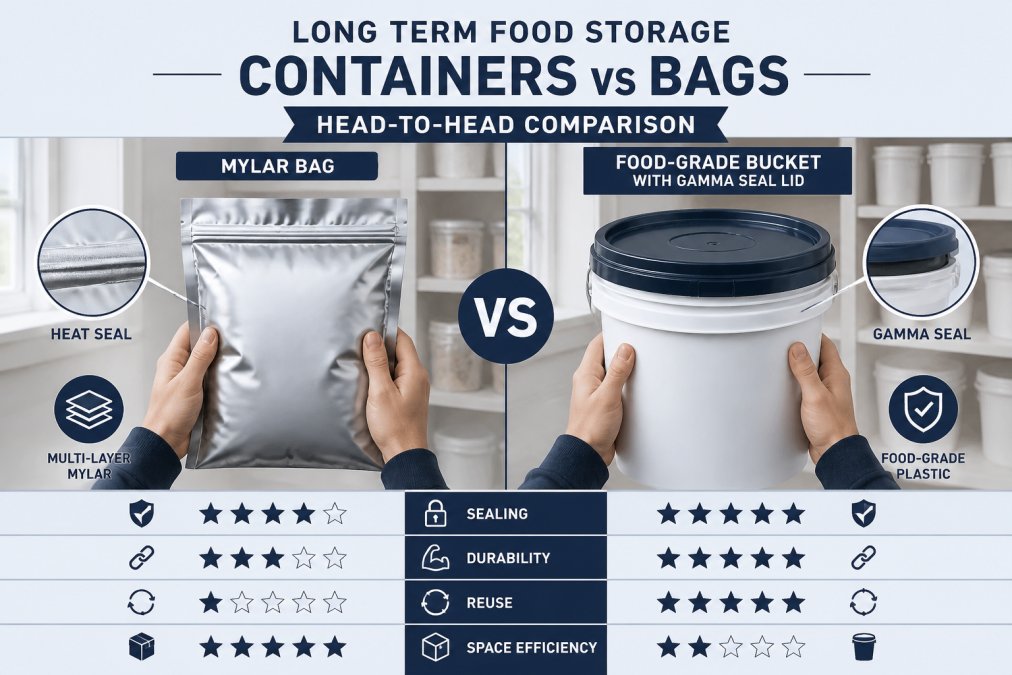
Comparison Table: Containers and Bags at a Glance
| Feature | Mylar Bags | Food-Grade Buckets | Winner |
|---|---|---|---|
| Initial Cost Per Unit | $0.15-$0.50 | $5-$15 (bucket) + $10-$20 (lid) | Mylar Bags |
| Airtight Seal Quality | Excellent with oxygen absorbers | Excellent with Gamma Seal lids | Tie |
| Space Efficiency | Highly stackable, flexible | Stackable but rigid | Mylar Bags |
| Puncture Resistance | Low (requires outer protection) | High (HDPE plastic) | Buckets |
| Reusability | Single-use or limited | 10+ years of service | Buckets |
| Best For Frequent Access | Poor (breaks seal) | Excellent (resealable lid) | Buckets |
| Shelf Life Potential | 25+ years | 25+ years | Tie |
| Protection Against Light | Complete (opaque foil) | Partial (requires dark storage) | Mylar Bags |
Mylar Bags for Food Storage: Flexibility and Cost-Effectiveness
Mylar bags dominate when storing large quantities of dry goods while maximizing storage density. A 5-gallon Mylar bag filled with rice or beans costs far less than a bucket and stacks efficiently in closets, under beds, or basement corners. The laminated polyethylene and aluminum foil composite creates a formidable barrier against oxygen, light, and moisture when sealed properly.
Mylar bags are vulnerable to punctures, so serious preppers nest them inside buckets or storage bins, letting the bag handle the oxygen barrier while the bucket handles physical protection.
How Mylar Bags Create an Airtight Seal
Mylar bags achieve an airtight seal through thermal sealing, applying heat to melt the plastic layers together. You'll need a heat source: a vacuum sealer, household iron, or hair straightener. Thicker bags (5.5 mil or 7 mil) create more durable seals than thinner versions (4.3 mil).
When paired with oxygen absorbers, small packets containing iron powder that react with oxygen, Mylar bags create an anaerobic environment that stops oxidation and extends shelf life to 25 years or longer, provided the seal stays intact and storage temperature remains stable.
Pros and Cons of Mylar Bags
Pros:
- Cost-effective for large quantities ($0.15-$0.50 per bag)
- Excellent moisture and light barriers due to opaque aluminum foil layer
- Flexible design allows custom portions and efficient stacking
- 25+ year shelf life when sealed with oxygen absorbers
- Lightweight and portable for emergency evacuation
Cons:
- Vulnerable to punctures without outer protection
- Requires a heat sealer or iron to create proper airtight seal
- Not resealable once opened
- Time-intensive manual sealing process for large quantities
- Difficult to assess contents without opening
Food Grade Buckets for Storage: Durability and Reusability
Food-grade buckets represent a different philosophy: invest more upfront for a container serving your family for decades. A 5-gallon HDPE bucket costs $5-$15. Add a Gamma Seal lid, a two-piece system with snap-on adapter ring and twist-off cap, and you're looking at $10-$20 per bucket.
That bucket will hold dried beans, flour, or pasta for 25 years while allowing repeated access without compromising remaining contents. Buckets excel where you need regular access, particularly when rotating stored goods into regular meals using "first in, first out" practices.
HDPE plastic resists punctures, rodent damage, and physical impact far better than Mylar. A bucket can be dropped, stacked under other buckets, or stored in damp basements without failing.
Pros and Cons of Food Grade Buckets
Pros:
- Durable HDPE plastic resists punctures, rodent damage, and physical stress
- Gamma Seal lids provide excellent airtight seals for 25+ years
- Resealable design allows repeated access without compromising remaining contents
- Stackable for efficient vertical storage
- Reusable for decades, reducing long-term cost per use
- Opaque buckets block light degradation
- Easy to label and identify contents
Cons:
- Higher upfront cost ($15-$35 per bucket with lid)
- Rigid structure less portable than bags
- Requires dark storage location
- Gamma Seal lids don't create zero-oxygen environment without oxygen absorbers
- Takes up more floor or shelf space than equivalent Mylar volume
- Buckets without food-grade certification may contain BPA
Oxygen Absorbers for Food Storage: Extending Shelf Life
Oxygen absorbers are small packets containing iron powder and other compounds that react chemically with oxygen in enclosed spaces, removing it entirely. The result is an anaerobic environment where oxidation, mold growth, and insect reproduction cannot occur.
A 2000 cc oxygen absorber removes approximately 2000 cubic centimeters of oxygen. A 5-gallon bucket contains roughly 1200 cubic centimeters, so a single 2000 cc absorber is sufficient. A 1-gallon Mylar bag needs a 300-500 cc absorber. Match absorber size to container volume.
Oxygen absorbers work only in sealed containers. If you plan to open a bucket frequently, absorbers become less effective because you're repeatedly reintroducing oxygen. They're ideal for "set and forget" storage.
How Oxygen Absorbers Work with Containers and Bags
Oxygen absorbers are most effective with airtight containers having low oxygen transmission rates. Mylar bags, particularly 7 mil versions, have nearly zero oxygen transmission, making them ideal partners for absorbers. Buckets with Gamma Seal lids also achieve excellent results when properly sealed.
The absorber begins working immediately upon oxygen exposure. Within 24-48 hours, it has consumed most available oxygen. Seal your container within an hour of adding the absorber to trap as much oxygen as possible.
Temperature affects absorber performance. In cool storage (50-70°F), absorbers work efficiently for years. In warm conditions (above 75°F), they exhaust faster. This is why cool, dark storage locations extend viability of both containers and bags.
Vacuum Sealing for Long Term Food Storage: Active vs. Passive Methods
Vacuum sealing removes air mechanically before sealing, creating a different approach than passive oxygen absorption. A FoodSaver or similar device removes approximately 80-90% of air from a bag, then heat-seals it. This immediate air removal gives you a head start compared to relying on oxygen absorbers alone.
For most preppers, the hybrid approach wins: vacuum-seal your bags, then add oxygen absorbers as backup. This combines the speed of active removal with the redundancy of passive absorption.
Thermal Sealing and Hermetic Seal Integrity
A hermetic seal means the container is completely airtight with no gas exchange. Thermal sealing creates this by melting plastic layers together. The quality of your seal determines how long storage remains viable.
A poor seal allows oxygen to slowly diffuse back into the container over months and years. You want a continuous, unbroken bond along the entire sealing edge. Test your seal by trying to pull the bag apart; if it tears before the seal gives, you've done it correctly.
For buckets, the Gamma Seal lid creates a hermetic seal through an EPDM rubber gasket that compresses when twisted closed. Over time, this gasket can harden or crack. Replacement gaskets are inexpensive, and most preppers replace them every 5-10 years as preventive maintenance.
Chemical Safety and Food-Grade Standards
Not all plastic is created equal. Containers and bags for food storage must meet food-grade standards, meaning they've been tested and certified not to leach harmful chemicals into stored food over time.
Mylar bags marketed for food storage are typically made from food-grade polyethylene and aluminum foil. This combination doesn't leach chemicals into dry goods. However, cheap Mylar bags from unknown sources may use non-food-grade materials or adhesives that degrade over time.
Food-grade buckets are manufactured from HDPE plastic meeting FDA standards. However, the lid gasket is where problems can emerge. Low-quality gaskets may contain BPA or other endocrine disruptors. When purchasing Gamma Seal lids or replacement buckets, verify they're explicitly labeled "food-grade" and "BPA-free."
Polyethylene, PETE Plastic, and Chemical Leaching Risks
HDPE (high-density polyethylene) is the standard for food storage buckets and is considered very safe. LDPE (low-density polyethylene) is more flexible and used in some food-grade bags but is less rigid.
PETE (polyethylene terephthalate) is used in beverage bottles but isn't recommended for long-term dry goods storage because it degrades faster under temperature stress.
Chemical leaching becomes a concern when plastic is exposed to heat, light, or acidic foods over extended periods. For dry goods stored in cool, dark conditions, leaching is minimal.
Climate-Specific Storage Recommendations for Containers and Bags
Your climate determines which storage method works best. In hot, humid environments, moisture is the enemy. In cold, dry climates, temperature fluctuations matter more.
In the American South and other hot-humid regions, Mylar bags with oxygen absorbers excel because the sealed barrier prevents moisture from entering. Buckets with Gamma Seal lids also work well, but you must ensure the gasket remains sealed. Humidity can cause the rubber to swell or degrade faster, so replace gaskets more frequently.
In cold, dry climates like the Mountain West, both methods work equally well. Temperature stability is more important than humidity control. Store containers in basements or root cellars where temperature fluctuations are minimal.
Managing Light Degradation and Environmental Stressors
Light is the most underestimated threat to stored food. Ultraviolet radiation causes oxidation and degradation of fats, proteins, and vitamins. This is why opaque containers matter.
Mylar bags with aluminum foil backing block virtually all light. Buckets block light if opaque and stored in dark locations. Clear plastic containers, even if food-grade, will allow light penetration and should not be used for long-term storage.
Temperature stability matters more than absolute temperature. Fluctuations between 40°F and 80°F accelerate degradation. A cool basement with stable temperatures is ideal. An attic swinging from 30°F in winter to 120°F in summer will shorten shelf life significantly.
Oxygen, moisture, light, and temperature, control these four variables, and your stored food will remain viable for 25 years or longer.
Inventory Management and Rotation Systems for Long-Term Storage
The best storage container is worthless if you forget what's inside. A simple inventory system prevents waste and ensures proper rotation.
Use a spreadsheet or notebook to record: item name, quantity, storage date, expiration date, and location. Update it whenever you add to or remove from storage.
Rotation follows the "first in, first out" principle. Older items get used first, and new purchases go to the back. Buckets with resealable lids excel here; you can access old stock without compromising the entire container.
For Mylar bags, rotation is trickier. Once opened, you've broken the seal. Some preppers purchase smaller bags so each represents a single meal or week's worth. Others use buckets for rotation and Mylar bags for long-term emergency reserves.
Post-Opening Storage Solutions
Once you open a Mylar bag, you've lost the airtight seal. Transfer remaining contents to an airtight container, smaller Mylar bag, glass jar with tight lid, or bucket with Gamma Seal lid within a few hours to minimize oxygen exposure.
For buckets, the Gamma Seal lid lets you reseal after each use. Over time, each opening introduces oxygen, and after 5-10 years of regular use, the gasket may no longer create a perfect seal. Keep replacement gaskets on hand.
A practical hybrid system works well: use buckets for daily or weekly access to staples like flour or sugar. Use Mylar bags sealed with oxygen absorbers for emergency reserves you don't plan to touch for years.
When deciding between long term food storage containers vs bags, the answer depends on your specific needs. If storing large quantities for emergencies without frequent access, Mylar bags with oxygen absorbers offer the best value. If building a practical rotation system with regular access to stored goods, food-grade buckets with Gamma Seal lids are worth the investment. SHTF Prepper Club offers comprehensive guidance on implementing both methods, along with expert-vetted storage solutions designed for up to 25-year shelf life. Start with a small test batch, seal a few bags and buckets, label them clearly, and evaluate which method fits your household's emergency preparedness plan.
Frequently Asked Questions
Are Mylar bags or buckets better for long-term food storage?
Both have distinct advantages. Mylar bags excel at creating an airtight seal when combined with oxygen absorbers, offering excellent light-blocking properties and cost-effectiveness for bulk storage. Food-grade buckets provide superior pest-proof protection, durability, and reusability, making them ideal for frequent access. Choose Mylar bags if you prioritize space efficiency and cost-per-pound savings; choose buckets if you need robust protection and plan to open containers regularly.
How do oxygen absorbers work in Mylar bags and containers?
Oxygen absorbers remove oxygen from sealed storage environments, creating an anaerobic atmosphere that prevents oxidation and microbial growth. In Mylar bags, they work by absorbing residual oxygen trapped during sealing, extending shelf life to 25+ years for dry goods. In buckets, they're equally effective when the lid creates a hermetic seal. For maximum effectiveness, seal the container immediately after placing oxygen absorbers inside to maintain the anaerobic environment.
What is the cost-benefit analysis of containers versus bags for long-term food storage?
Mylar bags have a lower upfront cost per unit and excellent cost-per-pound efficiency, especially for large quantities of bulk dry goods like grains and beans. Food-grade buckets require a higher initial investment but offer multi-year reusability and durability, reducing long-term costs. Buckets also eliminate recurring purchases of bags and sealing materials. For one-time bulk storage, bags are more economical; for ongoing preparedness and frequent access, buckets provide better long-term value.
How do I prevent chemical leaching from plastic containers into stored food?
Use only food-grade containers and bags certified as BPA-free and made from safe polymers like HDPE or PETE plastic. Avoid storing foods with high acidity or fat content in substandard plastic, as these accelerate chemical leaching. Mylar bags with proper laminate construction and Gamma Seal-equipped buckets with FDA-compliant HDPE plastic and EPDM rubber gaskets provide excellent chemical stability. Always verify food-grade certification on product labels before purchase.
What should I do with opened containers or bags during long-term storage?
For post-opening storage, transfer remaining contents to smaller sealed containers or vacuum-seal bags to minimize air exposure and maintain seal integrity. If using a bucket with a Gamma Seal lid, reseal immediately after each access. For Mylar bags, use a heat sealer or iron to create a new thermal seal. Store opened items in a cool, dark place away from environmental stressors like light and temperature fluctuations to preserve remaining shelf life.
This article was written using GrandRanker