
Table of Contents
- Is Freeze Dried Food Worth the Cost? Breaking Down the Real Numbers
- Freeze Dried Food Benefits vs. Traditional Storage Methods
- Freeze Dried Food vs Dehydrated: Which Offers Better Value?
- Cost of Freeze Dryer Machine: Is DIY Worth It?
- DIY Freeze Dried Food Savings: Calculating Your ROI
- Storage Space and Practical Considerations for Your Home
- When Freeze Dried Food Makes Financial Sense
- Conclusion: Making Your Freeze Dried Food Decision
Is Freeze Dried Food Worth the Cost? A 2026 Analysis
Last Updated: July 30, 2026
Is Freeze Dried Food Worth the Cost? Breaking Down the Real Numbers
Whether is freeze dried food worth the cost depends on timing, household size, and specific food choices. A quality home freeze dryer costs several thousand dollars upfront but preserves food for 25+ years with minimal degradation. The break-even point depends entirely on your consumption patterns and investment commitment.
A freeze dryer creates genuine value for long-term food security, but the real cost includes the machine, electricity, maintenance, and time investment. When you factor all three together, the financial case becomes much clearer, and sometimes less favorable than buying pre-made freeze-dried food.
Below, we'll walk through actual costs, compare freeze drying to other preservation methods, calculate your specific break-even point, and show you exactly when DIY freeze drying makes financial sense.
What You're Actually Paying For
When you buy a home freeze dryer, you're paying for the ability to remove 98% of water content while preserving nutritional structure, flavor, and texture. This requires a vacuum pump, refrigeration coils, and heating elements working in precise coordination.
Equipment costs range from several thousand dollars for entry-level models to significantly more for commercial-grade units. Freeze dryers consume substantial power during sublimation, roughly 1,200-1,800 watts for 20-40 hours per batch depending on food type.
Maintenance costs accumulate over time. Vacuum pumps require regular oil changes ($20-40). Replacing a vacuum pump costs $800-2,000. There's also hidden time cost: batch processing requires preparation, loading, monitoring, packaging, and maintenance, roughly 5-10 hours per week if running multiple batches.
The value proposition changes dramatically based on what you're freezing. Expensive foods with long shelf-life value (premium berries, specialty meats, heirloom vegetables) justify the cost faster than common items. Organic strawberries at retail are expensive; freeze-dried, they store for decades and retain 95% nutritional value.
Freeze Dried Food Benefits vs. Traditional Storage Methods
Freeze-dried food occupies a unique position in food preservation. It solves specific problems other methods cannot address as effectively.
Nutritional Retention and Flavor Profile
Freeze drying preserves nutrients better than any other home preservation method. Research shows freeze-dried foods retain 97% of vitamins and minerals compared to fresh food, while canned foods retain 50-80% and dehydrated foods retain 60-85%. This matters significantly for emergency food storage where nutritional density becomes critical.
Flavor retention is equally remarkable. Freeze-dried strawberries taste like concentrated strawberries, the actual fruit flavor intensifies because water is removed but cellular structure remains intact. Dehydrated strawberries taste like leather. The taste difference is substantial enough that families are far more likely to actually eat freeze-dried emergency food during real crises.
Texture retention also differs dramatically. Freeze-dried food rehydrates to a texture remarkably close to fresh; crispy vegetables crunch when bitten, fruits maintain their structure. Dehydrated food becomes mushy. For families with children or elderly relatives who are texture-sensitive eaters, this distinction determines whether emergency food gets consumed or rejected.
Shelf Life and Food Security
Freeze-dried food stored in proper conditions (cool, dry, airtight containers) remains safe and nutritious for 25-30 years. That shelf life exceeds any other home preservation method. Canned goods typically last 3-5 years. Dehydrated food lasts 5-10 years. Frozen food requires continuous electricity.
That extended shelf life creates genuine peace of mind for families building long-term food security. You preserve food once and it remains viable for decades. For households in disaster-prone areas or families prioritizing self-sufficiency, that stability has real value.
However, the shelf life advantage only matters if you use the equipment consistently. A freeze dryer sitting idle between batches doesn't improve food security; it just represents capital tied up in equipment. The financial case depends on treating it as an active tool.
Freeze Dried Food vs Dehydrated: Which Offers Better Value?
This comparison determines whether home freeze drying makes financial sense for many households. Dehydration is cheaper, simpler, and requires far less equipment investment. Freeze drying costs more but delivers superior results.
Cost Per Serving Comparison
Dehydrated food costs significantly less to produce at home. A basic food dehydrator costs $100-300. Electricity consumption is modest (300-600 watts) compared to freeze dryers (1000-2000 watts). Dehydration is faster (6-12 hours) versus freeze drying (20-40 hours).
Per-serving cost for DIY dehydrated food is genuinely low. A batch of dehydrated apple slices might cost $5 in raw apples plus $2 in electricity, yielding 20-30 servings at roughly $0.25-0.35 per serving.
Freeze-dried apples cost more to produce. The same quantity of raw apples plus 30+ hours of equipment operation means per-serving cost is higher, roughly $0.75-1.25 per serving depending on batch size and local rates.
Commercial freeze-dried food prices range from $8-15 per pound. Homemade freeze-dried food, after the break-even point, typically costs $4-8 per pound.
The comparison shifts when considering shelf life. Dehydrated food lasts 5-10 years. Freeze-dried food lasts 25+ years. For 25-year storage, per-year cost of freeze-dried food becomes competitive with dehydrated food even at higher upfront costs.
| Preservation Method | Equipment Cost | Cost Per Serving | Shelf Life | Taste/Texture | Best For |
|---|---|---|---|---|---|
| Dehydration | $100-300 | $0.25-0.50 | 5-10 years | Chewy, concentrated flavor | Short-term storage, budget-conscious |
| Freeze Drying (DIY) | $3,000-8,000 | $0.75-1.50 | 25-30 years | Near-fresh taste and texture | Long-term storage, serious preparedness |
| Freeze Dried (Commercial) | $0 | $8-15 | 25-30 years | Excellent but variable | Convenience, specific foods, no investment |
| Canning | $50-150 | $0.50-1.00 | 3-5 years | Good, cooked flavor | High-acid foods, jams, pickles |
| Freezing | Freezer cost | $0.10-0.30 | 6-12 months | Excellent | Short-term storage, requires electricity |
Taste, Texture, and Rehydration Differences
Freeze-dried food rehydrates by absorbing water back into cellular structure. A freeze-dried strawberry placed in water becomes strawberry-like within minutes, soft, juicy, recognizable. Dehydrated food doesn't rehydrate as completely and remains fundamentally a dried strawberry, denser, chewvier, with concentrated sweetness that can feel overwhelming.
Freeze-dried meat rehydrates to a texture remarkably close to cooked fresh meat. Dehydrated meat becomes jerky-like, chewy, dense, requiring significant cooking time to soften. For families with elderly relatives or young children, the texture difference determines whether emergency food is actually consumed.
Cost of Freeze Dryer Machine: Is DIY Worth It?
The equipment investment is substantial, and break-even depends on multiple variables you need to calculate for your own household.
Initial Investment and Break-Even Analysis
Quality home freeze dryers range from approximately $3,000 to $8,000 depending on capacity and features. Entry-level models process 3-5 pounds of fresh food per cycle. Mid-range models process 8-15 pounds per cycle.
The break-even calculation requires three inputs: equipment cost, annual freeze-drying volume, and price difference between homemade and commercial freeze-dried food.
A realistic example: a mid-range freeze dryer costs $5,000. Commercial freeze-dried food costs $10 per pound. Homemade freeze-dried food (after amortizing equipment and electricity) costs $5 per pound. That's a $5 per pound savings. To break even, you need to produce 1,000 pounds of finished food.
A typical freeze dryer running one 30-hour batch per week produces approximately 8-10 pounds of finished freeze-dried food weekly, roughly 400-500 pounds annually. At that rate, break-even takes 2-2.5 years.
| Scenario | Annual Production | Years to Break-Even |
|---|---|---|
| Casual use (200 lbs/year) | 200 | 5 years |
| Regular use (400 lbs/year) | 400 | 2.5 years |
| Serious use (600 lbs/year) | 600 | 1.7 years |
| Heavy use (1,000 lbs/year) | 1,000 | 1 year |
Electricity Costs and Energy Efficiency
A typical mid-range freeze dryer draws 1,200-1,800 watts during sublimation. A 30-hour batch at 1,500 watts consumes 45 kilowatt-hours of electricity.
At the national average electricity rate of $0.12-0.18 per kilowatt-hour, a single 30-hour batch costs $5.40-8.10 in electricity. Running one batch per week costs $280-420 annually.
That electricity cost is built into per-pound production cost. If you produce 400 pounds annually, you're spending $280-420 on electricity, or $0.70-1.05 per pound just for energy.
Regional electricity rates matter significantly. In states with lower rates (Louisiana, Oklahoma, Washington), rates are $0.09-0.11 per kilowatt-hour. In states with higher rates (Hawaii, Massachusetts, California), rates reach $0.18-0.28 per kilowatt-hour. A household in Hawaii pays nearly triple the electricity cost of a household in Louisiana.
Energy efficiency improves with batch size. A freeze dryer processing 15 pounds uses roughly the same electricity as one processing 5 pounds. Larger batches spread energy cost across more finished food, improving per-pound economics.
Maintenance, Repairs, and Hidden Ownership Costs
Equipment maintenance costs accumulate over time and are frequently underestimated. Vacuum pumps require regular oil changes every 100-200 operating hours. A pump oil change costs $20-40. Running one batch per week means 2-3 oil changes annually.
Heating elements degrade with use. Replacing a heating element costs $200-500. Most home freeze dryers need replacement within 3-5 years of regular use.
Vacuum pump replacement is the most expensive maintenance item. A new pump costs $800-2,000. Most pumps last 5-10 years with regular maintenance.
Cumulative maintenance and repair costs over 5 years typically run $1,500-3,000 depending on equipment quality and usage intensity.
DIY Freeze Dried Food Savings: Calculating Your ROI
Return on investment depends entirely on your specific situation.
Batch Processing Efficiency and Batch Size Impact
Batch size dramatically affects economics. A freeze dryer processing a full load uses nearly the same electricity as one processing a half-empty load. A 5-pound batch of strawberries takes 30 hours at $6 in electricity, or $1.20 per pound in energy costs. A 15-pound batch takes roughly 35 hours at $7 in electricity, or $0.47 per pound. The larger batch cuts per-pound electricity cost by more than 60%.
This efficiency principle applies to equipment amortization. The $5,000 machine cost is the same whether you process 200 pounds annually or 600 pounds annually. Larger annual volume spreads that fixed cost across more finished food.
Realistic batch size depends on your household's food consumption patterns and storage space. A family of four interested in emergency preservation might realistically process 300-500 pounds annually, roughly 6-10 batches per year.
The efficiency sweet spot for most households is 400-600 pounds annually. At that volume, you're running roughly one batch per week, which is sustainable without becoming overwhelming.
Resale Value of Used Equipment
Many people overlook resale value when calculating ROI. Used freeze dryers sell for 50-70% of original retail price on secondary markets. A $5,000 machine typically resells for $2,500-3,500 after 3-5 years.
That resale value meaningfully improves the financial picture. If you purchase a $5,000 freeze dryer, use it for 5 years, and resell it for $3,000, your actual equipment cost is only $2,000 spread across 5 years, $400 per year rather than $1,000 per year.
This resale option provides a genuine exit strategy if freeze drying isn't right for your household.
Storage Space and Practical Considerations for Your Home
Equipment footprint and storage requirements are often overlooked when evaluating whether freeze drying makes sense.
Appliance Footprint and Storage Requirements
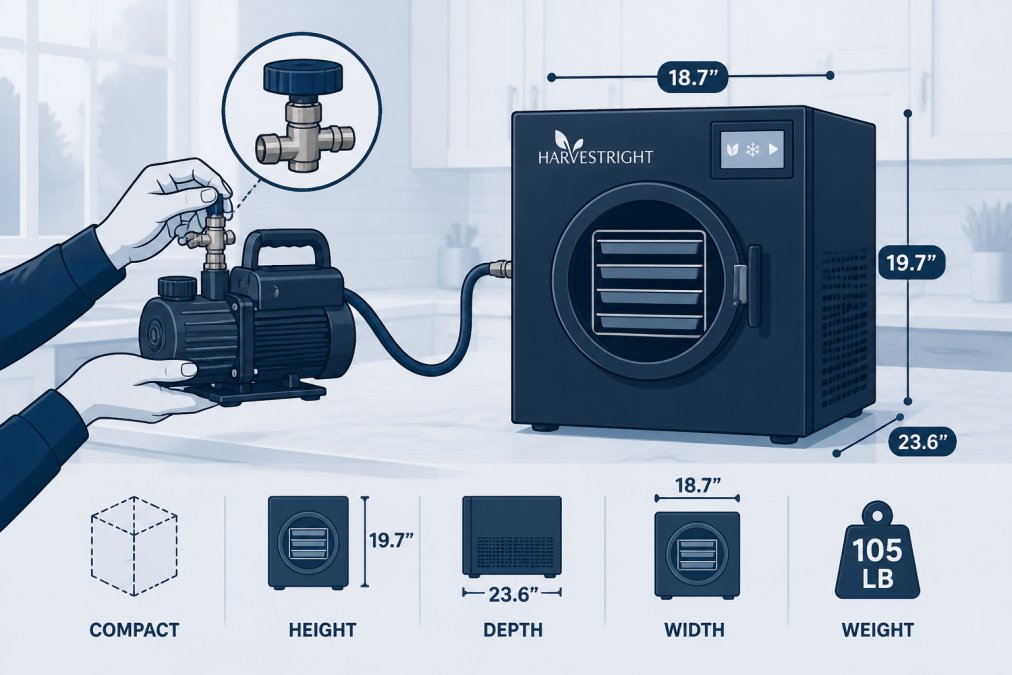
A typical mid-range home freeze dryer measures approximately 27 inches wide, 28 inches deep, and 32 inches tall, roughly the size of a large refrigerator. It needs good ventilation, electrical power access, and ideally placement away from high-traffic areas.
Most households place freeze dryers in basements, garages, or utility rooms. Apartment dwellers or people with limited space face genuine challenges.
The finished freeze-dried food requires storage in cool, dry conditions in airtight containers. A household producing 400-500 pounds annually needs approximately 40-60 large storage containers, requiring roughly 50-100 cubic feet of shelf space, equivalent to a large closet or dedicated basement shelf system.
Space constraints are a genuine limiting factor. If you don't have suitable space for both equipment and storage of finished products, freeze drying becomes impractical regardless of financial case.
Space-Efficient Food Preservation Alternatives
For households with limited space, other preservation methods offer better practical solutions. Dehydration requires minimal space; a small dehydrator occupies less than one square foot of counter space. Canning requires only a pot, jars, and shelf space. Freezing requires a freezer (which most households already have).
If space is your primary constraint, focus on preservation methods matching your available space. Some households use a hybrid approach: they purchase commercial freeze-dried food for long-term storage and use dehydration or freezing for other preservation needs.
Space constraints frequently override financial advantages. An expensive piece of equipment you can't conveniently use provides no value regardless of theoretical ROI.
When Freeze Dried Food Makes Financial Sense
Understanding specific situations where freeze drying delivers genuine value helps you evaluate whether this investment makes sense.
Best Use Cases for Families and Preppers
Freeze drying makes the strongest financial case for households meeting several criteria simultaneously. First, you need consistent access to foods worth preserving, either expensive items like berries and specialty meats, or foods you grow yourself. Commercial freeze-dried strawberries cost $15-20 per pound. Homegrown strawberries preserved at home cost roughly $5-8 per pound after amortization, a $7-12 per pound savings that justifies equipment investment if processing multiple pounds annually.
Second, you need adequate space for both equipment and storage. A basement or garage with 150+ cubic feet of available space makes freeze drying practical.
Third, you need commitment to consistent batch processing. Break-even requires running equipment regularly, ideally at least weekly. Sporadic use extends break-even to 5+ years.
Fourth, you need household size and food consumption pattern justifying the volume. A family of six with significant food storage goals benefits from freeze drying. A single person or couple with modest preparedness goals is better served by purchasing commercial freeze-dried food.
The strongest financial case exists for families committed to long-term food security who grow their own food or have access to bulk purchases of expensive produce.
Comparing Pre-Made vs. DIY Costs
Commercial freeze-dried food offers genuine advantages for households that don't meet all criteria for DIY success. Pre-made freeze-dried meals from established suppliers cost $10-20 per serving depending on complexity. That's reasonable compared to DIY freeze drying per-serving cost when factoring in equipment amortization and electricity.
More importantly, commercial freeze-dried food requires no equipment investment, no time investment, and minimal storage space beyond a pantry shelf. You buy what you need, store it, and use it during emergencies.
For families building emergency food supplies but lacking space, commitment, or resources for a freeze dryer, commercial freeze-dried food is the better choice. You'll spend more per pound but avoid equipment investment and operational complexity.
Many households discover that a hybrid approach works best: they purchase some commercial freeze-dried food for specific items (meals, specialty foods) and use a home freeze dryer for bulk preservation of seasonal produce.
Is freeze dried food worth the cost? The answer depends entirely on your specific situation. For families with adequate space, consistent food preservation goals, and access to foods worth preserving, a home freeze dryer delivers genuine value and breaks even within 2-3 years. For households with limited space, sporadic preservation needs, or tight budgets, commercial freeze-dried food provides better economics and and convenience. SHTF Prepper Club offers expert guidance and a curated selection of essential survival gear, including long-term food storage solutions, to help families evaluate their specific situation and choose the preservation method matching their goals, space, and budget. Whether you invest in equipment or purchase commercial products, the key is building a food security strategy that you'll actually maintain and use during emergencies. Get started with SHTF Prepper Club and create a customized food preservation plan that fits your household's unique needs.
Additional Resources
For more information on food preservation and emergency preparedness, explore these authoritative sources:
According to the USDA's food preservation guidelines, proper storage conditions are essential for maintaining nutritional value and safety in preserved foods. The USDA provides detailed recommendations for temperature, humidity, and container selection that apply directly to freeze-dried food storage.
Research from the National Center for Home Food Preservation documents the shelf life and safety of various food preservation methods, including freeze drying. Their research shows that properly stored freeze-dried food maintains nutritional value and safety for 25+ years under optimal conditions.
The Consumer Reports guide to food storage equipment evaluates the long-term costs and practical considerations of home food preservation equipment, including freeze dryers, dehydrators, and freezers. Their analysis includes real-world testing and cost-benefit assessments.
Frequently Asked Questions
Is freeze dried food worth the cost compared to buying regular groceries?
Whether freeze dried food justifies its expense depends on your priorities. Pre-made freeze dried emergency food offers 25-year shelf life and food security for unpredictable events, making it valuable for preparedness. DIY freeze drying requires significant upfront equipment investment but can lower per-serving costs over time if you process large batches regularly. For most households, the break-even point occurs after 2-4 years of consistent batch processing. Calculate your own ROI by dividing equipment and operating costs by the number of servings you'll produce.
What are the main benefits of freeze dried food for emergency preparedness?
Freeze dried food benefits include exceptional nutritional value retention (vitamins and minerals remain largely intact), superior flavor and texture compared to dehydrated alternatives, and extremely long shelf life, up to 25 years when stored properly. The sublimation process removes 98% of moisture, preventing bacterial growth and spoilage. Unlike canning, freeze dried food requires no special storage conditions, making it ideal for apartments, garages, or basements. Rehydration is simple: just add water. For families building long-term emergency food supplies, these advantages provide genuine peace of mind.
How much does a home freeze dryer cost, and what are the hidden ownership expenses?
Home freeze dryer equipment represents a substantial initial investment, with pricing depending on capacity and brand. Beyond the purchase price, hidden costs include electricity consumption (typically $15-40 per month depending on usage), vacuum pump oil changes and replacement parts, and occasional professional maintenance. Space requirements also factor in, most units need 2-3 square feet of floor space plus ventilation clearance. Before buying, calculate total cost of ownership over 5-10 years, including electricity, maintenance, and potential repairs. Many owners don't account for these ongoing expenses when evaluating whether DIY freeze drying offers real savings.
Is freeze dried food better than dehydrated food for long-term storage?
Freeze dried food vs dehydrated food depends on your priorities. Freeze dried options retain superior texture and flavor, rehydrate more completely, and maintain better nutritional profiles. Shelf life is comparable when both are stored correctly (15-25 years), but freeze dried food is less prone to moisture reabsorption. Dehydrated food costs significantly less and requires no special equipment to produce at home. For emergency preparedness, freeze dried offers better taste and texture, critical if your family needs to actually eat the food during a crisis. For budget-conscious preppers, dehydration is a practical alternative with acceptable trade-offs.
Can I really save money by freeze drying my own food at home?
DIY freeze dried food savings are real but require commitment. A home freeze dryer costs thousands upfront, plus electricity and maintenance expenses. Your break-even point depends on batch size and frequency: processing large batches weekly yields faster ROI than occasional use. Cost per serving drops significantly after 200-400 batches. If you have access to bulk seasonal produce or hunt/raise your own food, savings accelerate. However, if you're buying small quantities of retail produce to freeze dry, commercial pre-made options may be more cost-effective. Calculate your specific scenario before investing in equipment.
This article was written using GrandRanker