
Table of Contents
- What to Consider When You Buy Long Term Food Storage Supplies
- Emergency Food Supply Checklist: What You Actually Need
- Freeze Dried Food vs Dehydrated Food: Which to Buy
- How Much Food to Store for 1 Year: Practical Calculations
- Long Term Food Storage Shelf Life: What Lasts How Long
- Commercial Kits vs. DIY Bulk Storage: Cost Analysis
- How to Buy Long Term Food Storage Supplies: Step-by-Step
- Integration with Everyday Cooking: Using Your Supplies
Last Updated: July 4, 2026
When you decide to buy long term food storage supplies, you're making one of the most practical decisions for your family's security. According to research from the Federal Emergency Management Agency (FEMA), households that maintain adequate emergency food supplies report significantly higher confidence in their disaster preparedness. A well-stocked pantry means your family eats during disruptions; a poorly planned one means expensive mistakes and wasted space.
What to Consider When You Buy Long Term Food Storage Supplies
Three core decisions determine success: budget constraints, available storage space, and your household's actual eating habits. Most people pick a fancy emergency kit first, then realize it won't fit their apartment or tastes nothing like what their family eats.
Budget vs. Quality Trade-offs
A family of four can build a basic one-year supply for under $2,000 using bulk staples, or spend $5,000+ on commercial emergency kits. Budget-friendly options mean buying rice, beans, flour, and canned vegetables in bulk, then storing them yourself. Commercial kits cost more upfront but arrive ready to store and require zero preparation.
The middle ground works best: buy commercial emergency kits for the first 30 days, then supplement with bulk staples for longer-term coverage. This balances convenience, cost, and psychological comfort.
Storage Space and Environment
Measure your actual space before purchasing. A one-year supply for a family of four requires roughly 50-70 cubic feet. Climate matters enormously: cool, dark, dry spaces (50-70°F, below 15% humidity) preserve food longest. Basements work well; hot attics do not.
If your only option is warm and humid, you'll need aggressive packaging like Mylar bags with oxygen absorbers or sealed 5-gallon buckets, and you'll replace stock more frequently. Assess your environment before purchasing to set realistic shelf-life expectations.
Emergency Food Supply Checklist: What You Actually Need
An emergency food supply is calories plus nutrition plus foods your family will actually eat. The most common mistake is buying 1,000 pounds of rice and beans, then discovering your kids won't eat them when stressed.
Caloric Requirements for Survival
A sedentary adult needs roughly 2,000 calories per day. During physical stress or emergency management, people burn 2,500-3,500 calories daily. Your emergency supply should plan for the higher number.
For a family of four, that's 10,000-14,000 calories per day, or 3.65-5.1 million calories annually. Most people don't need a full year. A 90-day supply covers 95% of likely scenarios and is far more manageable.
Nutrient Density vs. Caloric Density
Most guides focus entirely on calories, ignoring nutrition. A diet of pure sugar and oil leaves your family malnourished within weeks. Prioritize foods with meaningful nutrients: proteins (canned meat, beans, peanut butter), fats (oils, nuts, canned fish), carbohydrates (rice, pasta, oats), and micronutrients (canned vegetables, freeze-dried fruits, multivitamins).
Build your supply with variety. Monotony during emergencies reduces food intake. Include comfort foods like cookies and chocolate. Morale matters during extended disruptions.
Freeze Dried Food vs Dehydrated Food: Which to Buy
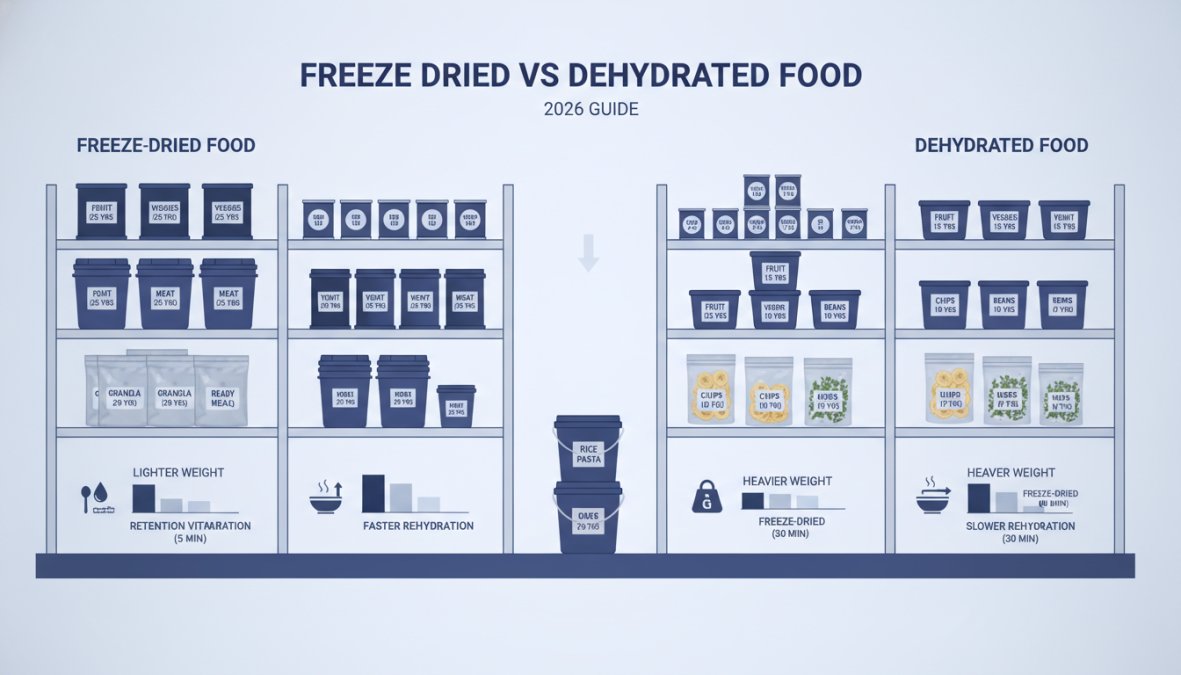
Freeze-dried food removes water through sublimation, retaining 97% of original nutrients, texture, and flavor. A pound of freeze-dried strawberries equals 10-12 pounds of fresh. Shelf life reaches 25+ years in ideal conditions.
Dehydrated food removes water through heat, retaining 80-90% of nutrients and costing 40-60% less. Shelf life is 10-15 years. For emergency supplies, freeze-dried excels at vegetables and complete meals; dehydrated works better for grains and legumes.
Rehydration Time and Ease of Preparation
Freeze-dried food rehydrates in 5-10 minutes with hot water. Dehydrated vegetables take 15-30 minutes. Beans and grains take 1-2 hours regardless of method. If your emergency scenario includes limited fuel or water, freeze-dried becomes more valuable.
Cost Comparison for Each Method
Freeze-dried strawberries cost $15-25 per pound; dehydrated cost $6-12. That 2-3x difference compounds across a year's supply. Most cost-effective approach: buy freeze-dried vegetables and fruits for nutrition and morale (20-30% of supply), then fill the rest with dehydrated bulk staples and canned goods.
How Much Food to Store for 1 Year: Practical Calculations
A family of four eating 2,400 calories per person daily needs 3.5 million calories annually. Start with household size and adjust for age and activity level. Most families find three months manageable: 650,000 calories for a family of four, occupying roughly 30-40 cubic feet.
| Household Size | 3-Month Supply | 6-Month Supply | 1-Year Supply |
|---|---|---|---|
| 2 adults | 580,000 calories | 1.16M calories | 2.32M calories |
| 2 adults + 2 children | 650,000 calories | 1.3M calories | 2.6M calories |
| 2 adults + 2 teens | 780,000 calories | 1.56M calories | 3.12M calories |
| Single adult | 290,000 calories | 580,000 calories | 1.16M calories |
Long Term Food Storage Shelf Life: What Lasts How Long
Canned goods last 3-5 years at room temperature, 10+ years in cool conditions. High-acid canned foods (tomatoes, citrus) last 2-3 years; low-acid foods (vegetables, meat) last 5-10 years.
Freeze-dried food in Mylar bags with oxygen absorbers lasts 25+ years. Dehydrated food lasts 10-15 years. Bulk grains and beans in food-grade buckets with oxygen absorbers last 10-20 years. The critical variable is packaging and environment. A can in a hot garage lasts 2-3 years; the same can in a cool basement lasts 8-10 years.
Packaging Methods and Preservation
Mylar bags with oxygen absorbers extend shelf life to 10-25 years for grains, beans, flour, and dehydrated foods. Cost: $0.10-0.30 per bag.
Food-grade 5-gallon buckets with Mylar liners and oxygen absorbers reach 15-20 years. Cost: $3-8 per bucket.
PETE plastic bottles work for grains and dry goods but provide less protection. Expect 5-10 years.
Storage Conditions That Maximize Longevity
Temperature is the dominant factor. Every 10°C increase roughly halves shelf life. A basement at 55°F preserves food twice as long as a kitchen at 72°F.
Humidity below 15% is ideal. Light degrades vitamins and triggers sprouting in grains. Store food in opaque containers or dark spaces. Avoid temperature swings; stability matters more than absolute temperature.
Commercial Kits vs. DIY Bulk Storage: Cost Analysis
Pre-Made Emergency Food Kits
Commercial kits arrive ready to store with 25-year shelf life and meals requiring only water. A 30-day kit costs roughly $400-600, or $0.0067-0.010 per calorie. Equivalent calories from bulk staples cost $0.0003-0.0005 per calorie, 10-20 times cheaper.
Commercial kits offer real value: zero preparation time, guaranteed nutrition, and psychological comfort. Most cost-effective use: buy one 30-day commercial kit for immediate emergencies, then build longer-term reserves with bulk staples.
Building Your Own with Bulk Staples
DIY bulk storage costs 70-80% less per calorie. A family of four can build a one-year supply for $1,500-2,000. But DIY requires 20-40 hours of research, purchasing, packaging, and organizing, plus ongoing rotation management.
| Method | Cost for Family of 4, 1 Year | Setup Time | Best For |
|---|---|---|---|
| Commercial kits | $4,000-6,000 | 2 hours | Hands-off, guaranteed nutrition |
| DIY bulk staples | $1,500-2,000 | 30-40 hours | Budget-conscious, hands-on |
| Hybrid approach | $2,500-3,500 | 15-20 hours | Balanced cost and convenience |
How to Buy Long Term Food Storage Supplies: Step-by-Step
Assess Your Needs and Set a Budget
Answer three questions: How many people? What's your timeline (30 days, 90 days, one year)? What's your budget? Write these down and be honest.
Assess your storage space by measuring available cubic feet. Finally, list your family's actual eating preferences. If your family won't eat beans, don't buy 200 pounds.
Select Storage Methods and Materials
Based on your budget and timeline, decide your mix. A 30-day supply works well as commercial kits. A 90-day supply might be 30 days commercial plus 60 days bulk. A one-year supply could be 30 days commercial plus 335 days bulk.
For bulk storage, decide your packaging: Mylar bags for grains and dehydrated foods, 5-gallon buckets for larger quantities, cans for vegetables and proteins. Purchase supplies in advance: Mylar bags, oxygen absorbers, 5-gallon buckets, labels, and a permanent marker. These cost $50-100.
Organize and Rotate Your Supply
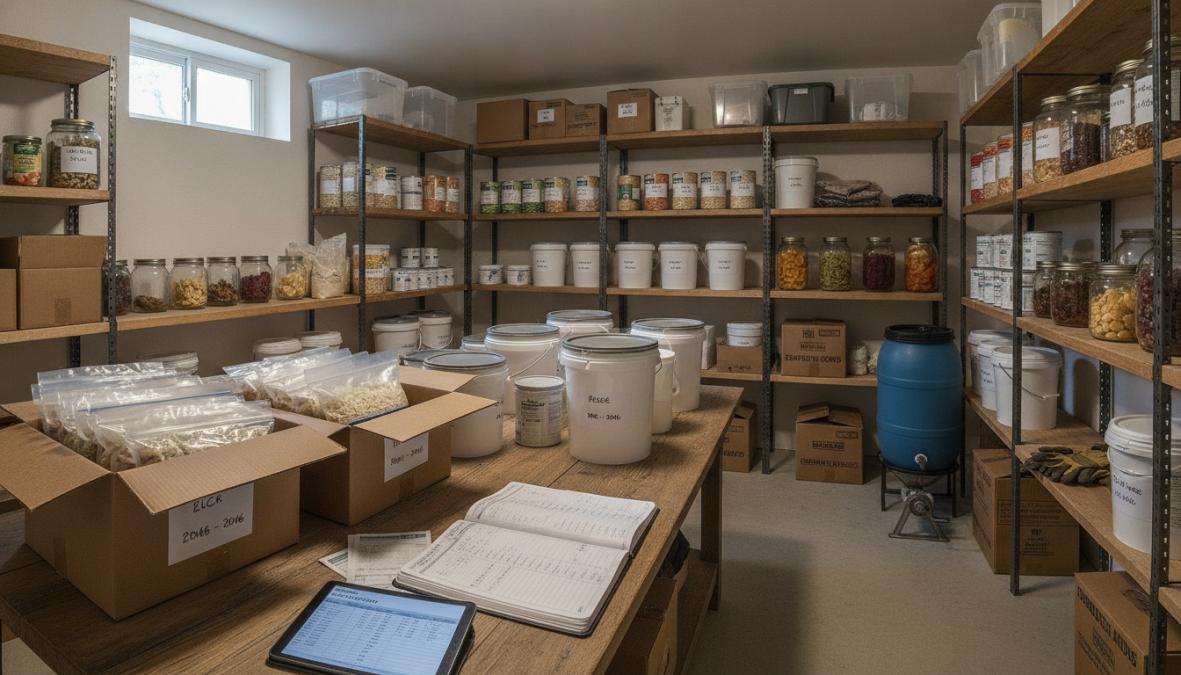
Label everything with contents and packing date. Store food in logical order with oldest stock in front (first-in, first-out rotation). Maintain a simple spreadsheet tracking contents, quantities, and expiration dates.
Rotation happens naturally if you use stored food regularly. Cook with your stored rice and beans. Replace what you use. A family that cooks with stored food monthly will naturally rotate stock without thinking about it.
Integration with Everyday Cooking: Using Your Supplies
The best emergency supply is one you actually use. Integrate stored foods into regular cooking: use canned vegetables in soups, cook with stored rice and pasta, bake with stored flour. This keeps food fresh through rotation, tests whether your family eats these foods, and normalizes emergency supplies as part of regular life.
When you cook with stored food, you naturally replace it. A family using 10 pounds of stored rice monthly will buy 10 pounds of new rice. Stock levels stay constant and nothing expires.
Building an emergency food supply transforms abstract preparedness into concrete security. Start with honest assessment of your needs, realistic budgeting, and commitment to rotation. Start with a 30-day kit and expand as your budget allows. Consistency matters more than perfection. A modest supply you actually maintain beats an elaborate one you abandon after a year.
Frequently Asked Questions
What's the difference between freeze-dried food and dehydrated food for long-term storage?
Freeze-dried food retains more nutrients and flavor while having longer shelf life (25+ years), but costs more. Dehydrated food is less expensive and still shelf-stable for 10-15 years, though it requires more water for rehydration. Freeze-dried is ideal for nutritional density; dehydrated works well for bulk staples and cost-conscious buyers building long-term food storage supplies.
How much food should I store for one person for a year?
A single person needs approximately 730,000-1,095,000 calories annually (2,000-3,000 per day). Plan for 275-365 pounds of food total, including grains, proteins, fats, and vegetables. Account for your household size, dietary needs, and storage space when calculating how much food to store for 1 year. Include variety to maintain nutrition and morale during extended emergencies.
What's the best place to buy long-term food storage supplies?
Dedicated preparedness retailers like SHTF Prepper Club, My Patriot Supply, and Survival Frog offer vetted emergency food kits with guaranteed shelf life. Bulk suppliers work for DIY approaches. Compare commercial kits (convenience, pre-planned nutrition) against bulk purchases (lower per-calorie cost). Choose based on budget, storage space, and whether you prefer ready-made solutions or customizable options.
How do I know if my long-term food storage supplies are still safe to eat?
Check expiration dates and signs of damage to packaging. Properly stored food in Mylar bags with oxygen absorbers or 5-gallon food-grade buckets can last 25+ years. Inspect for moisture, pests, or odors before consuming. Rotate stock using FIFO (first in, first out) method. Store in cool, dry conditions (below 70°F, low humidity) to maximize shelf life of your long-term food storage supplies.
This article was written using GrandRanker