
Table of Contents
- Freeze Dried vs Dehydrated Food for Storage: Key Differences at a Glance
- What Is Freeze-Dried Food and How Does It Work?
- What Is Dehydrated Food and How Does It Work?
- Shelf Life of Freeze-Dried Food vs Dehydrated: Which Lasts Longer?
- Nutritional Value of Preserved Foods: Freeze-Dried vs Dehydrated
- Weight, Volume, and Storage Efficiency for Long-Term Food Storage
- Rehydrating Freeze-Dried vs Dehydrated Food: Process and Time
- Home Freeze Dryer Cost vs Food Dehydrator: DIY Economics
- Taste, Texture, and Flavor Profiles: What Your Family Will Actually Eat
- Environmental Impact: Which Preservation Method Is More Sustainable?
Freeze Dried vs Dehydrated Food for Storage: Complete 2026 Guide
Last Updated: July 28, 2026
Long-term food storage requires choosing between two dominant preservation methods. Understanding the differences between freeze dried vs dehydrated food determines what you'll eat during an emergency, how much space you'll need, what you'll spend, and whether your family will actually consume what you've stored. At SHTF Prepper Club, we've analyzed both methods extensively to help families make informed choices for their preparedness plans.
A poorly chosen storage method means money wasted on food your family won't eat or discovering too late that supplies have degraded. This guide breaks down how each method works, costs, shelf life, and which approach fits your situation.
Freeze Dried vs Dehydrated Food for Storage: Key Differences at a Glance
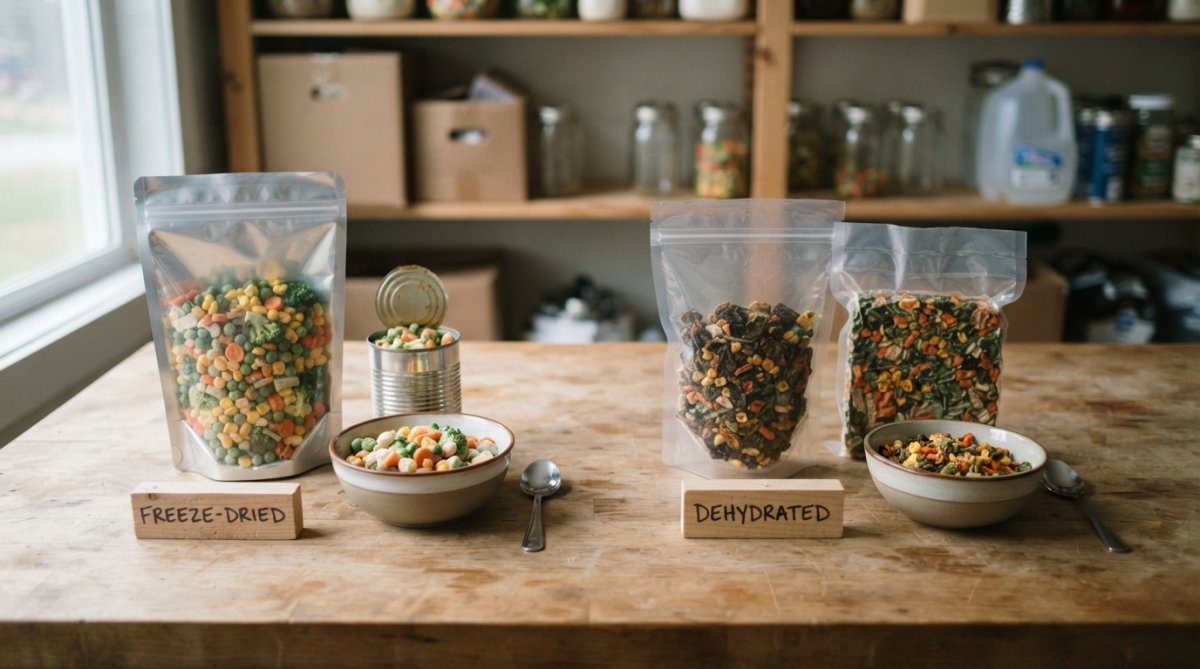
Freeze-drying uses a vacuum chamber and extreme cold to extract moisture while preserving nearly all nutrients and flavor. Dehydration uses heat and air circulation to slowly remove water, which can impact some nutrients and alter texture. Both create shelf-stable food requiring no refrigeration and lasting for decades under proper conditions, but practical differences shape your entire storage strategy.
| Factor | Freeze-Dried | Dehydrated |
|---|---|---|
| Shelf Life | Up to 25+ years | 5-15 years |
| Rehydration Time | 5-15 minutes | 20-60 minutes |
| Nutritional Retention | 97-98% | 60-80% |
| Weight per Serving | Very light | Light |
| Initial Cost | Higher | Lower |
| Storage Space | Minimal | Moderate |
| Flavor Profile | Nearly identical | Slightly altered |
| Best For | Long-term storage, variety | Budget-conscious, specific foods |
What Is Freeze-Dried Food and How Does It Work?
Freeze-dried food is preserved through lyophilization, which removes moisture without using heat. Food is frozen to below negative 40 degrees Fahrenheit, then placed in a vacuum chamber where pressure drops dramatically. Ice crystals sublimate directly from solid to vapor, skipping the liquid phase entirely. This preserves cellular structure, shape, color, and nutrient density in ways heat-based methods cannot match.
The Harvest Right Home Freeze Dryer represents the most accessible option for home use. It can freeze-dry fruits, vegetables, dairy products, meat, and complete prepared meals. The machine includes vacuum pump technology, stainless steel trays, and storage supplies like Mylar bags and oxygen absorbers.
What Is Dehydrated Food and How Does It Work?
Dehydration removes water through heat and air circulation. A food dehydrator maintains controlled temperature, typically between 85 and 165 degrees Fahrenheit, while circulating warm air across trays. Water gradually evaporates from the food's surface and interior over hours or days depending on food type and thickness.
The Excalibur Food Dehydrator exemplifies modern dehydration technology. Its horizontal parallex air flow system distributes heat evenly without requiring tray rotation. The adjustable thermostat lets you set precise temperatures for different foods. Most dehydrators can run continuously for up to 80 hours.
Dehydrated food becomes shelf-stable because reduced moisture prevents microbial growth. However, heat exposure causes some nutrient loss and texture changes. Dehydrated berries become chewy rather than crispy. The flavor remains recognizable but slightly concentrated. The advantage is accessibility and cost, a quality dehydrator costs a fraction of a freeze dryer.
Shelf Life of Freeze-Dried Food vs Dehydrated: Which Lasts Longer?
Properly stored freeze-dried food maintains quality for 25 to 30 years. Mountain House offers a 30-year taste guarantee on freeze-dried meals in #10 cans. The extremely low moisture content and proper oxygen-free storage create conditions where food degradation happens at a glacial pace.
Dehydrated food typically lasts 5 to 15 years depending on storage conditions and food type. Properly dried and stored items like beans, grains, and jerky can approach the 15-year mark. Foods with higher residual moisture content degrade faster.
The storage environment matters enormously for both methods. Temperature fluctuations, humidity exposure, and light damage all reduce shelf life. Freeze-dried food stored in a cool basement can last 25 years; the same food stored in a hot garage might degrade to 10 years.
ReadyWise Emergency Food Supply buckets demonstrate commercial-scale combinations. Their 150-serving bucket includes both preservation methods in sealed Mylar pouches, achieving up to 25-year shelf life through careful packaging.
Nutritional Value of Preserved Foods: Freeze-Dried vs Dehydrated
Freeze-drying preserves approximately 97 to 98 percent of original nutritional content. Because the process uses no heat, heat-sensitive vitamins like vitamin C and B vitamins remain largely intact. Minerals, fiber, and protein survive unchanged.
Dehydration retains 60 to 80 percent of original nutrients depending on food and temperature. Heat damages some vitamins, particularly water-soluble ones. Prolonged air exposure during drying oxidizes certain nutrients.
The practical difference matters most for long-term emergencies. If your family relies on stored food for weeks or months, freeze-dried options provide better nutritional insurance. However, both methods beat fresh food that spoils.
Weight, Volume, and Storage Efficiency for Long-Term Food Storage
Freeze-dried food weighs dramatically less than dehydrated alternatives because sublimation removes more water more completely. A pound of freeze-dried strawberries takes up roughly the same space as a handful of berries. The same weight of dehydrated strawberries occupies noticeably more volume.
For preppers with limited storage space, freeze-dried food is transformative. A small closet can hold months of freeze-dried meals. This weight-to-calorie ratio matters enormously for emergency scenarios where mobility matters. Ultralight backpacking communities rely almost exclusively on freeze-dried meals.
Dehydrated food remains reasonably compact and weighs less than fresh food. For apartment dwellers or those with moderate storage constraints, dehydration strikes a practical balance. Freeze-dried food in Mylar bags with oxygen absorbers stacks efficiently in buckets or shelving. Dehydrated food can use similar containers but often benefits from glass jars because slightly higher residual moisture makes it more sensitive to humidity.
Rehydrating Freeze-Dried vs Dehydrated Food: Process and Time
Freeze-dried food rehydrates quickly, typically within 5 to 15 minutes depending on food type. Freeze-dried berries rehydrate in 5 minutes; vegetables might need 10 minutes; meat and complete meals often take 15 to 20 minutes. Simply add hot water, wait briefly, and the food returns to near-original texture.
Dehydrated food requires longer rehydration. Most dehydrated vegetables need 20 to 45 minutes of soaking or simmering. Dehydrated beans can require an hour or more. The slower rehydration process means longer meal preparation times during stressful situations.
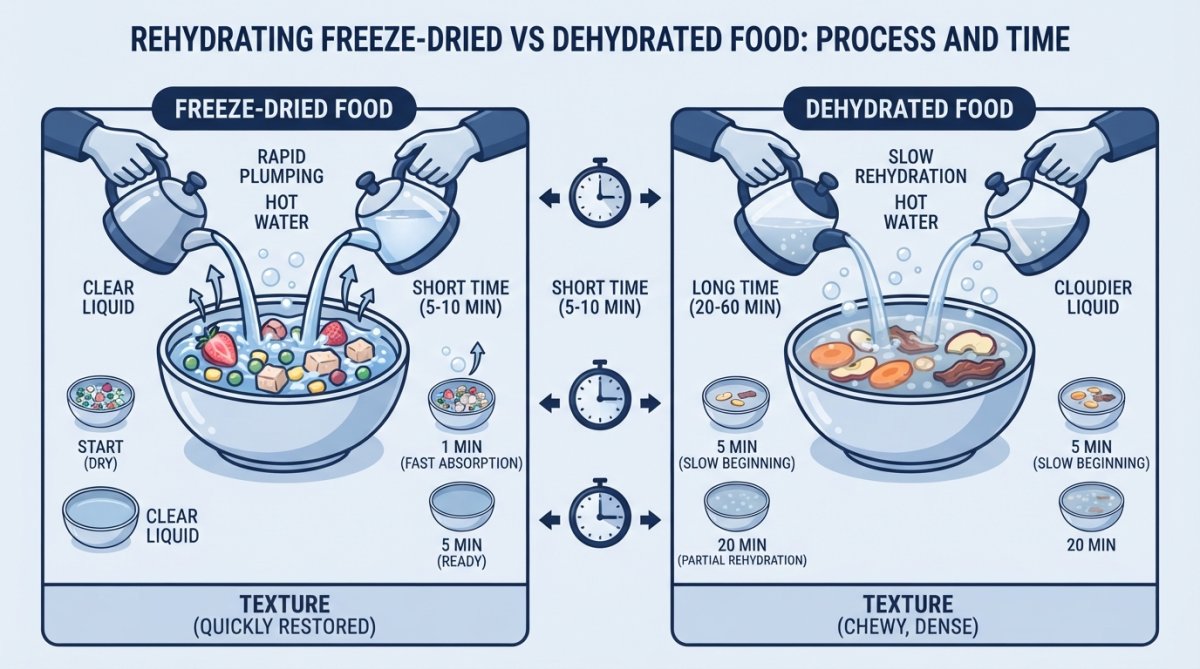
During a power outage or emergency, you might have limited hot water. Freeze-dried food's quick rehydration means faster meal preparation using less fuel or electricity. Dehydrated food requires more water and heating time, which matters when resources are constrained.
Home Freeze Dryer Cost vs Food Dehydrator: DIY Economics
The initial investment difference is substantial, but true cost-of-ownership is more complex than equipment price alone.
Equipment Investment
A quality food dehydrator like the Excalibur 6-tray model costs around $249.99. Home freeze dryers represent a much larger investment. The Harvest Right Home Freeze Dryer starts at $1,595.00 for the smallest model (Medium capacity, approximately 7 pounds per batch). The Large model costs $2,495.00 and processes roughly 10 pounds per batch. The XL model reaches $3,495.00 with 15-pound batch capacity.
Energy Costs Per Batch
Food dehydrators consume 300 to 600 watts during operation. Running a 24-hour cycle at 500 watts costs approximately $0.29 to $0.58 per cycle at the U.S. average of $0.14 per kilowatt-hour. Processing 5 pounds per cycle means energy cost of roughly $0.06 to $0.12 per pound.
Freeze dryers consume substantially more power. A complete freeze-dry cycle lasting 24 to 30 hours consumes 30 to 50 kilowatt-hours of electricity. At $0.14 per kilowatt-hour, a single batch costs $4.20 to $7.00 in electricity. Processing 7 to 10 pounds per cycle means energy cost of $0.42 to $1.00 per pound.
Over a year of regular use processing 200 pounds of food, a dehydrator costs $12 to $24 in electricity while a freeze dryer costs $84 to $140. This $72 to $116 annual difference compounds over the equipment's 10-year lifespan.
Storage Container and Packaging Costs
Both methods require airtight storage. Freeze-dried food storage requires Mylar bags ($0.15 to $0.35 each), oxygen absorbers ($0.10 to $0.25 each), and food-grade buckets ($3 to $8 each). Storing 200 pounds across multiple Mylar bags might require 40 to 60 bags, 40 to 60 oxygen absorbers, and 4 to 6 buckets. Total packaging cost: $15 to $30 per batch.
Dehydrated food can use similar Mylar storage but often benefits from glass jars or buckets. A year's worth of dehydrated storage (200 pounds) might use 20 to 30 Mylar bags, 20 to 30 oxygen absorbers, and 2 to 4 buckets. Total packaging cost: $8 to $18 per batch.
Cost-Per-Serving Over Time
Commercial freeze-dried meals from ReadyWise cost around $189.99 for 150 servings, or approximately $1.27 per serving. Mountain House meals average $1.50 to $2.00 per serving.
If you process your own food in a freeze dryer, assume you purchase bulk fresh strawberries at $2.50 per pound. A 7-pound batch yields approximately 1 pound of freeze-dried strawberries (roughly 85% water loss). Equipment amortization ($1,595 ÷ 500 batches over 10 years) = $3.19 per batch. Energy cost = $4.20 to $7.00. Packaging = $0.50. Raw material = $17.50. Total cost per batch = $25.39 to $28.19 for 1 pound, or roughly $0.40 to $0.45 per ounce.
A dehydrator processing the same strawberries: Equipment amortization ($249.99 ÷ 300 batches) = $0.83 per batch. Energy cost = $0.29 to $0.58. Packaging = $0.25. Raw material = $17.50. Total cost per batch = $18.87 to $19.16 for 2 pounds of dehydrated strawberries (60% water loss), or roughly $0.30 to $0.31 per ounce.
The dehydrator is cheaper per unit weight, but freeze-dried strawberries last 25 years versus 8 to 10 years for dehydrated. Over 25 years, you'd need to replace dehydrated strawberries 2.5 times, tripling total cost. Freeze-dried becomes cost-competitive over the long term.
Maintenance and Repair Costs
Vacuum pumps in freeze dryers require regular oil changes every 100 to 200 operating hours. Vacuum pump oil costs $15 to $30 per quart, and you'll need 1 to 2 quarts per change. Maintenance costs roughly $30 to $60 per 100 hours of operation, or $60 to $120 annually for regular users. Oil-free pump upgrades eliminate this maintenance but increase initial equipment cost by $400 to $600.
Food dehydrators require minimal maintenance beyond regular cleaning.
Taste, Texture, and Flavor Profiles: What Your Family Will Actually Eat
Your family will eat what tastes good. Not all foods preserve equally well using each method, and understanding food-type compatibility is essential for building a storage plan your family will actually consume.
Freeze-Dried vs Dehydrated by Food Category
Freeze-drying excels with foods that lose appeal when dehydrated. Freeze-dried strawberries taste remarkably like fresh strawberries. Freeze-dried chicken tastes like chicken. Freeze-dried dairy products (yogurt, cheese, ice cream) retain distinctive flavors in ways dehydration cannot match. Most people cannot detect meaningful differences between freeze-dried and fresh when rehydrated properly.
Dehydrated food tastes noticeably different. Dehydrated strawberries taste like concentrated strawberry candy, sweeter and more intense than fresh. Dehydrated vegetables develop a chewier texture and slightly cooked flavor. Some people prefer this; others find it off-putting.
Fruits: Freeze-drying is superior. Dehydrated berries become hard and candy-like. Freeze-dried berries rehydrate to near-fresh texture. If your family eats fruit regularly, freeze-dried is worth the premium.
Vegetables: Mixed results. Dehydrated carrots, celery, and onions work well in soups and stews. Freeze-dried vegetables retain crispness and are superior for salads or side dishes. For emergency meals where texture preservation matters psychologically, freeze-dried vegetables are preferable.
Meats: Freeze-drying is strongly preferred. Dehydrated meat becomes jerky-like and requires significant rehydration time. Freeze-dried meat crumbles easily and rehydrates quickly into recognizable texture. Freeze-dried ground beef, chicken, and turkey are staples in commercial emergency meals.
Dairy: Freeze-drying is essential. Dehydration damages dairy products significantly. Freeze-dried yogurt, cheese, and milk powder retain flavor and nutritional profile. If your emergency plan includes dairy products, freeze-drying is the only viable option.
Prepared Meals: Freeze-drying dominates. Mountain House and ReadyWise freeze-dried meals taste reasonably close to fresh-prepared food. Commercial freeze-dried meals have established reputations for taste quality among preppers and outdoor enthusiasts.
Grains and Legumes: Dehydration is adequate. Dried beans, rice, and pasta don't require preservation beyond standard dry storage.
Texture Differences and Psychological Impact
Texture differences matter more than nutrition during emergencies. Freeze-dried food returns to near-original texture when rehydrated. Dehydrated food remains somewhat chewy even after rehydration. If your children dislike dehydrated vegetable texture, they won't eat them when stressed. Freeze-dried alternatives might be accepted more readily because they taste and feel more like familiar fresh food.
Flavor Retention Over Time
Freeze-dried food maintains flavor intensity for the full 25-year shelf life. Dehydrated food's flavor concentrates initially but can fade over 5 to 10 years, particularly if storage conditions fluctuate. For "set it and forget it" storage that tastes acceptable decades later, freeze-dried is more reliable.
Practical Recommendation for Family Acceptance
Start with commercial freeze-dried meals like those from Mountain House or ReadyWise to establish baseline emergency supplies. Your family can try them in non-emergency situations to confirm acceptability. Supplement with home-dehydrated foods for items your family already enjoys. Reserve freeze-drying for foods where texture and flavor preservation are critical: berries, dairy products, complete prepared meals, and vegetables intended for side dishes.
Environmental Impact: Which Preservation Method Is More Sustainable?
Both methods avoid the waste of fresh food spoilage. However, the preservation process itself carries different environmental footprints.
Freeze-drying requires significant electrical energy to power the vacuum pump and maintain the sublimation chamber. However, freeze-dried food's extreme shelf life means less frequent replacement and less total food waste over time. A freeze-dried product lasting 25 years requires fewer replacement cycles than a dehydrated product lasting 10 years.
Dehydration uses less energy per batch but requires more frequent replacement due to shorter shelf life. The freeze-dried product lasts 2.5 times longer, potentially offsetting the energy difference over a multi-decade period.
Packaging matters significantly. Both methods require airtight storage using Mylar bags and oxygen absorbers. Mylar is not readily recyclable. Neither method is particularly sustainable from a packaging perspective, though this is necessary for food safety and shelf life.
The most sustainable approach combines both methods strategically. Use dehydration for foods you consume regularly and replace frequently. Use freeze-drying for long-term emergency reserves that rarely need replacement.
Choosing between freeze-dried and dehydrated food depends on your specific situation, budget, and priorities. For families seeking maximum shelf life with minimal space requirements and superior nutritional retention, freeze-dried food is the clear choice despite higher costs. For budget-conscious preppers or those with adequate storage space, dehydration offers practical benefits and accessibility. SHTF Prepper Club recommends starting with commercial freeze-dried meals like those from ReadyWise or Mountain House to establish baseline emergency supplies, then supplementing with home-dehydrated foods as your budget and space allow. This layered approach ensures your family has reliable, palatable food storage that will actually be consumed during an emergency, with the peace of mind that comes from knowing your supplies will remain viable for decades.
Frequently Asked Questions
What is the main difference between freeze-dried and dehydrated food for storage?
Freeze-dried food uses sublimation, a vacuum chamber process that removes moisture while preserving structure and nutrients, resulting in shelf-stable food that rehydrates quickly. Dehydrated food uses heat and air circulation to remove moisture, which takes longer but costs less. Freeze-dried retains up to 97% of nutrients; dehydrated retains 50-80% depending on temperature and food type. For long-term storage, freeze-dried offers superior nutrient retention and shelf life.
Which lasts longer: freeze-dried or dehydrated food?
Freeze-dried food typically lasts 25-30 years in airtight storage with oxygen absorbers, while dehydrated food lasts 5-15 years under the same conditions. The difference lies in moisture content, freeze-dried has 1-3% residual moisture versus 10-20% in dehydrated food. Lower moisture means less oxidation and food spoilage. For emergency preparedness and long-term food independence, freeze-dried is the clear winner for shelf-stable, multi-decade storage.
Is freeze-dried food more nutritious than dehydrated food?
Yes, freeze-dried food generally retains more nutrients because the sublimation process occurs at low temperatures, preventing thermal degradation. Dehydrated food loses some water-soluble vitamins and heat-sensitive nutrients during thermal processing. However, both methods preserve caloric density and macronutrients well. For maximum nutrient retention in preserved foods, freeze-dried is superior, though both are far better than fresh food that spoils.
What is the cost difference between home freeze dryers and food dehydrators?
A home freeze dryer starts around $1,595 for entry-level models and can exceed $4,000 for larger units, while quality food dehydrators range from $250-$500. However, freeze dryers offer better cost-effectiveness over time if you process large batches regularly, you can freeze-dry bulk ingredients and achieve a lower per-serving cost than buying commercial freeze-dried food. Dehydrators are ideal for smaller-scale preservation or those with limited budgets.
Can I freeze-dry and dehydrate all types of food?
Most foods can be freeze-dried, fruits, vegetables, dairy, meat, and complete meals, making it versatile for emergency food storage. Dehydration works well for fruits, vegetables, jerky, and herbs, but high-fat foods (oils, nuts, fatty meats) degrade faster due to oxidation. For comprehensive long-term food independence, freeze-drying accommodates a wider range of foods without texture degradation or flavor profile loss.
This article was written using GrandRanker