
Table of Contents
- Why Your Family Needs an Emergency Preparedness Checklist
- Water and Hydration: The First Priority
- Non-Perishable Food and Emergency Stockpiles
- First Aid Kit Essentials and Medical Supplies
- Building Your 72-Hour Kit Checklist for Family
- Communication Plans and Important Documents
- Sanitation, Hygiene, and Tools for Emergencies
- Disaster Preparedness for Kids: Teaching Your Children
- Pet Emergency Preparedness Checklist
- Budget-Friendly Emergency Preparedness: Start Where You Are
Emergency Preparedness Checklist for Families: 2026 Guide
Last Updated: July 22, 2026
When disaster strikes, families without a plan face chaos, fear, and preventable loss. An emergency preparedness checklist for families isn't optional, it's the difference between your household staying safe and scrambling in crisis mode. At SHTF Prepper Club, we've helped thousands of families move from anxiety to readiness with practical, step-by-step guidance that cuts through the overwhelm.
This guide walks you through building a comprehensive emergency preparedness checklist for families that actually works. Below, we'll cover water storage, food supplies, medical kits, communication plans, and specialized preparations for children and pets. Most families can complete their core preparedness setup in 4-6 weeks without breaking the bank.
Why Your Family Needs an Emergency Preparedness Checklist
The difference between families that survive emergencies intact and those that don't isn't luck. It's preparation.
Natural disasters, power outages, severe weather, and supply chain disruptions happen more frequently than most people realize. When they do, families without a plan face hours of confusion, dangerous decisions made under stress, and gaps in critical supplies. A written emergency preparedness checklist removes the guesswork and ensures every family member knows exactly what to do.
The real value of an emergency preparedness checklist isn't the list itself, it's the confidence it creates. When your household has practiced your plan, knows where supplies are stored, and understands each person's role, you move through a crisis with purpose instead of panic. Children feel safer. Adults make better decisions. Recovery happens faster.
SHTF Prepper Club has found that families using a formal checklist report significantly higher confidence in their ability to handle emergencies. The act of planning itself, discussing scenarios, assigning tasks, testing gear, builds psychological resilience that no amount of supplies alone can create.
Water and Hydration: The First Priority
Water is non-negotiable. A person can survive weeks without food but only days without water. Most families severely underestimate how much water they need.
The standard recommendation is 1 gallon per person per day for drinking and basic hygiene. For a family of four, that's 4 gallons daily. Over a 72-hour emergency kit period, you need 12 gallons minimum. For longer-term preparedness (two weeks), store 56 gallons for a family of four.
How Much Water to Store
Calculate your household's water needs using this formula: number of people × 1 gallon per day × number of days you want to cover.
A common mistake is storing water in containers that degrade or contaminate over time. Food-grade plastic containers, glass bottles, or purpose-built water storage containers work best. Avoid milk jugs, they degrade quickly and can introduce bacteria. Rotate stored water every six months to maintain freshness, or use water storage containers designed to last 5+ years without rotation.
Store water in multiple locations. Keep some in your home, some in your vehicle, and some in a secondary location if possible. Concentrated storage creates a single point of failure. If one storage area becomes inaccessible, your household still has backup supplies.
Water Purification and Filtration
Stored water covers normal use, but purification methods handle contaminated water sources. A water filtration system removes bacteria, protozoa, and some chemical contaminants. Boiling water kills most pathogens but requires fuel and time. Water purification tablets offer a lightweight, long-shelf-life option for emergency kits.
Families should maintain at least two purification methods. A primary system (like a gravity-fed filter) handles large volumes. A backup system (tablets or portable filter) works for smaller quantities or when the primary system fails. Test your purification method before you need it, don't discover it doesn't work during an actual emergency.
Non-Perishable Food and Emergency Stockpiles
Food storage seems straightforward until you realize your family won't eat freeze-dried camping meals during a crisis. Emergency food works only if your family will actually consume it.
The foundation of emergency food storage is familiar items your household already eats. Canned vegetables, canned proteins (tuna, chicken, beans), pasta, rice, peanut butter, and crackers create a realistic emergency diet. Add comfort foods, chocolate, coffee, tea, because psychological comfort matters during stressful situations.
Avoid the trap of buying bulk emergency food without testing it first. Open a package before an emergency and eat it. If your family dislikes the taste or texture, you've wasted money and shelf space. SHTF Prepper Club recommends buying 50% familiar foods and 50% purpose-built emergency rations. This balance ensures your household eats well during a crisis without relying entirely on foods they've never tried.
Choosing Foods Your Family Will Actually Eat
Start with a three-day supply covering 2,000 calories per person daily. For a family of four, that's 24,000 calories total, roughly 8 cans of mixed vegetables, 8 cans of protein, 4 pounds of pasta, 2 pounds of rice, and 2 jars of peanut butter. This creates a rotating stockpile that fits in a single closet.
Build your emergency stockpile around meals your family recognizes. Spaghetti with canned sauce and canned meatballs. Chili made from canned beans and canned ground beef. Tuna salad with crackers. These meals require minimal cooking and use only shelf-stable ingredients.
Keep a manual can opener in your emergency kit. Electric can openers fail during power outages. A simple hand-crank opener costs three dollars and takes up almost no space.
| Food Category | Amount (Family of 4) | Storage Life | Examples |
|---|---|---|---|
| Canned vegetables | 8-12 cans | 2-5 years | Beans, corn, peas, carrots |
| Canned proteins | 8-12 cans | 2-5 years | Tuna, chicken, salmon, beef |
| Grains and pasta | 4-6 lbs | 2-3 years | Rice, pasta, oats, flour |
| Fats and oils | 2-3 containers | 1-2 years | Peanut butter, cooking oil, butter |
| Comfort foods | 2-4 items | 1-2 years | Chocolate, coffee, crackers, nuts |
First Aid Kit Essentials and Medical Supplies
A basic first aid kit handles cuts, burns, sprains, and minor illnesses. A comprehensive emergency first aid kit addresses situations where professional medical help isn't immediately available.
Your first aid kit should contain bandages in multiple sizes, antibiotic ointment, pain relievers, antacids, anti-diarrhea medication, antihistamines, and hydrocortisone cream. Add tweezers for splinter removal, elastic bandages for sprains, and a thermometer. Include any prescription medications your family members take, stored in original containers with clear labels.
Beyond the basic kit, consider adding items for more serious situations: sterile gauze pads, medical tape, a triangular bandage for slings, tourniquets, and a CPR face shield. A basic first aid manual or printed guide helps when you're stressed and can't remember proper technique.
Store your first aid kit in a cool, dry location and check it twice yearly. Replace expired medications and replenish used items immediately. A first aid kit that's missing supplies when you need it creates false confidence.
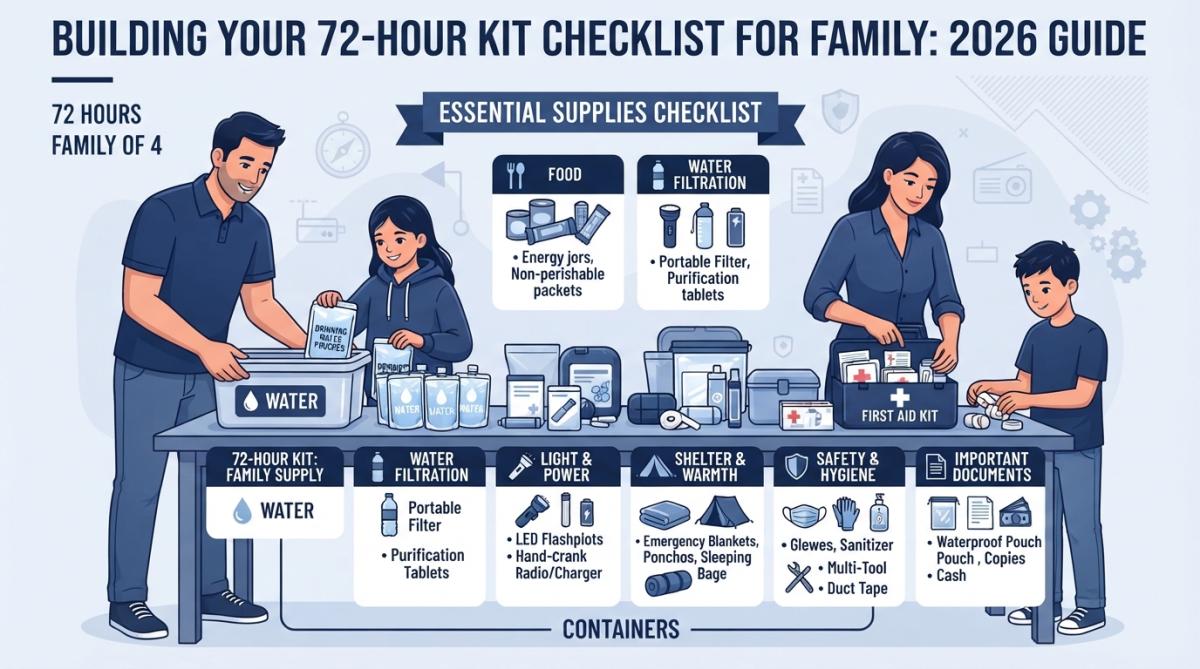
Building Your 72-Hour Kit Checklist for Family
A 72-hour kit (also called a go-bag or bug-out bag) contains supplies your family needs for three days of self-sufficiency. The purpose is clear: if you must evacuate or shelter in place, you have everything necessary without scavenging or relying on outside help.
A 72-hour kit isn't optional for families. It's the minimum baseline for emergency preparedness. The specific contents vary by family, but the structure remains consistent: water, food, shelter, first aid, light, communication, and documents.
What Goes in Your Go-Bag
A practical 72-hour kit for a family of four requires multiple containers. One large backpack or duffel bag per person works well, allowing each family member to carry their own supplies if evacuation is necessary.
Water and Food (per person):
- 1 liter of water (minimum, more is better)
- High-calorie snacks: granola bars, trail mix, dried fruit, peanut butter packets
- Electrolyte replacement: sports drink powder or electrolyte tablets
Shelter and Warmth:
- Emergency blanket or space blanket (compact and lightweight)
- Tarp or plastic sheeting (provides emergency shelter)
- Change of clothes appropriate to your climate
Light and Communication:
- Flashlight with extra batteries
- Battery-powered or hand-crank radio
- Whistle (for signaling help)
- Phone charger (battery pack or solar)
First Aid and Hygiene:
- Basic first aid kit
- Prescription medications (one-week supply minimum)
- Hygiene items: toilet paper, hand sanitizer, wet wipes, feminine hygiene products if needed
- Sunscreen and insect repellent
Documents and Information:
- Copies of important documents (IDs, insurance policies, medical records) in waterproof container
- List of emergency contacts with phone numbers
- Map of your area with evacuation routes marked
Tools and Supplies:
- Multi-tool or knife
- Duct tape (wrapped around a pencil to save space)
- Paracord (50 feet minimum)
- Matches or lighter in waterproof container
- Rope or nylon cordage
Store your 72-hour kit in an accessible location, not in the basement where you can't reach it quickly, not in the garage where it might be blocked. A front closet or bedroom closet works well. Rotate perishable items (food, medications, batteries) annually.
Communication Plans and Important Documents
When disaster strikes, families get separated. Relatives outside the affected area can't reach you. Cell networks become overwhelmed or fail entirely. A family communication plan ensures everyone knows how to reconnect.
A communication plan answers three critical questions: Where will we meet if we can't reach each other by phone? Who outside the area will we contact to report our status? How will we communicate if normal phone service fails?
Creating a Family Emergency Contact List
Establish an out-of-area contact person, a relative or trusted friend in another city or state. When disaster strikes, family members call this person to report their status and location. It's often easier to make a long-distance call than a local one during emergencies.
Write down this contact person's name and phone number on a card each family member carries. Include your home address, workplace addresses, and school locations. Add your family's cell phone numbers. This seems basic, but most people don't memorize phone numbers anymore, a written list becomes essential when your phone dies.
Identify multiple meeting locations. A primary meeting location near your home (a specific park, street corner, or landmark). A secondary meeting location farther away if your neighborhood becomes inaccessible. A tertiary location outside your city if evacuation becomes necessary. Discuss these locations with your entire family so everyone knows where to go.
Practice your communication plan once yearly. Have family members separate and practice the plan as if an emergency occurred. This reveals gaps and ensures everyone remembers the details.
Protecting Your Important Documents and Records
Critical documents, birth certificates, marriage licenses, insurance policies, property deeds, medical records, are irreplaceable. A disaster that damages your home can destroy these documents permanently.
Store copies of important documents in a waterproof, fireproof container. A safe deposit box at a bank provides excellent protection but requires a trip to access. A fireproof home safe offers quick access. Whichever method you choose, ensure at least two family members know where the documents are stored and how to access them.
Consider digital backup as well. Scan important documents and store them in an encrypted cloud service. Include usernames and passwords for critical accounts in a secure location. A family member should know how to access these digital records if you become incapacitated.
Sanitation, Hygiene, and Tools for Emergencies
When water systems fail or sewage systems become unusable, sanitation becomes a serious health concern. Diseases spread rapidly in unsanitary conditions. A family emergency preparedness checklist must address sanitation explicitly.
Maintain a supply of toilet paper, hand sanitizer, wet wipes, trash bags, and soap. If your water supply is disrupted, hand sanitizer becomes more valuable than water for basic hygiene. Store at least two weeks of supplies for a family of four.
Portable camping toilets or bucket-based toilet systems provide sanitation when municipal sewage systems fail. A five-gallon bucket with a toilet seat lid and biodegradable liners creates a functional emergency toilet. This seems uncomfortable until you realize the alternative, it's far better than the actual alternative.
Tools for emergency response should include a basic toolkit (hammer, screwdrivers, adjustable wrench), pry bar, shovel, and axe. These tools help clear debris, shut off utilities, and handle minor repairs. A generator provides power for essential appliances, but fuel storage requires careful planning and safety precautions.
Disaster Preparedness for Kids: Teaching Your Children
Children who understand emergency procedures and know what to expect handle crises with significantly less fear and trauma. Age-appropriate safety training is one of the most valuable investments in family preparedness.
Younger children (ages 4-8) need simple, concrete instructions: "If there's an earthquake, drop to the ground and cover your head with your hands." They respond well to repetition and practice. Teach them to recognize danger signs, shaking, loud noises, sirens, and the appropriate response.
Older children (ages 9-12) can understand more complex scenarios. Teach them how to call 911, what information to provide, and when to call. Explain your family's evacuation plan and meeting locations. Practice the plan regularly so it becomes automatic.
Teenagers can handle detailed preparedness discussions. Teach them basic first aid, how to shut off utilities, and how to operate emergency equipment. Involve them in building your family's emergency kit, ownership increases their buy-in and ensures they know what supplies you have and where they're located.
Age-Appropriate Safety Training
For young children, focus on specific, actionable responses to common emergencies:
Earthquake: "Drop, cover, and hold on. Get under a sturdy table or against an interior wall."
Severe Weather: "Go to the basement or interior room away from windows."
Fire: "Get low and go. Feel doors before opening them. Get outside and go to the meeting place."
Stranger Danger: "Tell a trusted adult immediately. Run to a safe location."
Practice these responses through games and drills. Make it fun rather than frightening. A child who has practiced dropping and covering during an earthquake will respond correctly when an actual earthquake occurs.
Building Confidence Without Fear
The goal of disaster preparedness for kids is confidence, not anxiety. A child who understands what to do feels empowered. A child who only hears scary stories without learning responses feels helpless.
Frame preparedness positively: "We're learning how to handle tough situations so our family stays safe." Avoid graphic descriptions of disasters. Focus on actions and solutions rather than dangers and fears.
Include children in age-appropriate preparedness activities. Let a young child help pack non-perishable food into the emergency kit. Let an older child help organize the first aid kit and learn what each item does. This involvement builds competence and reduces anxiety.
Pet Emergency Preparedness Checklist
Pets are family members. A complete family emergency preparedness checklist includes supplies and plans for your animals.
Each pet needs a 72-hour supply of food and water, medications, medical records, and identification. Create a pet evacuation kit similar to your family kit: food, water, bowls, leash, carrier, litter box and litter (for cats), medications, and veterinary records.
Microchip your pets and maintain current ID tags. During evacuation chaos, pets can become separated from their owners. A microchip dramatically increases the chance of reunion. Ensure the microchip registry has current contact information.
Photograph your pets regularly. During an evacuation, a clear photo helps authorities identify and locate your animal if it becomes lost. Include the photo in your emergency kit.
Identify pet-friendly shelters and boarding facilities in advance. Not all emergency shelters accept pets. Knowing where you can take your animals if evacuation becomes necessary prevents last-minute scrambling.
Budget-Friendly Emergency Preparedness: Start Where You Are
A comprehensive emergency preparedness checklist for families doesn't require thousands of dollars. Strategic purchasing spreads costs over time and keeps expenses manageable.
Start with the basics: water, non-perishable food, and a first aid kit. These three items cost less than $100 for a family of four and cover the most critical needs. Add to your preparedness gradually as your budget allows.
Buy supplies during regular shopping trips rather than in bulk emergency purchases. When you buy canned vegetables for dinner, buy two extra cans for storage. When you replace batteries in remote controls, buy extra batteries for your emergency kit. Over six months, this approach builds substantial supplies with minimal financial impact.
Generic and store-brand items cost significantly less than name brands and work equally well for emergency supplies. A store-brand can opener functions identically to a premium brand. Store-brand canned beans taste fine and cost half as much.
Focus spending on items with long shelf lives and high utility. Water, canned food, batteries, and first aid supplies provide maximum value. Avoid low-utility items that sound good but rarely get used.
SHTF Prepper Club offers curated emergency kits that bundle essentials efficiently, eliminating the guesswork of what to buy and how much to store. Their approach simplifies preparedness for families overwhelmed by choices, providing vetted solutions for water filtration, food storage, and safety gear designed specifically for family situations.
Frequently Asked Questions
What should be in a family emergency preparedness checklist?
A complete emergency preparedness checklist for families includes water storage (1 gallon per person per day for 3+ days), non-perishable food, first aid supplies, flashlights, battery-powered or hand-crank radios, medications, important documents in waterproof containers, sanitation supplies, and a communication plan. For families, also add items for children and pets, plus any special medical needs. Review and update your emergency supplies every 6-12 months to ensure freshness and functionality.
How do I create a family emergency contact list and communication plan?
Create a written family emergency contact list with out-of-state contacts, workplace numbers, and neighbors' information. Assign a meeting location if your family is separated. Ensure each family member has a copy in their wallet or phone. Practice your plan twice yearly. Include a code word so everyone knows it's a real emergency. Test your communication plan during a power outage or disaster drill to identify gaps before a real crisis occurs.
What's the difference between a 72-hour kit and a larger emergency stockpile?
A 72-hour kit checklist for family contains essentials for short-term survival (3 days) and fits in a go-bag for evacuation. It includes water, food, first aid, and critical documents. A larger emergency stockpile supports longer-term sheltering in place with extended food, water, and supplies for weeks or months. Most families benefit from both: a portable 72-hour kit for evacuation scenarios and a home stockpile for power outages or temporary disruptions.
How do I involve children in disaster preparedness without causing anxiety?
Teach disaster preparedness for kids through age-appropriate activities like practicing evacuation drills, learning to call 911, and identifying safe spaces in your home. Use positive language focused on being 'ready and safe' rather than fearful. Let older children help assemble emergency kits. Younger children can practice 'safety games' like meeting at a designated spot. Emphasize that preparation is normal family planning, similar to car seats or smoke detectors. Reassure them that you're in control.
What does a pet emergency preparedness checklist need to include?
A pet emergency preparedness checklist should contain food and water for 2+ weeks, medications and medical records, a carrier or crate, leashes and ID tags, recent photos, vaccination records, and comfort items. Include a pet first aid kit and know your local pet-friendly shelters. Keep a microchip registry current and consider a pet alert sticker on your front door. Practice evacuation with your pet to reduce stress during a real emergency.
Your family's safety depends on preparation, not luck. An emergency preparedness checklist for families transforms anxiety into confidence and readiness. Start today with water and food storage. Add communication plans and important documents this month. Build your 72-hour kit gradually. Within a few months, your household will be genuinely prepared for whatever comes. The peace of mind is worth far more than the modest investment required.
This article was written using GrandRanker