
Table of Contents
- Why Protecting Important Documents Matters
- Fireproof and Waterproof Document Bags: Portable Protection
- Choosing the Best Fireproof Document Safe for Your Home
- Offsite Storage and Bank Safe Deposit Boxes
- Digital Backup for Important Documents: Your Recovery Plan
- Build Your Emergency Document Checklist
- Post-Disaster Document Retrieval and Maintenance
- Conclusion
Last Updated: August 29, 2026
Why Protecting Important Documents Matters
Your documents are irreplaceable. Birth certificates, property deeds, insurance policies, and medical records represent your identity, assets, and family's future. Yet most households keep them in a desk drawer with no protection. A single fire or flood can destroy decades of financial records and critical information in minutes.
According to FEMA's disaster preparedness guidance, families without organized vital records face months of delays and thousands in additional expenses when recovering from disasters. Losing important documents creates cascading problems: proving homeownership to rebuild, establishing identity for insurance claims, and accessing medical histories when needed most.
This guide from SHTF Prepper Club walks you through a comprehensive strategy to protect important documents from fire and flood. We'll cover physical protection methods, fireproof bags and safes, alongside digital backup systems that ensure your records survive catastrophic loss.
Fireproof and Waterproof Document Bags: Portable Protection
Fireproof and waterproof document bags offer the simplest entry point for protecting important documents. They're portable, affordable, and require no installation. You can grab them during evacuation and take your most critical records with you.
These bags use specialized materials, typically silicone-coated fiberglass or ceramic-filled fabric, to insulate contents from extreme heat and water. Quality bags seal with velcro or magnetic closures to prevent water infiltration during flooding and can protect documents at temperatures exceeding 2,000 degrees.
The main limitation is capacity. A typical fireproof bag holds 8-10 standard folders, not your entire filing system. They're best used for highest-priority items: passports, birth certificates, property deeds, and insurance policies.
What to look for when choosing a fireproof bag:
- Water-resistant seals that remain effective after repeated use
- Interior organization (pockets, dividers) to keep documents sorted
- A carrying handle for quick evacuation
- Independent testing certification showing fire and water ratings
Choosing the Best Fireproof Document Safe for Your Home
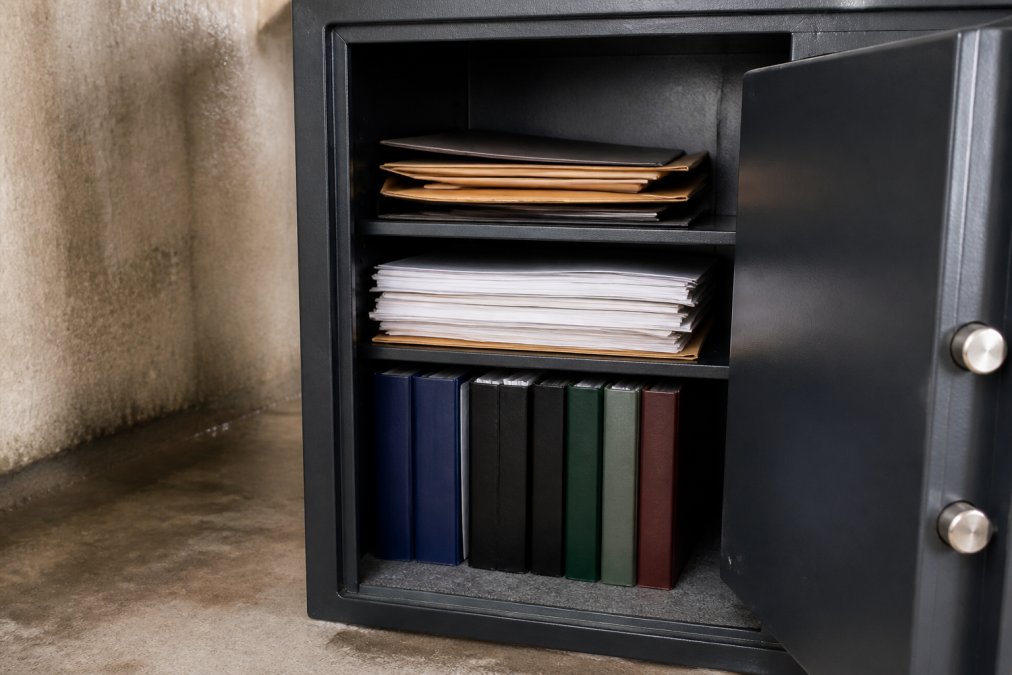
For comprehensive protection of important documents, a fireproof safe is the standard. Unlike bags, safes provide permanent, stationary protection for your entire document collection and are bolted to the floor or wall, making them resistant to theft.
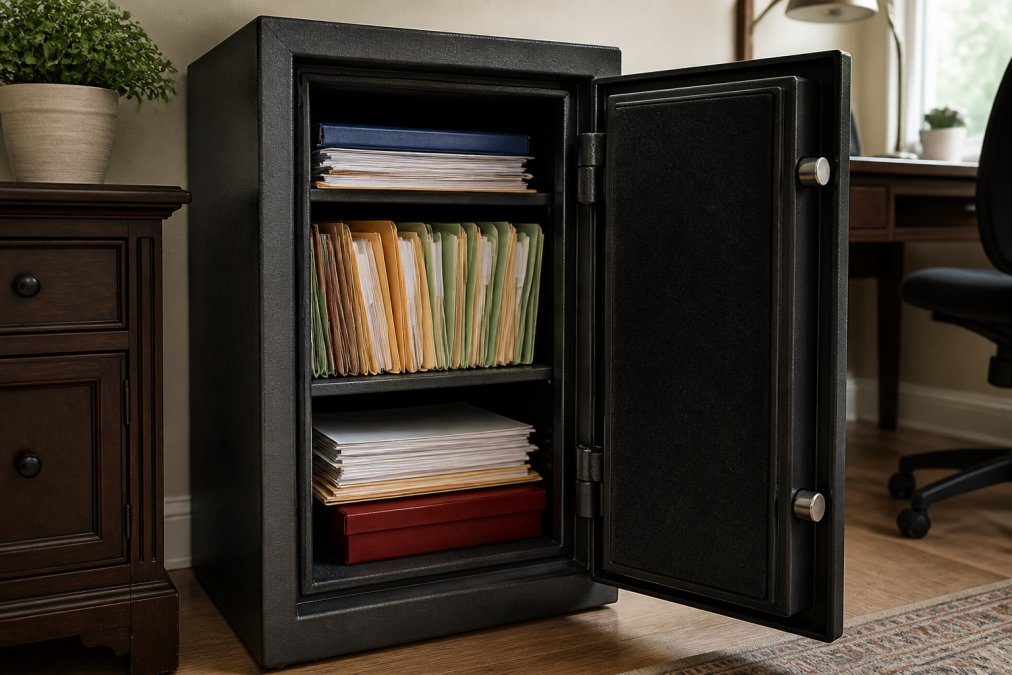
A fireproof safe works by surrounding documents with insulating material, typically gypsum, perlite, or ceramic composite, that absorbs heat and slows temperature rise inside the chamber. Quality safes maintain internal temperatures below 350 degrees Fahrenheit even when exposed to 1,200-degree fires, the threshold where paper ignites.
Size matters. A small safe (0.5-1 cubic foot) fits a desk but holds only essential documents. A medium safe (2-3 cubic feet) accommodates a full household filing system. Weight is critical: quality fireproof safes weigh 400-800 pounds because of insulation material, making them theft-resistant but requiring floor support and professional installation.
Understanding UL Ratings and Fire Ratings
UL ratings are standardized certifications from Underwriters Laboratories indicating how a safe performs under specific test conditions. A "UL 350-1 Hour" rating means the safe maintained internal temperatures below 350 degrees Fahrenheit for one hour when exposed to a 1,200-degree fire. A "UL 350-2 Hour" rating held that temperature for two hours. For household documents, a 1-hour rating is typically sufficient.
Look for safes with independent UL testing, not manufacturer claims. The UL label should be visible on the safe itself. If a product claims fire protection without UL certification, its actual performance is unverified.
Water Submersion and Humidity Control
Waterproofing is equally important as fire protection. Quality safes seal tightly to prevent water infiltration and include desiccant packs, materials like silica gel that absorb moisture from the air inside the chamber. These packs need periodic replacement (typically annually) to remain effective.
Look for safes tested under pressure conditions that simulate actual flood scenarios, not just exposed to standing water. A safe that survived sitting in a bathtub might fail when subjected to floodwater pressure from multiple directions.
Offsite Storage and Bank Safe Deposit Boxes
No safe in your home is immune to total loss. A house fire can destroy even a fireproof safe if the building collapses. Offsite storage solves this problem by keeping critical documents away from your property.
A bank safe deposit box is the traditional option. You rent a small metal box housed in a bank vault with climate control and security. The vault is typically fireproof and waterproof, separate from the main building. Safe deposit boxes cost $50-200 annually depending on size and location.
Safe deposit boxes have practical limitations: you can only access them during bank hours, and in emergencies, you may face delays retrieving documents. Additionally, some states restrict access after the account holder dies, complicating estate settlement.
Private vault services offer an alternative. Companies like specialized document storage providers maintain climate-controlled vaults specifically designed for document preservation. They typically cost more than bank boxes but offer extended hours and faster retrieval.
For offsite storage, keep originals of your most critical documents (property deeds, birth certificates, marriage certificates) in a safe deposit box or vault. Store copies at home in your fireproof safe. This way, you have immediate access to copies for most situations, and originals are protected separately.
Digital Backup for Important Documents: Your Recovery Plan
Physical protection alone is incomplete. A comprehensive document protection strategy includes digital backups that let you recover information even if physical originals are destroyed.

Create a digital recovery plan: a documented process for what to scan, where to store it, and how to access it when needed. This plan becomes your lifeline if you lose physical documents.
Identify which documents absolutely need digital backups. Focus on documents that are hard to replace or that you need quick access to: insurance policies, mortgage documents, property deeds, medical records, and financial statements. Scan these at high resolution (300 dpi for text, 600 dpi for detailed documents).
Cloud Storage With Encryption
Cloud storage services like Google Drive, Dropbox, and OneDrive offer convenient access, but storing sensitive documents in standard accounts creates privacy risks. Your insurance policy, mortgage details, and medical information shouldn't be accessible to anyone with email account access.
The solution is encrypted cloud storage. Services like Tresorit or Sync.com provide end-to-end encryption for sensitive files, meaning files are encrypted on your device before uploading. The cloud service stores encrypted data and cannot read your files. You control the encryption key, making recovery dependent only on remembering your password.
Write your encryption password in your fireproof safe or bank deposit box as a backup. The physical copy stays secure while digital files remain encrypted in the cloud.
Organizing Your Digital Files
Organization determines whether you can find documents when you need them. Create a folder structure that mirrors your physical filing system using categories like "Insurance," "Property," "Medical," "Financial," and "Legal." Name files clearly: "Homeowners_Insurance_2026_Policy.pdf" is infinitely more useful than "insurance.pdf."
Include a master index, a spreadsheet listing every important file, where it's stored (physical safe, cloud, bank box), and what it contains. During a disaster, this index becomes your recovery roadmap. Store your index in multiple places: print a copy in your fireproof safe, save it in your encrypted cloud folder, and keep a copy with your will.
Build Your Emergency Document Checklist
An emergency document checklist ensures you don't forget critical items and guides what to grab during evacuation.
Essential Paperwork to Protect
Start with documents that prove identity and ownership:
- Birth certificates (yours, spouse, children)
- Marriage certificate and divorce decrees
- Social Security cards or proof of Social Security numbers
- Passports and travel documents
- Property deed and mortgage documents
- Home insurance policy and proof of coverage
- Auto insurance and vehicle registration
- Will and testament
- Power of attorney documents
- Healthcare proxy or advance directive
Add financial and tax documents:
- Last three years of tax returns
- Bank account statements (recent)
- Investment account statements
- Credit card account numbers and contact information
- Loan documents and payment schedules
Include medical and health information:
- List of current medications and dosages
- Vaccination records
- Allergy information
- Medical insurance information
- Blood type and organ donor status
Vital Records and Identity Theft Protection
Vital records are documents issued by government agencies that prove legal status and identity. Birth certificates, marriage licenses, and death certificates are the hardest to replace if lost. Keeping copies in your fireproof safe and digital backups in encrypted cloud storage ensures you can prove these facts even if originals are destroyed.
Consider keeping a separate "identity recovery" document listing all your financial accounts, credit card numbers, bank account numbers, and contact information for each institution. This document should be encrypted and stored securely. During identity theft recovery, this list lets you quickly contact institutions and freeze accounts.
Post-Disaster Document Retrieval and Maintenance
Protecting important documents requires ongoing maintenance and testing. Your protection system needs annual verification to remain effective.
Post-disaster document retrieval begins with your index. Prioritize documents needed for immediate recovery: insurance policies (to file claims), property deeds (to prove ownership), and identification documents (to establish identity).
If documents are wet from flooding, lay them flat on clean surfaces in a well-ventilated area, or use a dehumidifier to speed drying. Avoid heat sources like ovens or hair dryers, which can cause paper to curl and ink to smudge.
Maintenance schedules keep your protection system functional. Test your fireproof safe annually by checking seals and replacing desiccant packs. Verify that your encrypted cloud backups are accessible by logging in and retrieving a test file. Update your document index when you acquire new important documents. Replace fireproof bags every 3-5 years as sealing materials degrade.
Conclusion
Protecting important documents from fire and flood requires a three-layer approach: physical safes for immediate protection, digital backups with encryption for recovery, and offsite storage for critical originals. Combined, they ensure that no disaster can erase your records.
At SHTF Prepper Club, we understand that emergency preparedness is about having systems in place so you can focus on what matters when crisis strikes. A comprehensive document protection plan is foundational to household resilience.
Start with your highest-priority items: birth certificates, property deeds, and insurance policies. Store originals in a fireproof safe or bank deposit box. Create digital backups in encrypted cloud storage. Maintain your system annually. When disaster strikes, you'll have the proof and records you need to recover quickly.
Get started with SHTF Prepper Club's comprehensive emergency preparedness guidance and vetted survival gear to build a complete household protection plan.
| Protection Method | Best For | Maintenance | Cost Range |
|---|---|---|---|
| Fireproof bag | Emergency grab-and-go | Check seals annually | $50-150 |
| Fireproof safe | Comprehensive home storage | Replace desiccant yearly | $300-800 |
| Bank safe deposit box | Critical originals | Annual review | $50-200/year |
| Encrypted cloud backup | Digital recovery copies | Test access quarterly | $0-100/year |
| Offsite vault service | Maximum protection | Annual verification | $200-500/year |
Frequently Asked Questions
What documents should I prioritize when protecting important documents from fire and flood?
Start with vital records: birth certificates, marriage licenses, wills, deeds, insurance policies, medical records, and financial account information. Property inventory photos and home improvement receipts support insurance claims. Tax returns (last 7 years) and Social Security cards are also critical. Keep originals in a fireproof safe and digital copies in encrypted cloud storage. This dual approach ensures you can recover essential information even if one storage method fails.
Do fireproof document bags actually work, or should I invest in a safe instead?
Fireproof bags offer portable, affordable protection for moderate heat exposure, but they have limits. Most are rated for 30 minutes at 1,200°F, adequate for many residential fires but not guaranteed for all scenarios. A fireproof document safe provides superior protection with UL-tested ratings for extended heat exposure and water submersion. The best approach combines both: use a fireproof safe at home for permanent storage and a fireproof bag for emergency evacuation. Consider your risk level and budget when deciding.
How should I set up digital backup for important documents to ensure they survive a disaster?
Use encrypted cloud storage services that offer automatic syncing and version history. Scan essential documents (both sides) and store them in password-protected folders with strong encryption. Enable two-factor authentication on your cloud account. Create a backup on an external hard drive stored offsite or in a safe deposit box. Test your recovery process quarterly by downloading a file to confirm access works. Data redundancy, copies in multiple locations, is the key to post-disaster recovery.
What is a bank safe deposit box, and is it worth the cost for document storage?
A safe deposit box is a secure storage unit at a bank, protected by vault-grade security and climate control. Banks typically charge $50-$200 annually depending on box size. It's ideal for original documents you rarely need (deeds, titles, wills) and irreplaceable items. However, access is limited to banking hours, and you cannot store cash or hazardous materials. Combine a safe deposit box with a home fireproof safe for documents you need quick access to during emergencies.
This article was written using GrandRanker