
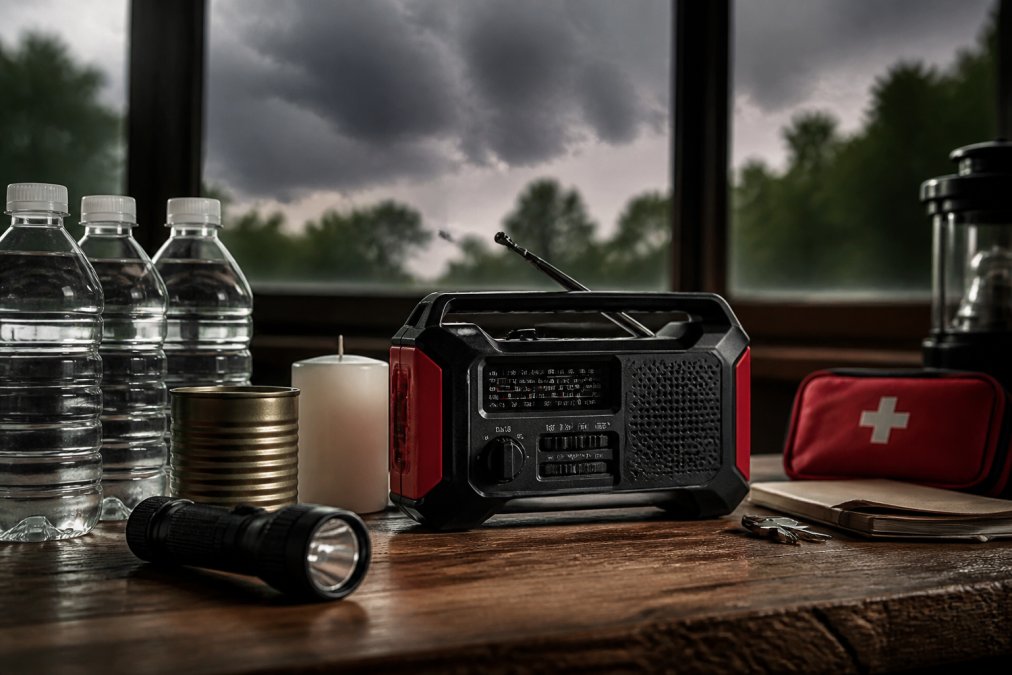
Table of Contents
- What Makes an Emergency Radio Reliable for Severe Weather
- Key NOAA Weather Radio Features to Evaluate
- Power Source Options: Solar, Hand-Crank, Battery, and USB
- Portable vs Desktop Weather Radios: Which Fits Your Needs
- How to Program a Weather Radio for Your Area
- Top Emergency Radios for Severe Weather Protection
- Building Your Family Emergency Plan Around Alert Radio Reliability
- Conclusion
Last Updated: August 30, 2026
What Makes an Emergency Radio Reliable for Severe Weather Alerts
An emergency radio designed for severe weather alerts must deliver real-time warnings when conditions deteriorate. The difference between a radio that sits unused and one that becomes part of your household routine comes down to three core reliability factors: reception quality, alert responsiveness, and sustained power availability across multiple charging methods.
A reliable emergency radio must receive NOAA weather broadcasts consistently, trigger automatically when hazardous conditions develop in your area, and continue operating even after days without external power.
Key NOAA Weather Radio Features to Evaluate
NOAA weather radios operate on dedicated frequencies (162.4-162.55 MHz) that broadcast continuous weather information and emergency alerts. Understanding what separates a capable weather radio from a mediocre one requires looking at three specific technical features.
S.A.M.E. Technology and Localized Alerts
S.A.M.E. stands for Specific Area Message Encoding. This technology allows the radio to decode which county or region an alert applies to, then only alert you when warnings affect your actual location. Without S.A.M.E., your radio triggers every time any warning is issued anywhere in the state, creating alert fatigue that causes people to disable alerts entirely.
A weather radio with S.A.M.E. lets you program your county code (or multiple codes if you work in different areas). When a tornado warning is issued for a county 50 miles away, the radio stays silent. When one is issued for your county, it activates immediately. The Sangean CL-100 and Eton FRX5-BT both include S.A.M.E. with up to 25 programmable county codes.
Reception Range and Signal Strength
Weather radio reception depends on antenna design and proximity to NOAA transmitters. Most areas have reliable coverage within 40-60 miles of a transmitter, but urban environments with tall buildings can create dead zones even closer (noaa.gov).
A radio with a telescoping antenna and good internal amplification performs better in challenging environments. The Kaito KA500 and Mesqool 12000 both feature extended telescoping antennas that users can adjust for optimal reception. A radio that requires antenna adjustment is more reliable than one with a fixed antenna, because you can troubleshoot poor reception by repositioning rather than replacing the unit.
Power Source Options: Solar, Hand-Crank, Battery, and USB
The power source strategy determines how long your radio remains operational during extended outages.
Hand-crank generators deliver immediate power without waiting for sunlight or charging cycles. One minute of cranking typically provides 10-30 minutes of operation (peer-reviewed research). Hand-crank radios are best suited for people who want the security of a power source they can activate immediately, not for continuous use.
Solar panels work best as battery maintainers, not primary chargers. A small solar panel can extend the time between charges by 20-40%, but won't fully charge a depleted battery in a single day. Solar is valuable for long-term reliability, a radio that slowly charges via sunlight during normal times means you're less likely to face a dead battery when an emergency strikes.
Rechargeable lithium-ion batteries provide the most practical power storage. Modern emergency radios use 2000-12000 mAh batteries that deliver 20-45 hours of operation on a single charge (peer-reviewed research). The Midland ER310 includes a 3500 mAh battery rated for 45 hours of normal use, while the Mesqool 12000 offers a 12000 mAh battery for extended outages.
USB charging is essential because it lets you charge the radio from power banks, car chargers, or any USB power source. This single feature dramatically improves real-world reliability.
Portable vs Desktop Weather Radios: Which Fits Your Needs
The choice between portable and desktop models reflects how you plan to use the radio.
Portable radios (2-4 pounds, 6-8 inches) go with you in a go-bag, vehicle emergency kit, or camping setup. The FosPower Emergency Solar Hand Crank and Midland ER310 are both portable and work anywhere. Portable radios sacrifice some reception quality and speaker volume to achieve mobility, but for households that might need to evacuate, a portable radio is non-negotiable.
Desktop radios (2-3 pounds, permanently powered) stay in one location, typically the kitchen or bedroom. They plug into AC power with battery backup, feature larger displays and louder speakers, and often include additional features like dual alarms or external alert outputs. The Sangean CL-100 is a desktop model certified for Public Alert broadcasts. It won't leave your home, but it provides superior reception and alert reliability.
Most households benefit from both: a desktop radio for primary monitoring and a portable radio in your vehicle or go-bag for evacuation readiness.
| Radio Type | Best For | Key Trade-off | Typical Price Range |
|---|---|---|---|
| Portable (hand-crank, solar) | Go-bags, vehicles, evacuation readiness | Smaller speaker, limited battery | $30-$100 |
| Desktop (AC-powered, battery backup) | Home base, continuous monitoring | Requires AC outlet, less mobile | $80-$130 |
| Hybrid (portable + desktop) | Maximum coverage | Higher total cost | $110-$230 |
How to Program a Weather Radio for Your Area
Programming a weather radio is straightforward but essential. An unprogrammed radio will alert on every weather event in your entire state. A properly programmed radio alerts only when warnings affect your location.
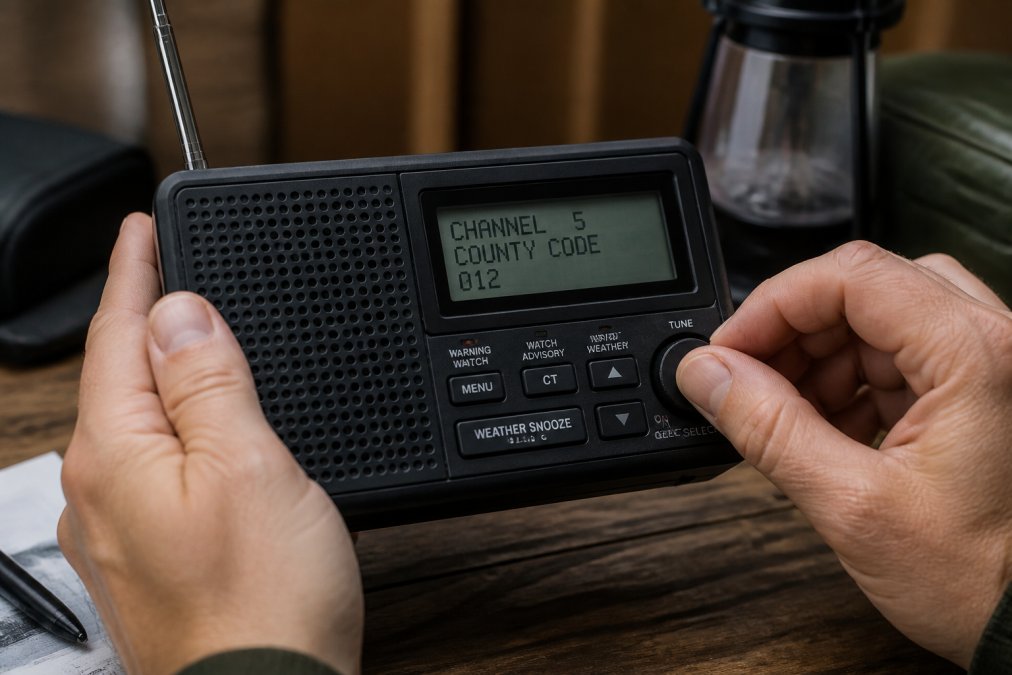
Step 1: Locate your county FIPS code. FIPS codes are five-digit numbers assigned to every county. Find your code by searching "FIPS code [your county name]" or consulting the National Weather Service website.
Step 2: Access the programming menu. Most radios have a "Menu" or "Program" button. Press it to enter S.A.M.E. programming mode.
Step 3: Enter your primary county code. Input the five-digit FIPS code for your county. If you work in a different county or travel regularly to another area, add that code as well. Most radios allow 10-25 programmable codes.
Step 4: Select alert types. Choose which hazard types trigger alerts. Most radios default to all hazards, which is appropriate for household use.
Step 5: Test the alert function. Many radios include a test alert feature. Use it to verify that the radio responds correctly when an alert matching your programmed county codes is received.
Step 6: Set the alert volume. Ensure the alert volume is loud enough to wake you or alert you from other rooms.
Top Emergency Radios for Severe Weather Protection
The following radios represent the best options across different priorities: comprehensive features, advanced alert technology, budget constraints, home-base reliability, and extended outage capability.
Best All-Around: Midland ER310 E+Ready
The Midland ER310 balances portability, battery life, and practical features without unnecessary complexity. It delivers 45 hours of operation on a single charge, includes hand-crank and solar charging options, and features a USB port for mobile device charging. The radio includes AM/FM bands plus NOAA weather channels, a Cree LED flashlight with SOS strobe, and an ultrasonic dog whistle for search and rescue scenarios.
The ER310 doesn't include S.A.M.E. technology, meaning it will alert on all weather events in your region. For most users, this is acceptable, the trade-off is simplicity in exchange for occasional non-critical alerts.
Best for: Families seeking a portable radio that works immediately without programming, households with vehicles that need emergency kit radios, and people who prioritize battery life and multiple charging options.
Best for Advanced Alerts: Eton FRX5-BT
The Eton FRX5-BT includes S.A.M.E. technology, allowing you to program specific county codes and receive only alerts relevant to your area. The radio also includes Bluetooth connectivity, letting you stream audio from your phone during normal times and use it as a regular speaker, making it more likely you'll keep it powered and accessible.
The FRX5-BT includes solar, hand-crank, and USB charging options, plus a 2000 mAh battery.
Best for: Users who want S.A.M.E. localized alerts, people who prefer multi-use devices that serve as speakers during normal times, and households that want to reduce alert fatigue through county-specific programming.
Best Budget Option: FosPower Emergency Solar Hand Crank
The FosPower delivers exceptional features at an entry-level price point. It includes AM/FM/shortwave reception, NOAA weather channels with all-hazards alerts, hand-crank and solar charging, and a 10000 mAh power bank for charging mobile devices. The power bank capacity is notably higher than competitors in this price range.
The trade-off is battery capacity and charging speed. The solar panel works primarily as a battery maintainer, and the hand-crank requires more effort than some alternatives.
Best for: Budget-conscious households, people building multi-radio setups (home + vehicle + go-bag), and those prioritizing the power bank feature for mobile device charging.
Best for Home Base: Sangean CL-100 Public Alert Certified
The Sangean CL-100 is certified for Public Alert broadcasts and includes S.A.M.E. technology with up to 25 programmable county codes. The CL-100 is designed for AC power with battery backup, featuring a digital display, dual alarms, and external alert output capability. This stationary unit stays in your kitchen or bedroom, providing continuous monitoring.
The advantage is reception quality and alert reliability. The CL-100 includes a high-quality DSP-based AM/FM tuner with RBDS capability.
Best for: Households seeking a primary weather monitoring station, people who want Public Alert certification, and those prioritizing superior reception quality and alert responsiveness over portability.
Best for Extended Outages: Mesqool 12000
The Mesqool 12000 delivers the highest battery capacity in this comparison, a 12000 mAh battery providing 44+ hours of continuous operation. For households facing multi-day outages, this capacity means fewer charging cycles and longer periods of independent operation. The radio includes hand-crank, solar, USB, and AAA battery backup options.
The 12000 mAh battery makes this radio heavier than portable alternatives (approximately 1.5 pounds), but the trade-off is legitimate: a radio that operates for two full days without charging is fundamentally more reliable during extended emergencies.
Best for: Households in areas prone to extended outages (ice storms, hurricanes), people building comprehensive emergency kits, and those who prioritize battery capacity over portability.
Building Your Family Emergency Plan Around Alert Radio Reliability
An emergency radio is only useful if it's integrated into your household's emergency plan. Start by identifying the specific hazards your area faces. Tornado-prone regions need immediate alert capability. Coastal areas facing hurricanes need multi-day monitoring. Earthquake zones need portable radios because power and communications infrastructure may be damaged.
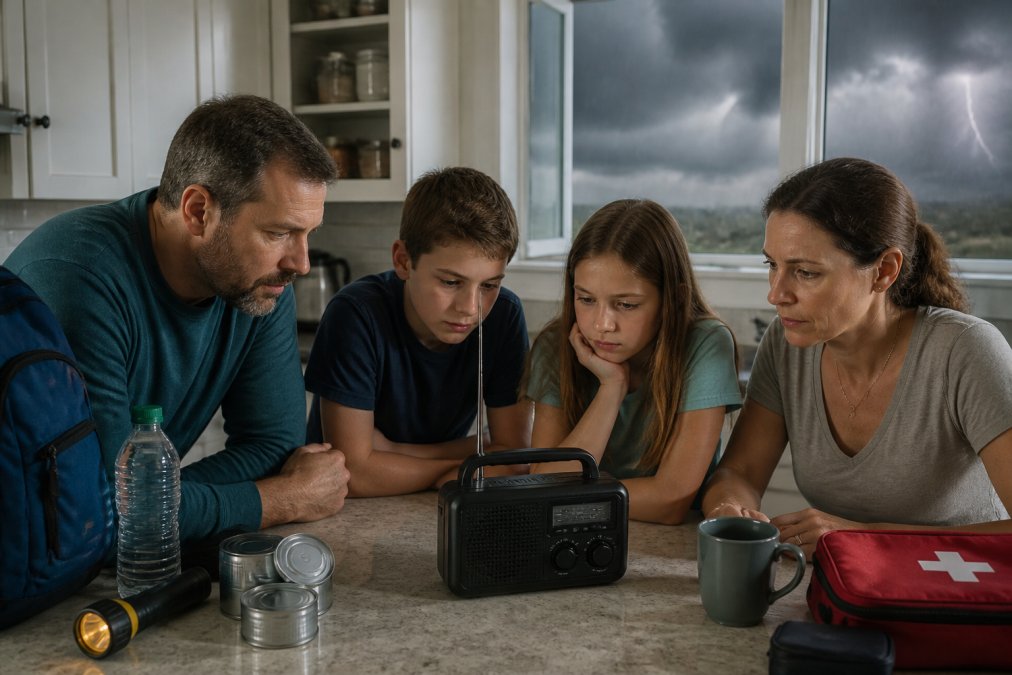
Designate one radio as your primary home-monitoring station (the Sangean CL-100 or Eton FRX5-BT) in a central location, typically the kitchen. Ensure this radio is plugged in and charged at all times. Maintain backup portable radios in your vehicle, go-bag, and potentially your workplace. Check these monthly to confirm they're charged and functional.
Practice your alert response plan. When the radio alerts, what do you do? Where do family members go? How do you communicate if cell networks are down? Discussing these scenarios in advance means you'll respond correctly during the actual event.
Finally, integrate your radios into your broader emergency preparedness with SHTF Prepper Club's comprehensive approach. An alert radio tells you when danger is approaching, but you also need water storage, food reserves, and power solutions to sustain your household through the event.
An emergency radio is the early warning system your household needs when severe weather threatens. The best choice depends on your specific scenario, portable for evacuation readiness, desktop for home monitoring, or both for comprehensive coverage. Whatever you choose, ensure it's programmed, charged, and integrated into your family's emergency plan before the next severe weather season arrives. SHTF Prepper Club provides expert guidance on selecting radios and building complete emergency kits that work together to keep your family safe. Visit our site to explore vetted emergency radio options and comprehensive preparedness solutions designed for families like yours.
Frequently Asked Questions
Q: Do emergency radios need a subscription to receive weather alerts?
A: No. NOAA weather alerts broadcast freely on dedicated frequencies (162.4-162.55 MHz), and all-hazard alert radios receive these broadcasts without subscription or activation fees. Your emergency radio simply needs to be powered on and tuned to a NOAA weather channel. Some models with S.A.M.E. technology allow you to program specific county codes so you receive only alerts relevant to your location, but this programming is a one-time setup, not an ongoing cost.
Q: What is the difference between a standard radio and a NOAA weather radio?
A: A standard AM/FM radio receives only commercial broadcast stations. A NOAA weather radio includes dedicated weather bands (seven channels on the 162.4-162.55 MHz range) that broadcast continuous weather information and emergency alerts from the National Weather Service. NOAA radios often include automatic alert features that trigger alarms when severe weather warnings are issued for your area, whereas standard radios do not monitor weather frequencies at all.
Q: Are hand-crank emergency radios reliable for long-term power outages?
A: Hand-crank radios are a dependable backup power source during extended outages, but they should not be your only power method. A few minutes of cranking provides 30-45 minutes of operation, making them useful for checking alerts periodically. For sustained use over days, combine hand-crank capability with a rechargeable battery, solar panel, or USB charging. Models like the Midland ER310 and Mesqool 12000 pair hand-crank generators with lithium-ion batteries, so you can crank once to store power rather than cranking continuously.
Q: Which emergency weather radio is best for severe weather protection in my home?
A: The best choice depends on whether you want portability or stationary home coverage. For a home base, the Sangean CL-100 offers Public Alert certification, S.A.M.E. programming for up to 25 county codes, and a clear LCD display, ideal if you stay in one location. For households that may shelter in place or need backup portability, the Midland ER310 combines excellent battery life, multiple power sources, and durability. Evaluate your area's primary hazards (tornadoes, hurricanes, flooding) and choose a radio with strong reception and automatic alert capability for those specific threats.
This article was written using GrandRanker