
Table of Contents
- What to Include in Your Home Emergency Binder
- Emergency Binder Checklist: Essential Documents for Emergency Preparedness
- Choosing the Right Binder or Organizer
- How to Organize Your Documents
- Printable Emergency Binder Templates and Family Communication Plans
- Keeping Your Information Secure
- Maintaining and Updating Your Home Emergency Binder
- Frequently Asked Questions
Last Updated: September 2, 2026
What to Include in Your Home Emergency Binder
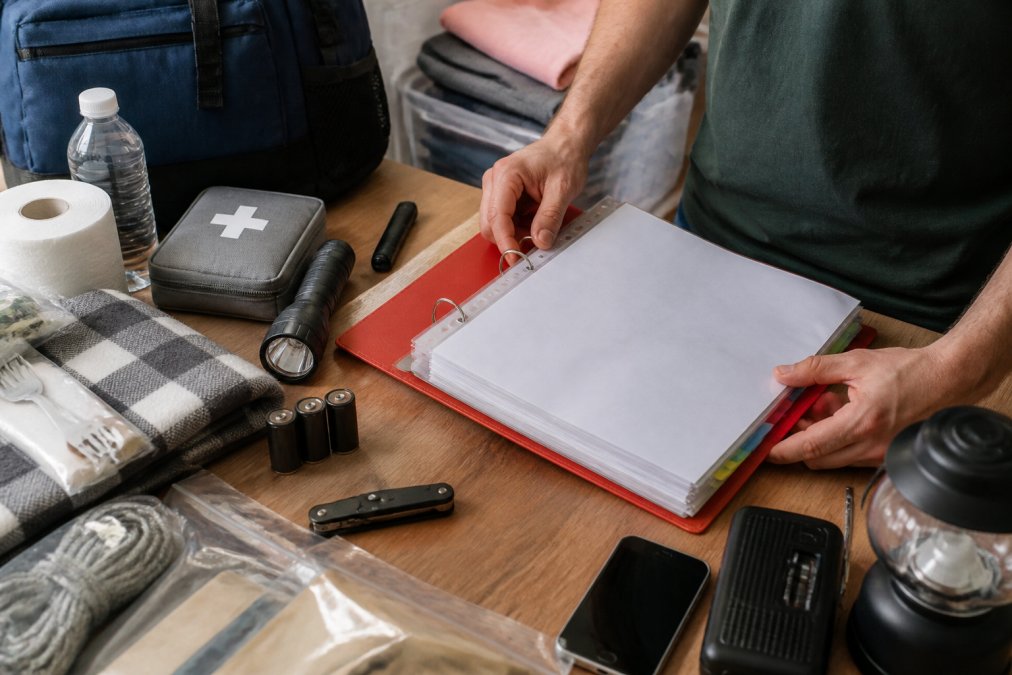
A home emergency binder is a centralized collection of vital documents and information your family can quickly access during a crisis. Whether facing a natural disaster, power outage, medical emergency, or evacuation, having these materials ready means you won't waste precious time searching for critical information when seconds count.
The core purpose is simple: consolidate everything your household needs to survive, recover, and prove ownership or identity in one secure, portable location. The difference between families who recover quickly and those who struggle often comes down to preparation.
Identification and Personal Documents
Start with documents that prove who you are. Birth certificates, Social Security cards, and passports should be originals or certified copies. Include driver's licenses for all household members, marriage certificates, custody documents, and guardianship papers, these become critical for insurance claims and medical decision-making authority.
Store copies of vehicle titles, registration documents, property deeds, and mortgage documentation. For children, include school records, vaccination documentation, and any special needs information that emergency responders need to understand.
Medical Information and Health Records
Medical records are critical during a crisis when you may not have access to your doctor's office or electronic health records. List all current medications with dosages, prescribing doctor's name, and pharmacy contact information. Document all known allergies, especially medication allergies, as emergency deaths often occur because responders didn't know about critical allergies (the CDC).
Add copies of recent medical test results and specialist evaluations. For chronic conditions like diabetes or heart disease, include a treatment summary. Include contact information for your primary care doctor and specialists. For elderly family members or dependents, document mobility limitations, cognitive conditions, or communication barriers that emergency responders need to know immediately.
Financial and Legal Documents
Include copies of insurance policies: homeowners, auto, health, life, and disability, with policy numbers, agent contact information, and claim procedures. Add bank account statements showing account numbers and balances, credit card account numbers with customer service contact information, and mortgage or loan documents.
Include a list of assets with photographs or video recordings of valuable items from multiple angles, essential for insurance claims. Add your will, trust documents, or power of attorney papers with executor or trustee contact information. Store tax returns from the last two years to verify income for insurance claims or disaster assistance.
Emergency Binder Checklist: Essential Documents for Emergency Preparedness
Use this checklist to ensure your home emergency binder contains everything your family needs.
| Category | Document | Why It Matters |
|---|---|---|
| Identification | Birth certificates, Social Security cards | Prove identity for services, benefits, travel |
| Identification | Passports, driver's licenses | Enable evacuation and relocation |
| Medical | Current medication list with dosages | Emergency responders need immediate access |
| Medical | Allergy documentation | Prevents life-threatening medical errors |
| Medical | Doctor contact information | Enables continuity of care |
| Financial | Insurance policy numbers and contacts | Essential for claims processing |
| Financial | Bank account numbers and statements | Access funds after disaster |
| Financial | Will and power of attorney | Enable decision-making if incapacitated |
| Legal | Property deed or mortgage documents | Prove ownership for recovery assistance |
| Legal | Vehicle titles and registration | Claim insurance or replace vehicles |
| Family | School records and vaccination docs | Prove enrollment and health status |
| Family | Emergency contact information | Enable family reunification |
Print this checklist and work through it section by section. Update annually, typically before hurricane season or at the start of a new year.
Choosing the Right Binder or Organizer
The physical container for your vital documents matters significantly.
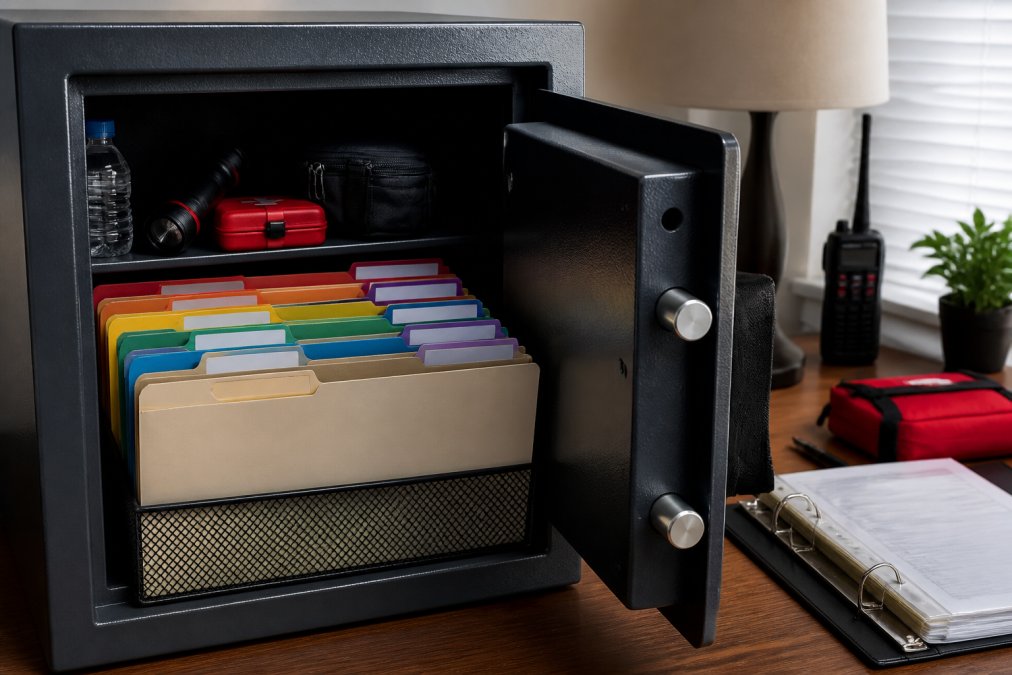
A three-ring binder remains the most practical choice for most households. It's affordable, easy to organize with dividers, and simple to update.
Fireproof and Waterproof Storage Options
Fireproof safes offer the best protection. A fireproof safe protects documents up to a specific temperature, typically 1,200 degrees Fahrenheit for 30 minutes (nist.gov). Waterproof containers are equally important, especially in flood-prone areas. Some safes offer both fireproof and waterproof protection, though they're more expensive.
If a safe isn't in your budget, waterproof plastic storage boxes work reasonably well. They won't protect against fire, but they'll keep documents dry during flooding. Store the box in an elevated location away from potential flood zones.
Consider a grab-and-go approach: keep your primary emergency binder in an easily accessible location, and store a backup copy of critical documents in your fireproof safe. Tell all adult family members where the binder is located and how to access it.
How to Organize Your Documents
Organization determines whether your emergency binder actually helps during a crisis.
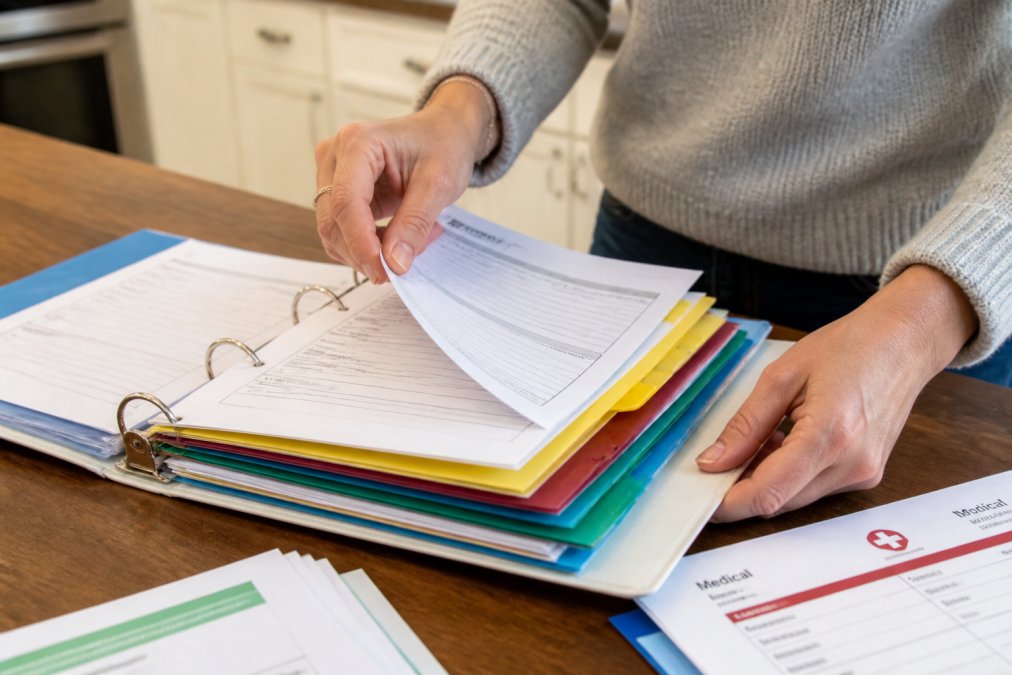
Use physical dividers to create clear sections: Identification, Medical, Financial, Insurance, Legal, and Family Information. Add additional sections if needed. Label each divider clearly using a label maker or permanent marker. Color-code your sections if possible, blue for medical, green for financial, red for legal.
Within each section, organize documents chronologically or by importance. Use sheet protectors for original documents to prevent water damage and wear.
Physical Organization and Grab-and-Go Setup
Create a grab-and-go setup that allows your family to evacuate with essential documents in seconds. Use a backpack or messenger bag as your grab-and-go container, storing your binder inside along with copies of keys, a flashlight, and a portable phone charger. Keep this bag in a bedroom closet or near your main exit.
Include a printed list of emergency contacts inside your binder, phone numbers for your insurance agent, doctor, bank, and trusted family members. During a crisis, your phone may be dead or networks may be down. Add a simple floor plan of your home showing where your binder is located to help emergency responders find your documents.
Digital Backup and Cybersecurity
Scan important documents and store digital copies in a secure, password-protected cloud service that encrypts your files. Never store sensitive documents on an unencrypted USB drive. Use strong passwords of at least 12 characters with numbers, symbols, and mixed case (cisa.gov).
Store one backup copy with a trusted family member who lives in a different area. If your home is destroyed, you still have access to copies.
Printable Emergency Binder Templates and Family Communication Plans
Templates accelerate the process of creating your home emergency binder. Use templates as starting points, then customize them for your family's specific situation.
Create a family emergency contact card listing out-of-area contacts for each family member. Designate one out-of-area contact person that everyone should call, this person becomes your family's communication hub. Include in your binder a meeting location if your family is separated during an evacuation. Choose a location outside your neighborhood that's easily identifiable.
Add instructions for children about what to do if separated from parents, including photos of parents, safe adult contacts, and instructions to find a uniformed emergency responder. Document any special needs or medical conditions that affect your family's evacuation plan.
Keeping Your Information Secure
Your home emergency binder contains sensitive information that could enable identity theft. Store your binder in a locked location when away from home. Limit who knows about your binder and use two-factor authentication on any cloud accounts.
Review your binder annually for outdated information. Shred documents before discarding them rather than throwing them in the trash. Don't store your Social Security number, full credit card numbers, or PIN codes in your binder, include only the last four digits if you need to reference them.
Maintaining and Updating Your Home Emergency Binder
Your home emergency binder isn't a one-time project. Life changes, and your binder must change with it. Update your binder every time something significant changes: new medications, new insurance policies, address changes, new family members, or financial status changes. Set a reminder on your calendar to review your binder at least annually.
When you renew insurance policies, update the policy numbers and contact information. Add new medical information whenever you see a specialist or receive a diagnosis. Update your will, power of attorney, or trust documents if your circumstances change. Review your emergency contacts annually to ensure current information.
Add photographs or video documentation of your home's contents annually for insurance claims. Keep your binder accessible but not in plain sight. Test your backup systems annually to confirm you can retrieve files when needed.
Creating a home emergency binder transforms abstract emergency preparedness into concrete, actionable preparation. Your family deserves to know that critical information is organized, protected, and accessible when crisis strikes. SHTF Prepper Club provides the tools, guidance, and vetted emergency supplies that make this preparation practical and achievable. Start building your binder today, your family's security depends on decisions you make now, before an emergency forces rushed, incomplete choices.
Frequently Asked Questions
Q: What documents should be included in a home emergency binder?
A: Your home emergency binder should contain identification documents (birth certificates, Social Security cards, passports), medical records and health history, insurance policies (health, home, auto, life), financial documents (bank account information, investment records), legal documents (power of attorney, living will, deed), and emergency contacts. Include copies rather than originals when possible, and keep vital documents like passports and Social Security cards in a secure, fireproof safe within or separate from your binder.
Q: How often should I update my home emergency binder?
A: Review and update your home emergency binder at least twice per year, ideally in spring and fall. Update it immediately after major life changes such as marriage, birth, death, job changes, or relocations. Check that all contact information is current, insurance policies are active, and medical records reflect any new diagnoses or medications. Annual maintenance ensures your emergency preparedness kit remains accurate and actionable when you need it most.
Q: What is the best way to store sensitive personal information in an emergency binder?
A: Store your emergency binder in a fireproof, waterproof safe or container kept in an accessible but secure location, such as a home office closet or bedroom. Avoid obvious places like under the mattress. Create digital backups encrypted with strong passwords and stored in a secure cloud service separate from the physical binder. Never store all originals in one place; keep vital documents like passports in a safety deposit box. Inform trusted family members where the binder is located so they can access it during a crisis.
Q: Can I use a free template to create my home emergency binder?
A: Yes, free printable emergency binder templates are widely available and provide a solid starting point. Templates help you organize documents into logical sections and ensure you don't overlook critical information. However, customize any template to match your family's specific needs, such as regional disaster risks, medical conditions, or dependent care requirements. Combine templates with your own additions like family communication plans, evacuation routes, and emergency contact trees to create a comprehensive preparedness system tailored to your household.
This article was written using GrandRanker