
Table of Contents
- Best Portable Water Filtration Systems for Family Emergency Preparedness
- Emergency Water Purification Methods: Filters vs. Purifiers
- How to Choose a Portable Water Filter for Your Family
- Gravity Water Filters for Emergency: Basecamp and Family Use
- Portable Water Filter Comparison: Top Systems for Emergencies
- Microplastic Filtration and Cold-Weather Performance
- Sustainability and Filter Disposal for Long-Term Preparedness
- DIY and Emergency Water Treatment Alternatives
Best Portable Water Filtration Systems for Family Emergency Preparedness
Last Updated: July 25, 2026
Why Water Filtration Matters for Your Household
When clean water becomes scarce, families face a critical vulnerability. Municipal systems fail during natural disasters, contamination spreads through aging infrastructure, and access to safe drinking water can vanish overnight. This is where the best portable water filtration systems become essential, not as luxury items, but as genuine lifelines for household resilience.
At SHTF Prepper Club, we understand that emergency preparedness isn't about fear; it's about control. Having reliable water purification on hand means your family drinks safely whether you're sheltering in place during a power outage or forced to rely on untreated sources. According to the CDC, waterborne pathogens cause illness in millions of Americans annually, yet most households have zero backup water treatment capability. The difference between a filter and a purifier matters: a filter removes particles and some microorganisms through physical barriers, while a purifier eliminates viruses and chemical contaminants that filters alone cannot catch. For family emergency preparedness, understanding this distinction determines whether you're adequately protected.
Emergency Water Purification Methods: Filters vs. Purifiers
A water filter uses physical barriers, typically a hollow fiber membrane or activated carbon, to remove particles, bacteria, and protozoa. A 0.1 micron filter removes bacteria and most parasites but not viruses, which measure 0.001 to 0.1 micrometers and pass straight through. For domestic emergencies where your water source is contaminated surface water or questionable municipal supply, filtration often suffices.
A water purifier combines multiple filtration stages with chemical treatment or ultraviolet technology to eliminate viruses, bacteria, protozoa, and often chemicals and heavy metals. Purifiers provide comprehensive protection but typically cost more and filter more slowly. The choice depends entirely on your anticipated contamination sources and risk tolerance.
Understanding Micron Rating and Contaminant Removal
Micron rating measures the smallest particle size a filter can reliably remove. Bacteria range from 0.5 to 5 micrometers, protozoa like Giardia measure 5 to 15 micrometers, both stopped by 0.1 micron filters. Viruses measure 0.001 to 0.1 micrometers; only purifiers using 0.02 micron or smaller membranes physically remove viruses. The best portable water filtration systems combine hollow fiber membranes for particle and pathogen removal with activated carbon for taste and chemical reduction.
Bacteria, Protozoa, Viruses, and Waterborne Pathogens
Bacteria like E. coli and Salmonella cause dysentery and severe gastrointestinal illness, stopped by 0.1 micron hollow fiber filters. Protozoan cysts, Giardia and Cryptosporidium, cause intestinal infection and diarrhea lasting weeks; standard filters remove them effectively. Viruses present the hardest challenge: hepatitis A, norovirus, and rotavirus survive in untreated water and resist chlorine treatment. Only purifiers with 0.02 micron membranes or chemical purification methods reliably eliminate viruses. Chemical contaminants like pesticides, heavy metals, and industrial pollutants require activated carbon or ion exchange; filtration alone won't remove them.
How to Choose a Portable Water Filter for Your Family
Selecting the right system requires matching your scenario to the right technology. A gravity-fed system works beautifully for basecamp use but is useless for ultralight backpacking. A squeeze filter handles day hikes but can't provide high-volume water for a family sheltering in place.
Start by defining your emergency scenario. Are you filtering water for a family at home? Hiking with a partner? Traveling internationally? Your answer determines whether you need high volume, ultralight weight, virus protection, or speed.
Flow Rate, Capacity, and Weight-to-Performance Ratio
Flow rate measures how quickly a filter produces drinking water, ranging from 0.5 liters per minute for squeeze filters to 2.5 liters per minute for pump purifiers. Capacity indicates total volume a filter can process before replacement, a LifeStraw handles 1,000 gallons; a Sawyer Squeeze manages 100,000 gallons. Higher capacity means longer intervals between cartridge replacement, critical for long-term preparedness. Weight-to-performance ratio determines practical usability: a 2-pound gravity filter produces 1.75 liters per minute, excellent for groups, but a LifeStraw weighing 2 ounces fits in a pocket.
NSF Certification and EPA Standards
NSF (National Sanitation Foundation) certification means a third-party laboratory tested the filter and verified it removes specific contaminants to specific levels. NSF P231 applies to water filters and verifies removal of bacteria, parasites, and microplastics. NSF P248 covers purifiers and includes virus removal. When evaluating a filter, look for NSF certification or independent testing results against NSF protocols.
Maintenance, Backflushing, and Cartridge Lifespan
A filter that requires daily maintenance becomes a liability during crisis. Backflushing, forcing water backward through the filter to dislodge trapped particles, extends filter life and maintains flow rate. Cartridge lifespan varies dramatically: a LifeStraw lasts 1,000 gallons before replacement; a Sawyer Squeeze lasts 100,000 gallons. For long-term household preparedness, higher-capacity filters reduce replacement frequency. Cold-weather performance matters if you live in freezing climates; water can freeze inside filters, cracking hollow fiber membranes. Gravity filters and squeeze filters handle freezing better than pump filters.
Gravity Water Filters for Emergency: Basecamp and Family Use
When your family shelters in place or establishes a basecamp, gravity-fed filtration becomes your workhorse. These systems require no pumping, no manual effort, and no batteries. Fill the dirty-water reservoir, wait, and collect clean water from the lower chamber. The Platypus GravityWorks system filters 1.75 liters per minute, fast enough to produce 100 liters in under an hour. This high-volume capability makes gravity systems ideal for families, groups, or extended sheltering scenarios.
High-Volume Filtration Without Pumping
The appeal of gravity filtration is elegantly simple: no strength required, no mechanical failure points, no electricity needed. A family of four can produce drinking water for cooking, drinking, and hygiene without exhausting anyone. During extended power outages or shelter-in-place situations lasting days or weeks, this matters profoundly. The trade-off: gravity filters don't remove viruses. The 0.2 micron hollow fiber membrane stops bacteria and protozoa but not viruses. For domestic emergencies where your water source is contaminated surface water or municipal supply, this suffices.
Best for Groups and Multi-Day Sheltering
A gravity system shines when multiple people need water over extended periods. One filter can serve a family of four indefinitely, as long as you have a contaminated water source and space to set up. During a multi-day power outage, having high-volume filtration eliminates the burden of boiling water or purchasing bottled supplies. Setup location matters: the system needs a height difference, the dirty-water bag hanging above the clean-water collection container.
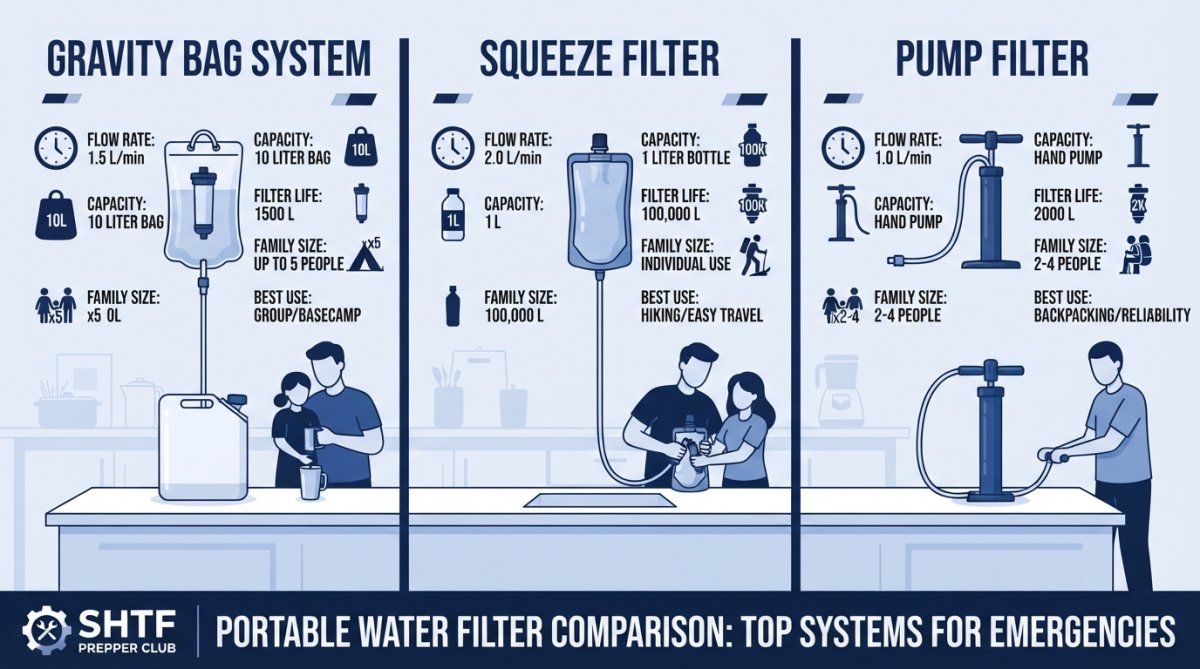
Portable Water Filter Comparison: Top Systems for Emergencies
The best portable water filtration systems span multiple categories, each excelling in different scenarios. This comparison covers the systems most relevant for family emergency preparedness.
| System | Micron Rating | Flow Rate | Capacity | Best For | Virus Protection |
|---|---|---|---|---|---|
| LifeStraw Personal | 0.1 | Sip-based | 1,000 gallons | Individual hiking | No |
| Sawyer Squeeze | 0.1 | Moderate | 100,000 gallons | Versatile backpacking | No |
| Katadyn BeFree | 0.1 | 2 L/min | 1,000 liters | Fast hydration | No |
| Platypus GravityWorks | 0.2 | 1.75 L/min | Unlimited | Family basecamp | No |
| MSR Guardian | 0.02 | 2.5 L/min | 100,000 gallons | International travel | Yes |
| GRAYL GeoPress | 0.01 | Fast | 250 liters | Comprehensive protection | Yes |
| Survivor Filter PRO | 0.01 | Moderate | 100,000 gallons | Emergency preparedness | Yes |
Squeeze Filters and Straw Systems
Squeeze filters represent the simplicity end of the spectrum. Fill a pouch with contaminated water, screw on the filter, and squeeze into your mouth or a container. The Sawyer Squeeze system weighs 3 ounces and handles 100,000 gallons of water. Straw systems like LifeStraw take simplicity further: drink directly from the water source through the filter, or use it as a straw inserted into a bottle. For individual use or emergency kits, straw systems offer unmatched portability. The limitation: flow rate is slow, making them impractical for families needing multiple liters daily.
Pump Purifiers and Bottle-Based Solutions
Pump purifiers use hand-operated pumps to force water through multiple filtration stages. The Survivor Filter PRO combines a 0.01 micron ultra filter with activated carbon and pre-filtration, removing viruses, bacteria, protozoa, heavy metals, and improving taste. Bottle-based purifiers like the GRAYL GeoPress integrate the purification system into a drinking bottle. Fill the bottle with contaminated water, press down the plunger, and the mechanism forces water through multiple filtration stages in 8 seconds. These systems excel when comprehensive protection matters.
Ultralight Options for Backpacking and Hiking
Ultralight backpacking demands weight discipline. The LifeStraw Personal weighs 2 ounces; the HydroBlu Versa Flow weighs 1.5 ounces. These fit in a jacket pocket and handle most wilderness water sources. Cold-weather performance becomes critical for ultralight systems used in winter: squeeze filters handle freezing better than pump filters because you can thaw them easily.
Comprehensive Protection for International Travel
International travel exposes you to contamination levels uncommon in developed countries. A filter that removes bacteria and protozoa but not viruses leaves you vulnerable. The MSR Guardian Purifier represents the gold standard for international protection with its 0.02 micron membrane physically removing viruses, bacteria, and protozoa. The GRAYL GeoPress Purifier offers similar comprehensive protection in a more portable bottle format, removing viruses, bacteria, protozoa, chemicals, and heavy metals.
Microplastic Filtration and Cold-Weather Performance
Modern water contamination includes microplastics, tiny plastic particles from synthetic textiles, tire wear, and plastic degradation. Cold-weather environments present mechanical challenges that standard filtration doesn't address.
Removing Microplastics and Fine Particulates
Microplastics measure 1 to 1,000 micrometers. A 0.1 micron filter removes particles down to 0.1 micrometers, technically including the smallest microplastics. The LifeStraw Personal explicitly claims removal of 99.999% of microplastics, silt, sand, and cloudiness. Activated carbon improves microplastic removal by adsorbing some particles and improving water clarity.
Ensuring Reliability in Freezing Conditions
Frozen water inside a filter cracks hollow fiber membranes and ruins the system. Gravity filters handle freezing well because water flows through quickly. Squeeze filters are also relatively freeze-resistant. Pump filters are most vulnerable because they require water to remain in the system. Cold-weather preparedness means storing filters indoors or in insulated containers. For families in cold climates, consider maintaining multiple filter types to ensure functional filtration even if one system fails.
Sustainability and Filter Disposal for Long-Term Preparedness
Filter cartridges aren't infinite. Eventually, they clog, lose effectiveness, or expire. Long-term preparedness requires understanding cartridge lifespan, replacement costs, and disposal options.
Extending Cartridge Lifespan Through Field Maintenance
Backflushing extends filter life by dislodging particles trapped in the membrane. A Sawyer Squeeze filter includes a syringe specifically for backflushing. Pre-filtration extends cartridge lifespan significantly: if you filter water through cloth or a coffee filter first, removing large particles, the main filter stays cleaner longer. Store filters in cool, dry conditions and replace them every 3-5 years even if unused.
Responsible Disposal and Environmental Impact
Spent filter cartridges contain concentrated contaminants. Most municipal recycling programs don't accept filter cartridges because they're composite materials. Some manufacturers accept used cartridges for recycling: Sawyer and LifeStraw both offer cartridge recycling programs. For long-term preparedness, calculate cartridge replacement costs and stock extras.
DIY and Emergency Water Treatment Alternatives
Portable filters aren't the only way to ensure safe water. Boiling, chemical treatment, and alternative methods provide backup options when filters fail or aren't available.
Boiling, Chemical Treatment, and Iodine Tablets
Boiling water kills bacteria, viruses, and protozoa through heat. Bring water to a rolling boil for one minute (three minutes if you're above 6,500 feet elevation). Chemical treatment uses iodine tablets, chlorine dioxide, or other disinfectants to kill pathogens. Iodine tablets cost pennies and weigh nothing: drop one tablet in a liter of water, wait 30 minutes, and the water is safe. Chlorine dioxide tablets are more effective, working against bacteria, viruses, and protozoa including Cryptosporidium. For family preparedness, stock iodine tablets as backup.
When to Use Filters vs. Alternative Methods
Filters are superior for regular use because they're fast, improve taste, and require no chemical aftertaste. Boiling and chemical treatment are backup methods for emergencies. A complete emergency water strategy includes all three: primary filtration system, backup gravity filter, personal straw filters for each family member, iodine tablets for emergency backup, and knowledge of boiling procedures. This layered approach ensures your family has safe water regardless of which systems fail.
Water security is foundational to family emergency preparedness. When municipal systems fail, contaminated sources become your only option. The best portable water filtration systems eliminate that vulnerability, transforming questionable water into safe drinking water within seconds. SHTF Prepper Club provides expert-vetted filtration solutions, comprehensive preparedness guides, and reliable systems designed specifically for families. With the right filtration system in place, whether a gravity filter for your home, a squeeze filter for your vehicle, or a purifier for international scenarios, your household maintains independence and resilience when emergencies strike. Start with your primary scenario, build redundancy with backup systems, and store replacement cartridges. Your family's water security depends on preparation made today.
Frequently Asked Questions
What is the best portable water filtration system for family emergency preparedness?
The best system depends on your family's specific needs. For households sheltering in place, gravity-fed systems like the Platypus GravityWorks offer high-volume filtration without pumping. For mobile preparedness, squeeze filters such as the Sawyer Squeeze provide versatility and high capacity. For comprehensive protection against viruses, bacteria, and protozoa, including giardia and cryptosporidium, pump purifiers like the MSR Guardian or GRAYL GeoPress offer the broadest contaminant reduction. Consider your family size, storage space, and whether you need portability.
How do I choose a portable water filter based on micron rating and flow rate?
Micron rating determines what the filter removes: 0.1-micron hollow fiber membranes remove bacteria and protozoa; 0.02-micron filters also remove viruses. Flow rate matters for convenience, gravity systems deliver 1-2 liters per minute, while squeeze filters vary by model. For families, balance flow rate against portability and ease of use. Higher micron ratings (larger pores) filter faster but remove fewer contaminants. Match the micron rating to your water source's likely contamination level and your family's daily water needs.
What are the differences between gravity water filters for emergency use and portable squeeze filters?
Gravity water filters like the Platypus system require no pumping or squeezing, water drips through a hollow fiber membrane into a clean reservoir, ideal for basecamp scenarios and families. Squeeze filters like the Sawyer Squeeze are lightweight, portable, and versatile, fitting standard bottles or hydration packs. Gravity systems handle high volumes efficiently but are bulkier; squeeze filters are compact but require manual effort. For family emergency preparedness, gravity systems suit sheltering-in-place scenarios, while squeeze filters work better for evacuation or multi-location preparedness.
How do I maintain and extend the lifespan of a portable water filtration system?
Most hollow fiber membrane filters can be backflushed, run clean water backward through the filter using a syringe or squeeze action to restore flow rate. Store filters in a cool, dry place and avoid freezing, which can damage membranes. Replace activated carbon filters after the manufacturer's recommended lifespan (often 2,000 liters). For gravity systems, clean the cartridge regularly by shaking in water. Check NSF certification details for your specific model's maintenance schedule. Proper field maintenance can extend cartridge life to the stated capacity, often 100,000 gallons or more.
This article was written using GrandRanker