
Table of Contents
- How Much Water Per Person Daily: Health vs. Household Usage
- Average Daily Water Consumption Per Person
- Water Usage by Appliance and Daily Activities
- Factors Affecting Hydration Needs and Water Consumption
- Signs of Dehydration and When to Increase Intake
- How to Drink More Water Daily and Track Consumption
- Water Conservation Tips for Household Efficiency
- Emergency Water Storage and Preparedness Planning
How Much Water Per Person Daily: Complete Guide
Last Updated: July 9, 2026
Understanding how much water per person daily is essential for health and household planning. Water needs extend beyond drinking recommendations to encompass personal hydration, appliances, and emergency preparedness. This guide covers medical hydration guidelines, household consumption patterns, conservation strategies, and emergency storage planning.
How Much Water Per Person Daily: Health vs. Household Usage
Daily water requirements split into two categories: drinking water needed for bodily functions and total household water consumption, which includes toilets, bathing, laundry, and cooking. Your body loses water through respiration, perspiration, and elimination, requiring replacement to maintain proper cellular function and regulate body temperature. Your household's total water footprint, measured in gallons per day, encompasses all water flowing through your pipes.
Daily Fluid Requirements for Hydration
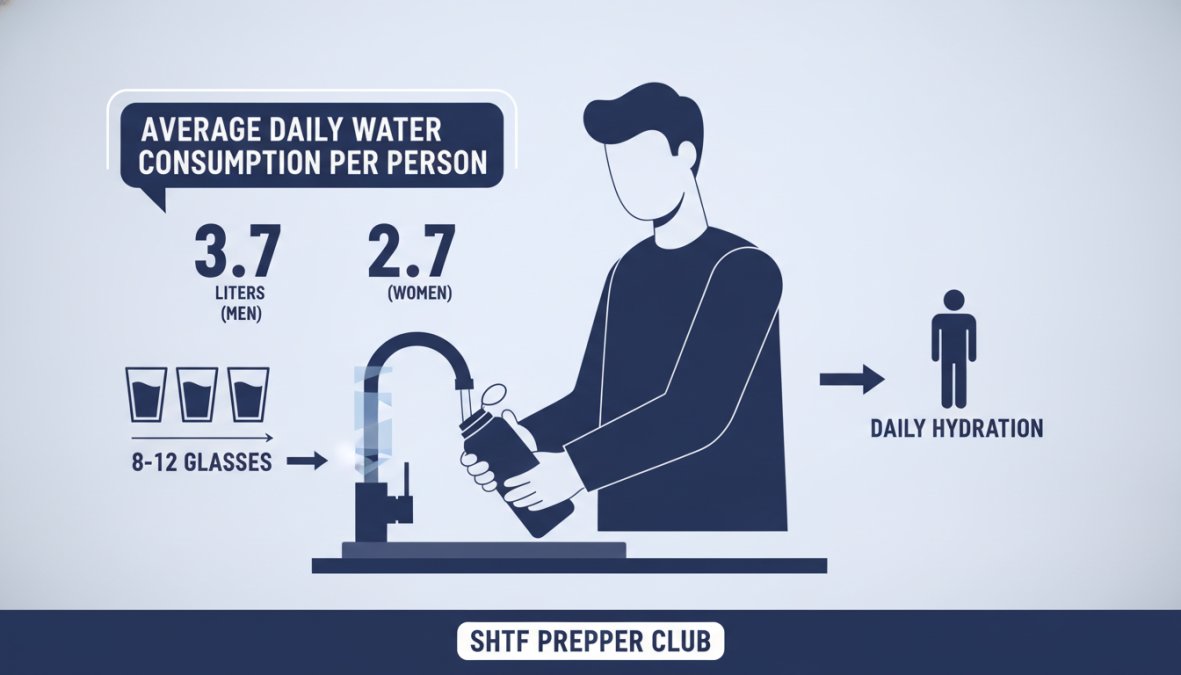
The commonly cited "8x8 rule", eight 8-ounce glasses daily, provides a baseline of roughly 2 liters or 64 ounces per day for sedentary adults in moderate climates. However, the National Academies of Sciences, Engineering, and Medicine suggests adequate daily fluid intake is about 15.5 cups (3.7 liters) for men and 11.5 cups (2.7 liters) for women, though about 20% comes from food.
Individual needs vary based on body size, activity level, climate, and health status. Beverages like coffee and tea contribute to daily fluid requirements, as do fruits and vegetables with high water content. However, water remains the optimal choice for hydration, while sugary drinks and excessive caffeine shouldn't replace plain water as your primary source.
Total Household Water Consumption Explained
The average American household uses approximately 300 gallons per day. Toilets account for roughly 24% of indoor water use, washing machines consume 21%, showers use 17%, and faucets account for 16%. Outdoor water use varies dramatically by region, homes in arid climates may use 50% or more for landscape irrigation, while humid regions use minimal outdoor water.
Per capita usage averages 80-100 gallons per day when dividing household consumption by family size. Regional variation is substantial; southwestern states average 150+ gallons per person daily due to irrigation demands, while northeastern states average 50-75 gallons per person. Understanding these numbers helps identify realistic conservation targets.
Average Daily Water Consumption Per Person
The average American uses between 80 and 100 gallons per day for all household activities. This encompasses direct personal use, showering, toilet flushing, drinking, cooking, plus a proportional share of laundry, cleaning, and outdoor maintenance. Upgrading to water-efficient appliances produces meaningful reductions, a household replacing a conventional toilet with a WaterSense-certified model saves approximately 13,000 gallons annually.
Larger households often achieve better efficiency per person because fixed water uses are distributed across more people. A family of four uses less water per person than a single occupant in the same home.
Gallons Per Day by Activity Level
Activity level dramatically influences daily water consumption. Someone exercising intensely may need additional showers daily, increasing personal consumption by 25-50 gallons. Outdoor workers in hot climates may require double the fluid intake of office workers. Seasonal activity changes influence household-level consumption patterns, summer typically sees 30-50% higher household water use due to increased showering and landscape irrigation.
Indoor vs. Outdoor Water Use Breakdown
Toilets represent the single largest indoor water use at nearly one-quarter of household consumption. Conventional toilets use 3.5-7 gallons per flush, while WaterSense models use 1.28 gallons or less. Washing machines represent the second-largest indoor water use at approximately 21% of household consumption. Modern high-efficiency machines use 7-10 gallons per load compared to 27-45 gallons for conventional machines.
Outdoor water use varies from nearly zero in some regions to 50-70% of total consumption in arid climates. Landscape irrigation dominates outdoor water use, particularly in western states. Replacing thirsty turf with native plants, mulch, or hardscaping reduces outdoor consumption dramatically.
Water Usage by Appliance and Daily Activities
Toilets consume 20-30% of daily household water. A family of four using conventional toilets flushes approximately 20-30 times daily, consuming 70-210 gallons. Upgrading to low-flow toilets reduces this to 20-50 gallons daily, a savings of 50-75%.
Showers consume 17-20% of household water. A standard showerhead flows at 2.5 gallons per minute, meaning a 10-minute shower uses 25 gallons. Low-flow showerheads reduce this while maintaining adequate water pressure through engineering improvements.
Toilet Flushing and Washing Machine Efficiency
Conventional toilets manufactured before 1992 use 5-7 gallons per flush. Federal standards from 1992-2005 reduced this to 1.6 gallons per flush. Modern WaterSense-certified toilets use 1.28 gallons or less per flush. A single upgrade reduces household consumption by 15-25%.
Conventional top-load washing machines use 40-45 gallons per load. Front-load machines use 15-20 gallons per load. High-efficiency top-load machines use 20-25 gallons per load. For a household doing seven loads weekly, upgrading to high-efficiency machines saves approximately 10,500 gallons annually. Modern machines with automatic sensing eliminate inefficiency from manual fill adjustment.
Showerhead Flow Rate and Faucet Usage
Standard showerheads manufactured before 1992 flow at 3-5 gallons per minute. Federal standards limit new showerheads to 2.5 gallons per minute. Low-flow showerheads reduce this to 1.5-2.0 gallons per minute while maintaining adequate pressure. A family of four with average shower duration of 8 minutes daily consumes 2,920 gallons monthly with standard showerheads versus 1,440-1,920 gallons with low-flow models.
Faucet usage accounts for approximately 16% of household water consumption. Low-flow aerators reduce faucet flow to 1.0-1.5 gallons per minute, cutting consumption by 25-50%. Turning off water while brushing teeth saves approximately 8 gallons daily per person.
Factors Affecting Hydration Needs and Water Consumption
Individual water requirements vary based on climate, age, activity level, health status, and medications. Climate represents one of the most significant factors, people in hot, arid climates require substantially more fluid intake than those in cool, humid regions. Altitude also affects hydration; people at high elevations experience increased respiratory water loss.
Climate, Age, and Activity Level Impact
Hot climates increase perspiration losses, requiring elevated daily fluid intake. Arid climates increase respiratory water loss in addition to perspiration. Age influences hydration physiology substantially, infants and young children have higher water requirements relative to body weight, while older adults experience diminished thirst sensation and reduced kidney function. Pregnant and lactating women require elevated fluid intake.
Activity level creates dramatic variation in daily fluid requirements. Sedentary individuals require baseline hydration of 2-3 liters daily. Moderate activity increases requirements to 3-4 liters daily. Intense exercise in hot conditions can increase requirements to 5-6 liters or more daily.
Health Conditions and Medication Effects
Certain health conditions significantly increase water requirements. Diabetes increases urinary water losses and requires elevated fluid intake. Gastrointestinal conditions causing diarrhea or vomiting create acute fluid losses requiring immediate replacement. Fever increases metabolic rate and perspiration, elevating fluid requirements during acute illness.
Medications influence hydration needs through multiple mechanisms. Diuretics increase urinary water losses and require compensatory fluid intake increases. Stimulant medications increase metabolic rate and perspiration. Antihistamines and decongestants reduce fluid intake by suppressing thirst sensation. People taking medications that affect hydration should discuss appropriate fluid intake with their healthcare provider.
Signs of Dehydration and When to Increase Intake
Mild dehydration produces subtle symptoms often attributed to other causes. Thirst represents the first sign, though older adults may not experience adequate thirst sensation. Dry mouth and lips indicate fluid loss. Urine color provides a practical indicator, pale yellow or clear urine indicates adequate hydration, while dark yellow or amber urine suggests mild dehydration.
Reduced urine output signals inadequate fluid intake. Constipation often accompanies dehydration because the colon reabsorbs water when overall hydration is inadequate. Physical performance declines noticeably with dehydration, a 2% loss of body water reduces physical capacity and cognitive function. Headaches, dizziness, and reduced concentration indicate dehydration severe enough to impair function.
Increased thirst, reduced sweating despite heat exposure, and rapid heart rate indicate dehydration requiring immediate attention. Infants and young children showing signs of dehydration need immediate medical evaluation. Older adults with dehydration symptoms should seek medical attention because they often tolerate dehydration poorly.
How to Drink More Water Daily and Track Consumption
Establishing consistent hydration habits requires intentional strategies rather than relying on thirst alone. Keeping a water bottle with you throughout the day increases consumption by making water constantly accessible. Refilling the bottle at established times creates a structured approach ensuring consistent intake.
Practical Strategies and Hydration Tracking Tools
Flavor enhancement strategies help people who find plain water unappealing. Adding lemon, lime, or cucumber slices to water increases palatability without adding calories. Herbal teas served cold provide variety while maintaining hydration benefits. These approaches work better than sugary drinks because they don't introduce metabolic complications.
Pairing water consumption with existing habits anchors new behavior to established routines. Drinking a full glass of water with each meal ensures intake at predictable times. Having water available at your workspace makes consumption effortless during work. Drinking water before, during, and after exercise becomes automatic when water is positioned at your exercise location.
| Strategy | Implementation | Daily Impact | Sustainability |
|---|---|---|---|
| Water bottle with time markers | Refill at breakfast, lunch, dinner | +500-750 ml | High - automatic |
| Herbal tea rotation | 2-3 cups daily | +500-750 ml | High - variety prevents boredom |
| Water with meals | Full glass with each meal | +750 ml | High - tied to existing habits |
| Infused water | Prepare morning batch | +500 ml | Medium - requires preparation |
| Hydration app tracking | Log drinks throughout day | Awareness only | Medium - requires engagement |
Technology can support hydration tracking without requiring constant manual logging. Smartphone apps send hydration reminders at regular intervals. Smart water bottles track consumption and sync with fitness apps. These tools work best for people who enjoy technology engagement; simple approaches like marking a bottle often produce better long-term compliance.
Water Conservation Tips for Household Efficiency
Reducing household water consumption requires addressing the largest uses first. Toilet replacement represents the single highest-impact conservation action, saving 13,000-20,000 gallons annually with a payback period of 3-7 years. Washing machine replacement ranks second, saving 10,000-15,000 gallons annually with a payback period of 5-10 years.
Showerhead replacement provides immediate conservation with minimal cost. Low-flow showerheads cost $10-30 and save 3,000-5,000 gallons annually per household, with a payback period of less than one month. Installation requires no tools.
EPA WaterSense Standards and Leak Detection
The EPA WaterSense program identifies water-efficient products that reduce consumption while maintaining performance. WaterSense-labeled toilets use 1.28 gallons per flush compared to the federal standard of 1.6 gallons per flush. WaterSense-labeled showerheads use 2.0 gallons per minute compared to the federal standard of 2.5 gallons per minute. According to EPA WaterSense program guidelines, WaterSense-labeled faucets use 30% less water than standard models while maintaining spray force.
Leak detection represents a critical but often overlooked conservation opportunity. A single leaking toilet can waste 200+ gallons daily. A dripping faucet wastes 3,000 gallons annually. Many households lose 10-20% of water supply to undetected leaks.
Simple leak detection methods reveal hidden water loss. Checking your water meter before bed and again in the morning without using water identifies nighttime leaks. Adding food coloring to toilet tanks reveals slow leaks. Inspecting visible pipes and fixtures for moisture identifies active leaks. Addressing detected leaks immediately prevents extended water waste.
Water Conservation Tips Summary
| Conservation Action | Annual Savings | Cost | Payback Period |
|---|---|---|---|
| Toilet replacement (conventional to WaterSense) | 13,000-20,000 gallons | $200-400 | 3-7 years |
| Washing machine upgrade (conventional to high-efficiency) | 10,000-15,000 gallons | $400-800 | 5-10 years |
| Showerhead replacement | 3,000-5,000 gallons | $10-30 | <1 month |
| Faucet aerator installation | 700-1,000 gallons | $5-15 | <1 month |
| Leak repair (typical toilet leak) | 73,000 gallons | $50-150 | Immediate |
| Landscape conversion (turf to native plants) | 15,000-30,000 gallons | $500-2,000 | 2-5 years |
Emergency Water Storage and Preparedness Planning
Water becomes critical during emergencies when municipal supply interruptions occur. Unlike food, which can be rationed, water has no substitutes for drinking and basic hygiene. Emergency preparedness planning requires calculating storage needs, understanding water quality considerations, and implementing rotation protocols.
The Federal Emergency Management Agency (FEMA) recommends storing one gallon per person per day, though SHTF Prepper Club recommends one and one-half gallons per person per day to account for cooking and hygiene. A family of four should maintain 180-210 gallons in emergency storage.
Calculating Storage Needs and Water Quality Considerations
Emergency water storage calculations depend on duration, how long you need to be self-sufficient if municipal water becomes unavailable. A two-week supply provides buffer for most municipal disruptions. A one-month supply addresses extended outages.
Calculating storage needs follows a simple formula: (family size) × (gallons per person daily) × (days of supply desired) = total gallons needed. A family of four planning two weeks of storage calculates (4) × (1.5) × (14) = 84 gallons minimum. SHTF Prepper Club recommends maintaining 120-150 gallons for a family of four.
Water quality considerations determine storage methods and rotation requirements. Tap water containing chlorine remains safe for longer periods because chlorine prevents bacterial growth. Well water or untreated water requires more frequent rotation or the addition of unscented household bleach, one-eighth teaspoon per gallon. Commercial emergency water storage containers include stabilizers extending shelf life to five years or longer.
Storage location significantly affects water safety. Cool, dark environments preserve water quality better than warm, sunny locations. Basements and interior closets provide ideal storage conditions. Avoid storing water near chemicals, gasoline, or other contaminants. Distributed storage in multiple locations ensures access even if one location becomes inaccessible.
Water filtration systems complement stored water supplies by enabling water collection and treatment during extended outages. Portable water filters using activated carbon and ceramic elements remove bacterial contaminants. Gravity-fed filtration systems operate without electricity. Boiling water, rolling boil for one minute at sea level, three minutes above 6,500 feet, kills pathogens when other treatment methods aren't available. A combination of stored water, filtration capacity, and treatment knowledge provides comprehensive water security during emergencies.
According to FEMA emergency preparedness guidelines, establishing household water supplies represents one of the highest-priority preparedness actions because water has no substitutes and municipal supplies can be interrupted by multiple hazards.
Understanding how much water per person daily, both for health and household consumption, helps you make informed decisions about hydration, conservation, and preparedness. The distinction between drinking water needs and total household consumption clarifies why both matter for different reasons. While standard hydration recommendations provide helpful baselines, individual variation based on climate, activity level, and health status means personalizing your approach delivers better results.
SHTF Prepper Club simplifies emergency water preparedness by providing vetted storage solutions, rotation tracking systems, and comprehensive guidance on water quality and treatment. Combining adequate emergency storage with household conservation practices and personal hydration awareness creates complete water security for your household.
Frequently Asked Questions
How much water per person daily do I need for basic hydration?
General hydration guidelines suggest 8 glasses (64 ounces) daily, though daily fluid requirements vary by individual. The National Academies of Sciences recommends about 15.5 cups for men and 11.5 cups for women, including fluids from food. Your actual daily water intake needs depend on activity level, climate, age, and health status. Filtered water or tap water both count toward your daily fluid intake.
What's the difference between drinking water needs and total household water consumption?
Daily water intake for health focuses on fluids you consume (gallons per day for drinking and cooking). Total household water consumption includes toilets, showers, washing machines, and outdoor use, typically 80-100 gallons per person daily in the average American household. Understanding this distinction helps with both personal hydration and water efficiency planning.
What are the signs of dehydration I should watch for?
Common signs of dehydration include dark urine, dry mouth, fatigue, dizziness, and reduced urination. Mild dehydration can impair cognitive function and physical performance. If you experience persistent thirst, headaches, or confusion, increase your daily water intake immediately. Severe dehydration requires medical attention. Monitoring your hydration status helps prevent these symptoms.
How can I calculate my personal water footprint and usage?
Calculate your water footprint by tracking daily consumption: record toilet flushes, shower duration, washing machine cycles, and drinking water. Multiply shower minutes by showerhead flow rate (2.5 gallons/minute standard). Add appliance usage and drinking water. This reveals your per capita usage and identifies where water waste occurs. Many utilities provide water meter readings to track actual consumption.
This article was written using GrandRanker