
Table of Contents
- Understanding Portable Water Filtration for Home Use
- Water Filter vs Water Purifier: Key Differences
- Types of Portable Water Filtration Systems
- Emergency Water Filtration Systems
- How to Store Water for Emergencies
- Selecting the Right Portable System for Your Home
- Maintenance and Long-Term Reliability
- Conclusion
Understanding Portable Water Filtration for Home Use
Portable water filtration has become essential for households seeking reliable access to clean drinking water during emergencies or when dealing with contaminated supplies. The difference between a filter and a purifier matters significantly: filters remove particles and sediment, while purifiers eliminate bacteria, viruses, and chemical compounds. According to the EPA, the average American household uses over 300 gallons of water daily, yet many have no backup plan if their water supply becomes compromised.
Why Water Filtration Matters for Household Safety
Water quality directly impacts your family's health. Contamination can come from aging infrastructure, natural disasters, or microbial pathogens. Portable systems offer flexibility that fixed installations cannot match, you can move them between rooms or take them during evacuation without specialized plumbing knowledge. A common mistake is waiting until a crisis hits to think about water filtration. Households that maintain systems in advance experience far fewer problems when emergencies occur.
Water Quality vs. Quantity in Home Preparedness
You can have 100 gallons of contaminated water and still face a crisis. Quality and quantity work together: quantity ensures sufficient volume, while quality ensures that volume is safe to drink. Most health guidelines recommend approximately half a gallon to a gallon per person daily for drinking and cooking.
Water storage containers themselves affect quality, use food-grade plastic buckets, glass carboys, or stainless steel tanks. Replace stored water every six months to prevent stagnation.
Water Filter vs Water Purifier: Key Differences
How Filters and Purifiers Work Differently
A water filter works through mechanical or chemical barriers that trap particles and some contaminants. Sediment filters catch visible particles, carbon filters absorb chemicals and improve taste, and ceramic filters block bacteria. However, most filters cannot remove viruses or dissolved chemicals effectively.
Purifiers employ multiple stages, typically combining filtration with additional processes like reverse osmosis, UV light, or distillation. Reverse osmosis forces water through a semi-permeable membrane, removing up to 99% of dissolved solids. The trade-off exists in speed and cost: filters work quickly and cost less, but purifiers take longer and cost more.
Which Option Is Right for Your Home
Your choice depends on three factors: your current water quality, your budget, and your intended use case. Start by knowing what contaminants you're actually dealing with. Many areas offer free water testing through local health departments. If your water contains only sediment and chlorine taste issues, a filter suffices. If testing reveals bacteria, viruses, or chemical contamination, you need purification.
For daily use, a gravity-fed filter pitcher offers simplicity and low cost. For emergency preparedness, a multi-stage purifier provides the safety margin you need when water source is uncertain.
| System Type | Primary Use | Contaminants Removed | Speed | Cost |
|---|---|---|---|---|
| Pitcher Filter | Daily drinking | Sediment, chlorine, taste | Fast | Low |
| Faucet Filter | Kitchen tap | Sediment, some chemicals | Fast | Low |
| Gravity-Fed | Emergency backup | Bacteria, sediment, some chemicals | Medium | Medium |
| Reverse Osmosis | Maximum purity | 99% of dissolved solids, most contaminants | Slow | High |
| UV Purifier | Microorganism elimination | Bacteria, viruses, protozoa | Medium | Medium |
Types of Portable Water Filtration Systems
Gravity-Fed Filtration Systems
Gravity-fed systems represent the most practical choice for household emergency preparedness. They require no electricity, no pressure, and no moving parts. Water flows downward through filter media, relying on gravity alone. Most models process one to three gallons per hour.
These systems typically consist of an upper chamber where you pour untreated water and a lower chamber where filtered water collects. The filter media, usually ceramic combined with activated carbon, sits between chambers. The ceramic component blocks particles down to 0.2 microns, catching most bacteria. The carbon layer improves taste and removes chlorine.
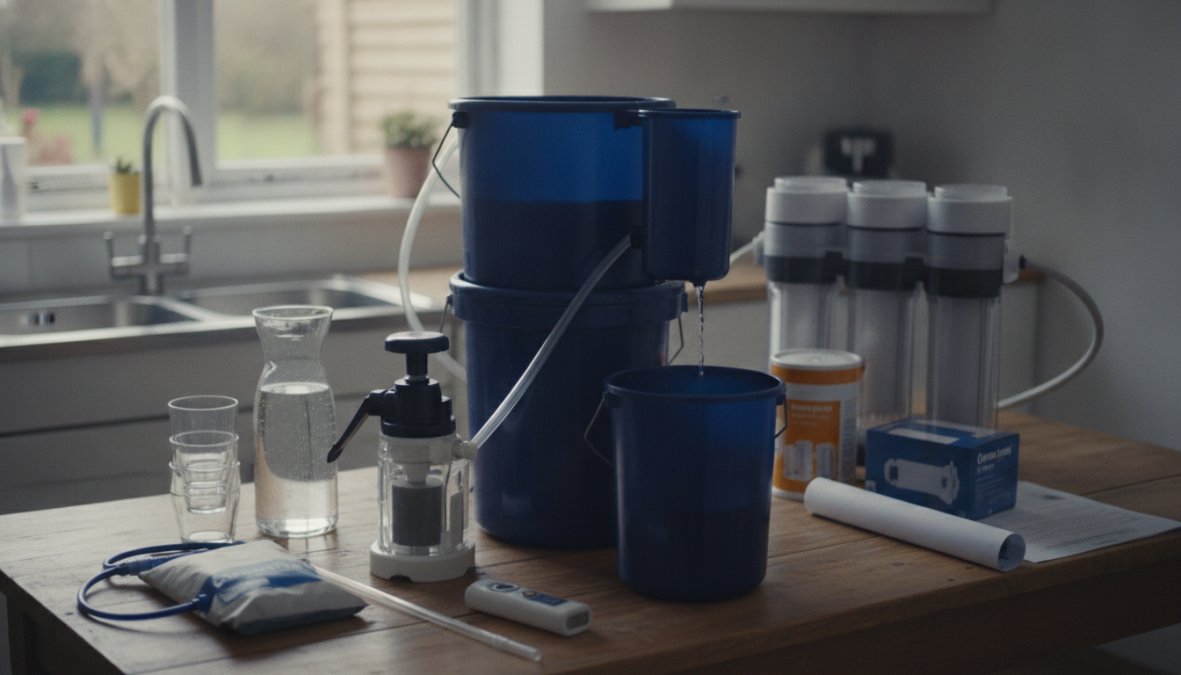
Common gravity-fed options include the Berkey system and simpler pitcher-style models. The primary limitation is speed, if you need large quantities quickly, gravity-fed systems struggle.
Squeeze and Straw Filters
Squeeze filters and straw filters offer maximum portability and minimal storage footprint. These systems work by forcing water through a filter membrane when you squeeze a container or sip through a straw. They're ideal for camping, evacuation, or portable emergency kits.
Squeeze filters typically connect to a water bottle or hydration bladder. Most squeeze filters remove bacteria and protozoa but may not eliminate viruses or chemical contaminants. A single straw filter typically purifies 700-1,000 liters before requiring replacement. Neither type removes dissolved chemicals effectively.
Countertop and Under-Sink Models
Countertop and under-sink filtration systems provide convenience for daily use while maintaining reasonable cost and maintenance. Countertop models sit visibly on your counter, connecting directly to your faucet. Under-sink models hide beneath your sink, connecting to a dedicated tap or your existing cold-water line.
These systems usually employ multi-stage filtration: sediment pre-filter, activated carbon, and sometimes a final polishing stage. Limitations include filter replacement costs and the inability to remove all contaminants. Most countertop and under-sink models won't eliminate viruses or heavy metals effectively.
Emergency Water Filtration Systems
Multi-Stage Filtration for Maximum Protection
Multi-stage filtration combines different filter types to address multiple contaminant categories. A typical emergency system includes sediment filtration, activated carbon, ceramic, and potentially additional stages like UV or reverse osmosis. Each stage removes specific contaminants, with later stages catching what earlier ones miss.
The first stage removes visible particles and sediment. The second stage, usually activated carbon, removes chlorine and some chemicals. The third stage, often ceramic, blocks bacteria and protozoa. This layering approach provides comprehensive protection that no single filter can achieve.
Backup Systems and Redundancy
Redundancy means having multiple systems so that if one fails, you still have water security. A practical approach includes a primary system for daily use and a backup system for emergencies. Your primary might be a countertop filter for convenience. Your backup could be a gravity-fed system stored in a closet, ready for deployment if the primary fails.
Different systems also provide flexibility for different water sources. Maintain multiple types to match your system to your actual water quality challenge. Store backup systems in climate-controlled locations away from direct sunlight. Check them annually to ensure seals remain intact.
How to Store Water for Emergencies
Storage Containers and Best Practices
Container selection directly affects water quality during storage. Food-grade plastic buckets, glass carboys, and stainless steel tanks preserve water longest. Avoid metal drums unless specifically designed for water storage. Never use containers that previously held chemicals, pesticides, or non-food substances.
Food-grade plastic buckets are affordable and practical. Before filling containers, clean them thoroughly with uncontaminated water and let them air dry. Fill containers completely, leaving minimal air space. Oxygen in the headspace promotes microbial growth.
Store containers in cool, dark locations away from direct sunlight. Basements, closets, and pantries work well. Avoid locations near chemicals, pesticides, or gasoline.
Water Rotation and Maintenance Schedules
A practical rotation system uses the FIFO approach: first in, first out. Label each container with the date filled. When you use water, use the oldest containers first. For households with large storage quantities, establish a quarterly rotation schedule.
Inspect containers monthly for signs of contamination or damage. Look for discoloration, unusual odors, or visible particles. Test your filtration system quarterly by running water from your storage containers through it, confirming the system works as expected.
| Task | Frequency | Purpose |
|---|---|---|
| Visual inspection | Monthly | Detect contamination or damage |
| Rotation (use oldest water) | Quarterly | Prevent stagnation, maintain freshness |
| Filter testing | Quarterly | Confirm system functionality |
| Complete water replacement | Annually | Ensure emergency supply quality |
| Filter cartridge replacement | 6-12 months | Maintain filtration effectiveness |
Selecting the Right Portable System for Your Home
Evaluation Criteria and Decision Framework
Start with water quality testing. Contact your local health department or use a home testing kit to identify what contaminants actually exist in your water. Testing costs twenty to fifty dollars but provides specific information that eliminates guesswork.
Next, assess your storage capacity and budget across two time horizons: initial purchase and ongoing maintenance. Calculate five-year costs, not just purchase price. Think about your most likely emergency scenario and whether it's a brief outage lasting hours or days, or a longer disruption lasting weeks.
Common Mistakes to Avoid
A frequent error is storing water without any filtration capability. You might have 200 gallons of water that becomes contaminated through improper storage. Without filtration, that water becomes unusable. Always pair storage with filtration.
Another mistake involves choosing a system based on marketing claims rather than actual testing. Look for NSF certification or third-party testing data, not just manufacturer claims. Underestimating water needs represents another common problem, people calculate drinking water only, forgetting that cooking, hygiene, and sanitation require additional water. Neglecting filter replacement schedules causes system failure when you need it most.
Maintenance and Long-Term Reliability
Filter Replacement Schedules
Different filters require replacement on different schedules. Sediment pre-filters might need changing every three months with heavy use. Activated carbon filters typically last six to twelve months. Ceramic filters can last one to two years. Check your specific system's recommendations and adjust based on your water quality.
Create a simple tracking system by writing replacement dates on your calendar or setting phone reminders. When a filter needs replacement, order it immediately rather than waiting until you actually need it. Store replacement filters in cool, dry locations away from direct sunlight.
Testing and Leak Detection
Test your system quarterly to confirm it works. Run water through your backup system, checking for proper flow rate and any leaks. Check for leaks where filter cartridges connect to the system. Even small leaks waste water and indicate that seals might not be creating a proper seal.
Monitor water output quality. If water suddenly flows much slower than normal, the filter is clogging and needs replacement. If water taste changes or develops odor, filtration effectiveness is declining. Keep simple records of your maintenance, noting when you replaced filters and any issues you encountered.
Water security requires both quantity and quality. Portable water filtration for home use addresses the quality component, ensuring that the water you store and drink remains safe regardless of what happens to municipal supplies. By understanding the differences between filter types, selecting systems matched to your actual needs, and maintaining them consistently, you transform water filtration from a theoretical concern into practical household resilience.
Frequently Asked Questions
What is the best portable water filter for home emergency use?
The best portable water filtration for home use depends on your specific needs. Gravity-fed systems work well for larger households and don't require electricity, while squeeze filters offer portability. For emergencies, choose systems with multi-stage filtration that remove bacteria, viruses, and sediment. Consider your water source, household size, and whether you need portability. SHTF Prepper Club offers vetted options designed for reliable emergency preparedness without guesswork.
Do portable water filters remove viruses and bacteria?
The answer depends on your filter type. A water filter removes bacteria and sediment but may not eliminate viruses. A water purifier uses additional technologies like UV light or chemical treatment to remove viruses. For emergency preparedness, understand this distinction when selecting your portable water filtration system. Multi-stage filters combine mechanical filtration with activated carbon and additional purification methods for comprehensive protection against contaminants.
How long do portable water filtration systems last?
Lifespan varies by system type and water quality. Gravity-fed filters typically last 100-300 gallons before replacement, while squeeze filters may filter 100,000+ gallons depending on the model. Countertop systems have different cartridge lifespans. Regular maintenance and proper storage extend reliability. Check manufacturer specifications for your specific portable water filtration system. Keep replacement filters on hand as part of your emergency preparedness kit to ensure continuous access to safe water.
How should I store filtered water for long-term emergency use?
Store water in food-grade containers in a cool, dark location away from direct sunlight. Proper water storage for emergencies requires rotation every 6-12 months to maintain freshness. Use airtight, opaque containers to prevent contamination and algae growth. For households, store at least one gallon per person per day for multiple days. Include portable water filtration systems as backup to your stored supply. Label containers with storage dates and maintain an inventory checklist for your emergency preparedness plan.
What's the difference between a water filter and water purifier?
A water filter uses mechanical filtration and activated carbon to remove particles, sediment, chlorine, and some contaminants. A water purifier uses additional methods like UV light, reverse osmosis, or chemical treatment to eliminate viruses and bacteria. For portable water filtration systems, filters are lighter and simpler, while purifiers offer more comprehensive protection. Choose based on your water source quality and emergency needs. Both play important roles in a complete household water safety strategy.
Can I use a portable water filtration system with any water source?
Most portable water filtration systems work with tap water, rainwater, and surface water. However, heavily contaminated or saltwater sources may overwhelm some filters. Check your system's specifications for compatible water sources. For emergency preparedness, understand your local water risks and choose a portable water filtration system rated for those contaminants. Multi-stage systems handle varied sources better than single-stage filters. Test your system with your actual water source before relying on it during emergencies.
This article was written using GrandRanker