
Table of Contents
- How to Store Water for Emergencies: Why It Matters for Family Preparedness
- How Much Water Per Person for Emergency Situations
- Choosing the Right Emergency Water Containers
- Water Purification for Emergencies: Treatment Methods
- Long Term Water Storage Solutions and Maintenance Schedules
- Optimal Storage Location and Environmental Conditions
- Sanitizing Containers and Preventing Waterborne Pathogens
- Common Mistakes and Emergency Water Usage During Crises
Last Updated: July 25, 2026
How to Store Water for Emergencies: A Complete Guide
When disaster strikes, access to clean drinking water becomes your family's most critical need. Learning how to store water for emergencies is one of the simplest, most effective steps you can take to protect your household. At SHTF Prepper Club, we've helped thousands of families build reliable water reserves that actually work when they need them most. Below, we'll show you exactly how to calculate your household's needs, choose the right containers, maintain your supply long-term, and avoid the mistakes that leave most families unprepared.
How Much Water Per Person for Emergency Situations
The baseline recommendation is one gallon per person per day for drinking and basic sanitation. A family of four needs four gallons daily, which means a two-week supply requires 56 gallons. However, realistic consumption including cooking, washing, and hygiene jumps to three gallons per person per day. A two-week emergency for four people requires 168 gallons.
Most people focus on drinking water alone, roughly half a gallon to one gallon per adult daily. But during a crisis, stress and physical exertion increase water needs significantly. SHTF Prepper Club recommends storing at least two gallons per person per day for a 30-day emergency, 240 gallons for a family of four.
Calculating total household capacity
Multiply your household size by two gallons for your 30-day baseline. For a family of four, that's 240 gallons. Factor in pets: a large dog drinks one gallon daily. Consider your living situation, an apartment may target 14 days, while a house with a garage can accommodate 60 days or more.
| Household Size | 2-Week Supply | 30-Day Supply | 60-Day Supply |
|---|---|---|---|
| 2 people | 28 gallons | 60 gallons | 120 gallons |
| 4 people | 56 gallons | 120 gallons | 240 gallons |
| 6 people | 84 gallons | 180 gallons | 360 gallons |
Write your target number down. Everything else, container selection, storage location, rotation schedule, flows from this number.
Choosing the Right Emergency Water Containers
The container you choose determines whether your water stays safe for years or becomes contaminated in weeks.
Food-grade plastic versus other materials
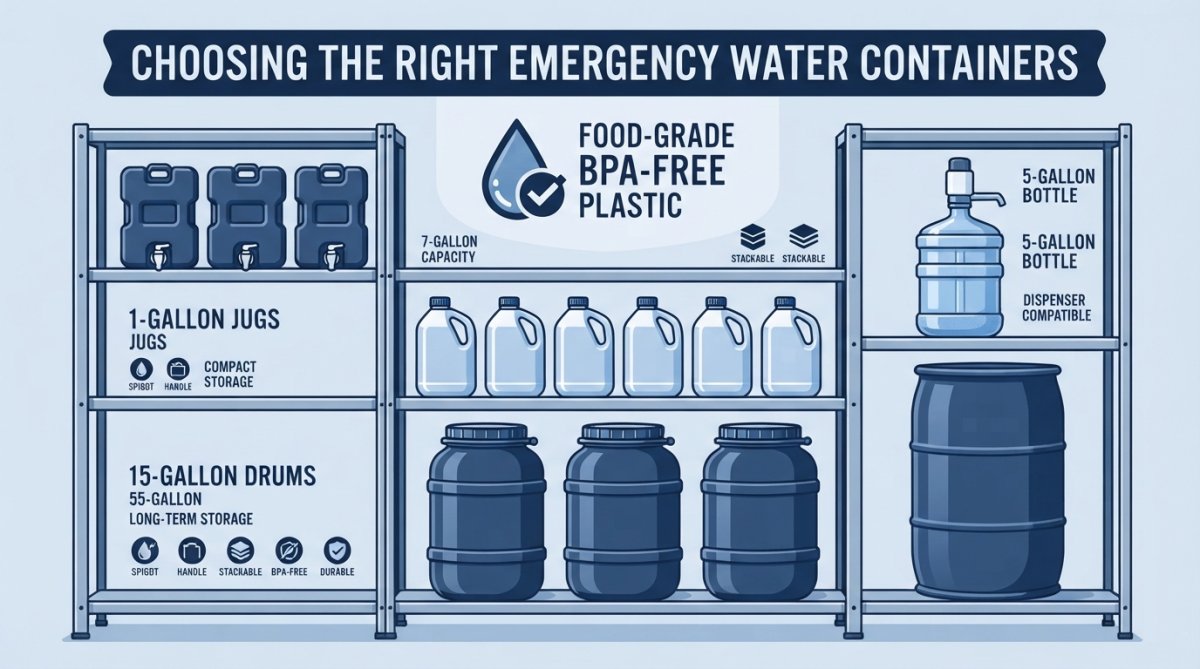
Food-grade plastic is the standard for emergency water storage. Look for containers marked "food-grade" or labeled with recycling number 2 (HDPE) or 5 (polypropylene). BPA-free containers are non-negotiable, BPA can leach into stored water, especially in warm conditions.
Glass is chemically inert but heavy, fragile, and impractical for storing hundreds of gallons. Metal containers (food-grade stainless steel) work excellently but cost significantly more. Avoid untreated wood, standard milk jugs, and any container that previously held chemicals or pesticides.
Container sizes and space-saving options for apartments
Five-gallon jugs are the sweet spot for most households. They're stackable and manageable. A family of four targeting 120 gallons needs 24 five-gallon containers.
Fifty-five-gallon drums are efficient for large supplies but require significant space and special equipment to move. Two-liter bottles are practical for apartments and small spaces, you need 60 two-liter bottles for 120 gallons, but they fit in closets, under sinks, and in cabinets.
For apartments, a hybrid approach works best: store 30-50 gallons in five-gallon jugs in a closet, and supplement with two-liter bottles distributed throughout the apartment under kitchen sinks, in bathroom cabinets, and bedroom closets.
Water Purification for Emergencies: Treatment Methods
Stored water can become contaminated. Knowing how to purify it turns a questionable supply into a safe one.
Boiling, chemical treatment, and filtration approaches
Boiling is the most reliable purification method. Bring water to a rolling boil for one minute to kill most pathogens. At elevations above 6,500 feet, boil for three minutes.
Chemical treatment using chlorine bleach is fast and practical. Add eight drops of unscented household bleach (5-6% sodium hypochlorite) per gallon of water, stir well, and let it sit for 30 minutes. The water should have a slight chlorine smell. If not, add another eight drops and wait 15 minutes.
Water purification tablets (iodine or chlorine dioxide) are compact and long-lasting. Follow package instructions, which typically involve adding one tablet per liter and waiting 30 minutes. Filtration systems like gravity-fed filters improve water taste and clarity but shouldn't be relied on as the sole purification method.
The most practical approach combines methods: store water chemically treated with bleach, use filtration to improve taste, and know how to boil water if needed.
Testing water quality before and after treatment
Before storing water, request your municipal water system's annual water quality report from your local utility. After treatment, visual inspection is your first check, treated water should be clear with no cloudiness, discoloration, or particles.
Water test strips are affordable and test for chlorine residue, pH, and bacterial indicators. Use them on water you've treated with bleach to verify the chlorine level is appropriate.
Long Term Water Storage Solutions and Maintenance Schedules
The difference between water that stays safe for years and water that becomes contaminated is maintenance.
Shelf life expectations and rotation timelines
Properly stored water in food-grade, sealed containers lasts indefinitely. Chlorine-treated water stays potable for six to twelve months before the chlorine dissipates. Untreated tap water stored in sealed containers lasts one to two years before bacterial growth becomes likely.
Rotate your supply every six months if treated with bleach, or every year if storing municipal tap water in sealed containers. Set a rotation date on your calendar, many families choose spring and fall clock changes. Use the oldest water first for household purposes and refill with fresh water.
Creating a maintenance checklist for year-round readiness
Quarterly (every three months):
- Visual inspection of all containers for cracks, leaks, or cloudiness
- Check seals for tightness
- Verify containers are stored in a cool, dark location
Every six months (rotation day):
- Use stored water for household cleaning or watering plants
- Refill containers with fresh water
- Add chlorine treatment if using untreated tap water
- Update rotation date labels on containers
Annually:
- Complete inventory of total gallons stored
- Verify storage space is still adequate
- Check that containers remain accessible
- Review water purification methods and ensure tablets or filters haven't expired
Post this checklist near your water storage area.
Optimal Storage Location and Environmental Conditions
Location determines whether your water stays safe or becomes compromised. Three factors matter: temperature, light, and accessibility.
Cool, dark place requirements and temperature control
Water stored between 50°F and 70°F lasts longest. Basements, interior closets, and garages typically meet this range. Avoid areas that freeze in winter or exceed 80°F in summer. Darkness is non-negotiable, light promotes algae growth even in sealed containers. Store water away from windows and artificial light sources.
Avoid attics, outdoor sheds, or garages in hot climates. Attics reach extreme temperatures. Outdoor structures expose containers to temperature swings and UV light. For apartments, prioritize closets over under-bed storage, closets stay cooler and darker.
Avoiding contamination and light exposure
Store containers in opaque covers if they're in any area with ambient light. A cardboard box or dark plastic storage tote works. Keep containers off the floor if possible, concrete can be damp, and water can wick into containers through micro-gaps. Use wooden pallets or shelving to elevate containers slightly.
Don't stack containers so heavily that weight damages lower containers. Five-gallon jugs can stack three or four high safely. Maintain distance from chemical storage, never store water near pesticides, cleaning supplies, gasoline, or fertilizers.
Sanitizing Containers and Preventing Waterborne Pathogens
Clean containers are the foundation of safe water storage.
Chlorine bleach sanitization protocols
Before filling containers for long-term storage, sanitize them thoroughly. For new containers, a thorough rinse with clean water is usually sufficient. For reused containers, sanitization is essential.
Mix one teaspoon of unscented household bleach per gallon of water. Fill the container with this solution, seal it, and shake vigorously for 30 seconds. Let it sit for 30 minutes. Empty the solution, rinse the container thoroughly with clean water three times, and let it air dry completely before filling with water for storage.
For five-gallon containers, use one tablespoon of bleach per five gallons of water. Follow the same process. The bleach smell should be completely gone after rinsing.
Pre-storage cleaning steps and frequency
Before first use, wash any new container with hot soapy water, rinse thoroughly, and let it air dry. For containers you're refilling during rotation, empty the old water, rinse with clean water, refill with fresh water, and add chlorine treatment. You don't need to repeat the full bleach sanitization unless the container has been empty for months or you suspect contamination.
If you notice any cloudiness, discoloration, or smell in a container, discard the water, sanitize thoroughly using the bleach method, rinse extensively, and refill.
Common Mistakes and Emergency Water Usage During Crises
Most families make predictable errors that undermine their preparedness.
Mistake 1: Storing water in the wrong containers. People grab whatever is available, old milk jugs or containers that previously held chemicals. These leach contaminants or fail to seal properly. Use only food-grade, BPA-free containers.
Mistake 2: Storing water without rotation. Water stored for five years without maintenance becomes unsafe. Containers degrade, seals weaken, and contaminants accumulate. Rotate every six to twelve months.
Mistake 3: Underestimating household needs. Families calculate one gallon per person per day and think they're done. During a real crisis, consumption increases due to stress, physical labor, and sanitation needs. Store at least two gallons per person per day if space allows.
Mistake 4: Storing water in warm, bright locations. Attics, hot garages, and areas near windows accelerate container degradation and promote bacterial growth. Cool, dark basements or interior closets are correct.
Mistake 5: Not having a purification backup plan. Containers can crack. Water can become questionable. Have bleach, water purification tablets, or a filtration system ready to treat water if needed.
During an actual emergency, water usage differs from daily life. Showers become sponge baths. Toilets are flushed sparingly. Drinking and basic hand hygiene become the priority. A family of four with 120 gallons can sustain for 15 days with disciplined consumption.
The families that handle crises best are those who've practiced their plan. Use your stored water during rotation. Drink it, cook with it, understand how long it lasts under realistic consumption. This removes panic and uncertainty when a real emergency arrives.
Emergency preparedness isn't about fear, it's about ensuring your family has what they need when normal systems fail. Water storage is the foundation. SHTF Prepper Club provides expert-vetted water filtration systems, food-grade storage containers, and comprehensive emergency kits designed to work together as a cohesive system. Our solutions are tested, reliable, and built for families who want to be ready without the overwhelm. Start with a realistic storage goal, choose the right containers, and commit to a maintenance schedule. Your family's safety depends on it.
Frequently Asked Questions
How much water should I store for my family's emergency preparedness?
The recommended guideline for emergency preparedness is to store one gallon per person per day. For a family of four, this means storing at least a four-day supply (16 gallons minimum) for basic drinking and sanitation needs. However, for longer-term emergency planning, consider storing a two-week supply or more. Calculate based on your household size and any special needs like infants or pets, then adjust upward if your living situation or local disaster risks warrant extended preparedness.
What type of emergency water containers are best for long-term storage?
Food-grade plastic containers are ideal for water storage because they don't leach harmful chemicals into your potable water supply. Look for BPA-free containers specifically labeled as food-grade. Water jugs ranging from 5 to 55 gallons work well depending on your space and handling ability. For apartments or small homes, stackable 5-gallon containers or smaller jugs offer space-saving solutions. Avoid using containers that previously held non-food items, as they may be contaminated with waterborne pathogens or other contaminants.
How do I maintain my stored water supply over time?
Implement a rotation schedule by replacing your water supply every six months to one year, depending on storage conditions. Store water in a cool, dark place away from direct sunlight and temperature fluctuations. Check containers regularly for signs of contamination or damage. If you add chlorine bleach as a preservative (typically 1/8 teaspoon per gallon for untreated water), rotate more frequently. Document your storage dates and create a maintenance checklist to ensure your emergency water supply remains safe and ready for disaster readiness.
What's the best way to treat and purify stored water before using it in an emergency?
Water purification for emergencies can be accomplished through boiling (rolling boil for one minute), chemical treatment with chlorine bleach, or using water filtration systems designed to remove waterborne pathogens. If you stored untreated tap water, boiling is the most reliable method. For longer-term emergency management, consider investing in emergency water filtration devices like portable filters or purification tablets as backup options. Test water quality before consuming if possible, and follow CDC guidelines for treating water during disasters when normal water supply is compromised.
This article was written using GrandRanker