
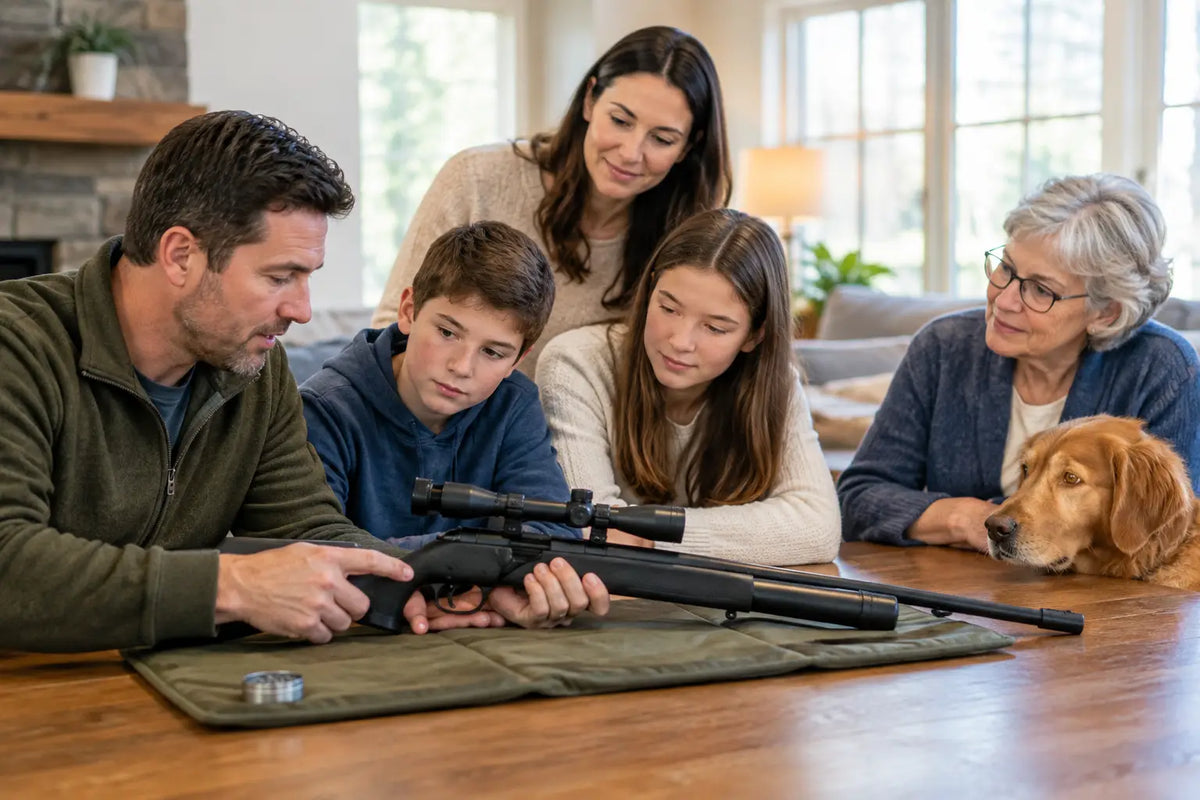
A search for the best family protection airgun usually starts with a reasonable feeling: you want your home to feel safer without turning it into a fortress. Maybe a recent power outage left your street dark. Maybe a break-in happened nearby. Wanting a practical plan for your family is not overreacting.
But an airgun is not a reliable family-protection solution, and treating one as a home-defense tool can create more risk than security. Airguns can cause severe injury, are often mistaken for firearms by neighbors and responding officers, and may not stop a determined threat. For most households, the best first investment is not a weapon. It is a layered plan that gives your family warning, time, light, communication, and safe choices.
Is There a Best Family Protection Airgun?
For protecting people during an emergency, the honest answer is no. There is no airgun we would recommend as the centerpiece of a family safety plan.
That does not mean airguns have no legitimate place. Some households use them for target shooting, training in safe handling habits, or lawful pest control on rural property. Those uses require careful supervision, local-law compliance, and locked storage. They are different from preparing for an intruder, civil disturbance, or uncertain situation at the door.
The trouble is that an airgun can look convincing from a distance, especially in low light. That creates a serious escalation risk. A neighbor, visitor, or law enforcement officer may reasonably assume it is a firearm. In a stressful moment, that misunderstanding can change everything.
A family protection plan should reduce confusion and slow a problem down. An airgun can do the opposite.
Build Protection in Layers Instead
The most useful home-security tools are usually unglamorous. They work before a confrontation occurs, and they do not require anyone in the family to make a split-second decision with a weapon.
Start outside. Motion-activated lighting makes it harder for someone to approach unseen and easier for your household to see what is happening. Trim shrubs near windows and doors so they do not provide cover. Make sure house numbers are visible from the street, especially for emergency responders at night.
Then look at entry points. A solid deadbolt, reinforced strike plate, longer mounting screws installed into framing, working window locks, and a door viewer or camera can make a meaningful difference. These are small upgrades, but they create time. Time is what lets you move children away from a door, call 911, and avoid opening the door to an unknown person.
Inside the home, focus on communication. Keep charged phones accessible at night. A battery backup or portable power station can keep phones, a modem, and basic lighting running during an outage. Put dependable flashlights where family members can find them without searching, including bedrooms and the main living area. Darkness raises stress quickly. Light restores options.
For many families, a monitored alarm system or basic door and window sensors are also worthwhile. The goal is not to live in fear. It is to receive early warning and make it clear that your home is not an easy target.
Make a Simple Family Emergency Plan
Security equipment matters most when everyone knows what to do with it. A calm, simple plan is more valuable than a closet full of gear.
Choose a meeting spot inside the home, preferably away from exterior doors and street-facing windows. Decide who calls 911, who checks on children or older relatives, and who brings pets to the safe area if there is time. Keep the plan short enough that a child, a grandparent, or a houseguest can understand it.
Practice the plan once or twice a year. You are not staging a tactical drill. Think of it like reviewing a fire escape plan. Walk through what happens if the doorbell rings late at night, if an alarm sounds, or if the power goes out and someone is outside. The right response is generally to secure the home, gather your family, call for help, and avoid confrontation.
It also helps to agree on a family rule: no one opens the door for an unexpected visitor without checking first. A locked door is not rude. It is a normal boundary.
Airgun Safety for Homes That Already Own One
If you already own an airgun for a lawful recreational or property-management purpose, keep its role clear. It is sporting equipment, not an emergency protection plan.
Store it unloaded in a locked cabinet or safe, separate from ammunition or pellets, and keep the keys or access code away from children and unauthorized visitors. Teach every member of the household that it is never a toy and never something to display, point at a person, or carry during a tense situation.
Check your state, county, and city rules before using an airgun outdoors. Regulations vary widely, particularly in suburban neighborhoods and incorporated areas. Homeowners association rules may apply as well. If you use an airgun for pest control where lawful, understand the local restrictions, know your property boundaries, and consider what lies beyond the intended area. A pellet can travel farther than many people expect.
Parents should also remember that a child who has learned safe target-shooting rules may still make poor decisions under stress. Secure storage is not optional. It is part of responsible ownership.
What to Buy Before Considering a Protection Tool
If your budget is limited, put it toward the problems families actually face most often: outages, severe weather, temporary evacuation, and delayed emergency services. Those events are where preparedness equipment earns its place.
A practical starter setup includes dependable flashlights, spare batteries or rechargeable power, a weather radio, basic first-aid supplies, a way to charge phones, extra water, and enough food your household will actually eat. Add smoke and carbon monoxide detectors with fresh batteries, especially if you use backup heat, a generator, or indoor cooking alternatives during a storm.
A portable power station can be a particularly useful family purchase. It can support communication, lighting, medical devices within its capacity, and small essentials without the risks of running a generator indoors. For a longer outage plan, pair stored water with a reliable water filtration method and keep a written list of medications, emergency contacts, and insurance information in a protected location.
SHTF Prepper Club encourages families to build readiness in stages. Start with the gap most likely to affect your home. For one family, that may be water after a hurricane. For another, it may be heat and phone power during a winter outage. Progress does not require buying everything at once.
When You Feel Unsafe Right Now
If you believe someone is trying to enter your home or you feel threatened, prioritize distance and communication. Get family members to the planned safe area, lock doors, call 911, and clearly describe what you see or hear. Do not go outside to investigate a noise. Do not open the door to argue with someone. Do not rely on an airgun to make a dangerous situation manageable.
If an unfamiliar person is at the door but there is no immediate threat, speak through the locked door or use a doorbell camera or viewer. If the situation feels wrong, trust that instinct and call local authorities. You do not owe anyone access to your home.
For ongoing neighborhood concerns, consider a non-emergency conversation with local law enforcement, a trusted neighbor network, or your homeowners association. Better lighting, shared awareness, and accurate reporting often do more for a block than individual households trying to solve security concerns alone.
The strongest form of family protection is a home that is hard to approach unnoticed, difficult to enter quickly, stocked for common disruptions, and guided by a calm plan. That kind of readiness helps your family on an ordinary stormy night just as much as it does during a serious emergency.