
Table of Contents
- Why Home Medical Equipment Needs Emergency Power Backup
- Types of Backup Power Systems for Home Medical Equipment
- How to Calculate Power Needs for Medical Equipment
- Battery Backup Duration for Oxygen Concentrators
- Choosing a Portable Power Station for Medical Devices
- Insurance and Medicare Coverage for Backup Power
- Maintenance and Testing for Emergency Power Backup
- Conclusion
- Frequently Asked Questions
Last Updated: September 21, 2026
Why Home Medical Equipment Needs Emergency Power Backup
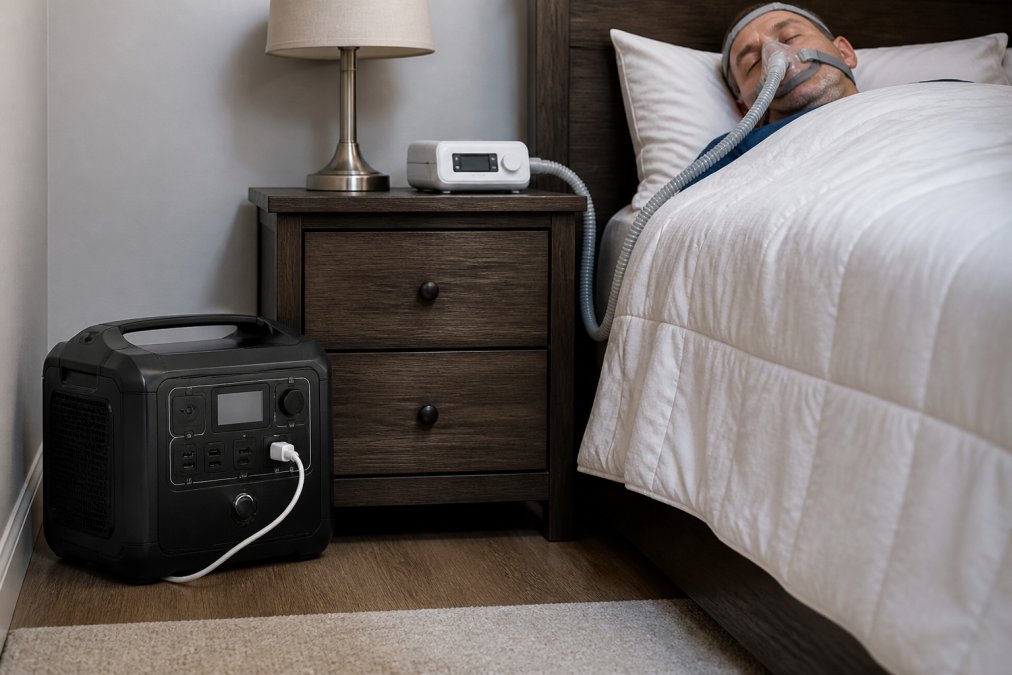
A grid failure is not an inconvenience when someone in your house depends on a machine to breathe. Emergency power backup for home medical equipment keeps devices like oxygen concentrators, CPAP machines, and dialysis equipment running through an outage using batteries, generators, or uninterruptible power supplies. At SHTF Prepper Club, we treat this as the first item on any readiness plan.
Types of Backup Power Systems for Home Medical Equipment
Three system types cover nearly every home medical scenario: portable power stations, standby generators, and medical-grade UPS units. Each solves a different problem, and picking the wrong one wastes money or leaves a device unprotected.
Portable Power Stations
A portable power station is a battery bank with an inverter built in, sized to run specific devices for a set number of hours. Most modern models use lithium iron phosphate (LiFePO4) chemistry, which tolerates deep discharge better than older battery types. Charge them before an outage and move them room to room.
Standby Generators
A standby generator runs on propane or natural gas and connects to your home electrical panel through a transfer switch. Automatic switches detect grid loss and start the generator without you touching anything; manual switches cost less but require you to flip the breaker yourself, which matters if the patient cannot wait.
Medical-Grade UPS Systems
A medical-grade UPS is an uninterruptible power supply built to hospital safety standards, with pure sine wave output and automatic voltage regulation. It sits between the wall outlet and the device, providing continuous power and surge protection. Runtime is short, often minutes, because its job is bridging the gap until a larger source takes over.
How to Calculate Power Needs for Medical Equipment
Add up the wattage of every device you need to run, multiply by the hours of backup you want, and you have your watt-hour target. The complexity comes from reading device labels correctly and accounting for how medical equipment actually draws power.
Step 1: Build a device inventory
List every device the patient depends on, then find the watts or amps on each label or power supply brick. Convert amps to watts by multiplying amps by volts (2.5 amps at 120 volts draws 300 watts).
Typical running wattage ranges for common home medical equipment:
| Device | Typical Running Watts | Notes |
|---|---|---|
| CPAP/BiPAP (no humidifier) | 30-60 W | Humidifier can add 50-150 W |
| CPAP/BiPAP (with heated humidifier) | 80-200 W | Highest draw during heat-up |
| Home oxygen concentrator (1-3 LPM) | 250-400 W | Continuous flow; higher settings draw more |
| Home oxygen concentrator (5 LPM) | 400-600 W | Continuous flow |
| Portable oxygen concentrator | 40-100 W | Runs on internal battery too |
| Nebulizer compressor | 100-200 W | Short duty cycle |
| Suction machine | 100-300 W | Intermittent use |
| Hospital bed (adjustable) | 100-400 W | Only draws during adjustment |
| Feeding pump | 30-60 W | Continuous |
| Dialysis machine (home) | 500-1,500 W | Varies widely by model |
| IV infusion pump | 20-50 W | Continuous |
| Pulse oximeter / monitor | 5-20 W | Low draw |
Step 2: Separate running watts from peak (surge) watts
Motors and compressors pull a surge of current at startup, often two to three times their running wattage for a fraction of a second. Concentrators, nebulizers, and dialysis machines all have compressors. If your inverter's continuous rating is below the surge, the station shuts down the instant the device kicks on, even with plenty of battery capacity.
Step 3: Estimate daily runtime hours per device
Be honest about how long each device actually runs. A CPAP runs 7-8 hours a night; a concentrator may run 24 hours a day for a patient on continuous oxygen. Multiply each device's running watts by its daily hours.
Step 4: Total the watt-hours and add a buffer
Worked example, a household supporting one oxygen patient overnight:
- Oxygen concentrator: 350 W × 10 hours = 3,500 Wh
- CPAP with humidifier: 120 W × 8 hours = 960 Wh
- Feeding pump: 40 W × 24 hours = 960 Wh
- Phone charging and a small light: 50 W × 12 hours = 600 Wh
- Subtotal: 6,020 Wh
- Add a 20% buffer for inverter inefficiency and battery aging: ~7,225 Wh
That household needs roughly 7,200 watt-hours of usable capacity for a 24-hour outage, which is why a single mid-size portable power station is rarely enough for a continuous-flow oxygen patient.
Step 5: Compare against usable capacity, not marketing capacity
Manufacturers list total capacity in watt-hours but output in watts. Two traps:
- Inverter limit. A station with 5,000 Wh of battery but a 1,000 W inverter cannot run a 1,500 W dialysis machine, no matter how full the battery is.
- Usable capacity. Many lithium stations allow 80-90% depth of discharge, so a "2,000 Wh" unit may deliver closer to 1,700-1,800 Wh in practice. Lead-acid options often allow only 50%.
Manufacturers list capacity in watt-hours but output in watts. A station with plenty of capacity can still shut down if a single device's peak wattage exceeds the inverter rating.
Build your watt-hour target for the longest outage you realistically expect, not the average. For a patient on continuous oxygen, that is often 24-72 hours, which usually means pairing a power station with a generator or a second battery.
Size to the highest-draw device's surge wattage first, then to total watt-hours. Getting the order backwards is the most common and most expensive mistake.
Battery Backup Duration for Oxygen Concentrators
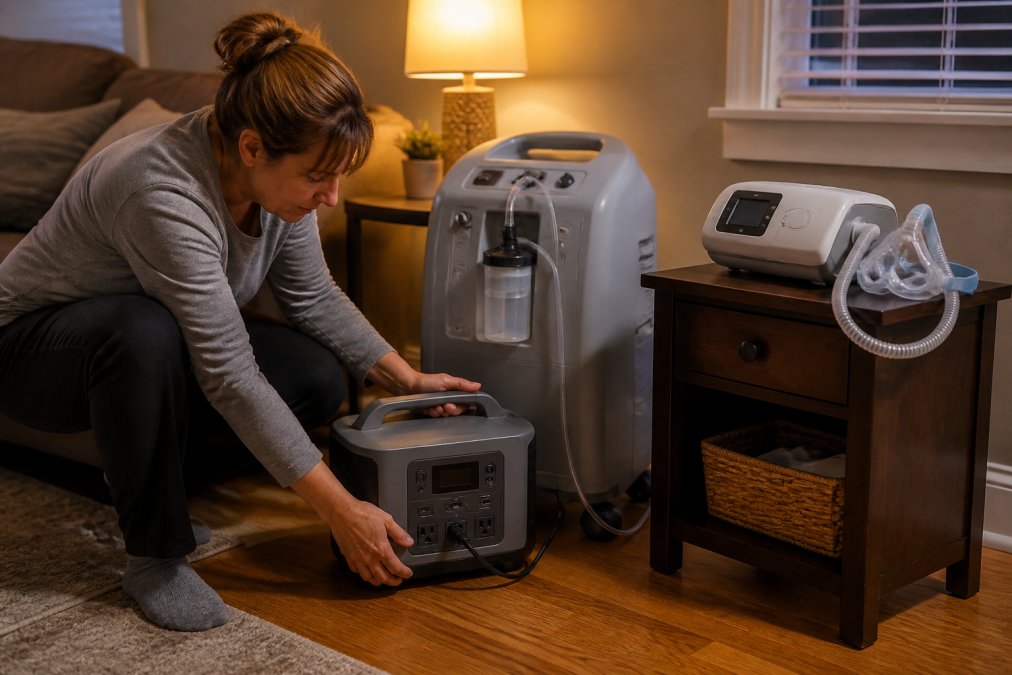
Runtime depends on the concentrator's draw and the battery's usable capacity. Most home oxygen concentrators pull 250-400 watts continuously, and higher flow settings increase that draw. A 2,000 watt-hour station running a 300-watt concentrator yields roughly 6 hours before efficiency losses, closer to 5 in practice.
Choosing a Portable Power Station for Medical Devices
Match the station to the device, not to the biggest number on the box. The right unit delivers pure sine wave output, enough continuous wattage for your highest-draw device, and capacity for your realistic outage window.
| Option | Starting Price | Best For | Key Feature |
|---|---|---|---|
| EcoFlow Delta Pro 3 | $3,199 | High-draw, long-duration devices | Integrated UPS mode |
| Anker SOLIX F3800 Plus | $3,999 | Multiple devices, scalable needs | Expandable battery system |
| BLUETTI AC200L | $1,499 | Mid-range home health care | 20ms UPS switchover |
| Pecron E3800 Bundle | $2,800 | Extended outages | High-wattage inverter |
| CyberPower Medical-Grade UPS | $450 | Small sensitive devices | Pure sine wave, AVR |
| Tripp Lite Medical UPS | $2,335 | Critical hospital-grade needs | Medical safety certifications |
| Jackery Explorer Series | $599 | Portable devices that travel | Lightweight design |
| Nature's Generator | $999 | Quiet, solar-ready backup | Silent operation |
Insurance and Medicare Coverage for Backup Power
Most guides stop at the equipment spec sheet and never mention who pays for any of this. Backup power for a medically necessary device sits in an awkward coverage zone that few households understand until they are already in an outage.
The core distinction: the device vs. the power source
Original Medicare Part B covers durable medical equipment (DME) when it is medically necessary and prescribed by a treating provider. Oxygen concentrators, CPAP machines, hospital beds, and infusion pumps commonly qualify. What Part B does not cover is the backup power source that keeps those devices running, a portable power station, standby generator, or medical-grade UPS is generally treated as a convenience item, not DME.
Where coverage sometimes exists
A few paths are worth checking, though none is guaranteed:
- Medicare Advantage supplemental benefits. Some Medicare Advantage plans offer flex benefits for over-the-counter and wellness items, and a small number have expanded these to include emergency preparedness supplies. Terms vary plan by plan and year by year, call member services and ask whether backup power equipment is eligible.
- Medicaid waiver programs. Some state Medicaid home- and community-based services waivers include emergency backup power as a covered support for beneficiaries who depend on life-sustaining equipment at home. Eligibility and coverage differ by state and waiver.
- Homeowners insurance. Standard policies typically do not list backup power as a covered item, but they may cover the loss of a medically necessary device during a covered peril (fire, lightning, a covered power surge). Replacing a fried concentrator is a different claim from paying for the battery that would have protected it.
- HSA and FSA accounts. If a physician writes a letter of medical necessity stating that backup power is required to operate prescribed DME, some account administrators will accept the purchase as a qualified medical expense. Ask your plan administrator before you buy, not after.
- Manufacturer and nonprofit assistance. Oxygen and CPAP manufacturers occasionally run patient assistance programs, and some disease-specific nonprofits offer emergency preparedness grants. These are worth a phone call if the household is on a fixed income.
What to ask before you assume you are on your own
When you call your plan or insurer, use specific language:
- "Is backup power for a prescribed oxygen concentrator covered under my DME benefit?"
- "Does my plan offer a supplemental benefit for emergency preparedness equipment?"
- "If a covered power surge damages my concentrator, what documentation do you need?"
- "Will you accept a letter of medical necessity for an HSA or FSA reimbursement?"
Document everything before an outage
Photograph every device label, serial number, and purchase receipt, and keep the prescription and letter of medical necessity in the same folder. Insurers process claims faster when you can prove what the device is, why it is medically necessary, and when you bought it.
Photograph every device label and serial number before an outage. Insurers process claims faster when you can prove what was damaged and when you bought it.
Maintenance and Testing for Emergency Power Backup
An untested backup system is a guess. Every few months, plug in the actual devices, unplug from the wall, and time how long the system holds, during daylight, not during a storm.
Keep a written schedule:
- Monthly: check battery charge level and inspect cables for damage
- Quarterly: run a partial load test with your highest-draw device
- Annually: run a full-duration test and replace any battery showing reduced capacity
- After every outage: recharge fully and log the runtime you observed
Conclusion
The hardest part of medical power backup is not buying equipment. It is knowing which device needs how much power for how long, and testing it before you need it.
Frequently Asked Questions
Will Medicare pay for a backup generator?
Medicare generally does not cover backup generators for home use. Original Medicare Part B may cover some durable medical equipment and related accessories, but power backup systems are typically excluded. Some Medicare Advantage plans might offer additional benefits, so check your specific plan. For coverage of medical equipment, Medicare requires a doctor's prescription and certification of medical necessity. If you need financial assistance, look into state Medicaid programs or charitable organizations that help with home safety modifications.
How long can a battery backup keep a home oxygen concentrator running?
Runtime depends on the concentrator's wattage and the battery's capacity in watt-hours. Most home oxygen concentrators draw between 250 and 600 watts. A 2,000Wh battery can run a 400W concentrator for about 5 hours. To find your runtime, divide the battery's watt-hours by the device's wattage. For longer outages, consider a larger battery bank or a generator. Always test your setup to confirm actual runtime and keep spare batteries charged.
What is the difference between a portable power station and a standby generator for medical use?
Portable power stations use batteries and produce no fumes, making them safe indoors. They require manual setup and have limited runtime. Standby generators run on propane or natural gas, start automatically during an outage, and can power a whole house indefinitely if fuel is available. However, they must be installed outdoors and require professional installation. For medical equipment, a portable power station offers quiet, emission-free backup, while a standby generator provides long-term power but at a higher cost and with more installation complexity.
What is the best backup power supply for a CPAP machine?
The best backup for a CPAP machine depends on your needs. A medical-grade UPS provides short-term runtime and surge protection, ideal for brief outages. For longer outages, a portable power station offers more capacity and portability. Calculate your CPAP's wattage (typically 30-60 watts without humidifier) and choose a battery with enough watt-hours for at least one night. Ensure the device outputs pure sine wave power to avoid damaging sensitive electronics.