
Table of Contents
- Why an Emergency Supply of Prescription Medications Matters
- Medication Storage Temperature Requirements: What You Need to Know
- Emergency Medication Kit Checklist: What to Include
- How to Rotate Emergency Medicine Supply to Avoid Expiration
- Safe Storage Locations in the Home: Cool, Dry, and Secure
- Digital Medication Records and Insurance Coordination
- Travel-Specific Emergency Storage and Disposal of Expired Meds
- Conclusion
- Frequently Asked Questions
Last Updated: September 20, 2026
Why an Emergency Supply of Prescription Medications Matters
When a storm knocks out power for days, the pharmacy counter is the last thing on your mind, until you realize you're down to your last few pills. Building a backup supply of prescription medications is one of the most overlooked steps in emergency preparedness, and it's one that SHTF Prepper Club hears about constantly from families who wish they'd planned ahead.
Here's the core problem: most prescriptions are filled in 30-day increments. That leaves almost no cushion if roads close, pharmacies shut down, or a refill gets delayed. For anyone managing a chronic condition, that gap isn't an inconvenience, it's a health risk.
The good news is that a workable emergency supply doesn't require hoarding or breaking any rules. It requires planning, rotation, and the right storage conditions. Below, we'll walk through how to store prescription medications for emergencies step by step, from temperature control to kit assembly.
Medication Storage Temperature Requirements: What You Need to Know
Medication storage temperature requirements matter more than most people realize. Heat, cold, and humidity can all weaken a drug before its expiration date arrives.
According to the FDA guidance on drug storage, most medications should be kept at controlled room temperature, which generally means a cool, dry spot away from direct light.
Room Temperature vs. Refrigerated Medications
Not all prescriptions store the same way. Some need room temperature, others need cold storage, and mixing them up can reduce how well they work.
- Room temperature drugs: Most tablets, capsules, and many liquids
- Refrigerated drugs: Certain insulin products, some liquid antibiotics, and specific injectables
- Freezer drugs: Rare, but a few specialty medications require it
Handling Refrigerated Drugs During Power Outages
A power outage is the scenario that catches people off guard. Refrigerated drugs can lose potency if they get too warm for too long.
Emergency Medication Kit Checklist: What to Include
An emergency medication kit checklist keeps your planning simple and repeatable. The kit should hold your backup supply, your records, and the tools you need to manage doses during a disruption. What separates a kit that actually works from a drawer of loose bottles is documentation and redundancy, a paper copy and a digital copy of everything, and a supply sized to the disruption you are most likely to face.
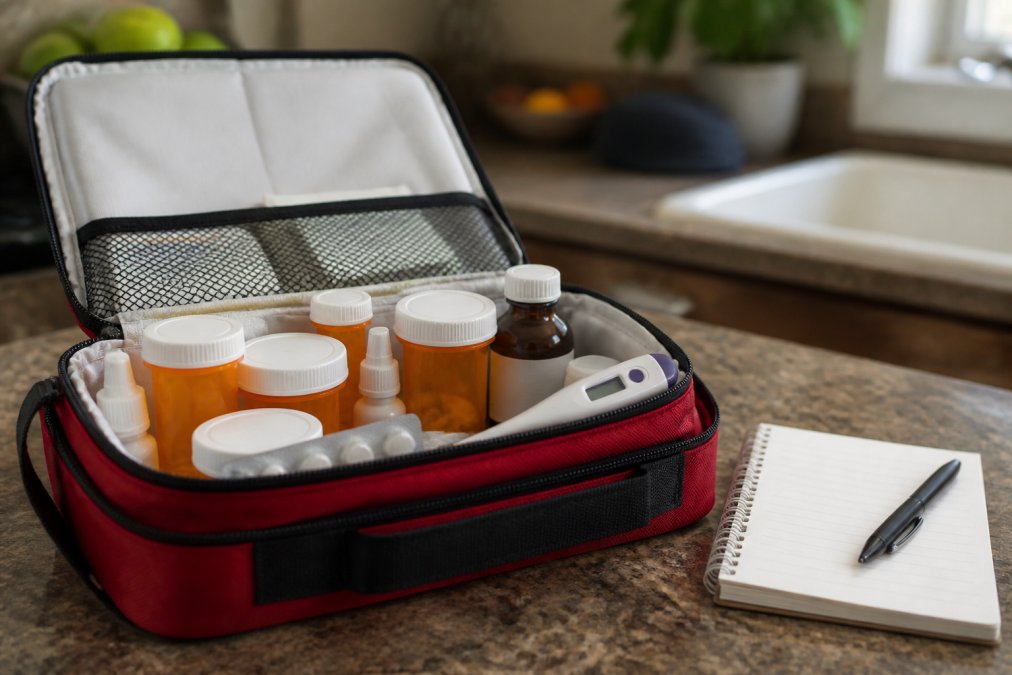
Build yours with these items:
- A 7 to 14 day backup supply of each essential prescription (see the rotation section below for how to build this without extra spending)
- A printed medication list with drug name, dosage, frequency, prescribing doctor, and pharmacy phone number
- A digital copy of that same list, a photo in a cloud folder you can open from any phone
- A small thermometer for storage checks
- Chemical ice packs for refrigerated drugs
- A waterproof pouch or container
- A copy of your insurance card and pharmacy contact info
- A notebook for tracking doses and refill dates
- A spare set of labels or a permanent marker for re-labeling containers
Organizing Medications in Original Containers
Keep medications in their original packaging whenever possible. Original containers carry the drug name, dosage, and expiration date, which matters if you ever need to hand them to a first responder or a substitute caregiver.
Documentation That Survives the Emergency
The single most common failure point in a real disruption is not the medication, it is the paperwork. If you are displaced to a shelter, a relative's home, or an emergency room, you need to be able to answer "what do you take and how much" without your bottles in hand.
A practical pattern is the three-copy rule:
- Paper copy in the kit itself, sealed in a zip-top bag.
- Digital copy as photos of every label, stored in a cloud folder and shared with one trusted family member.
- Wallet copy, a folded index card listing drug names, strengths, and dosages, kept with your ID.
Sizing the Supply to the Disruption
A 7 to 14 day buffer covers most short-term events, a winter storm, a regional flood, a pharmacy closure. For longer disruptions, the buffer grows through rotation rather than through a single large purchase. The next section explains how to build that buffer month by month without running afoul of refill rules or insurance limits.
How to Rotate Emergency Medicine Supply to Avoid Expiration
Rotating your emergency medicine supply is the difference between a kit that works and a kit full of expired pills. The method is simple: use the oldest first, and replace what you use.
Here's a rotation routine that works:
- Set a reminder for the first of each month.
- Check expiration dates on every item in the kit.
- Pull the oldest supply and use it as your daily medication.
- Replace it with your newest refill.
- Note the swap in your medication inventory.
Safe Storage Locations in the Home: Cool, Dry, and Secure
The best storage spot is cool, dry, dark, and out of reach of children. That combination rules out most kitchens and bathrooms.
Good options include:
- A locked cabinet in a bedroom closet
- A high shelf in a hallway linen closet
- A dedicated lockbox in a home office
Digital Medication Records and Insurance Coordination
Most emergency guides stop at storage. They miss the two things that cause the most panic during a real disruption: lost records and refill problems.
- Can I get an emergency refill if I'm displaced?
- Does my plan allow a vacation or travel override?
- Which nearby pharmacy shares my records?
Travel-Specific Emergency Storage and Disposal of Expired Meds
Most guides stop at the home shelf. The two situations that actually test a medication plan are being away from home and cleaning out a kit that has aged past its dates. Both deserve their own playbook.
Travel and Evacuation Storage
Travel adds a wrinkle: you need your medications to survive heat, motion, and tight packing. A small insulated pouch with a chemical ice pack handles most refrigerated drugs on the road. Keep everything in a carry-on, never a checked bag, a lost checked bag can mean a lost supply with no way to replace it mid-trip.
- Keep medications in their original labeled containers. Security and pharmacy staff can verify a labeled bottle; they cannot verify a bag of loose pills.
- Carry a copy of the prescription or the prescriber's contact information. For controlled substances, this is often the difference between a smooth screening and a long conversation.
- Pack a small thermometer in the pouch so you can confirm the internal temperature did not spike during a hot drive.
- For a go-bag, pre-pack a 3 to 7 day supply in a waterproof pouch, separate from your daily supply, so you are not disassembling your routine every time you leave the house.
- Never leave medication in a parked car. Interior temperatures can climb well above the safe storage range within an hour, and cold snaps can push them below freezing.
Disposal of Expired Emergency Meds
When medications do expire, don't just toss them in the trash or flush them. The DEA guidance on drug disposal recommends using take-back programs or authorized collection sites. Many pharmacies offer drop-off boxes, and many communities run periodic take-back events.
Rotation as the Real Disposal Strategy
The best disposal plan is the one you rarely need. If you rotate your emergency supply on a monthly schedule, using the oldest stock first and replacing it with each new refill, nothing in the kit should ever reach its expiration date. Disposal becomes the exception, not the routine.
Expired emergency meds should never sit in your kit "just in case." Remove them, dispose of them properly, and replace them so your supply stays reliable. A monthly rotation makes that a five-minute task instead of a yearly cleanup.
Conclusion
Building a real emergency medication plan takes an afternoon, not a weekend. The families who struggle most are the ones who waited until the shelves were empty.
Frequently Asked Questions
How to stockpile prescription meds legally?
You can ask your doctor for a 90-day supply or an extra emergency refill, which many insurers allow. Some states permit early refills for emergency preparedness. Always consult your pharmacist about your specific situation and never buy medications from unverified sources.
What should be included in a basic emergency medication kit?
A basic kit should include a 7-14 day supply of your essential prescription medications in their original labeled containers, a written medication list with dosages, and a small first-aid kit with over-the-counter drugs like pain relievers and antihistamines. Include a thermometer and any necessary medical supplies.
How often should I rotate my emergency medication supply?
Rotate your emergency supply every 6 to 12 months, or whenever you receive a new refill. Use the oldest medications first by checking expiration dates. Set a calendar reminder to review your kit and replace anything expiring soon.
How do temperature and humidity affect medication shelf life?
Most medications degrade faster in high heat, humidity, and direct light. Store them in a cool, dry place away from bathrooms and kitchens. Extreme temperatures can reduce effectiveness, so use waterproof containers and consider chemical ice packs for refrigerated drugs during outages.
This article is for general informational purposes only and is not medical advice. Always consult your pharmacist or physician about how to store your specific prescriptions.