
Table of Contents
- 10 Best Foods for Long-Term Survival Storage: A Practical Selection
- Understanding Calorie Needs for Survival Planning
- Grains and Legumes: The Foundation of Your Long-Term Food Storage List
- Freeze-Dried and Dehydrated Proteins: Shelf-Stable Nutrition Without Refrigeration
- Fats, Oils, and Calorie-Dense Staples for Extended Survival
- Food Preservation Methods: How to Store Food for Years
- Cooking Without Electricity: Preparing Your Survival Foods
- Psychological Comfort Foods and Morale in Survival Situations
- Rotating Your Food Supply: Managing Long-Term Storage Effectively
- Allergy-Friendly Survival Planning: Dietary Restrictions and Long-Term Storage
Last Updated: July 28, 2026
10 Best Foods for Long-Term Survival Storage: A Practical Selection
When an emergency strikes, whether a natural disaster, job loss, or extended power outage, your household's first line of defense is food security. The 10 best foods for long term survival storage aren't just about calories; they're about creating a system that sustains your family through uncertainty without requiring electricity, fresh water, or constant rotation. This guide from SHTF Prepper Club covers the most reliable, nutrient-dense options that actually taste good enough your family will eat them during a real crisis, plus the storage methods that keep them viable for 25 years or more.
Most prepping guides treat survival food like a checkbox: buy some cans, stack them in the basement, forget about them. That approach fails spectacularly when the power goes out and your family refuses to eat another freeze-dried meal. The real challenge isn't finding foods that store, it's selecting foods that balance three competing demands: caloric density, nutritional completeness, and palatability.
Below, we'll walk you through the exact foods we recommend, the science behind why they work, and the storage methods that keep them viable for decades.
How We Selected These Foods
Selecting the best foods for long-term survival storage requires balancing multiple factors that most guides overlook. We prioritized foods based on shelf life (minimum 5 years, ideally 25+), caloric density per pound, nutritional variety, and honest taste ratings from people who've actually eaten them during emergencies.
Each food on this list meets these criteria: it stores reliably without refrigeration, requires minimal preparation equipment, and provides macronutrients your body needs under stress. We excluded foods that taste so bad families won't eat them during a crisis, a common failure point in survival planning.
Understanding Calorie Needs for Survival Planning
Your survival food supply must provide enough calories to sustain activity and maintain body temperature. The average sedentary adult needs 2,000 calories per day; under stress or physical exertion, that number climbs to 2,500-3,000 calories. A family of four requires 8,000-12,000 calories daily for one month of supply.
This is where most preppers miscalculate. They buy emergency food kits labeled "1-week supply" that actually provide only 1,200 calories per day, enough to prevent starvation but not enough to maintain strength or cognitive function. When you're managing a crisis, you need full nutrition, not minimal survival rations.
Calculate your household's actual caloric needs by multiplying your family size by 2,200 calories per person per day (accounting for some reduced activity). For a family of four, that's 8,800 calories daily, or 264,000 calories for 30 days. Knowing this number prevents the common mistake of under-provisioning.
Grains and Legumes: The Foundation of Your Long-Term Food Storage List
Grains and legumes form the caloric backbone of any survival pantry. These foods are inexpensive, shelf-stable for decades, and provide the carbohydrates and plant-based proteins your body needs to function under stress.
White rice stores for 25+ years in airtight containers with oxygen absorbers. It's calorie-dense (1,650 calories per pound), requires only water to prepare, and provides quick energy when your body needs it. White rice stores longer than brown rice because its lower oil content resists rancidity. A 50-pound bucket of white rice costs less than most emergency food kits but provides far more calories.
Wheat berries store for 30+ years and provide complete proteins when combined with legumes. Unlike white rice, whole wheat contains the germ and bran, delivering fiber, B vitamins, and minerals your body needs during high-stress periods. The trade-off: you need a grain grinder to process them into flour. If you don't have one, this food becomes nearly useless in a real emergency.
Dried beans and lentils store for 10-30 years depending on storage conditions. They're protein powerhouses, one pound of dried beans provides 1,200 calories and 80 grams of protein. Combined with rice, beans create a complete amino acid profile your body can use immediately. Red lentils cook in 20 minutes without soaking; black beans and pintos require longer preparation but store longer.
Grains and legumes are the foundation because they're affordable, reliable, and provide the volume of calories you need. But they're monotonous alone. That's why the remaining foods on this list add variety, micronutrients, and psychological comfort.
Freeze-Dried and Dehydrated Proteins: Shelf-Stable Nutrition Without Refrigeration
Freeze-dried and dehydrated proteins solve the biggest challenge in survival food planning: getting enough protein without refrigeration. Unlike canned meats, which are heavy and bulky, freeze-dried options provide 20-30 grams of protein per serving in a package the size of a deck of cards.
Mountain House freeze-dried meals offer 30-year shelf life and require only hot water for preparation. Their entrees range from beef stroganoff to teriyaki chicken, and taste ratings from actual preppers are consistently positive, a rarity in survival food. The drawback: at approximately $8-12 per serving, they're expensive compared to bulk grains. Use them strategically for morale during extended emergencies, not as your primary protein source.
Powdered eggs and dairy provide essential micronutrients and cooking flexibility. Powdered eggs reconstitute into scrambled eggs or baked goods; powdered milk adds calories and fat to grain-based meals. Both store 10-25 years in cool, dry conditions. Taste is noticeably different from fresh, but acceptable when mixed into other foods.
Canned meats, tuna, salmon, chicken, beef, store 5-10 years and provide immediate protein without preparation. They're heavier than freeze-dried alternatives but require no special equipment to prepare. A single can of tuna (5 ounces) provides 25 grams of protein and 150 calories. Rotate these regularly since they have shorter shelf life than freeze-dried options.
Textured vegetable protein (TVP) is an overlooked option that stores 25+ years, costs pennies per serving, and provides 12 grams of protein per ounce. It has a neutral taste and absorbs flavors from broths and sauces. Many preppers dismiss it, but combined with rice and beans, TVP creates filling meals that taste significantly better than eating plain grains.
| Protein Type | Shelf Life | Calories per Pound | Cost per Serving | Best For |
|---|---|---|---|---|
| Freeze-Dried Meals | 30 years | 400-500 | $8-12 | Morale & variety |
| Powdered Eggs | 10-25 years | 1,600 | $0.50 | Baking & cooking |
| Canned Meats | 5-10 years | 600-800 | $1-2 | Quick protein |
| TVP | 25+ years | 1,600 | $0.30 | Bulk meals |
| Canned Beans | 5-10 years | 500 | $0.40 | Complete protein |
Fats, Oils, and Calorie-Dense Staples for Extended Survival
Fats are the most calorie-dense macronutrient, 9 calories per gram versus 4 for carbohydrates and protein. In a survival scenario, fats also support hormone production, nutrient absorption, and mental function. Yet most emergency food lists overlook them.
Coconut oil and vegetable shortening store 2-5 years at room temperature and provide 1,920 calories per pound. Use them for cooking, baking, and adding calories to bland grain-based meals. Coconut oil has stronger flavor; vegetable shortening is neutral. Both work in survival cooking without electricity.
Peanut butter stores 6-9 months at room temperature, longer in cool conditions. It's 1,500 calories per pound, packed with protein and fat. Buy natural peanut butter (oil on top) rather than stabilized versions, the oil separation actually indicates longer shelf life. Store in cool conditions and rotate annually.
Nuts and seeds (almonds, walnuts, sunflower seeds) store 6-12 months and provide 2,500+ calories per pound. They're expensive compared to grains but provide essential minerals and fats. Use them sparingly for morale and nutritional completeness, not as primary calories.
Honey is the ultimate survival food: 1,380 calories per pound, never spoils (archaeologists found 3,000-year-old honey still edible), and requires no special storage. It provides quick energy, has antimicrobial properties, and improves the taste of otherwise bland survival meals. Buy raw honey when possible, it's nutritionally superior to processed versions.
Sugar and salt store indefinitely and serve dual purposes. Sugar provides quick calories and psychological comfort; salt preserves food and replaces electrolytes lost during stress or physical exertion. Store at least 5-10 pounds of each per person in your household.
Fats and calorie-dense staples prevent the "survival diet fatigue" where people lose interest in eating monotonous grain-based meals. A tablespoon of peanut butter or honey transforms a bowl of rice into something psychologically satisfying.
Food Preservation Methods: How to Store Food for Years
Storage conditions determine whether your survival food remains viable for 5 years or 25 years. Temperature, humidity, light, and oxygen are the four enemies of shelf stability.
Mylar Bags and Oxygen Absorbers
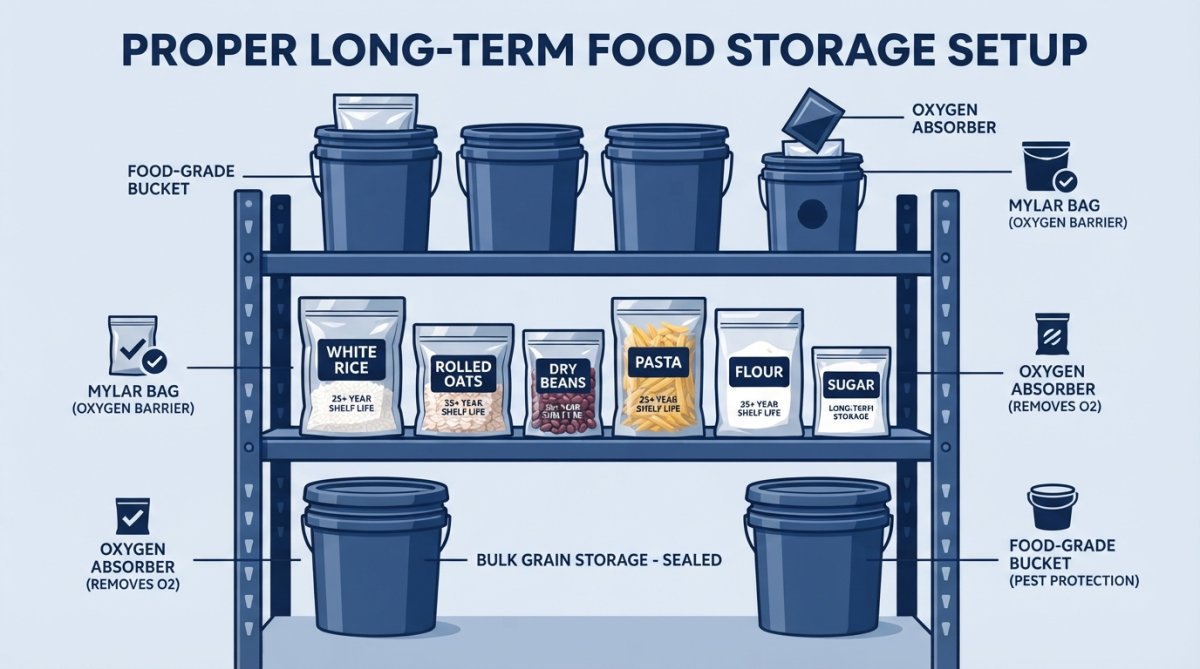
Mylar bags with oxygen absorbers are the gold standard for long-term grain and legume storage. Mylar is a reflective plastic that blocks light and prevents moisture transmission. Oxygen absorbers (small packets containing iron powder) remove oxygen from the sealed bag, preventing oxidation and insect reproduction.
The process is straightforward: fill a Mylar bag with grains or legumes, place an oxygen absorber packet inside (one 300cc packet per gallon of food), seal the bag with a heat sealer or clothes iron, and store in a cool, dry location. Properly sealed, these bags keep food viable for 25+ years.
The common mistake is using regular plastic bags or leaving bags partially open. Regular plastic doesn't block oxygen or light; oxygen absorbers only work in sealed environments. If you seal a bag and it puffs back up within hours, the seal failed, reseal or transfer to a new bag.
Food-Grade Buckets and Temperature Control
Food-grade buckets (5-gallon capacity) provide durable, stackable storage for bulk grains and legumes. They're rodent-proof when sealed and protect contents from light. Line buckets with Mylar bags, add oxygen absorbers, and seal both the bag and bucket lid.
Temperature is critical: every 18-degree Fahrenheit increase cuts shelf life in half. Food stored at 50°F lasts twice as long as identical food at 68°F. Basements, crawl spaces, and cool closets are ideal; avoid attics, garages, and areas near heating vents.
Humidity should stay below 15% for optimal storage. Use silica gel packets or food-grade diatomaceous earth to absorb moisture in buckets. Replace packets annually if stored in humid climates.
Cooking Without Electricity: Preparing Your Survival Foods
The best survival food supply means nothing if you can't cook it. Most survival meals require boiling water, a challenge when the power is out and your stove is electric.
Camp stoves that burn propane, butane, or white gas work without electricity. A single-burner propane camp stove costs $20-30 and cooks rice, beans, and grains reliably. Store at least two stoves and backup fuel canisters. Test your stove before an emergency, many people discover their stove doesn't work when they actually need it.
Canned heat (Sterno) provides an alternative for people without outdoor space. A single can boils water for tea or rehydrating freeze-dried meals. It's slow compared to camp stoves but requires no fuel storage beyond the cans themselves.
Rocket mass heaters and outdoor fire pits work if you have space and access to firewood. These are slower and less convenient than camp stoves but require no fuel storage.
The critical step most preppers miss: practice cooking with your backup heat source before an emergency. Cook a meal using only your camp stove, canned heat, or fire pit. You'll discover problems, a stove that won't light reliably, fuel that doesn't flow properly, pots that don't fit your cooking surface, when you have time to solve them, not during a crisis.
Psychological Comfort Foods and Morale in Survival Situations
Extended emergencies create psychological stress that's as dangerous as physical deprivation. When people can't eat familiar foods, morale collapses. Families stop cooperating, children become anxious, and decision-making deteriorates. Psychological comfort foods prevent this breakdown.
Coffee and tea store indefinitely and provide caffeine, warmth, and ritual. They're inexpensive insurance against emotional collapse. Store 6-12 months of whatever your family actually drinks, instant coffee, ground coffee, tea bags. Add powdered creamer and sugar to complete the experience.
Chocolate stores 2-3 years and provides quick calories plus psychological reward. Dark chocolate with 70%+ cocoa stores longer than milk chocolate. A single ounce provides 150 calories and genuine morale improvement during stress.
Spices and bouillon transform bland survival meals into food people want to eat. Bouillon cubes store 5+ years and add flavor to rice and beans. Dried herbs (oregano, basil, garlic powder) store indefinitely. The cost is minimal, $20 worth of spices transforms hundreds of pounds of bland grains into meals people actually enjoy.
Comfort foods specific to your family, whether that's instant pudding, peanut butter cookies, or canned fruit, deserve space in your storage. A child eating familiar food during a frightening situation experiences measurable psychological benefit. Don't dismiss this as frivolous.
The mistake is over-investing in comfort foods at the expense of calories. Comfort foods should comprise 5-10% of your total storage, not more. But that 5-10% prevents the complete psychological breakdown that turns a manageable emergency into a family crisis.
Rotating Your Food Supply: Managing Long-Term Storage Effectively
A survival food supply that never rotates becomes a liability. You'll discover expired items, spoiled foods, and forgotten purchases when you actually need them. Rotation prevents waste and ensures your stored food remains fresh.
First In, First Out (FIFO) rotation is the standard approach: consume older stock before newer stock. Label everything with purchase dates. When you buy new rice, move old rice to the front and use it first. This requires discipline but ensures nothing expires unused.
Consumption rotation integrates survival food into regular meals. Use stored rice, beans, and canned goods in everyday cooking. Replace what you use with new purchases. This approach serves dual purposes: you know your food is edible (you've eaten it), and your family becomes comfortable with survival meals before an actual emergency.
Many preppers resist consumption rotation, fearing they'll run out during a crisis. But a survival food supply that never rotates becomes unfamiliar, your family won't eat it when stressed. The solution is simple: store more than you think you need, then rotate regularly.
Create a rotation schedule: every three months, review your stored food inventory, identify items approaching expiration, and incorporate them into meals. Replace what you consumed. This quarterly review ensures nothing surprises you.
| Rotation Task | Frequency | Time Required | Purpose |
|---|---|---|---|
| Check expiration dates | Quarterly | 30 minutes | Identify items nearing expiration |
| Consume & replace | Quarterly | 2-4 hours | Ensure food freshness & family familiarity |
| Inventory audit | Annually | 1-2 hours | Verify quantities & identify gaps |
| Storage condition check | Biannually | 1 hour | Confirm temperature, humidity, & pest prevention |
Allergy-Friendly Survival Planning: Dietary Restrictions and Long-Term Storage
Food allergies complicate survival planning. A family member with severe peanut allergies can't rely on peanut butter as a calorie source. Gluten sensitivities eliminate wheat-based foods. Dairy allergies require alternative proteins and fats.
The solution is intentional planning: identify your family's allergies and dietary restrictions, then select alternatives that store long-term. For peanut allergies, substitute sunflower seed butter (stores 6-9 months) or tahini (stores 12+ months). For gluten sensitivities, prioritize rice, corn, and certified gluten-free oats. For dairy allergies, use coconut milk powder and coconut oil for fats.
Don't assume commercial emergency food kits accommodate allergies. Most contain wheat, dairy, or peanuts. Read ingredient labels carefully. Better yet, build your own allergy-friendly supply using bulk ingredients you've verified as safe.
Store allergy-safe foods in clearly labeled containers. During a stressful emergency, mislabeling creates dangerous situations. Use permanent markers to label "gluten-free" or "dairy-free" on every container.
Test your allergy-friendly survival meals before an emergency. Cook them, eat them, ensure they're palatable. A family member with celiac disease won't eat rice-and-beans meals if they've never tried them. Pre-emergency testing prevents the discovery that your "safe" backup meals are actually unacceptable to your family.
Building a 10 best foods for long term survival storage supply protects your family from the most common emergencies, extended power outages, job loss, supply chain disruptions, and natural disasters. The challenge isn't finding foods that store; it's selecting foods your family will actually eat while managing the logistics of proper storage and rotation.
At SHTF Prepper Club, we simplify this process by curating pre-vetted survival food kits that combine caloric density, nutritional completeness, and palatability. Our comprehensive kits include grains, legumes, freeze-dried proteins, and fats, plus detailed storage guidance and rotation schedules. Rather than spending weeks researching individual components, you get a complete system designed for families who want emergency preparedness without the complexity. Start with SHTF Prepper Club and gain the peace of mind that comes with knowing your household can sustain itself through any disruption.
Frequently Asked Questions
What foods have the longest shelf life for long-term survival storage?
Freeze-dried foods, wheat berries, dried beans, rice, honey, and salt offer the longest shelf lives, often 25 years or more when stored correctly in mylar bags with oxygen absorbers. Canned goods typically last 5-10 years. Fats and oils like coconut oil extend shelf life significantly. Mountain House and ReadyWise offer freeze-dried options with 30-year taste guarantees. Store all items in cool, dry conditions below 70°F to maximize longevity.
How do I calculate calorie needs for survival when planning my long-term food storage?
The average adult needs 2,000-2,500 calories daily for sedentary survival; active individuals may need 3,000+. Multiply your household size by daily calorie needs, then by the number of days you want to cover (e.g., 30 days, 1 year). Prioritize calorie-dense foods like oils, nuts, and grains. A balanced survival diet includes 50% carbohydrates, 30% fats, and 20% protein. Use this calculation to ensure your food storage list meets actual nutritional requirements, not just volume.
What's the best way to store food for years without it spoiling?
Use mylar bags with oxygen absorbers for dry goods like grains, beans, and freeze-dried foods, this removes oxygen and prevents spoilage. Store in food-grade buckets in cool (50-70°F), dry environments away from direct light and pests. Maintain humidity below 15%. Freeze-dried and dehydrated foods last longest when sealed properly. Rotate stock using FIFO (first in, first out) to maintain freshness. ReadyWise and Legacy Food Storage provide pre-packaged options with 25-year shelf lives, eliminating guesswork.
Can I prepare survival foods without electricity or running water?
Yes. Freeze-dried meals require only hot water, use a camping stove, fire, or solar cooker. Dried beans and grains need boiling water but can cook over any heat source. Canned foods require no preparation. Bouillon cubes and salt enhance flavor without cooking. Store a manual can opener and waterproof matches. Practice cooking with alternative heat sources before an emergency. Mountain House and Augason Farms meals are specifically designed for minimal-prep, water-only preparation, making them ideal for off-grid survival scenarios.
External Sources Referenced
[EXTERNAL_LINK: USDA Food Storage Guidelines for Long-Term Preservation | usda.gov]
[EXTERNAL_LINK: Emergency Preparedness and Disaster Response from FEMA | fema.gov]
[EXTERNAL_LINK: Nutritional Requirements During Emergency Situations from the CDC | cdc.gov]
This article was written using GrandRanker