
Last Updated: November 14, 2026
Quick Summary
The best solar powered emergency lights for most households are the MPOWERD Luci Pro Outdoor 2.0 for diffused area light and the Goal Zero Crush Light as a budget backup. Judge them on per-mode runtime, realistic solar charging time, and a USB-C fallback, since sunlight alone is unreliable during an outage.
- Treat inflatable lanterns like the Luci Pro as ambient room light, not task lights for hands-on work.
- A light's headline runtime usually quotes its dimmest setting, so look for a per-mode runtime table.
- Solar charging is a top-up between USB charges, not your primary recharge method in a multi-day outage.
- Store lights at roughly half charge and top them up a few times a year to extend battery life.
- Build a kit with one light per person plus one per common area, each with a charging fallback.
Table of Contents
- How We Evaluated These Solar Powered Emergency Lights
- Best Solar Powered Emergency Lights for Most Households
- Choosing a Solar Emergency Light for Home Use
- Solar Rechargeable Emergency Light Runtime and Real Charging Performance
- When You Need a Solar Emergency Lantern With Phone Charging
- Battery Longevity, Replacement, and Outage Planning
- Building Your Family's Emergency Lighting Kit
- Frequently Asked Questions
How We Evaluated These Solar Powered Emergency Lights
A solar powered emergency lights review is only useful if it tells you how the light behaves after dark when the grid stays off.
We also weight the unglamorous stuff: a lantern that needs two hands is a problem when one is holding a flashlight or a child, and a sealed, non-replaceable battery is a disposable product pretending to be emergency gear.
Here is the framework we apply to every unit:
| Criterion | What We Check | Why It Matters |
|---|---|---|
| Light output | Stated lumens, verified across modes | Brightness claims often reflect only the top mode |
| Runtime | Hours per mode, not just the lowest setting | Backup duration is the whole point |
| Solar charging | Full-charge time in sun and overcast | Realistic charging, not lab conditions |
| Charging fallback | USB-C or micro-USB input | Sunlight is not guaranteed |
| Battery | Type, capacity, replaceability | Determines usable lifespan |
| Usability | Hands-free options, one-hand operation | Matters during an actual outage |
Best Solar Powered Emergency Lights for Most Households
For most households, the best solar powered emergency lights charge reliably, run long enough to cover a night, and operate in the dark without fumbling. We compare the two models that come up most often in independent comparisons on the same criteria.
MPOWERD Luci Pro Outdoor 2.0: The All-Around Pick
The MPOWERD Luci Pro Outdoor 2.0 is an inflatable solar lantern.
The solar panel is built into the base, so charging is a matter of setting it in a window. The inflatable design packs into a drawer or go-bag.
What to know before buying: inflatable lanterns are not task lights. Charging time depends on sunlight conditions, and overcast weather will lengthen it.
Goal Zero Crush Light: The Budget Backup
The Goal Zero Crush Light collapses into a small, crushable form that can live in a glovebox or junk drawer until you need it.
Solar charging gives it an outlet-free top-up, which matters when the power is out for days. Charging from direct sun takes time, and a USB input allows faster top-ups.
Buy two, stage them in different rooms, and test them twice a year.
How the two compare on the criteria that matter
| Criterion | Luci Pro Outdoor 2.0 | Goal Zero Crush Light |
|---|---|---|
| Form factor | Inflatable globe, packs flat | Collapsible lantern, crush-resistant |
| Light character | Diffused ambient | Diffused ambient, lower output |
| Solar charging | Built-in base panel, full sun most of a day | Small built-in panel, multi-hour full sun |
| Charging fallback | USB-C input | USB input |
| Battery | Sealed lithium cell | Sealed lithium cell |
| Best role | Primary area light per room | Backup and staging light |
The sections below on runtime, charging, and battery longevity explain what to look for instead.
If you are still cross-checking options, our broader guide to the best emergency lights for power outages covers the full field beyond these two picks.
Choosing a Solar Emergency Light for Home Use
A solar emergency light for home use should be judged on room coverage and one-hand operation, not peak lumen numbers.
Here is the decision framework we use when advising families:
- Ambient versus task lighting. Inflatable lanterns and diffused globes light a room; focused lights inspect a panel. Most homes need one of each.
- Ceiling bounce. A light with a hang loop or flat top that casts upward illuminates a room far better than one pointed at a wall.
- Hands-free mounting. Magnetic bases and hang loops matter more than most buyers expect, during an outage you are often holding a child, a phone, or a tool.
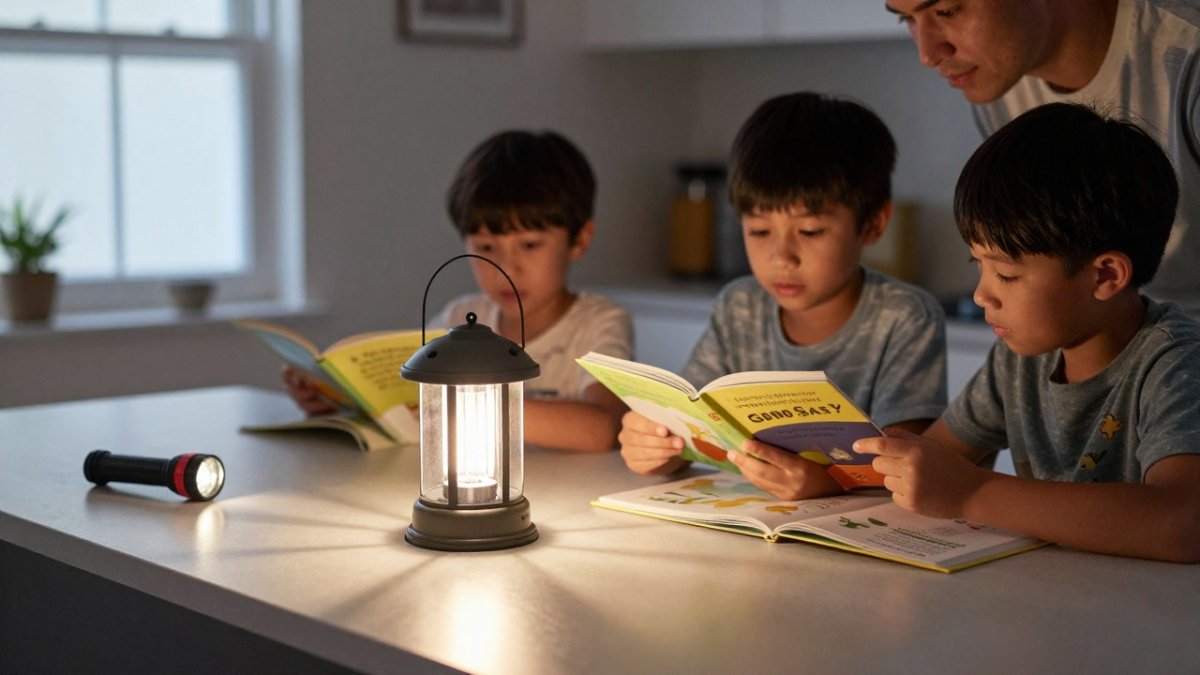
Watch out: buying one bright light for the whole house. Light placement beats light power every time. Three moderate lights in three rooms outperform one powerful light in one room.
Solar Rechargeable Emergency Light Runtime and Real Charging Performance
Solar rechargeable emergency light runtime depends far more on the brightness setting than on panel size, and real-world charging is slower than the box suggests. A light rated for many hours is usually quoting its lowest setting, not the mode you will actually use.
Runtime is mode-dependent, and the headline number is the low mode
A lantern advertising a long runtime is almost always quoting its dimmest setting; on its brightest setting it may run a fraction of that time because LED output and battery draw scale together. Look for a per-mode runtime table rather than a single headline figure. For a night-long outage, you want a light that runs at a usable ambient level for at least eight hours, usually a mid setting.
Realistic solar charging: what actually determines charge time
Solar charging speed is set by panel area, sunlight intensity, panel angle, and temperature, not marketing copy.
A common pattern: a lantern left in a south-facing window on a clear day reaches a useful partial charge in a few hours, while the same lantern on a cloudy day gains only a little. Treat solar charging as a top-up between USB charges, not your primary recharge method during a multi-day outage.
USB-C is the safety net that makes solar practical
A solar light with a USB-C charging input can be topped up from a power bank or car charger when the sun does not cooperate. This is the single most useful feature on the list because it decouples your lighting from the weather. USB-C is preferable to micro-USB for durability and cable commonality, and a light that charges from the same cable as your phone simplifies your kit.
Stored energy degrades, so test before you trust
Rechargeable batteries lose capacity over years, even unused, so a light you never touched may hold less charge than the label promises. Lithium cells age fastest when stored full or fully drained, so store lights at roughly half charge and top them up a few times a year. Readiness test: run each light on its mid setting until it dims, note the hours, and repeat twice a year.
A simple side-by-side test you can run at home
You do not need a lab to compare two lights fairly. Charge both fully by USB, run them on the same setting in the same room, and note when each dims. Repeat with a solar-only charge on a clear day and again on an overcast day.
The practical takeaway: buy for the worst day, not the best one. A light that charges slowly in overcast conditions is still useful if it has a USB-C input.
For a deeper look at how solar panels behave in poor light, the U.S. Department of Energy solar energy basics explains how photovoltaic output responds to cloud cover and panel angle.
When You Need a Solar Emergency Lantern With Phone Charging
A solar emergency lantern with phone charging solves the problem most preppers underestimate: a dead phone during an outage is a dead lifeline.
Understand the limits before you rely on it. Lantern-based phone charging is a trickle, not a fast charge.
If phone charging is a priority, our take is to pair the lantern with a dedicated solar power bank rather than expecting one device to do both jobs well. A unit like the Blavor solar power bank with built-in cables and flashlight covers the phone-charging job properly, and a second option like the QuadraPro solar power bank gives you a backup for the backup.
Watch out: charging a phone from a lantern drains the lantern's battery. If you spend the lantern's stored energy on your phone, you are back to a dark room.
Battery Longevity, Replacement, and Outage Planning
Battery longevity separates emergency lights that last a decade from ones that quietly die in a drawer. Most solar emergency lights use lithium-ion or lithium-polymer cells, and most are sealed inside the housing with no user-replaceable option.
What that means in practice:
- Check for replaceability before you buy. A light with a user-replaceable battery is a long-term asset. A sealed one has a shelf life.
- Store at partial charge. Lithium cells age fastest when stored full or fully drained. A light stored at roughly half charge and topped up a few times a year will outlast one stored at full.
- Recharge on a schedule. Put a recurring reminder to top up every emergency light and power bank. A light that has sat untouched for two years may not turn on when you need it.
This is where lighting connects to the rest of your plan. A light is one component of a larger outage strategy, and the family power plan for grid failure puts lighting, batteries, and charging in the right order so nothing gets missed.
For guidance on battery safety and storage, the NFPA emergency preparedness resources covers fire safety considerations for stored energy devices in the home.
Building Your Family's Emergency Lighting Kit
A family emergency lighting kit should cover one light per person plus one per common area, with a charging fallback for each.
Here is the kit we recommend assembling:
- One ambient lantern per bedroom, staged and tested
- One task light or headlamp per adult for hands-on work
- One solar lantern with a USB-C input per floor of the home
The family emergency preparedness checklist covers the rest of the household plan, from water to food to documents, so your lighting kit sits inside a complete system rather than standing alone.
The gap between a household that handles an outage calmly and one that panics usually comes down to preparation done in advance.
Frequently Asked Questions
How long do solar emergency lights run on a full charge?
Runtime depends on the model and the brightness setting you use. Most solar lanterns run longest on their lowest mode and drop sharply on high. In practice, check the stated runtime for the mode you would actually use during an outage, not the maximum figure on the box. A light rated for many hours on low may only last a fraction of that on high, so plan for one light per room rather than one light for the whole house.
Can a solar emergency light charge a phone?
Some can, but not all. Models built with a USB output can top up a phone in an emergency. Treat this as a trickle charge for calls and texts, not a full recharge of a modern smartphone. If phone charging matters to your plan, confirm the light lists a USB output before you buy, and keep a separate power bank as your primary phone backup.
How long does it take to recharge an emergency light with solar power?
Charging time varies widely by panel size and sunlight. A small built-in panel on a lantern typically needs a full day of direct sun to reach a useful charge, and overcast conditions stretch that further. For faster results, many lights also accept USB or USB-C charging, which is worth using before a storm arrives so the battery starts full rather than relying on the sun during the outage itself.
Are solar-powered lights worth it compared to battery-powered ones?
They are worth it as part of a layered plan. Solar lights avoid the problem of running out of disposable batteries, which makes them reliable for long outages. Their weakness is that they need sunlight to recover, so a stretch of overcast days limits them. The practical answer is to keep solar lanterns for everyday and multi-day use, and add a battery or USB-rechargeable light as a fallback for the worst-case scenario.
What features should I look for in a solar-powered emergency light?
Prioritize adjustable brightness, a stated runtime for each mode, and a USB or USB-C charging option so you are not dependent on sun alone. Look for weather resistance if the light will sit outside to charge, and a hanging hook or stand for hands-free use. Battery type matters too: a replaceable battery extends the light's life, while a sealed one limits it. Buy for the room you will actually light, not the spec sheet.
