
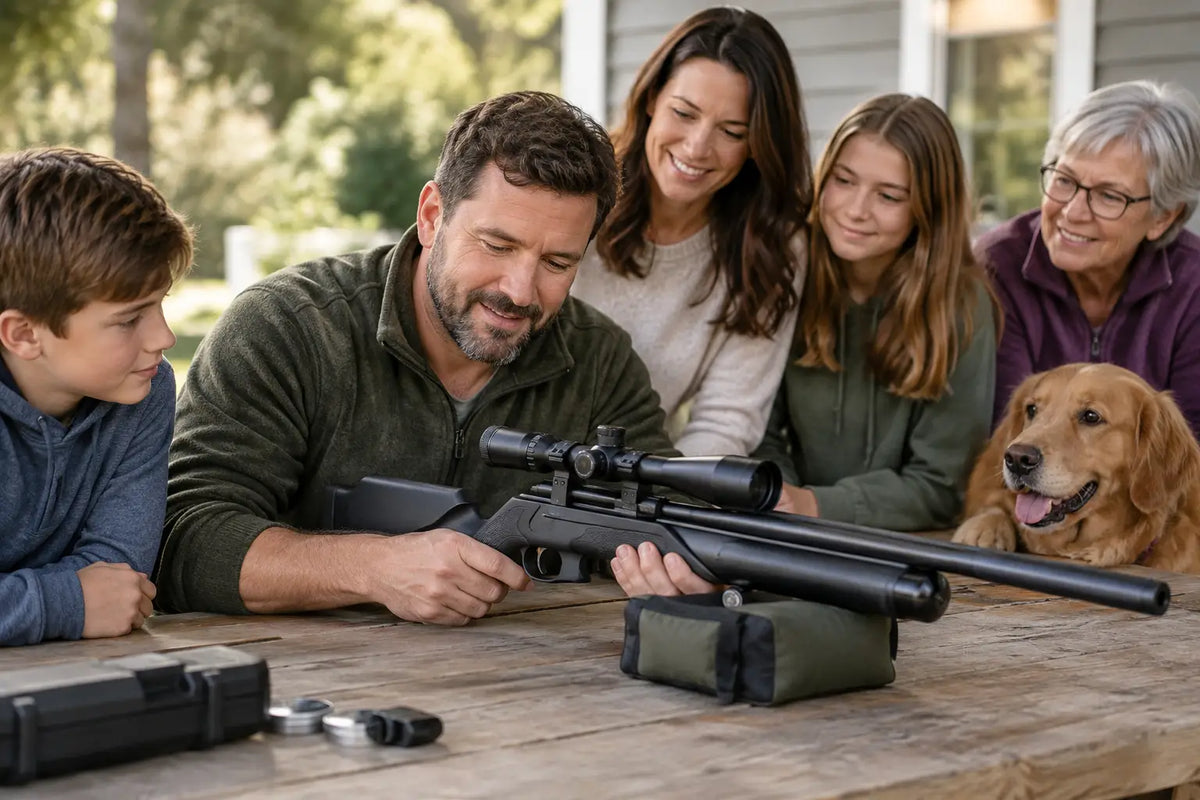
A downed fence, a garden-eating pest problem, or a long disruption can make rural and exurban households think differently about useful tools. A PCP airgun is one option some families consider for property management and food independence. It can be accurate, quiet compared with many firearms, and reusable with the right support equipment. It is not, however, a simple item to buy, set in a closet, and forget.
For a family preparedness plan, the real question is not whether a PCP airgun is impressive. The question is whether it fits your property, your local laws, your comfort level, and the systems you can realistically maintain. Water, food, medical supplies, backup power, and a communication plan will serve nearly every household first. For the right rural family, though, an airgun may have a practical and limited place after those basics are covered.
What a PCP Airgun Is
PCP stands for pre-charged pneumatic. Unlike a spring-powered air rifle or a CO2 model, it stores compressed air in an onboard reservoir. That stored air propels a pellet when the airgun is used.
The main appeal is consistency. A quality PCP airgun can offer repeatable performance and less recoil than many spring-powered models, which can make careful, responsible practice more approachable for an experienced adult. It also does not require disposable CO2 cartridges, a small advantage when store shelves are empty or resupply is delayed.
The trade-off is that the air supply has to come from somewhere. A PCP is only useful when its reservoir can be safely refilled using compatible equipment. Depending on the setup, that may mean a hand pump, a portable compressor, or a larger air tank. Each option adds cost, maintenance, storage needs, and safety responsibilities.
That makes a PCP airgun less like a stand-alone tool and more like a small system. Before buying one, think about the whole system, not just the rifle.
Where It Can Fit in a Preparedness Plan
For households with acreage, gardens, chickens, orchards, or livestock feed, nuisance wildlife can become a real concern. A tool that supports lawful pest management may protect food-producing areas and reduce losses. In some rural areas, an airgun may also be part of a broader, legal approach to small-game harvesting, although local seasons, species rules, property restrictions, and licensing requirements still apply.
That last point matters. An airgun is not exempt from responsibility simply because it is not a firearm. State, county, city, and neighborhood rules can vary widely. Some places regulate discharge within city limits, on small lots, or near roads and occupied buildings. Homeowners association rules may add another layer. Check the rules that apply where you live before you purchase equipment or make plans around it.
A PCP airgun is not a replacement for family security planning. It should not be treated as the centerpiece of an emergency plan, and it is not a shortcut around training, judgment, or secure storage. Families are better served by practical layers of readiness: reliable locks, exterior lighting, good communication with neighbors, evacuation planning, first aid skills, water storage, and enough food to stay home safely when conditions allow.
For many suburban homes, that is where the decision ends. There may be no lawful or appropriate use case for an airgun on a small lot. That is not a preparedness failure. It is good planning to choose tools that fit your actual surroundings.
The PCP Airgun Trade-Offs Families Miss
The purchase price is only the beginning. A responsible setup may also require a safe method for charging the air reservoir, pellets suited to the airgun, secure storage, eye protection, a safe backstop for practice, cleaning supplies, and potentially replacement seals or other service items over time.
The charging question deserves special attention. High-pressure air equipment must be used exactly as its manufacturer directs. Improvised fittings, damaged hoses, incompatible tanks, and neglected equipment create unnecessary risk. If no one in your household is comfortable learning the charging process and maintaining the equipment, a PCP may not be the right choice.
Power outages can complicate the picture as well. An electric compressor may be convenient day to day, but it depends on grid power or a properly sized backup power source. A manual pump avoids that dependency, but filling can take significant physical effort. A refill tank can be convenient, but it eventually needs professional refilling. There is no perfect answer. The best option depends on how often the airgun will be used, your physical abilities, available storage space, and local access to service.
Noise is another area where expectations need a reality check. PCP airguns can be quieter than many other options, but they are not silent. Pellets striking a hard backstop can be loud, and any discharge can draw attention in a close neighborhood. Safe, legal use requires enough space, a purpose-built or proven backstop, and certainty about what lies beyond the target area.
Storage Is the Family Safety Test
If children, teenagers, visiting grandchildren, or guests are ever in your home, secure storage is non-negotiable. Treat an airgun with the same seriousness you would any device capable of causing injury. It should be inaccessible to unauthorized people, stored according to applicable law and manufacturer guidance, and kept separate from ammunition where that adds another layer of control.
Adults in the home should also agree on clear rules. Who can access it? Where can it be used? Who is responsible for checking its condition? What happens if a child finds it or asks about it? Calm, direct conversations are better than secrecy or vague warnings.
Practice should never happen in a garage, basement, or backyard unless the space is genuinely suitable, lawful, and equipped with a safe backstop. A pellet can ricochet from hard surfaces or pass through inadequate materials. A controlled range or another approved setting is often the better place to build competence.
Training matters just as much as storage. Read the manufacturer manual, learn the local rules, use eye protection, and make sure every adult user understands safe handling principles. If that sounds like more commitment than your household wants to make, that is useful information. Preparedness tools should reduce stress, not create a new source of worry.
PCP Airgun or Another Option?
A PCP model is usually worth considering only when you have a clear, lawful use case and the willingness to maintain the supporting equipment. Rural homeowners dealing with recurring property-management needs may find that trade-off reasonable. Homesteads working toward food independence may also see value in a durable, repeatable tool as part of a larger plan.
A spring-powered air rifle may be simpler for someone who wants fewer charging accessories, though it has its own learning curve and handling characteristics. CO2-powered options can be convenient for casual use, but they depend on a consumable cartridge supply and may perform differently in cold weather. For many families, neither option is necessary. Better fencing, covered feed storage, motion lighting, garden barriers, and wildlife-resistant trash storage can solve the underlying problem more safely and with less ongoing responsibility.
Start with the problem, not the product category. If the problem is a raccoon getting into chicken feed, improve feed security first. If the problem is concern about a multi-day outage, prioritize water, shelf-stable food, lighting, charging, medications, and a safe way to cook. If the problem is building rural self-reliance over years, an airgun may be one carefully considered part of that plan.
A Practical Decision Before You Buy
Ask yourself whether you can answer four questions honestly: Is there a legal and appropriate use for it on our property? Can we store it so children and visitors cannot access it? Can we safely maintain its air supply during normal life and an outage? Are we prepared to train and practice responsibly rather than assume ownership equals readiness?
If any answer is no, put your budget toward a more immediate preparedness need. That might be additional water storage, a dependable filtration method, a family first aid kit, backup lighting, or several weeks of familiar food. Those investments help whether the next emergency is a hurricane, winter storm, wildfire evacuation, or a simple supply disruption.
If the answers are yes, take your time. Buy for the role the tool will actually play, learn the rules before it arrives, and make secure storage part of the purchase from day one. The most useful preparedness choices are rarely the most dramatic. They are the ones your family can operate safely, maintain steadily, and rely on with confidence when ordinary routines are interrupted.