
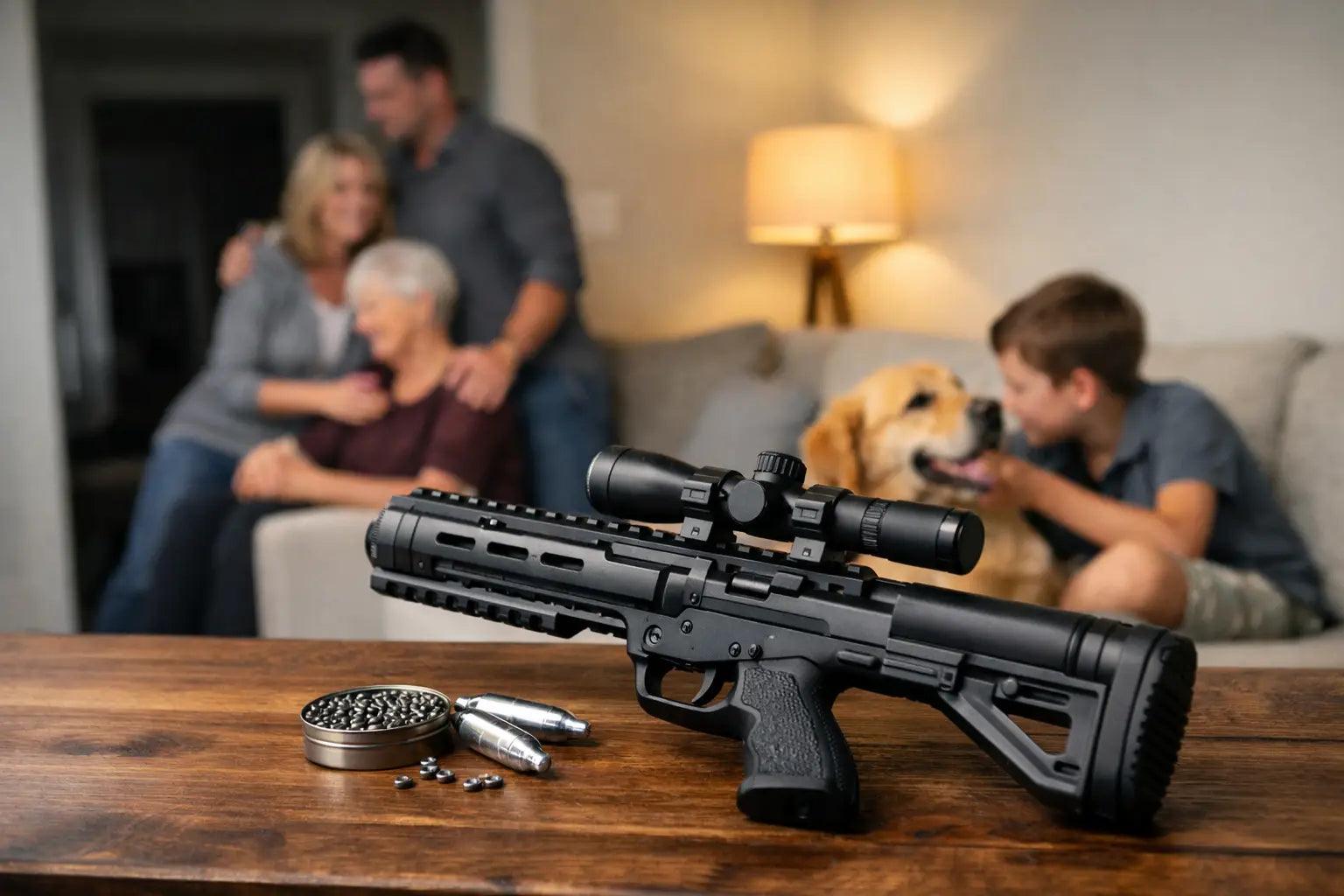
The question usually comes up after a real-life scare, not a casual shopping trip. A noise at 2 a.m. A break-in down the street. A storm outage that leaves the neighborhood dark and uneasy. When people ask about an airgun for home defense, they are usually trying to solve a serious family safety problem with something they hope is simple, affordable, and less intimidating than a firearm.
That instinct makes sense. But this is one of those topics where wishful thinking can get people hurt. If your goal is to protect your family during a violent home intrusion, an airgun is usually not the tool you want to bet your life on.
Airgun for home defense: the honest answer
An airgun can injure someone. In some cases, it can injure them badly. That is exactly why this topic creates confusion. People hear "high-powered pellet gun" or "BB gun" and assume that if it can punch through a can, break skin, or dispatch small pests, it must be good enough for home defense.
That leap is where the problem starts.
Home defense is not about whether a tool can hurt someone. It is about whether it can stop an immediate violent threat quickly and reliably under stress, in low light, with your heart pounding, while other family members may be nearby. Those are very different standards.
Most airguns are poor stoppers. They may cause pain. They may cause fear. They may even escalate the situation if an intruder realizes you are armed but not effectively armed. A desperate, intoxicated, or determined attacker may not be stopped by pain alone.
For family preparedness, that matters more than internet bravado. The standard should be simple: does this tool give your household a realistic margin of safety in a worst-case moment? In most cases, an airgun does not.
Why people consider an airgun in the first place
There are fair reasons this option comes up. Airguns are often easier to buy, cheaper to train with, quieter than firearms, and less overwhelming for people who did not grow up around weapons. Some homeowners also believe an airgun reduces legal risk or lowers the chance of overpenetration through walls.
Those concerns are not foolish. They are practical concerns from practical people.
But there is a difference between "better than nothing" and "appropriate for the job." An airgun may feel like a middle ground. In reality, it often combines the stress of using a weapon with much less stopping power than the situation may demand.
That trade-off is hard to justify when your spouse, children, or aging parents are sleeping down the hall.
Where an airgun falls short during a home intrusion
The biggest weakness is immediate incapacitation. If someone is breaking into your home and moving toward you, you do not need a tool that might persuade them to leave. You need a tool that can stop the threat fast enough to protect innocent people.
An airgun also creates accuracy problems under pressure. It is easy to imagine calmly taking a precise shot. It is much harder to do that after being startled awake, in dim light, while trying to identify whether the person in the hallway is a family member, a confused neighbor, or a criminal. Under stress, fine motor skill and precision fall off quickly.
Then there is reliability in real conditions. Some airguns depend on CO2 cartridges that can lose pressure over time or perform differently depending on storage and temperature. Others are slow to reload or awkward to operate when seconds matter. None of that sounds serious at a kitchen table. It matters a lot at 2 a.m.
There is also a legal and psychological issue people tend to overlook. If you point what appears to be a gun at an intruder, they are likely to respond as if it is a gun. If they are armed, the confrontation can turn deadly very quickly. An airgun does not announce its limitations to the other person.
The one place an airgun may fit
If we are being precise, an airgun may have limited value in a broader household security plan. It can be useful for pest control, for skill-building around safe handling, and in some homes as a lower-barrier way to introduce responsible adults to sight alignment, trigger control, and storage habits.
That is not the same as recommending it for home defense.
For example, if a homeowner physically cannot manage firearm recoil, cannot legally own a firearm, or is still in the very early stages of developing a home protection plan, an airgun may feel like the only tool currently on hand. In that narrow sense, it may be better than empty hands.
But that should be treated as a temporary gap, not a finished plan.
Better home defense starts before any weapon
The strongest family security plans do not begin with what you keep in a nightstand. They begin with making your home a harder target and giving your family more time to react.
Start with doors, locks, exterior lighting, and reinforced strike plates. Add motion lights and clear sightlines around entry points. Make sure first-floor windows actually lock and that sliding doors cannot be forced open easily. If you have an alarm system or cameras, use them consistently instead of treating them like decor.
Then think about communication inside the home. Who calls 911? Where do the kids go? What room can be secured from the inside? If grandparents are visiting, would they know what to do in the dark? A simple family emergency plan will do more for real-world safety than a marginal defensive tool ever will.
This is the part many households skip because buying gear feels more concrete than practicing a plan. But planning is what lowers panic.
If not an airgun, what should families consider?
That depends on your comfort level, legal environment, training commitment, and the ages of people in the home.
For some households, a firearm may be the right choice, paired with secure storage, professional training, and a clear access plan that keeps children and unauthorized guests safe. For others, a layered approach built around hardened entry points, alarms, medical readiness, flashlights, and defensive tools they can actually use under stress may be more realistic at first.
Pepper spray can be a better option than many people assume, especially for those who want a non-lethal tool with a more established defensive track record than an airgun. It still requires training, and indoor use has obvious downsides, but it is designed for personal defense rather than pest control or recreation.
A high-output flashlight also deserves more respect in this conversation. In low light, identification matters. A good flashlight helps you see clearly, move family members safely, and avoid tragic mistakes. It is not a stopping tool by itself, but it is often part of a much smarter response.
And if you are building readiness from scratch, do not overlook trauma supplies and basic first-aid training. Any serious home defense conversation that ignores medical response is incomplete.
What to ask before choosing any home defense tool
The better question is not, "Can this hurt someone?" It is, "Can I use this safely, legally, and effectively while protecting everyone else in my house?"
That means thinking through storage, access speed, training time, local laws, and how your home is laid out. A ranch house with kids in adjacent bedrooms presents different risks than a rural property with distance between structures. A retired couple may need a different setup than parents with teenagers coming and going at odd hours.
It also means being honest about your habits. If you are unlikely to train, maintain equipment, or rehearse a family plan, then your setup should be simpler, not more aggressive. Preparedness works best when it matches real life.
The readiness mindset matters more than the gadget
An airgun for home defense appeals to people who are trying to close a gap without jumping straight into something they are not ready for. That is understandable. Plenty of families feel caught between wanting to be responsible and not wanting to overcorrect.
The answer is not to shame that hesitation. The answer is to build a better plan.
Think in layers. Deter. Delay. Detect. Communicate. Protect. Medical backup matters too. When a household works through those layers calmly, the question becomes much clearer. The airgun usually stops looking like a solution and starts looking like what it is - a compromise with serious limits.
If your family has been through an outage, storm, evacuation, or neighborhood scare, you already know this much: peace of mind comes from preparation that holds up under pressure. Choose tools that match that standard, and let the rest go.