
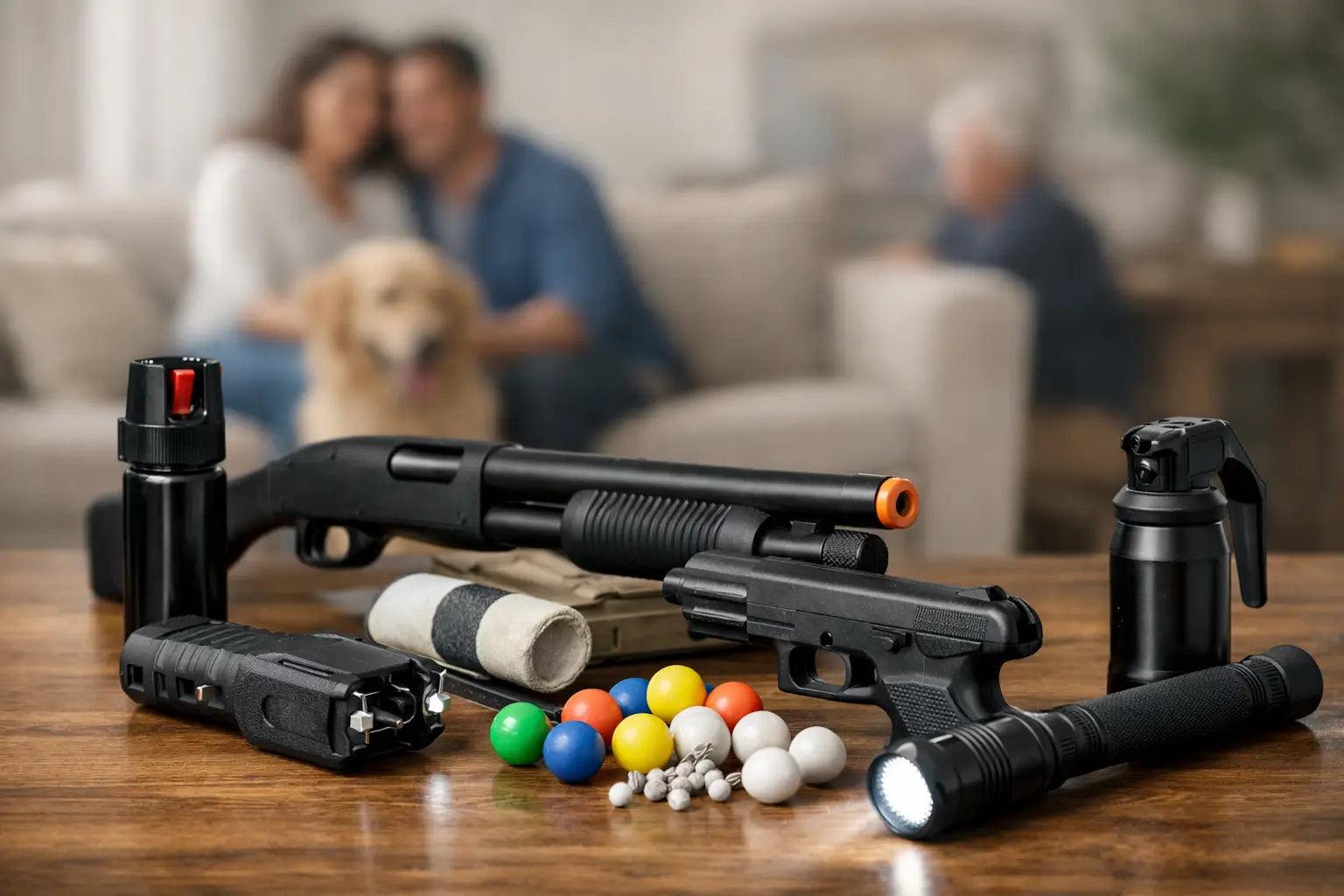
A bump in the night feels different when you have kids down the hall or grandkids asleep in the guest room. In that moment, most people are not looking for a dramatic answer. They want non lethal home defense options that are practical, legal in their area, and realistic to use under stress.
That is the right place to start. Home defense is not just about stopping a threat. It is about reducing confusion, buying time, protecting your family, and avoiding decisions you cannot take back. For many households, the best plan is layered. One tool by itself rarely does the whole job.
What non lethal home defense options are really meant to do
A lot of people hear "non-lethal" and assume it means weak. That is not the point. The goal is to interrupt, deter, disorient, alert, or create enough time for your family to move to safety and call 911. Sometimes the most effective home defense tool is the one that prevents close contact in the first place.
That matters because real emergencies are messy. You may be half asleep. Your spouse may be in another room. A teenager may open a bedroom door at the wrong time. A tool that sounds simple on paper can become complicated fast in a dark hallway.
That is why a family-first approach works better than a gear-first approach. Start with prevention, add warning systems, and only then think about hands-on defensive tools.
Start with the tools that keep distance on your side
If someone is trying a door or moving around your property, distance is your friend. You want early warning and visibility before you ever need to confront anyone.
Reinforced doors and window security
This is the least exciting option, and often the most useful. A solid core door, longer strike plate screws, quality deadbolts, window locks, and security film can turn a quick break-in attempt into a loud, delayed, and often abandoned effort.
The trade-off is that physical hardening is not cheap if you do the whole house at once. But you do not need to do everything in one weekend. Start with first-floor doors, sliding doors, and the windows that are hidden from the street.
Motion lights and visible cameras
Good outdoor lighting changes behavior. Most people looking for an easy target do not want attention. Motion lights around entry points, side yards, garages, and back patios make it harder for someone to approach unnoticed.
Cameras help too, but mostly as a deterrent and awareness tool. Do not think of them as a shield. Think of them as a way to know what is happening before you open a door you should have left closed.
Alarm systems and panic buttons
An alarm does two jobs at once. It tells you there is a problem, and it tells the intruder the house is not quiet anymore. Even a basic door and window alarm setup is better than relying on hearing alone.
For families with older parents, teenagers home alone, or multi-story homes, a bedside panic button can be more useful than people realize. Under stress, fine motor skills drop. Hitting one obvious button is easier than navigating a phone app at 2:13 a.m.
Hands-on non lethal home defense options for close range
If prevention fails, you are into a different category of decision-making. At that point, the best tool is the one you can access quickly, use correctly, and store responsibly.
Pepper spray or pepper gel
For many households, this is the most realistic close-range option. It is compact, affordable, and does not require much strength to use. A quality pepper spray can create intense eye and breathing irritation, giving you time to retreat, lock a door, and call for help.
Pepper gel is often a better fit indoors because it is less likely to blow back into your own face. That said, no spray is magic. In a tight room, stress and movement can still create contamination risk. Practice drawing it, unlocking it, and aiming low-to-high. Do not let the first time you touch it be during an emergency.
High-decibel personal alarms
These are often overlooked because they seem too simple. But a very loud alarm can be effective in a home, especially for teens, older adults, and anyone who is not comfortable with sprays or impact tools.
The value is disruption. Noise creates confusion, signals distress, and can wake other family members or neighbors. It will not physically stop someone, so it works best as part of a layered plan rather than your only line of defense.
Flashlights with strobe function
A powerful flashlight belongs in every bedroom anyway. During a home intrusion, it helps you identify what is happening before you act. That alone is a major safety benefit.
A bright light with a strobe setting can also disorient someone briefly in a dark space. The limit is obvious: it is a distraction tool, not a stopping tool. Still, paired with a locked bedroom door, a phone call to 911, and a clear family plan, it can buy valuable seconds.
Batons or impact tools
Some people consider expandable batons or other impact tools because they do not want sprays in the house. These options come with more risk than many expect. They require close distance, physical ability, and emotional readiness to use force in a chaotic situation.
They also vary a lot by state and local law. For most family households, they are not the first non-lethal tool I would recommend. If you go this route, legal research and training matter more than the purchase itself.
Tasers or stun devices
These are often grouped together, but they are not the same. A contact stun device requires you to be right next to the person. That is a serious drawback in a home defense situation.
A projectile-style conducted energy device gives you more distance, but cost, legality, reliability, and training all come into play. Some households find them worthwhile. Many buy them assuming they are foolproof, which they are not.
The best option for most families is a layered plan
If you strip away the marketing, most effective non lethal home defense options fall into a simple order. First, make entry harder. Second, make intrusion obvious. Third, create a safe place inside the home. Fourth, keep one or two close-range tools that adults in the house have actually practiced with.
For a suburban family, that might mean reinforced front and back doors, motion lights, an alarm system, a charged flashlight in each bedroom, pepper gel in a quick-access location, and a plan that says everyone moves to the primary bedroom and locks down. That is not flashy. It is effective.
For grandparents, the setup may be even simpler: better locks, brighter exterior lighting, bedside alarm buttons, and one easy-to-use defensive tool they feel confident handling. Confidence matters. A complicated tool people hesitate to use is not really part of the plan.
What to think through before you buy anything
First, check your state and local laws. Pepper spray, stun devices, batons, and conducted energy devices can all have different rules depending on where you live. Legal ownership is part of preparedness.
Second, think about children and storage. A tool is only helpful if it is accessible to the right person and inaccessible to the wrong one. Quick-access storage matters just as much for non-lethal tools as it does for any other defensive item.
Third, test your home at night. Walk from the bedrooms to the doors. Stand where your kids would stand. Notice blind spots, squeaky floors, missing flashlights, weak locks, and dead phone chargers. Most families find the real gaps that way, not by scrolling product pages.
Finally, practice the plan out loud. Who calls 911? Who gets the kids? Which room becomes the safe room? What phrase tells everyone this is real? When adrenaline hits, simple beats clever every time.
A calm plan beats a perfect gadget
There is no single best answer for every home. A townhouse with close neighbors, a rural property with a long driveway, and a home with aging parents all have different needs. But the pattern stays the same. Buy time. Create noise. Improve visibility. Protect distance. Keep your family coordinated.
If you have been meaning to think this through, that is already a good instinct. Start with one door, one light, one alarm, and one clear family plan. Small steps count, especially when they make a hard night more manageable.