
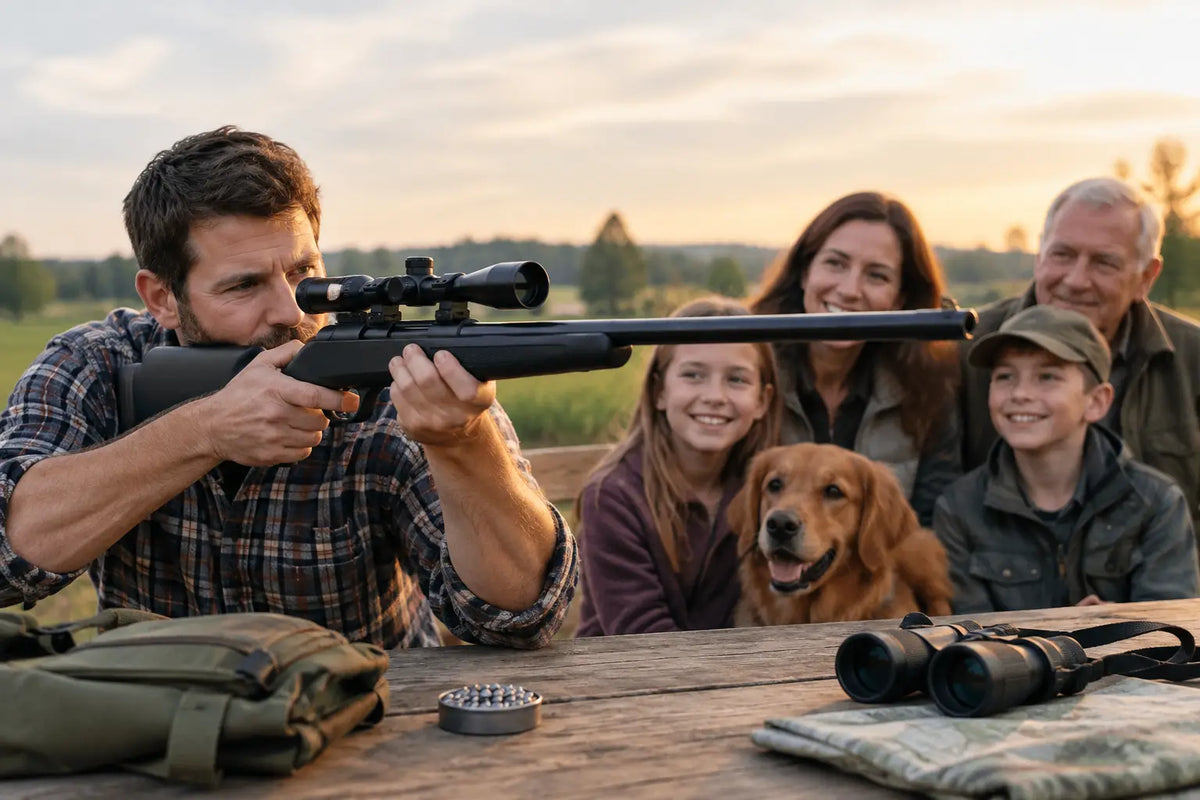
A freezer full of food can become a problem quickly after a long outage. That is why some families ask, “is an airgun helpful to hunt small game if you need food for your family?” The honest answer is yes, sometimes, but it is a backup food skill, not a replacement for stored food, clean water, and a way to cook.
An airgun can be a practical tool for a rural or exurban household that already hunts legally, understands local game rules, and has a realistic expectation of what lives nearby. It is quiet compared with many alternatives, ammunition stores compactly, and it does not depend on gasoline. But it also requires practice, appropriate equipment, legal access to game, and the judgment to pass on a shot that is not humane.
Is an airgun helpful to hunt small game for food?
It can be helpful when several conditions line up. You need legal permission to hunt, a suitable airgun and pellet for the animal, enough skill to make a clean shot, and a safe place to hunt. You also need actual small game in the area. A suburban backyard with occasional squirrels is not a dependable food source for a family of four, especially if local ordinances prohibit discharge or hunting.
Think of an airgun as one layer in a broader family food plan. Stored meals, pantry staples, garden production, fishing where legal, and relationships with nearby farmers or neighbors may provide more predictable calories. Hunting can supplement that plan, particularly in rural areas, but wild game is variable. Weather, season, pressure from other hunters, and local habitat all affect what is available.
For many families, the greatest value of an airgun is not an imagined long-term emergency. It is the ability to responsibly handle nuisance small game where permitted, develop a legitimate hunting skill before it is needed, and add some flexibility during a short-term disruption.
The legal question comes first
Game laws are not a suggestion during hard times. In most states, hunting seasons, bag limits, licenses, approved methods, and land-access rules still apply. Some animals may be protected, while others may be classified as game, furbearers, or nuisance wildlife under different rules. City and county restrictions can be stricter than state law, especially around airgun discharge.
Before buying gear or building a plan around hunting, check your state wildlife agency regulations and your local ordinances. Know whether you can hunt on your own property, whether a license is required, and which species may be taken in each season. If you hunt private land that is not yours, get clear permission in advance.
Do not assume an emergency cancels these rules. A declared disaster may change access, closures, or safety conditions, but it does not automatically create permission to hunt. Planning ahead keeps a difficult situation from becoming a legal problem too.
Humane hunting is the non-negotiable standard
A small animal is not a target for casual practice. If you choose to hunt for food, the responsibility is to make a clean, ethical kill and recover the animal promptly. That means using an airgun capable of the task, matching the pellet to the intended game and your equipment, and knowing your personal accuracy limits.
Capability varies widely. A lightweight pellet rifle appropriate for paper targets or pest birds may not be appropriate for rabbits or squirrels. More power is not the only answer, either. Consistent accuracy, pellet performance, shot placement, and your ability to stay calm matter just as much. An airgun that is inaccurate in your hands is not a food tool.
Practice on paper targets first, from the same stable positions you would use in the field. Practice until you can consistently place pellets where you intend at realistic, legal distances. If conditions are windy, the animal is moving, you do not have a safe backstop, or the shot does not feel certain, do not take it. Passing on a shot is responsible hunting, not failure.
Use pellets intended for hunting, and consider non-lead options when they perform well in your particular airgun. This can reduce concerns about lead fragments in meat. Whatever pellet you choose, test it for accuracy before relying on it. Different airguns can perform very differently with different pellet weights and shapes.
What an airgun can and cannot provide
Small game can add protein and variety, but it does not produce the volume of food many people imagine. Rabbits, squirrels, and similar animals are relatively lean and small. Cleaning and cooking time also matter when you are tired, cold, or managing children during an outage.
A family relying heavily on very lean wild game without enough fats and carbohydrates can run into a nutrition problem. That is one reason an emergency pantry should include calorie-dense staples such as rice, beans, oats, pasta, flour, cooking oil, nut butters, and shelf-stable meals. Pairing occasional wild game with stored staples makes far more sense than treating hunting as the whole plan.
An airgun also depends on supporting supplies. If it uses a spring-piston or pre-charged pneumatic system, understand its maintenance and power needs before an emergency. Some systems require a hand pump, a compressor, or an air source. CO2-powered models depend on cartridges that can be depleted or affected by cold weather. Keep the manufacturer’s manual, basic maintenance items, and an adequate supply of the correct pellets with the equipment.
Store the airgun securely, especially in a home with children or visiting grandchildren. Teach young family members that it is not a toy. Treat every airgun as if it were loaded, keep the muzzle in a safe direction, and never fire without knowing what is beyond the target.
Build the food plan before the hunting plan
If your family is starting from scratch, put your first preparedness dollars toward food and water that are certain to be available. A practical goal is a pantry your family already eats from, plus stored water and a reliable method to filter more. Add a manual can opener, fuel-safe cooking options, and a simple rotation system so food does not quietly expire in a closet.
From there, consider long-term food independence in ways that fit your home and schedule. A small garden, fruit trees, raised beds, seeds, food preservation skills, or a freezer with backup power can all contribute. None has to become a full-time hobby to be worthwhile. A few productive habits can reduce your dependence on last-minute grocery runs.
If hunting interests you, learn it while life is normal. Take a hunter education course if your state requires or recommends it. Spend time outdoors. Learn to identify local species and signs of disease. Practice field dressing and safe food handling under calm conditions, not while your family is waiting for dinner after a storm.
Safe handling matters after the harvest
The food safety work begins as soon as an animal is recovered. Field dress it promptly, keep the meat clean, and cool it quickly. Avoid animals that appear sick, behave unusually, or show obvious lesions. Follow local wildlife guidance for species-specific disease concerns.
Cook wild game thoroughly, and prevent cross-contamination with hands, knives, cutting boards, and kitchen surfaces. During a power outage, this is especially important because refrigeration may be limited. Cook only what your household can safely use, and do not let harvested meat sit in warm conditions while you deal with other emergency tasks.
A realistic role in family readiness
An airgun can be a useful small-game tool for a prepared, legally compliant household with the right skills and location. It is not a shortcut to food security, and it should never be the first line of a family emergency plan. The families who fare best in disruptions usually have several modest, dependable layers rather than one dramatic solution.
Start with the food, water, cooking equipment, and medical supplies your household will need this week. Then build skills that make your family more capable over time. If responsible small-game hunting belongs in that plan, learn it carefully now, practice it ethically, and let it remain what it should be: one useful option among many.