
Table of Contents
- How Much Emergency Water Does a 4-Person Family Actually Need?
- Water Storage Containers: Which Type Works Best for Families
- Best Water Purification Methods for Emergencies
- Safe Storage Locations and Shelf-Life Verification
- Water Rotation Schedule for Families: What Works
- Budget vs. Premium Emergency Water Supply Options
- Choosing the Best Emergency Water Supply for Your Situation
- Conclusion
Best Emergency Water Supply for 4-Person Family: Complete Guide
Last Updated: August 2, 2026
How Much Emergency Water Does a 4-Person Family Actually Need?
The Federal Emergency Management Agency (FEMA) recommends one gallon of water per person per day for drinking and sanitation during emergencies, meaning a 4-person family needs a minimum of 4 gallons daily. However, most families prepare for only 3 days and face critical shortages when disruptions last longer. A 2-week supply is the practical sweet spot for household emergency preparedness.
Daily Minimum vs. Extended Supply Duration
The one-gallon guideline assumes minimal activity and cool conditions. Realistically, families with children, pregnant women, or elderly members need 1.5 gallons per person daily when accounting for drinking, food preparation, and washing.
For a 4-person family:
- 3-day emergency kit: 12-18 gallons minimum
- 2-week supply: 42-60 gallons recommended
- 1-month supply: 180-240 gallons (for serious preparedness)
Families with only 3 days of water face rationing when emergencies extend into the second week. Those with 2 weeks can maintain normal hydration and basic sanitation without compromise.
Calculating Total Gallons for Your Household
For a 4-person family with 1.5 gallons per person daily:
- 3-day supply: 4 × 1.5 × 3 = 18 gallons
- 2-week supply: 4 × 1.5 × 14 = 84 gallons
- 1-month supply: 4 × 1.5 × 30 = 180 gallons
If your family includes infants, elderly members, or anyone with medical conditions, add 25-50% more. In hot climates, increase the baseline by 50%. The Reliance Aqua-Tainer (7 gallons) requires 12 containers for an 84-gallon supply. A 55-gallon drum covers most of the 2-week supply in a single container.
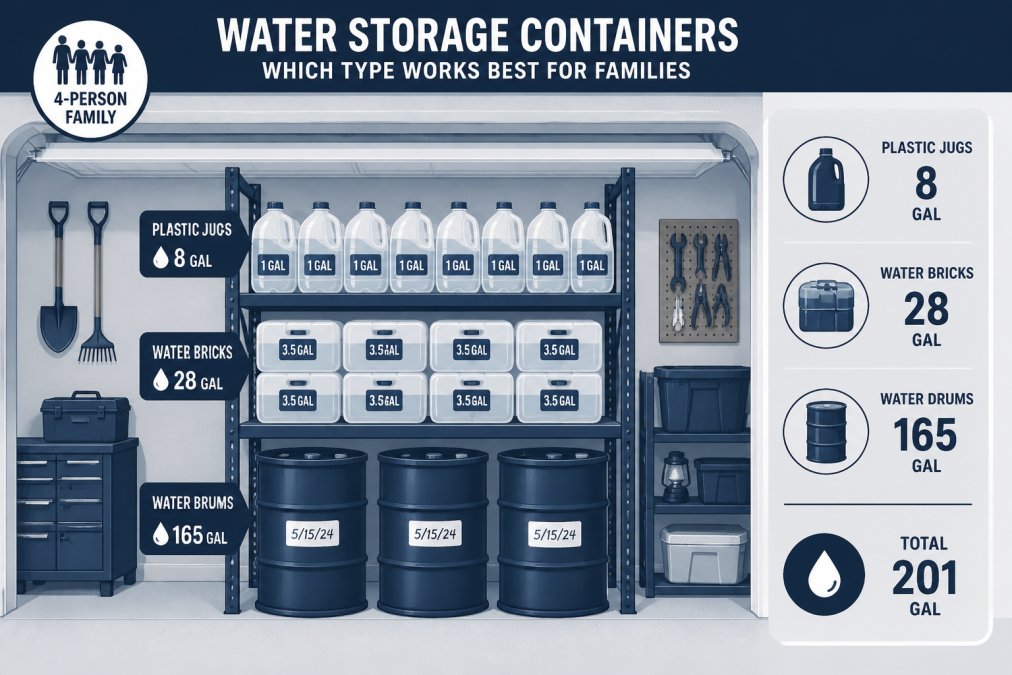
Water Storage Containers: Which Type Works Best for Families
Not all water containers are created equal. Material, shape, durability, and stackability determine whether your emergency supply remains safe and accessible when needed most.
Food-Grade vs. Non-Food-Grade Materials
Food-grade polyethylene is the standard for emergency water storage because it doesn't leach chemicals into water over time. Non-food-grade containers degrade faster and may contain residual chemicals that contaminate stored water.
Food-grade containers meet FDA standards for direct food contact and are manufactured without BPA. Check for NSF/ANSI 61 certification (drinking water contact) and BPA-free designation. Rigid polyethylene containers like the Reliance Aqua-Tainer (7-gallon, ~$24.95) offer impact resistance and last 5-10 years. Flexible water bricks (3.5-gallon models, ~$185 for a 10-pack) stack efficiently but require careful handling.
Space-Saving Solutions for Urban and Apartment Living
Urban families face the biggest storage challenge. An 84-gallon 2-week supply requires roughly the footprint of a large refrigerator.
The AquaPod Kit ($34.95) solves this elegantly. It's a food-grade liner that fits inside a standard bathtub, storing 100 gallons in space you already have. Your bathtub becomes unusable during storage, but for apartments with limited space, it's practical.
WaterBricks are the second-best option for compact living. Their rectangular shape and interlocking design let you stack them vertically in closets or under beds. A 10-pack stores 35 gallons in roughly 3 cubic feet. For families with garages or basements, 55-gallon drums remain the most efficient option, though they're difficult to move once filled (over 400 pounds).
Best Water Purification Methods for Emergencies
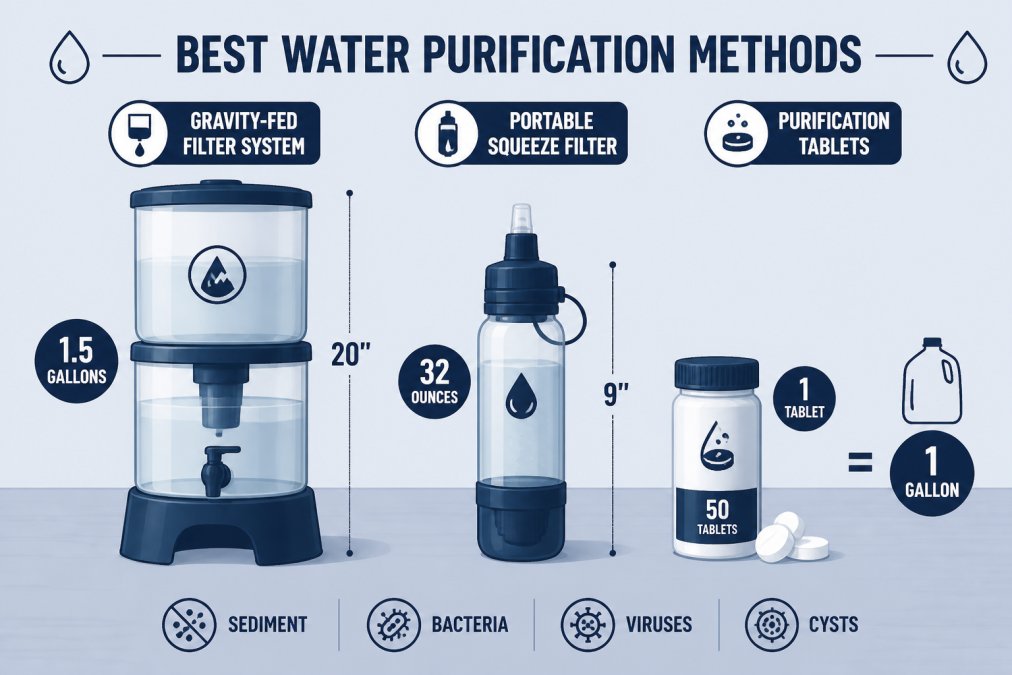
Stored water is only half the solution. If your water source becomes contaminated during an emergency, purification becomes essential. The three main methods, gravity filtration, portable filters, and chemical tablets, each have distinct advantages.
Gravity-Fed Filtration Systems
Gravity-fed systems require no electricity or physical effort. The LifeStraw Family 1.0 ($65.99) filters up to 4,755 gallons and removes 99.999% of viruses, 99.999999% of bacteria, and 99.999% of parasites. The flow rate of 3.1 gallons per hour is slow for immediate large-volume needs, but it's reliable. The Berkey Light ($305 without filters) offers higher capacity and broader contaminant removal, including heavy metals and some chemicals.
Gravity systems don't remove dissolved chemicals or heavy metals effectively. Combine gravity filtration with chemical tablets for comprehensive protection.
Portable Filters and Purification Tablets
Portable filters like the Sawyer Squeeze ($39.99) are lightweight and versatile, rated for 100,000 gallons. However, they don't remove viruses effectively. Portable filters work best combined with boiling or chemical disinfection.
Purification tablets are the most compact solution. Potable Aqua tablets ($15.99-$20.41 for a 50-count pack) treat questionable water in 35 minutes. Katadyn Micropur MP1 tablets ($12-$15 for 20 tablets) are the gold standard, killing all major pathogens including Cryptosporidium, which iodine tablets miss.
Disinfection Methods: Chlorine Bleach and Chemical Tablets
Houshold bleach (5-6% sodium hypochlorite) disinfects water at minimal cost. Add 2 drops per quart or 8 drops per gallon, let sit 30 minutes, and the water is safe from bacteria and viruses. Chemical tablets (chlorine dioxide) are more consistent than iodine because they're effective against Cryptosporidium and don't cause metallic taste.
The best approach combines methods: filter for particles, then chemically disinfect for pathogens.
Safe Storage Locations and Shelf-Life Verification
Where you store water matters as much as how you store it. Temperature fluctuations, light exposure, and contamination determine whether your supply remains safe after months or years.
Temperature, Light, and Contamination Control
Water stored in ideal conditions lasts indefinitely. Ideal means cool (50-70°F), dark, and sealed in food-grade containers. Basements and interior closets are better than garages or attics, where temperature swings encourage algae growth.
Direct sunlight is the enemy. UV light promotes algae growth and degrades plastic. Store water in opaque containers or dark locations. Temperature stability is critical, freezing damages rigid containers, and heat accelerates chemical leaching. A basement that stays 55-65°F year-round is ideal.
Seal containers tightly and store them off the floor to prevent ground moisture and pest access. Check seals every 6 months.
Water Quality Testing Before and After Storage
Before storing water from non-municipal sources, test it with simple test strips (available at hardware stores). After storage, visual inspection catches most problems. Cloudy water, algae growth (green tint), or sediment indicates contamination.
Water stored in cool, dark conditions stays safe for 6+ months easily. Beyond 1 year, rotation becomes important, use older water and replace it with fresh supplies.
Water Rotation Schedule for Families: What Works
A rotation schedule prevents water from stagnating and ensures your supply stays fresh. The right balance depends on your storage conditions and local water quality.
6-Month vs. Annual Rotation Cycles
The 6-month cycle is standard for families storing water in garages or less-than-ideal conditions. Every 6 months, use stored water for household tasks and replace it with fresh supplies. The annual cycle works for families with basements or consistently cool storage at 50-60°F.
Temperature determines the best schedule. If your storage location stays below 65°F, annual rotation is safe. If it fluctuates or stays above 75°F, rotate every 6 months.
Tracking and Labeling Systems
Mark each container with:
- Fill date (month/year)
- Expiration date (fill date + 12 months, or 6 months for uncertain conditions)
- Water source (tap, filtered, treated)
- Any additives (chlorine, bleach, stabilizer)
Use a permanent marker on opaque containers or waterproof labels on clear ones. Store a rotation log, a simple spreadsheet or notebook, near your water storage area.
Budget vs. Premium Emergency Water Supply Options
Understanding where to invest and where to save helps families build preparedness within their budget.
Cost-Effective DIY Storage Setup
A basic 2-week supply for 4 people costs $50-$100 using budget containers and methods:
- 12 Reliance Aqua-Tainers (7-gallon each): ~$300 for 84 gallons
- Sawyer Squeeze filter: ~$40
- Potable Aqua tablets (50-count): ~$16
- Household bleach for backup: ~$5
Total: ~$361 for a 2-week supply with filtration and disinfection backup.
This setup covers emergency basics but requires manual container handling and storage space. Families with limited budgets can use food-grade buckets (5-gallon, ~$8 each) instead of Aqua-Tainers, though buckets are less convenient for dispensing.
Integrated Home Plumbing Solutions
Whole-home water filtration systems (like Berkey or commercial systems) cost $300-$1,000 installed but provide comprehensive purification without ongoing effort. These systems treat water as it enters your home, ensuring safe water even if municipal supplies become contaminated.
For families serious about long-term water security, a whole-home filter combined with stored emergency supplies provides redundancy.
| Solution | Cost | Best For | Storage Needed |
|---|---|---|---|
| Reliance Aqua-Tainers (84 gallons) | $300 | Budget-conscious families | High (closet/garage space) |
| WaterBricks (35 gallons) | $185 | Apartments, space-limited | Medium (under beds, closets) |
| AquaPod (100 gallons) | $35 | Urban apartments | Minimal (bathtub) |
| LifeStraw Family 1.0 | $66 | Families with contamination concerns | Minimal (shelf) |
| Berkey Light System | $305 | Premium, long-term use | Minimal (shelf) |
| Whole-Home Filter System | $500-$1,000+ | Maximum security, ongoing use | Minimal (under sink/basement) |
Choosing the Best Emergency Water Supply for Your Situation
The best emergency water supply depends on your home, family, storage space, and budget.
Matching Storage Method to Your Home and Family Size
Start with your storage constraints. If you have a basement or garage, large containers (55-gallon drums or Aqua-Tainers) are efficient. If you're in an apartment, WaterBricks or the AquaPod are practical. If you have minimal space, prioritize a high-capacity purification system (Berkey) that lets you treat fresh water on-demand.
Next, assess your family's needs. Families with infants, elderly members, or medical conditions need more water and may benefit from a gravity-fed filter for convenience. Active families in hot climates should increase their stored supply by 50%.
Finally, consider your risk profile. If you live in an area prone to water system failures, a whole-home filter combined with stored supplies makes sense. If you're primarily concerned about short-term power outages, a 3-day emergency kit with portable filters is sufficient.
The best emergency water supply combines multiple methods: stored water for immediate access, a gravity-fed filter for larger contamination events, and portable filters or tablets for backup.
Common Mistakes That Undermine Emergency Preparedness
Most families buy supplies once and never check them again. Water containers fail silently. Seals crack. Algae grows. Tablets expire.
The second mistake is underestimating duration. Families who prepare for 3 days face panic when emergencies stretch into week two. Build for at least 2 weeks.
The third mistake is ignoring purification. Every emergency kit needs at least two purification methods (filtration + tablets or bleach).
The fourth mistake is choosing containers based on price alone. A $5 food-grade bucket works better than a $3 non-food-grade container.
Finally, families often forget rotation. Mark containers with dates and rotate every 6-12 months, using older supplies for household tasks while replacing with fresh water.
Conclusion
Preparing an emergency water supply for a 4-person family requires a realistic assessment of your family's needs, clear understanding of storage constraints, and commitment to rotation and maintenance.
The framework is straightforward: calculate your family's needs (minimum 84 gallons for 2 weeks), choose containers that fit your space, add purification methods for contamination events, and commit to a rotation schedule.
SHTF Prepper Club simplifies this process by providing expert guidance and curated emergency preparedness solutions. The platform offers vetted water storage containers, reliable filtration systems, and comprehensive guides that eliminate guesswork. Whether you are sheltering in place or preparing for the unexpected, we provide the reliable resources you need to protect your family.
Start with a 2-week supply of stored water, add a gravity-fed filter for peace of mind, and commit to checking your supplies every 6 months. Your family's safety depends on preparation that happens before the emergency arrives.
FEMA Emergency Preparedness Guide for Water Storage
CDC Guidelines on Water Purification and Disinfection
National Institutes of Health Research on Emergency Water Safety
Frequently Asked Questions
How much emergency water should a family of four store for 2 weeks?
A 4-person family needs 56 gallons minimum for 2 weeks (7 gallons per person per day: 1 gallon for drinking and cooking, 6 gallons for sanitation). The CDC recommends storing 1 gallon per person per day for at least 3 days, but 2-week supplies provide greater security during extended disruptions. Store in food-grade containers in a cool, dark location, rotating supply every 6 months if using tap water.
What's the best water rotation schedule for families?
Rotate tap water stored in containers every 6 months; commercially bottled water lasts longer. Mark each container with the fill date using waterproof labels. Create a simple calendar reminder for rotation dates. If using purification tablets or gravity-fed filters, check expiration dates annually. For families, a spring and fall rotation schedule aligns with daylight saving time changes, making it easy to remember.
Which water purification method works best during long-term emergencies?
Gravity-fed filtration systems remove bacteria, viruses, and protozoa without electricity, making them ideal for extended outages. Models like LifeStraw Family filter thousands of gallons over years. Pair gravity systems with purification tablets as backup for contaminated sources. Portable squeeze filters work well for smaller volumes. Chlorine bleach (unscented, 6-8% sodium hypochlorite) disinfects stored water: use 2 drops per quart, wait 30 minutes before drinking.
Can I store emergency water in my bathtub, and is it safe?
Bathtub liners like the AquaPod store up to 100 gallons of water without contaminating your bathroom. Fill liners only during emergencies since they're single-use. Untreated bathtub water requires purification before drinking. This method works well for sanitation and washing but shouldn't replace dedicated potable water storage in food-grade containers. Liners are cost-effective for large-volume backup storage in homes with limited cabinet space.
This article was written using GrandRanker