
Table of Contents
- Why a Disaster Plan for Single Parents Looks Different
- Start With a Household Hazard Assessment
- How to Build a 72-Hour Emergency Kit Your Kids Can Carry
- Emergency Communication Plan Template for Solo Parents
- Emergency Evacuation Plan for Single-Parent Homes
- Legal, Financial, and Medical Documents to Lock Down
- Support Network, Drills, and Keeping Kids Calm
- Frequently Asked Questions
Last Updated: September 16, 2026
Why a Disaster Plan for Single Parents Looks Different
A disaster plan is a written set of steps that tells your household what to do before, during, and after an emergency. For a single parent, it carries weight a two-adult checklist never accounts for: you are the only adult in the room. At SHTF Prepper Club, we offer expert guidance and vetted solutions to simplify family emergency preparedness.
The Solo-Parent Gap in Standard Preparedness Advice
Most preparedness checklists assume two adults splitting tasks. A single parent does every task alone, often while calming a frightened child.
That changes what your disaster plan needs to prioritize:
- One adult cannot drive two cars, so evacuation logistics must fit one vehicle
- School and daycare pickup authorization must be pre-arranged in writing
- Your support network replaces the missing second parent, so it must be named in advance
Start With a Household Hazard Assessment
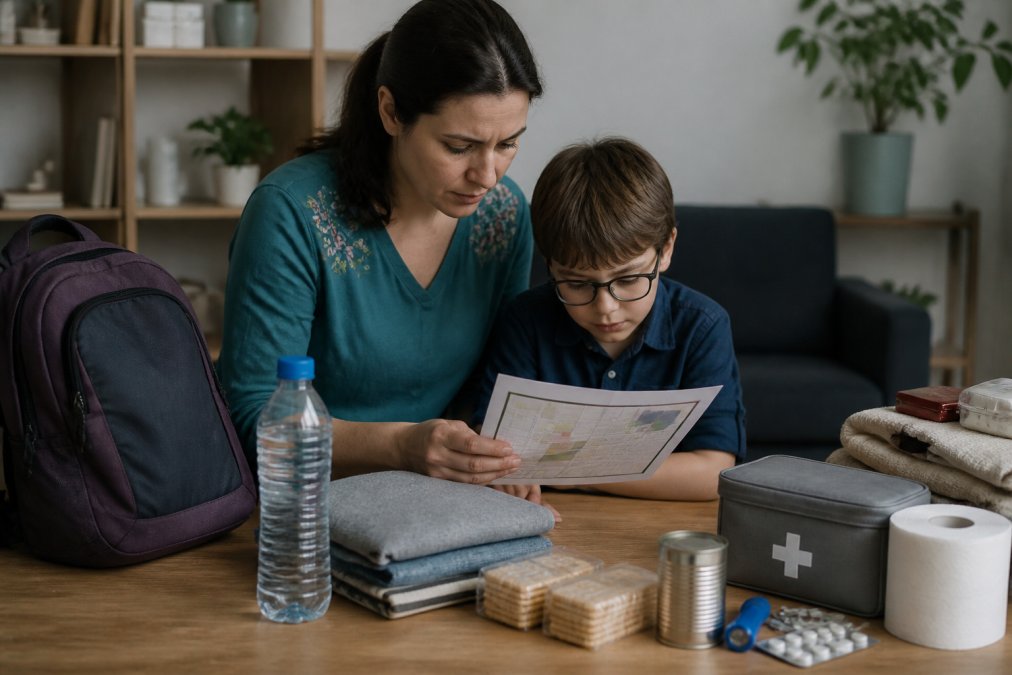
A household hazard assessment is a room-by-room and region-by-region review of the risks your family actually faces. It replaces generic checklists with a plan built for your address, home type, and children's ages.
Mapping Risks by Region, Home Type, and Child Age
Walk through each factor honestly:
| Risk Factor | What to Check | Why It Changes Your Plan |
|---|---|---|
| Region | Flood, wildfire, tornado, or hurricane exposure | Determines evacuation route and go-bag contents |
| Home type | Apartment, rental, or owned house | Renters cannot modify utilities; upper floors change evacuation |
| Child age | Infant, toddler, school-age, teen | Drives what kids can carry and understand |
| Household needs | Mobility, medical devices, medications | Sets supply priorities and backup power needs |
A common mistake is copying a neighbor's plan. Two houses on the same street can have different needs once a child's age or a medical condition enters the picture.
How to Build a 72-Hour Emergency Kit Your Kids Can Carry
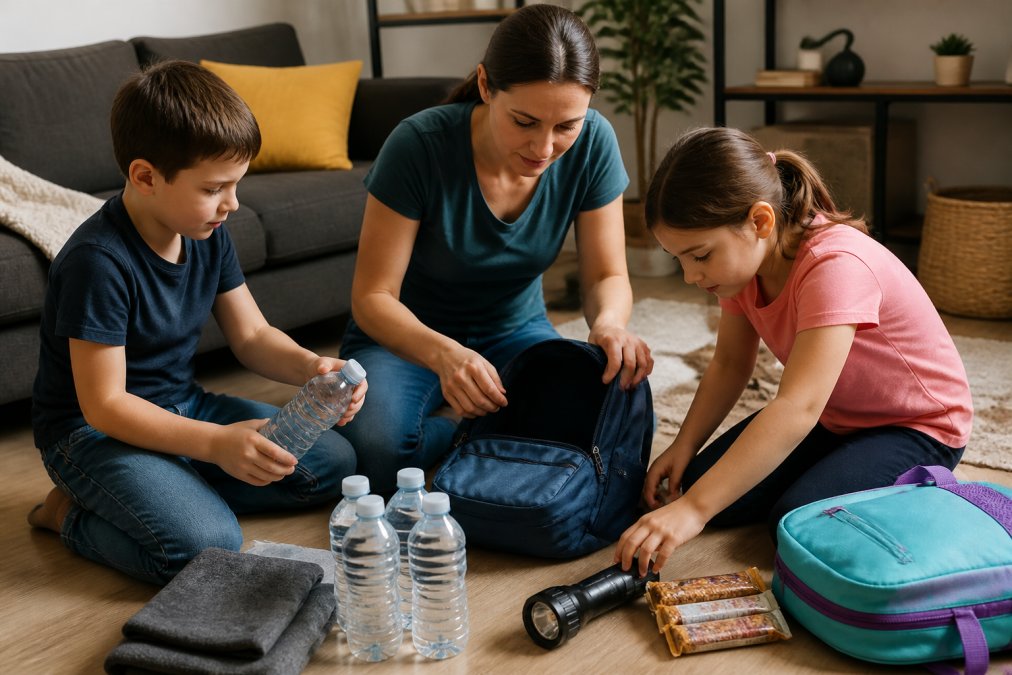
A 72-hour emergency kit holds everything your household needs to survive three days without outside help. For single parents, the goal is different: each child carries their own lightweight go-bag, so you keep both hands free.
Go-Bag Contents for One Adult and Two Children
Build one adult pack and two smaller child packs. Keep each child's bag under roughly ten percent of their body weight.
- Water: one small bottle per child, larger supply in the adult pack
- Non-perishable food: granola bars, nut butter packets, dried fruit
- Flashlight or headlamp with spare batteries
- First aid supplies: bandages, antiseptic wipes, children's pain reliever
- A comfort item: small toy, book, or blanket
- Copies of the emergency contact list
- A whistle on a lanyard
Emergency Communication Plan Template for Solo Parents
An emergency communication plan template is a one-page document listing who to call, where to meet, and who is authorized to collect your children. Fill it in, print two copies, and store one in each go-bag.
Household Emergency Communication Plan
- Out-of-state contact: Name: ______ Phone: ______
- Local backup contact: Name: ______ Phone: ______
- Emergency meeting point (near home): ______
- Emergency meeting point (outside neighborhood): ______
- School/daycare: Name: ______ Phone: ______
- Authorized pickup adults: 1) ______ 2) ______
- Children's medications and allergies: ______
- Insurance policy numbers: ______
Out-of-State Contact and School Pickup Authorization
An out-of-state contact is the single most useful line on the sheet. Local phone lines jam during a regional disaster, but long-distance calls often still connect.
Emergency Evacuation Plan for Single-Parent Homes
An emergency evacuation plan for single-parent homes is a written route and timeline one adult can execute alone. Practice it until your children can follow it without instructions.
- Map two evacuation routes from your home, plus one from school or daycare
- Identify your emergency meeting point if you get separated
- Keep the vehicle fueled above half a tank at all times
- Store a car kit with water, blankets, and a phone charger
- Assign each child one job, such as grabbing their go-bag
Legal, Financial, and Medical Documents to Lock Down
Vital documents turn a chaotic evacuation into a manageable one. Store copies in a waterproof folder in your go-bag and originals in a fireproof safe or with your attorney. For a single parent, this folder is the proof of authority that lets you and your children move through a shelter, hospital, or state line without a second signature.
Custody Orders, Guardianship Letters, and Medical Consent
This is the section most guides skip, and the one single parents cannot afford to ignore. Schools, hospitals, shelters, and law enforcement all operate on documented authority, not verbal claims. When a second parent is not present, only a piece of paper with the right signature unlocks a decision.
- Certified custody order: A photocopy is not enough. Request a certified copy from the issuing court and keep it in the go-bag. Across state lines, a certified order proves you have legal authority to travel with your children. Parents commonly discover at a shelter intake desk that a phone photo is not accepted.
- Notarized guardianship letter: A signed, notarized letter naming who cares for your children if you are incapacitated. It is only as strong as its specificity, name the guardian, name the children, state the duration, and state the authority granted. Some parents also file a standby guardianship or temporary custody arrangement through their local court for stronger footing.
- Medical consent form: Authorizes treatment and lets a trusted adult approve care when you cannot be reached. Pair it with a signed HIPAA authorization so a provider can discuss your child's care with your named adult. Without both, a hospital may treat on an emergency basis but will not release information or non-emergency decisions to your backup.
- Insurance policies: Health, home, and auto policy numbers and claim phone lines. Write the claim phone lines down, during a regional event, online portals are often the first thing to go down.
- Medical records: Immunization records, prescriptions, and allergy lists. For chronic conditions, add the treating provider's name, the pharmacy name and phone number, and the exact dosage schedule.
What to Do When a School, Shelter, or Hospital Refuses Release
Even a complete folder does not guarantee cooperation. A school district's release policy, a shelter's intake rules, and a hospital's consent policy are three separate systems that do not talk to each other. Build for the refusal, not just the approval.
- Get the release policy in writing before an emergency. Ask your child's school for its written pickup authorization policy and emergency release procedure. Confirm in writing that your named adults are on the list, and ask how the school verifies identity during a lockdown.
- Carry the certified order, not a copy of a copy. A certified copy carries a court seal. A photocopy of a certified copy usually does not satisfy an intake worker who is following a checklist.
- Name at least two authorized adults, and make sure both know the school's verification steps. If your one designated adult is unreachable, the school will hold your child. Two names, both briefed, is the minimum.
- Give each authorized adult a one-page packet. Include the child's full legal name, date of birth, the school's phone number, the certified order reference number, the medical consent form, and your out-of-state contact. A backup adult who arrives without paperwork waits in the lobby.
- Escalate in the right order. If a release is refused, ask for the supervisor on duty, then the district or facility emergency line. Keep the certified order and medical consent form in the same folder so you are not searching for two documents under pressure.
A notarized guardianship letter is not the same as a court-ordered guardianship. If you have an ongoing custody dispute, talk to a family law attorney about a standby guardianship or temporary custody order before a disaster, not during one. A letter can be challenged; a court order is much harder to ignore.
Financial Contingency When the Single Income Stops
A disaster that closes your workplace, bank branch, or direct deposit cycle hits a one-income household harder than a two-income one. Build a cash and access layer that does not depend on a working card reader.
- Keep small bills on hand. A mix of ones, fives, and twenties covers gas, food, and a motel night when card networks are down. Store it in the go-bag, not a drawer at home.
- Keep one physical debit or credit card separate from your daily wallet. If your wallet is lost or your primary account is frozen, a second card in the go-bag is a working fallback.
- Write down your account numbers and the bank's emergency phone line. Online banking is often the first service to fail in a regional event.
- Know your employer's disaster pay policy. Ask HR in advance whether you are paid for closure days, whether you can work remotely, and how to file for state unemployment if the closure is extended.
- Keep a copy of your most recent pay stub and your direct deposit details. These speed up an unemployment claim or a disaster assistance application.
The legal folder and the cash folder belong in the same bag. One proves you can make decisions for your children; the other lets you act on those decisions when the card reader is down.
Support Network, Drills, and Keeping Kids Calm
A support network is the group of trusted adults who fill the role a second parent would. Write their names into your disaster plan and tell them what you need. The mistake most single parents make is treating the network as a list of names. A network is a set of rehearsed roles, and a role never practiced fails on the day it is needed.
How to Recruit and Brief Your Backup Adults
Aim for three to five people, each with a defined job. Overlap is fine; single points of failure are not.
- Primary pickup adult: The person who goes to the school or daycare if you cannot. They need the certified custody order reference, the medical consent form, and a photo ID matching the school's list.
- Secondary pickup adult: A different person, at a different address, with a different phone carrier if possible. If one is stuck in traffic or out of signal range, the second is not.
- Household contact: Someone who knows where your go-bags are stored, how to shut off utilities, and how to reach your out-of-state contact.
- Out-of-state contact: The single most useful line on your communication sheet. Local phone lines jam during a regional disaster, but long-distance calls often still connect. This person relays messages between you and everyone else.
Drill Schedule and What to Time
Run a preparedness drill every six months. Time your evacuation, check go-bag contents, and update the contact list. Children who rehearse a plan handle the real thing far better than children who hear about it once.
- Evacuation timing. Start a timer when you say "go" and stop it when the last child is in the vehicle. Write the number down. If it climbs between drills, something in the go-bags has moved or a child has outgrown a task.
- Go-bag check. Open every bag. Replace expired food and water, test flashlights, and confirm each child's bag still fits. A bag right for a six-year-old is wrong for an eight-year-old.
- Contact list update. Call or text every name on the sheet. A number that no longer works is a hole in the plan. Update the school's list at the same time.
- Role swap. Have one child practice grabbing a sibling's bag, and have your primary pickup adult walk through the school release steps with you. The goal is to find the failure before the emergency does.
Put the next drill date on the family calendar and treat it like a dentist appointment. A drill that is not scheduled is a drill that does not happen.
Scripts for Keeping Kids Calm During an Evacuation
The emotional side of preparedness is not separate from the logistics. A child who knows the plan, has packed their own bag, and has met the adults on the contact list is calmer when the power goes out. But calm is not automatic, it is coached. Here are patterns that work at different ages.
For all ages, three techniques that lower the temperature:
- Box breathing: Inhale for four counts, hold for four, exhale for four, hold for four. Do it with your child rather than telling them to. Your own regulated breathing is the strongest signal in the room.
- The name-and-locate game: Have your child name five things they can see, four they can touch, three they can hear. This pulls attention out of the panic loop and into the present.
- The comfort item rule: Every go-bag has one comfort item chosen by the child. Let them pick and pack it themselves. A child who packed their own blanket knows exactly where it is.
You cannot promise a child that nothing bad will happen. You can promise them that you have a plan, that they have a job, and that the adults on the list know what to do. That promise is the one that holds.
Frequently Asked Questions
What should a single parent include in a basic emergency kit?
A 72-hour kit for one adult and two children needs one gallon of water per person per day, non-perishable food, a flashlight, a battery-powered or hand-crank radio, first aid supplies, and any prescription medications. Add copies of insurance policies and medical records in a waterproof bag, plus a comfort item for each child. Keep the kit where you can grab it in under a minute, and rotate food and water every six months so nothing expires.
How do I coordinate emergency communication when I'm the only adult?
Name one out-of-state contact who both you and your children call or text during a disruption, since local lines often fail first. Print the emergency communication plan template and tape it inside a kitchen cabinet and each child's backpack. Teach kids to text rather than call, because texts route faster when networks are strained. Give your school and daycare the out-of-state contact name so they can reach someone if you cannot get through.
What legal documents should a single parent prepare before a disaster?
Keep a notarized guardianship letter naming who takes your children if you are hospitalized or unreachable, plus a copy of any custody order, medical consent forms, and vaccination records. Store originals in a fireproof safe and digital copies in encrypted cloud storage. Check your state's rules on temporary guardianship, because requirements vary. Review the packet every year and after any custody change so the names and contact details stay current.
How can single parents simplify preparedness without feeling overwhelmed?
Break it into one task per week: week one, buy water; week two, print the contact list; week three, scan documents. A household inventory of what you already own prevents duplicate spending. Start with the 72-hour kit and communication plan, then layer in evacuation routes and drills. Small, steady steps build disaster resilience faster than one expensive weekend of shopping, and you can scale kits up as your budget allows.