
Table of Contents
- What to Look for in the Best Portable First Aid Kits for Families
- First Aid Kit Checklist for Families: Essential Supplies for Every Emergency
- How to Organize a Family First Aid Kit for Fast Access
- Portable First Aid Kit Maintenance: Expiration Management and Restocking
- Top Portable First Aid Kits for Families: A Comparison
- Age-Specific and Climate-Specific Customization for Your Family
- Conclusion: Choosing the Right Portable First Aid Kit for Your Family
- Frequently Asked Questions
Last Updated: September 16, 2026
What to Look for in the Best Portable First Aid Kits for Families
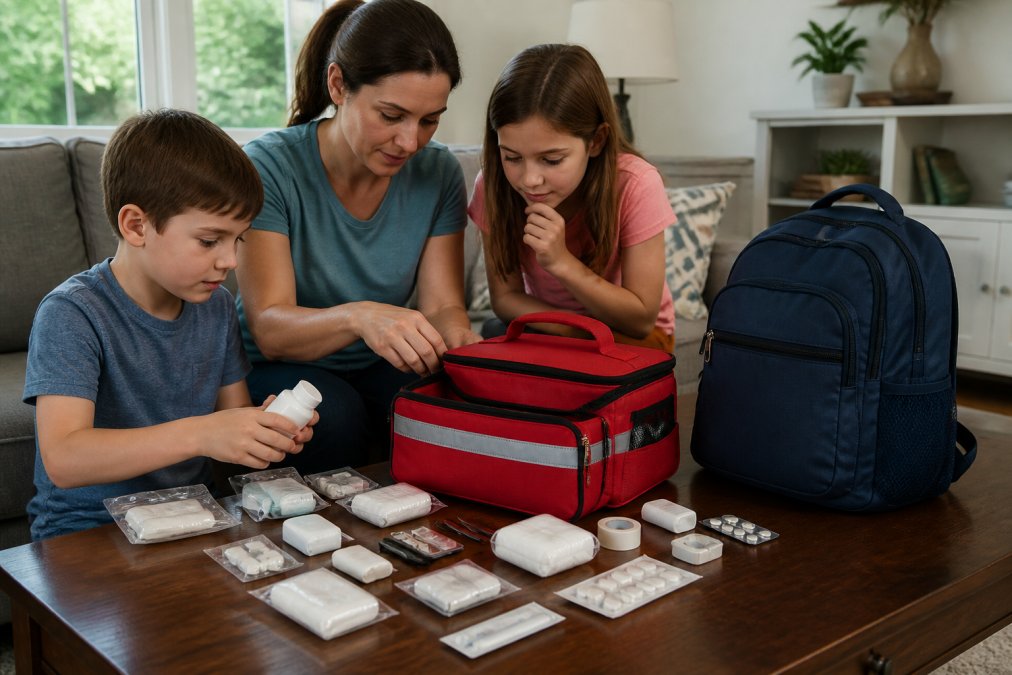
The best portable first aid kits for families balance supply depth with grab-and-go convenience, so you can treat everything from a scraped knee to a deeper wound without digging through a disorganized bag. This guide from SHTF Prepper Club breaks down exactly what belongs in a family kit, how to organize it, and which options hold up under real-world use.
A portable first aid kit is a compact, self-contained collection of medical supplies designed to be carried or stored within reach for immediate injury response.
Most families overbuy bandages and underbuy the supplies that actually matter in a serious situation. A common mistake is treating supply count as the only measure of quality. What most guides miss is that organization and expiration management determine whether a kit works when you're panicked.
Here's what separates a kit that helps from one that sits unused:
- Durable, compartmentalized case: water-resistant fabric or hard-shell protection keeps supplies sterile and dry. Look for 600D polyester or molded hard shells; thin nylon cases tear at zippers within a season of car storage.
- Trauma-capable supplies: sterile gauze, elastic bandages, and trauma shears for wounds beyond a simple scrape. A kit that only handles minor cuts is not a family kit.
- Family-scale quantity: enough adhesive bandages, antiseptic wipes, and burn treatment for multiple people. A family of four should plan for at least two full wound-care cycles before restocking.
- Portability: lightweight enough to move between car, home, and travel without becoming a burden. Under five pounds is the practical ceiling for a kit that actually leaves the house.
- Clear labeling and an inventory card: if a babysitter or grandparent can't find the gauze in ten seconds, the kit fails its main job.
Standards and certifications to look for
First aid kits sold in the United States are not required to meet a single federal standard, which is why quality varies so widely. Two reference points are worth knowing:
- ANSI/ISEA Z308.1 is the voluntary consensus standard for workplace first aid kits. It defines minimum fill requirements by kit class (Class A for common injuries, Class B for higher-risk environments). A kit that meets Class A is a reasonable floor for a family kit, even though household kits aren't legally bound to it.
- OSHA 29 CFR 1910.151 requires employers to have first aid supplies available, and many kits marketed to families borrow that language. It does not apply to homes, but it signals a kit was designed against a real supply list rather than a marketing checklist.
What most guides skip is that a kit's case matters as much as its contents. A water-resistant zipper and internal elastic loops prevent the two most common failure modes: rusted instruments and supplies spilling into an unsearchable pile.
American Red Cross first aid guidance recommends checking your kit's contents at least twice a year, since a kit you never inspect is a kit you can't trust.
The pediatric and multi-caregiver angle most buyers miss
Generic kits are built for an average adult. Families need three things generic kits rarely include:
- Child-sized dosing tools. A kitchen teaspoon is not a dosing device. Look for a kit that leaves room for a marked oral syringe and a weight-based dosing chart.
- A second set of instructions a non-parent can follow. Grandparents, sitters, and older siblings are often the first responders. A laminated card with 911 guidance, allergy information, and medication locations is worth more than an extra roll of tape.
- Child-resistant storage for anything swallowable. Loose pills in a zip pouch are a poisoning risk. Keep medications in their original child-resistant containers inside the kit.
Specificity beats volume. A kit sized for your household's ages, storage location, and most likely emergencies will outperform a bigger generic box every time.
First Aid Kit Checklist for Families: Essential Supplies for Every Emergency
A complete family first aid kit checklist covers wound care, burn treatment, blister prevention, and basic life support tools for the whole household.
Build your kit in three layers: minor injuries, trauma supplies, and emergency response gear.
How to Organize a Family First Aid Kit for Fast Access
A few organizing principles that hold up in practice:
- Color-code by category: red pouch for bleeding control, blue for burns, green for minor wounds.
- Front-load the critical items: heavy-duty supplies should never be buried under bandages.
- Add an inventory card: list every item and its expiration date so restocking is fast.
- Keep a laminated card with emergency numbers and basic first aid steps.
Portable First Aid Kit Maintenance: Expiration Management and Restocking
Portable first aid kit maintenance comes down to one habit: a scheduled inventory check every six months, plus immediate restocking after any use.
A maintenance routine that survives real households
| Task | Frequency | Why It Matters |
|---|---|---|
| Full inventory check | Every 6 months | Catches expired or missing items |
| Restock after use | Immediately | Keeps kit ready for the next event |
| Check seals and packaging | Every 6 months | Sterile supplies fail if compromised |
| Verify medication dates | Every 6 months | Expired meds can be ineffective |
| Update the pediatric dosing card | Every 6 months | Children's weights and prescriptions change |
| Confirm emergency contacts | Every 6 months | Phone numbers and sitters change |
The family-specific maintenance gap
- A shared digital inventory. Photograph the kit's contents and store the image in a shared cloud folder. Anyone can compare the photo to the physical kit in under a minute. This is the single highest-leverage maintenance upgrade for multi-caregiver homes.
- A restock bin, not a restock errand. Keep a small bin of the kit's most-used consumables (adhesive bandages, gauze, antiseptic wipes) in the same closet. When the kit is used, refill from the bin the same day. Waiting for a store trip is how kits stay depleted for weeks.
- A pediatric expiration pass. Children's fever reducers, nasal aspirators, and dosing syringes have shorter useful lives than adult supplies and are the items most often overlooked. Check them at every six-month pass, not just annually.
What to do with expired supplies
- Move expired-but-intact supplies to a practice kit. Gauze, tape, and bandages past their prime are fine for practicing wound wrapping or for a child's first-aid class.
- Dispose of anything sterile, medicated, or sealed. Compromised sterility is the one thing you cannot visually verify.
- Check local household hazardous waste rules for expired medications. Many communities run take-back programs; flushing is discouraged because of water-system impact.
Top Portable First Aid Kits for Families: A Comparison
Other solid options worth knowing:
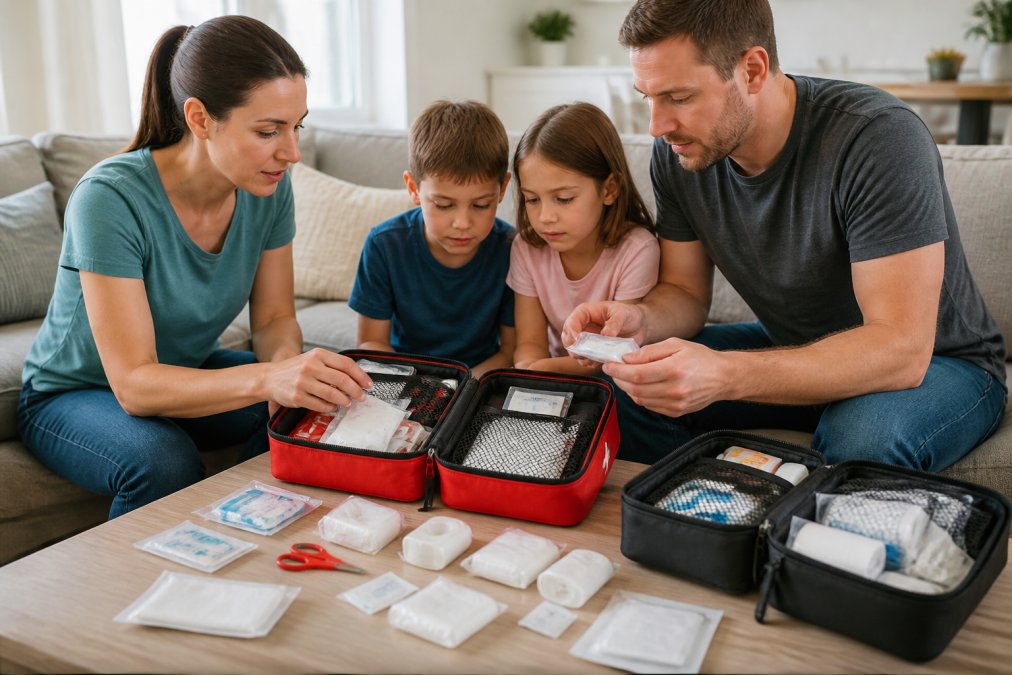
Surviveware Small Comprehensive Premium First Aid Kit (about $36): water-resistant 600D polyester, labeled compartments, MOLLE-compatible straps, 100 pieces. Best for car travel and hiking. The tradeoff is a higher price than basic kits.
| Kit | Approx. Price | Pieces | Best For |
|---|---|---|---|
| SHTF Prepper Club | See site | Curated set | Complete family preparedness |
| Surviveware Small | $36 | 100 | Car travel, hiking |
| Red Cross Deluxe Family | $49.95 | 115 | Home and family travel |
| Swiss Safe Professional | $28 | 120+ | Household and vehicle |
| First Aid Only All-Purpose | $20 | 299 | Home, office |
Age-Specific and Climate-Specific Customization for Your Family
Conclusion: Choosing the Right Portable First Aid Kit for Your Family
The hardest part of family preparedness isn't buying a kit, it's building one that actually fits your household and stays ready.
Frequently Asked Questions
What is the best first aid kit for home use?
The best kit depends on your family's size and needs. For home use, look for a kit with at least 100 pieces, including sterile gauze, adhesive bandages, antiseptic wipes, and a CPR mask. A hard-shell case offers durability, while a soft case provides portability. Ensure it includes a first aid guide and is easy to restock.
What should be in a household first aid kit?
A household first aid kit should include adhesive bandages, sterile gauze, medical tape, antiseptic wipes, antibiotic ointment, hydrocortisone cream, elastic bandage, instant cold pack, tweezers, scissors, and a CPR mask. Add medications like pain relievers and antihistamines, plus a thermometer. For families, include pediatric doses and hypoallergenic, latex-free options. Store items in a durable, waterproof, compartmentalized case. Check expiration dates every six months and restock as needed.
How often should you check your family first aid kit?
Check your family first aid kit every six months, or more often if you use it frequently. Inspect for expired medications, damaged packaging, and missing items. Replace any used or expired supplies immediately. A good routine is to check at daylight saving time changes each spring and fall. This ensures your kit is always ready for emergency response. Keep a checklist inside the kit to track inventory and expiration dates.
What are the essential items for a portable first aid kit?
Essential items for a portable first aid kit include adhesive bandages in various sizes, sterile gauze pads, rolled gauze, medical tape, antiseptic wipes, antibiotic ointment, blister prevention pads, elastic bandage, trauma shears, tweezers, and a CPR mask. Include nitrile gloves, a emergency blanket, and a first aid guide. For families, add children's medications and hypoallergenic supplies. Choose a lightweight, compact, waterproof case with organized storage for quick access during minor injuries or emergency response.