
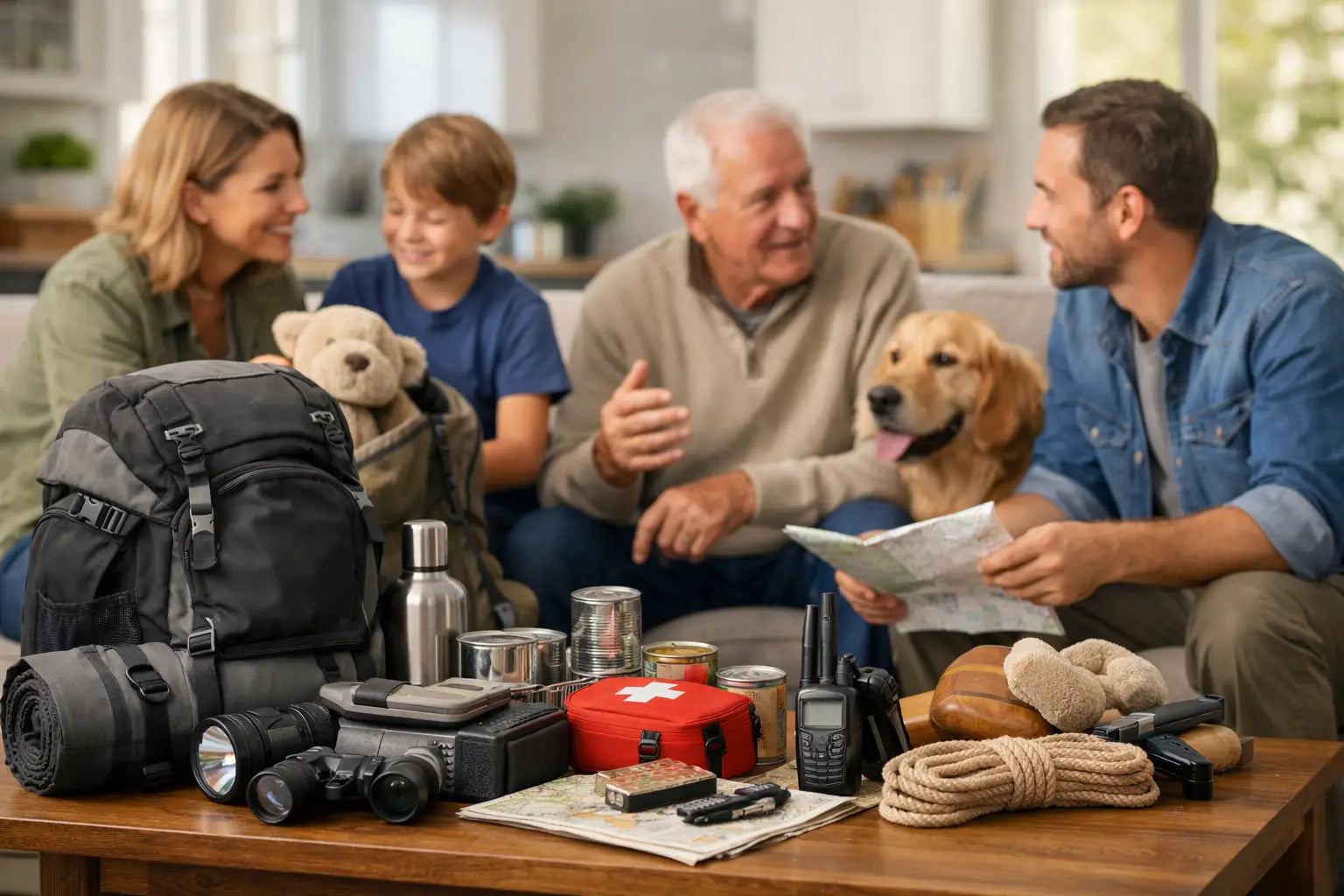
The order to leave rarely arrives at a convenient time. It may come while dinner is on the stove, when a child is at practice, or after a long night without power. Family bug out planning gives you a way to make clear decisions before a wildfire, hurricane, flood, or other emergency turns every small choice into a stressful one.
For most households, “bugging out” simply means evacuating safely and staying functional away from home for a few days. At SHTF Prepper Club, we call the gear an evacuation bag because the goal is not to disappear into the wilderness. It is to get your family, pets, medicines, documents, and basic comforts from point A to a safe place with less chaos.
Family Bug Out Planning Starts With One Decision
First, decide what would make your family leave home. Do not assume every emergency requires evacuation. A winter outage may be safer to ride out with stored water, food, warmth, and backup power. A fast-moving wildfire, a mandatory hurricane evacuation, a chemical spill, or rising floodwater is different. Leaving early can be the safest choice.
Write down the triggers that apply where you live. For example, your family may leave when local officials issue an evacuation order, when a nearby wildfire reaches a certain distance, when floodwater blocks the route to town, or when an approaching storm makes travel unsafe after a stated hour. The exact trigger depends on your area and your home.
The useful part is agreeing ahead of time. In an emergency, you do not want one adult thinking, “Let’s wait another hour,” while the other is already trying to pack the car.
Choose Where You Will Go Before You Need To Go
An evacuation plan needs destinations, not just a general intention to “head somewhere safe.” Pick a primary location, such as a relative’s home outside the hazard area, and at least two backups. One should be in a different direction than your first option. Wildfires, hurricanes, and road closures do not always cooperate with the route you expected to use.
Talk with the people you may stay with. Confirm their address, their preferred contact method, and whether they can realistically accommodate your household and pets. If staying with family is not possible, identify hotels, public shelters, or campgrounds that are outside your most likely hazard zone. Keep enough cash on hand for fuel, food, and a night or two of lodging if card systems are down.
Map at least two routes to each destination. Your phone may still be useful, but do not make it your only navigation plan. Keep a current paper road map in the vehicle and mark major highways, alternate roads, hospitals, fuel stops, and meeting locations.
Plan for Separation During the Day
Parents are often at work when children are at school, and older kids may be driving themselves. Set a family meeting point that is not your house, plus an out-of-area contact everyone can call or text. A relative in another state is often a good choice because local phone networks can be overloaded while long-distance messages still get through.
Each person should know who is authorized to pick up children, where the evacuation bags are stored, and what to do if they cannot reach the rest of the family right away. Keep this simple enough that a tired teenager, an aging parent, or a babysitter can follow it.
Build Evacuation Bags Around Real Needs
A good evacuation bag supports your family for 72 hours, but it should not become so heavy that no one can carry it. Start with one bag per person when possible. Young children can carry a small backpack with comfort items and lightweight essentials, while adults handle water, food, first aid, and shared equipment.
Every bag should cover the basics:
- Water and a dependable way to treat or filter additional water
- Ready-to-eat food your family will actually eat
- Weather-appropriate clothing, sturdy shoes, and rain protection
- A flashlight or headlamp, spare batteries, and charging cables
- Basic hygiene supplies, masks, and hand sanitizer
- Copies of key documents, emergency contacts, and some cash
- Necessary medications and a written list of prescriptions
- A compact first-aid kit tailored to your household
Food is one area where practicality matters more than variety. Choose items that are shelf-stable, require little or no cooking, and fit dietary needs. Emergency food storage at home is valuable, but evacuation food should be portable and easy to eat in a car, hotel room, or shelter.
Do Not Forget the Pets
Pets are family members, and many evacuation shelters have limits on animals. Keep a pet carrier, leash, vaccination records, medication, food, water bowl, waste bags, and a current photo of each pet near your household evacuation supplies. Microchip information and ID tags should be current before an emergency, not after.
If you have livestock or backyard chickens, your plan may look different. In a fast evacuation, you may need a trusted neighbor who can help, pre-positioned feed and water, and a clear plan for the animals you cannot transport. That is a hard reality, but planning for it early is kinder than hoping it works out under pressure.
Make the Vehicle Part of the Plan
Your car is likely your primary evacuation tool. Keep the fuel tank at least half full during high-risk seasons. Gas stations may lose power, run out of fuel, or have long lines once an evacuation begins.
Store a basic vehicle kit with jumper cables, a tire inflator, a tire repair kit, reflective triangles, blankets, a phone charging option, and drinking water. Keep your evacuation bags in a known location near the exit or garage, rather than scattered across closets. The best supplies are the ones you can load in five minutes.
Think through seating and cargo space before buying gear. A family of five, a large dog, and four oversized bags may not fit in one vehicle. If space is tight, prioritize medication, documents, water, essential clothing, and the items that keep children safe and calm. You can replace many things later. You cannot replace a missed medication or an irreplaceable document easily.
Assign Jobs So One Person Is Not Doing Everything
Many household emergency plans fail because one parent carries the entire mental load. Give each capable family member a short, specific role. One person loads bags and pet supplies. Another checks windows and turns off appliances if there is time. An older child can gather chargers, phones, and comfort items. A grandparent may be responsible for medications and document folders.
Put these roles on a single printed page near your supplies. Include a final five-minute check: people, pets, medications, documents, bags, phones, and fuel. Your plan should still work if the person who normally manages everything is stuck at work or helping an injured neighbor.
Practice once or twice a year. Pick a calm Saturday morning, set a timer, load the vehicle, and drive the first few miles of your primary route. You will quickly find problems: a bag that is too heavy, a missing pet carrier, an expired prescription, or a route that is always clogged after school. That is not failure. It is exactly why you practice.
Keep Your Plan Current Without Making It Complicated
Review your family evacuation plan at the start of hurricane, wildfire, tornado, or winter storm season. Update it after a move, a new school, a new medication, a new pet, or a change in a family member’s mobility. Rotate food and water, replace batteries, and check that documents are still current.
You do not need a garage full of gear to begin. A written destination, a full tank, a document folder, and a few well-chosen supplies are a meaningful start. Preparedness grows best in layers, one practical decision at a time.
The calm you want during an evacuation is built on an ordinary day. Put fifteen minutes on the calendar this week, choose your first destination, and talk it through with the people you love.