
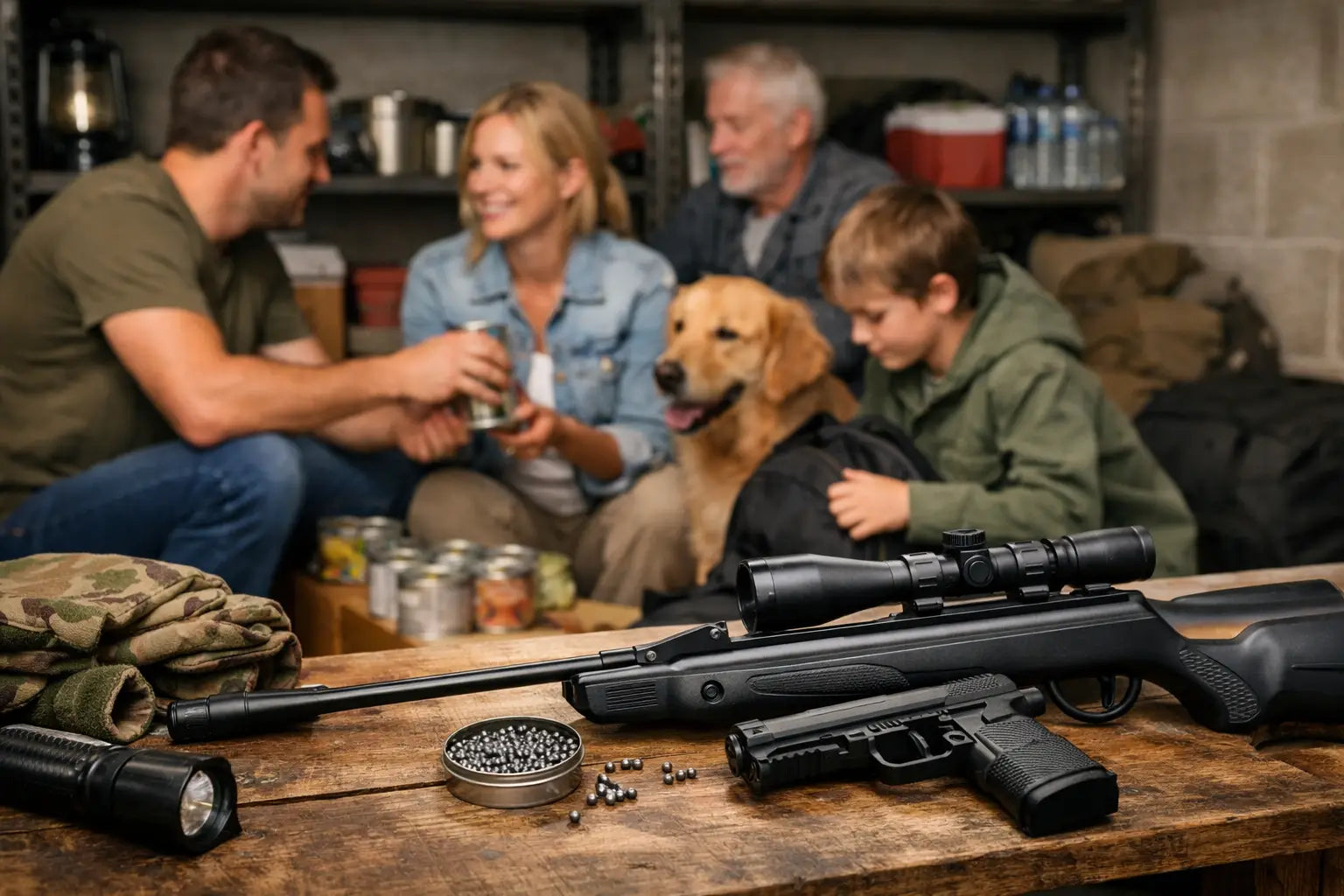
The first time a long outage stretches into day three, your thinking changes. You stop asking what feels interesting and start asking what is useful, affordable, and realistic for your household. That is where the question of why non licensed airguns help family emergency preparedness starts to make sense for ordinary families.
For many households, preparedness is not about building a bunker or collecting gear for the sake of gear. It is about filling practical gaps. Can you protect stored food from pests? Can you practice safe marksmanship without the cost and noise of a firearm? Can you add one more layer of capability to your home plan without adding complexity your family will never maintain? In the right setting, a non licensed airgun can help with all three.
Why non licensed airguns help family emergency preparedness
A non licensed airgun sits in a useful middle ground. It is not a replacement for every defensive tool, and it should never be treated casually. But for many families, it offers a lower-barrier way to build skill, handle small property problems, and increase self-reliance.
That lower barrier matters. Firearms training can be expensive, loud, intimidating for new shooters, and harder to practice regularly if you live in a suburban area. Airguns, especially quality pellet and BB models used responsibly, can be more approachable for adults who want to teach basic safety, sight alignment, trigger control, and calm handling habits. Those are foundational skills. They do not replace broader training, but they do make practice more accessible.
The other reason families consider them is utility. In some emergency scenarios, the issue is not dramatic personal defense. It is the raccoon getting into feed, the rat chewing into storage, or the squirrel damaging a garden that your household depends on more than usual during supply disruptions. A capable airgun may be a practical tool for pest control where legal and appropriate.
The value is in training, not fantasy
Preparedness works best when it stays grounded in likely problems. Most families are more likely to deal with storm damage, supply shortages, spoiled freezer food, and disrupted routines than a cinematic collapse. That is why the strongest case for airguns is not fantasy. It is repetition.
An airgun lets you practice the habits that matter under stress: safe storage, muzzle awareness, target identification, and disciplined shooting. If your family already owns firearms, an airgun can be a lower-cost way to keep skills fresh between range visits. If your household does not own firearms, it can still be a structured way to teach respect, control, and responsibility.
That matters for parents and grandparents because emergency readiness is partly about confidence. Tools are only useful when the people in the home know how to handle them safely. An item that sits untouched in a closet is not really part of your plan.
A better fit for cautious households
Some families are not comfortable bringing firearms into the home. Others are open to the idea but want to start with something less expensive and less overwhelming. A non licensed airgun can fit that gap.
It can also be easier to integrate into a broader home readiness plan. Families who are already organizing food storage, water filtration, backup power, first aid, and evacuation bags often appreciate tools that do more than one job without a steep learning curve. In that context, an airgun is not the center of preparedness. It is one supporting tool among many.
Where airguns make practical sense
The best use cases are pretty ordinary. Rural and exurban families may need occasional pest control around chicken feed, gardens, sheds, or stored grain. Homeowners with larger lots may want a quiet training option that does not require a full trip to the range. Grandparents with property may want a simple way to deal with nuisance animals before grandchildren visit.
There is also a budget angle. Preparedness adds up fast. Water storage, shelf-stable food, batteries, radios, medical supplies, and power backup all compete for the same dollars. Compared with many other shooting platforms, airguns often cost less to buy and less to train with over time. That makes consistent practice more realistic.
None of this means every family needs one. Apartment dwellers, households with no safe training space, and families focused entirely on evacuation readiness may have better places to put their money first. Water, food, medications, lighting, communication, and first aid still come before specialty tools.
Why non licensed airguns help family emergency preparedness for beginners
Beginners often need a first step that feels manageable. That is one reason why non licensed airguns help family emergency preparedness for newer households. They can reduce friction.
You can teach the basics in a more controlled way. The report is usually lower. Ammunition is often cheaper. Repetition is easier. For many adults, that leads to more practice instead of less. And practice is what turns a purchase into capability.
There is also less social baggage for some families. Plenty of parents want practical readiness without feeling like they are stepping into a culture that does not fit them. A calm, utility-focused approach works better. Learn safe handling. Understand local laws. Set strict household rules. Use the tool for training or legitimate property needs. Keep it in its lane.
They are not a substitute for everything
This is where nuance matters. Airguns are not a cure-all. They are not equal to firearms for home defense, and anyone suggesting otherwise is oversimplifying a serious topic. If your goal is comprehensive family security, your plan should include hardening the home, improving lighting, building communication procedures, strengthening doors and locks, maintaining medical readiness, and understanding your legal options.
Preparedness is layered. An airgun may fit one layer, especially around training and small-scale utility, but it should not carry expectations it cannot meet.
Safety and legal reality come first
Non licensed does not mean unregulated everywhere, and it definitely does not mean harmless. State and local laws vary. Neighborhood rules vary. Safe use standards do not vary.
If you bring an airgun into your preparedness setup, treat it with the same respect you would any projectile tool. Secure storage matters. Children need clear rules and active supervision. Backstops matter. Eye protection matters. So does a designated practice area where no person, pet, window, or neighboring property is at risk.
This is especially important for family-centered preparedness. The goal is not to add risk inside the home. The goal is to add useful capability while maintaining safety, calm, and clear boundaries.
How to decide if one belongs in your plan
Start with your actual risks. If you live on a small suburban lot with strict ordinances and no pest issues, an airgun may not solve a real problem for you. If you live on a few acres, store feed, manage a garden, or want an approachable way to build shooting discipline, it may deserve a place on your list.
Then look at priorities. If you still do not have enough stored water, backup lighting, shelf-stable food, weather radio coverage, and a basic medical kit, handle those first. Family preparedness works best when the boring basics are already covered.
After that, ask whether your household will really train. Honest answers save money. The best gear is the gear your family understands, uses, and maintains. A modest tool that gets used responsibly is more valuable than an ambitious purchase that gathers dust.
For families who want practical readiness without drifting into extremes, that is the real case here. Non licensed airguns can offer affordable skill-building, help with legitimate pest problems, and support self-reliance in a way that feels approachable. At SHTF Prepper Club, that kind of realistic readiness is always the goal - not more gear for its own sake, but the right tools for the life your family actually lives.
Preparedness does not have to start with the biggest decision. Sometimes it starts with one useful tool, one new skill, and one household conversation that leaves everyone a little more capable than they were last week.