
Last Updated: November 11, 2026
Quick Summary
To protect your car during civil unrest, prepare before trouble starts: keep your tank above half full, park facing out, and store a three-tier kit with a window breaker and seatbelt cutter in the driver's seat reach zone. Stay inside with doors locked and windows up, and drive away from crowds rather than through them.
- Keep your fuel tank above half full at all times and park facing out.
- Store the window breaker and seatbelt cutter in the reach zone, never the trunk.
- Check your vehicle kit twice a year and replace expired water and food.
- If surrounded, slow down, keep hands visible, and roll out through a safe gap.
- After any incident, preserve dash camera footage and file a police report if needed.
Table of Contents
- Why Vehicle Protection Starts Before You Leave the Driveway
- Build a Civil Unrest Survival Kit for Your Vehicle
- Defensive Driving Techniques for Civil Unrest
- How to Escape a Riot in Your Car
- Vehicle Hardening Modifications and Perimeter Security
- Legal Implications of Vehicle Defense Measures
- Post-Incident Vehicle Inspection and Next Steps
- Stock Your Vehicle Kit Before the Next Disruption
- Frequently Asked Questions
Why Vehicle Protection Starts Before You Leave the Driveway
Most drivers think about car safety mid-crisis. That is backwards. Learning how to protect your car during civil unrest starts at home, long before you turn the key.
Vehicle protection means reducing what can go wrong with your car, your route, and your visibility before a disruption reaches your street.
Civil unrest is a period of public disorder, protests, riots, or looting, that disrupts normal movement and safety.
Three prep habits pay off first:
- Keep your tank above half full at all times
- Park facing out so you never reverse into a crowd
- Store a kit in the trunk, not the garage
The broader family plan matters too. If you want the full picture for shelter, evacuation, food, and power, read civil unrest preparedness for families before you build the vehicle layer.
Build a Civil Unrest Survival Kit for Your Vehicle
A civil unrest survival kit is a compact set of tools and supplies that keeps you moving, safe, and self-reliant if roads close or you cannot get home.
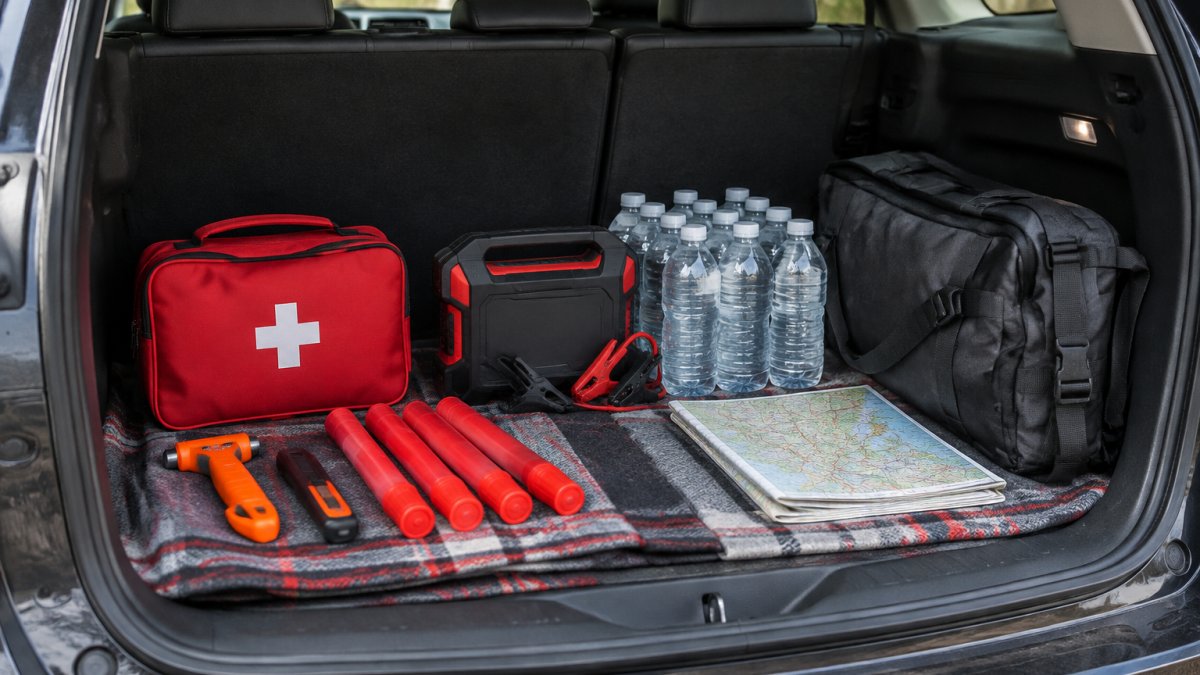
The mistake most drivers make is treating the kit as one undifferentiated bag. A better approach is three tiers, each stored where you can reach it when your hands are shaking and the road ahead is blocked.
Tier 1: The Reach Zone (Driver's Seat)
This is what you can grab without unbuckling. It handles the first sixty seconds of a problem.
- Window breaker and seatbelt cutter: one combined tool clipped to the door pocket or console, not the glovebox. Test it on a junkyard window once so you know the swing.
- Flashlight: a small handheld or headlamp within arm's reach. A headlamp keeps both hands free if you have to change a tire in the dark.
- Phone mount and charging cable: a dead phone is a dead map. Keep the cable plugged in so the phone charges whenever the engine runs.
Tier 2: The Trunk Kit (Core Survival)
This layer keeps you fed, watered, and mobile for 24 to 72 hours if you cannot get home. Pack it in a single soft-sided bag so it moves with you if you abandon the car.
- Water: sealed pouches or bottles sized for every seat, plus a filter straw as backup. Plan for a reasonable daily supply per person for drinking and basic sanitation, adjusting for climate and activity.
- Food: shelf-stable bars and pouches that tolerate heat and cold. Rotate them at your twice-yearly check.
- First aid kit: bandages, gloves, gauze, antiseptic wipes, and any personal medication, including a spare dose of anything you take daily.
Tier 3: The Contingency Layer (Optional but Worth It)
These items are not mandatory, but they close gaps that generic kits ignore.
- Prepaid backup phone on a second carrier: if your main phone dies or a network jams, a cheap prepaid device on a different carrier gives you a backup line. Keep it charged and off until needed.
- Spare pair of glasses or contacts: small, but critical if your primary pair breaks.
- Written contact card: two names and numbers on paper, taped inside the kit lid. Your phone may be the thing that fails.
Kit Maintenance That Actually Happens
A kit you never check is a kit you cannot trust. Put two dates on your calendar each year, the same months you change smoke detector batteries work well, and run this check:
- Open every bag and confirm nothing is missing or expired
- Test the jump box and the flashlight batteries
- Replace water and food that are near their dates
If you would rather buy one ready-made bag than assemble it item by item, our vehicle emergency kit covers the core tools in a single package. For a deeper checklist that mirrors a 72-hour setup, use this 72 hour survival kit checklist and match your car kit to it.
Watch out: do not store the breaker tool in the trunk with the rest of the kit. If the car is pinned or you are trapped by a seatbelt, the trunk is the one place you cannot reach.
The kit works best in three tiers, each stored where you can reach it when it matters.
| Tier | Where it lives | What it covers |
|---|---|---|
| Tier 1: Reach Zone | Driver's seat | Window breaker, flashlight, phone cable, paper map |
| Tier 2: Trunk Kit | Trunk, in one soft-sided bag | Water, food, first aid, jump box, flares, cash |
| Tier 3: Contingency Layer | Optional additions | Prepaid backup phone, spare glasses, contact card, extinguisher |
Defensive Driving Techniques for Civil Unrest
Defensive driving for civil unrest means driving to avoid trouble rather than react to it: reading the road ahead, keeping space around your car, and leaving before a situation tightens. The goal is never to win a confrontation, it is to never have one.
Planning Routes and Identifying Safe Havens
Map your normal trips and find a second way to reach each one. A route you have never driven is a bad route in a crisis.
Build a short list of safe havens along your common paths:
- Police and fire stations
- Hospitals with open lots
- Grocery stores with well-lit parking
Fuel management belongs here too. Fill up when the gauge hits half, not empty. Stations close, pumps run dry, and lines form fast.
How to Escape a Riot in Your Car
The safest move in a riot is usually to leave before it forms. If you are already near one, stay inside the vehicle, keep doors locked and windows up. Do not stop to watch or film from the driver's seat. Drive away on a route that avoids the crowd entirely.
A window breaker and seatbelt cutter belong within arm's reach, not buried in the trunk. If you want a compact tool that clips to your keys, our emergency escape tool keychain keeps glass-breaking and belt-cutting capability on you at all times. For a dedicated tool that stays in the console, the Stinger Super Duty car emergency escape hammer offers a heavier option for the same job.
What to Do If You're Surrounded by a Crowd
If a crowd closes in, stop trying to push through. Slow down, keep your hands visible, and let people move around the car. Sudden acceleration or horn blasting can turn a tense moment into a dangerous one.
Watch out: do not drive into a crowd to force your way out. That is how a scary moment becomes a legal and physical disaster.
Vehicle Hardening Modifications and Perimeter Security
Vehicle hardening means small, legal changes that make your car harder to break into and easier to see from, not turning a sedan into a tank. It is about closing easy opportunities.
Practical upgrades to consider:
- Window tint within your state's legal limits: reduces smash-and-grab visibility
- Steering wheel lock: a visible deterrent
- Dash camera: records events and discourages tampering
Perimeter security starts with parking. Back into spaces, park under lights, and avoid leaving valuables in view. A clean, empty cabin gives a thief nothing to want.
Legal Implications of Vehicle Defense Measures
Self-defense law varies by state, and a car is not a legal shield. Using a vehicle as a weapon against people, even in a crowd, can lead to criminal charges.
What most guides skip is the practical framework: how to think about force before you are in the moment, and what to do afterward so a lawful escape does not become a legal problem.
The Force Escalation Ladder for Drivers
Think of your options in order, and only move up when the one below has failed.
- Avoid: route planning and early departure. The cheapest legal outcome is the confrontation you never had.
- Deter: locked doors, windows up, visible awareness, and a moving vehicle that is clearly leaving. Most crowd interactions end here.
- Escape: slow, controlled movement toward a gap. Use the horn sparingly as a warning, not a punishment. Reversing out of a closing situation is usually safer than driving forward into one.
- Defend: force only to protect against imminent harm, and only the minimum needed to get free. A vehicle used to push through people is treated very differently from one used to back away from an attacker.
The line that matters: force to escape is defensible in most jurisdictions; force to punish, retaliate, or "teach a lesson" is not. If you find yourself angry, you have already moved past the point where the law is on your side.
The Specific Risk of Driving Near a Crowd
A crowd is not a single attacker, and courts do not treat it as one. If your vehicle contacts a person in a crowd, the inquiry focuses on whether a reasonable person in your position believed imminent harm was unavoidable and whether your response was proportional.
In post-incident reviews, drivers who stayed calm, kept speed low, and moved deliberately explain their actions far more easily than drivers who reacted in the moment. Your dash camera footage is often the difference between a statement and a defense.
Documentation Protocol After Any Incident
If you used force, or if your vehicle was damaged or contacted anyone, treat the next hour as evidence-gathering time.
- Call 911 as soon as you are safe and report what happened, including that you were in fear for your safety. Being the first caller matters.
- Do not leave the scene if there was contact with a person or property. Leaving can turn a lawful self-defense claim into a hit-and-run allegation.
- Preserve dash camera footage immediately. Many cameras overwrite after a set interval. Pull the card or lock the clip before you drive again.
Tools and the Law
Defensive tools carry their own legal rules. Pepper spray, batons, and similar items are restricted or banned in some jurisdictions, and carrying them across state lines can create problems even if they are legal at home.
This is general information, not legal advice.
Watch out: do not assume that because you were scared, the law will see the situation the same way.
Post-Incident Vehicle Inspection and Next Steps
After any disruption, inspect the car before you trust it again. Damage from a crowd, debris, or a rough exit is easy to miss in the dark.
Run this check:
- Walk the full perimeter and look for dents, scratches, and broken glass
- Check all four tires and the spare
- Test lights, brakes, and horn
Photograph everything. Insurance claims move faster with clear, dated images.
Stock Your Vehicle Kit Before the Next Disruption
The gap between calm and chaos is usually a few hours. A stocked car closes that gap.
Here is our challenge to you: pick one evening this week and build the kit.
Get started with SHTF Prepper Club and turn your car into a vehicle you can count on when it matters most.
A crisis rarely gives warning. The drivers who come through it well are the ones who prepared on an ordinary Tuesday.
Frequently Asked Questions
What is the best way to secure your vehicle during civil unrest?
Park off the street in a garage or gated lot whenever possible, keep doors locked and windows up, and remove anything visible that looks worth stealing. A steering wheel lock or aftermarket immobilizer adds a layer of deterrence if you must leave the car unattended. Keep at least half a tank of fuel so you can leave quickly, and back into parking spaces so you can pull out without maneuvering. These habits protect your car before a situation develops, not after.
What should be included in a vehicle emergency kit for civil unrest?
A civil unrest survival kit should cover first aid, self-extraction, visibility, and power. Include a first aid kit, window breaker and seatbelt cutter, road flares, a jump box or portable power source, a flashlight, water, non-perishable food, and a paper map in case cell service fails. Add a phone charger, cash, and a change of clothes. Keep the kit in the trunk and check it twice a year so batteries and supplies stay current.
How do you safely navigate a vehicle through a protest or riot?
Avoid protest zones entirely by checking traffic and news apps before you drive. If you cannot avoid a crowd, slow down, keep your doors locked, and leave a wide gap ahead so you have room to maneuver. Do not honk aggressively or make eye contact that reads as confrontation. If a crowd closes in, stop, stay calm, and look for a side street or parking lot exit rather than pushing through. Defensive driving techniques for civil unrest prioritize distance and escape routes over speed.
What are the legal implications of using vehicle defense measures?
Self-defense laws vary by state, and using a vehicle as a weapon is treated as deadly force in most jurisdictions. You generally may only act if you reasonably believe there is an imminent threat of serious harm, and the response must be proportionate. Fleeing when possible is usually the safer legal choice. Document what happened, call law enforcement, and contact an attorney after any incident. Consult a local attorney for guidance specific to your state before relying on any defense measure.
