
Last Updated: October 23, 2026
Quick Summary
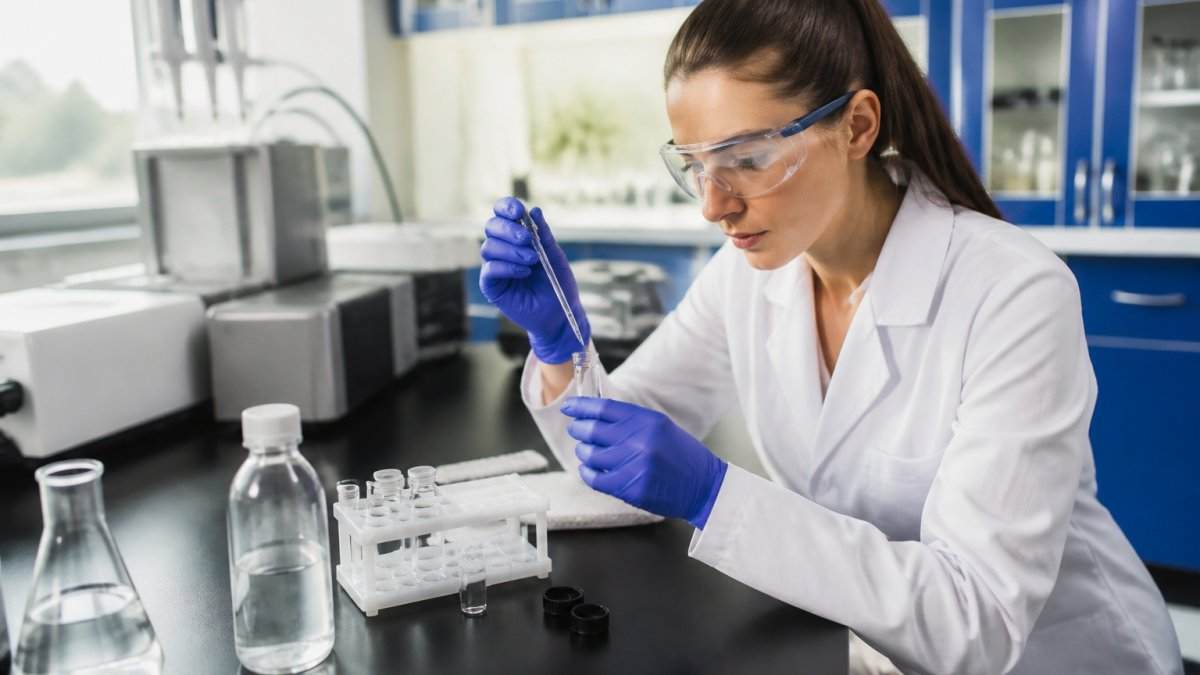
Certified PFAS water testing labs are accredited by your state primacy agency and hold TNI accreditation with a defined scope for the specific EPA method you need, verify the lab's current state certificate number, TNI scope document, and method-specific credentials before ordering. Most states publish searchable lists of certified drinking-water labs on their health or environmental department websites, and you can cross-check accreditation status through The NELAC Institute directory.
- State primacy agencies, not the EPA, certify PFAS labs; ask for the lab's state certificate number and TNI scope document listing the exact method and analytes.
- PFAS samples must reach the lab within 14 days of collection in lab-provided sterile vials kept cold during shipping; using your own containers introduces contamination.
- Standard turnaround time is 10-15 business days from receipt; call three labs with identical sample information to compare quotes fairly before deciding.
Table of Contents
- Why Finding a Certified PFAS Water Testing Lab Matters
- Step 1: Verify State-Accredited PFAS Laboratory Credentials
- Step 2: Understand EPA Method 533 PFAS Testing Requirements
- Step 3: How to Collect a Water Sample for PFAS Testing
- Step 4: Evaluate PFAS Water Testing Cost and Turnaround
- Step 5: Choose the Right Lab for Your Water Source
- Step 6: Interpret Your PFAS Test Results and Next Steps
- Common Mistakes to Avoid When Testing for PFAS
- Frequently Asked Questions
Why Finding a Certified PFAS Water Testing Lab Matters
Per- and polyfluoroalkyl substances (PFAS) are synthetic "forever chemicals" found in drinking water nationwide that don't break down in the environment or the human body.
Not all labs test PFAS accurately; many lack accreditation or use outdated methods, and false results leave your family exposed. At SHTF Prepper Club, we help families build water safety into their emergency preparedness plans, and the right lab delivers defensible results.
Step 1: Verify State-Accredited PFAS Laboratory Credentials
The EPA does not certify individual PFAS laboratories. Under the Safe Drinking Water Act, it delegates certification to state primacy agencies, and most states require labs to hold accreditation to The NELAC Institute (TNI) standard, which replaced the older NELAP framework. That chain, state primacy agency, TNI accreditation, method-specific scope, is what you need to verify.
The three credentials that matter
When you call a lab, ask for these three things and write down the answers:
- State certification for drinking water. The lab should be able to give you a certificate number issued by your state's drinking-water program. Certification is method-specific: a lab certified for Method 533 is not automatically certified for Method 537.1 or Method 1633.
- TNI accreditation with a defined scope. Accreditation is granted for a specific combination of analyte, method, and matrix (drinking water, groundwater, wastewater, solids). Ask for the scope document, not just a certificate. The scope should list PFAS analytes by name and the exact method number.
- Current status. Accreditation lapses. Ask the lab to confirm, in writing, that its PFAS drinking-water scope is current as of the date you ship. A certificate from two years ago proves nothing about today.
How to verify, step by step
- Find your state primacy agency. Search your state health or environmental department website for "drinking water laboratory certification" or "certified laboratories", most publish a searchable list or PDF.
- Match the method, not just the lab name. Confirm the lab is certified for the specific PFAS method you intend to use (see Step 2); a lab certified for metals and nitrate is not a PFAS lab.
- Cross-check TNI. The TNI website maintains a directory of accredited labs searchable by state and field of accreditation. Confirm the accreditation is active and the PFAS method appears in its scope.
- Call the state program directly. If the online list is stale, ask the certification officer: "Is [lab name] currently certified for [method] in drinking water, and what is the certificate expiration date?" This is a public record.
- Get it in writing from the lab. Ask the lab to email its current certificate and scope page for the method you are ordering.
What the EPA's resources actually cover
The EPA publishes method documents, occurrence data, and drinking-water standards and points to state certification programs, but it does not maintain a nationwide list of certified PFAS labs. Treat any "EPA lab directory" as a starting point for state contacts, not proof of certification, the proof is the state certificate plus the TNI scope.
EPA PFAS drinking water resources
Red flags in the credential check
- The lab cannot produce a certificate number.
- The certificate lists a different method than the one you are ordering.
- The scope lists PFAS analytes but not the drinking-water matrix.
If any of these come up, move to the next lab. The credential check takes about 20 minutes per lab and is the highest-value step here.
Step 2: Understand EPA Method 533 PFAS Testing Requirements
EPA Method 533 is one of several approved methods for PFAS in drinking water. The method a lab uses determines which compounds it can detect, how low it can measure, and whether results are comparable to state or utility data.
The three methods you will see quoted
EPA Method 537.1 was the first widely used drinking-water PFAS method.
EPA Method 533 covers 25 PFAS compounds and was designed to capture shorter-chain compounds that 537.1 misses. It also uses LC-MS/MS but with a different sample preparation approach.
EPA Method 1633 is the broadest of the three. Finalized in 2024 for aqueous, solid, biosolid, and tissue samples, it covers 40 PFAS compounds, including many that 533 and 537.1 do not report.
How method choice changes your results
- Analyte coverage. A 537.1 test can report "not detected" for a compound that 533 or 1633 would have found, so a 537.1-only test can understate exposure near facilities using shorter-chain replacements.
- Reporting limits. All three methods report in parts per trillion (ppt), but the lowest reliable limit varies by compound and lab. Ask for the method reporting limit (MRL) for each compound, not a single headline number.
- Comparability. To compare your result to your utility's Consumer Confidence Report or a state dataset, use the same method the utility or state used; mixing methods makes comparison misleading.
Questions to ask before you order
- "Which method will you run, 537.1, 533, or 1633, and is that method on your current certification scope for drinking water?"
- "Can you send me the analyte list with the method reporting limit for each compound?"
- "If I want the widest coverage, what does the 1633 panel cost and what is the turnaround?"
- "How do you handle quality control, method blanks, matrix spikes, and continuing calibration checks, and will the report include those results?"
- "Will the report state the method number and reporting limits so I can compare it to other data?"
What the EPA's method documents cover
The EPA publishes full method documents, including analyte lists and quality-control requirements, on its website. Use them to sanity-check any lab's coverage claims.
A practical default
For a private well or first-time tap test where you want broad coverage, ask for Method 1633 if your state accepts it and the lab offers it. For a compliance-style comparison to a public water system, match the method the utility uses, often 533 or 537.1.
The three EPA-approved methods for drinking-water PFAS testing differ in analyte coverage, cost, and turnaround time.
| Method | Compounds Covered | Key Difference | Best For |
|---|---|---|---|
| EPA Method 537.1 | 18 PFAS compounds | Oldest method; misses shorter-chain replacements | Budget screening |
| EPA Method 533 | 25 PFAS compounds | Captures newer replacement chemicals | Private wells and first-time tap tests |
| EPA Method 1633 | 40 PFAS compounds | Broadest coverage; finalized 2024 | Investigative and private-well testing |
Step 3: How to Collect a Water Sample for PFAS Testing
Collecting a sample incorrectly ruins the test. If you're concerned about contamination, you may also want to explore how to purify water without electricity as a backup safety measure.
Sample Collection Best Practices
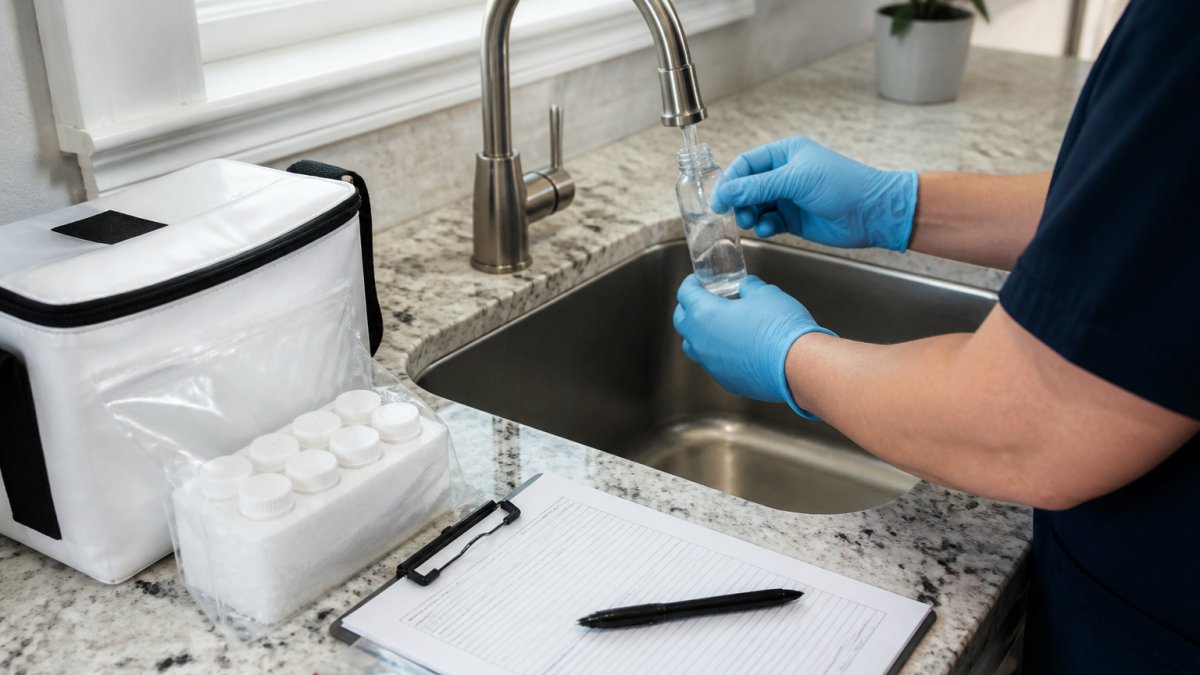
Most labs provide a sample collection kit with sterile vials, preservatives, and shipping materials. Never use your own bottles. The process:
- Let cold water run for 30 seconds to clear the line
- Fill the vial to the line marked on the label
- Don't touch the inside of the vial or cap
- Seal it immediately after filling
- Label it with the date, time, and location collected
- Place it in the provided cooler with ice packs
Collect from the tap you use for drinking. If you have a filter, test before and after it. For a private well, collect from the tap closest to where the well line enters your house.
Preservation and Chain of Custody
PFAS samples must reach the lab within 14 days of collection. Pack the vial in the cooler with ice packs to keep it cold during shipping. The lab provides a chain of custody form documenting who handled the sample and when; fill it out completely with your name and address, collection date and time, water source, any treatment, and your signature.
Step 4: Evaluate PFAS Water Testing Cost and Turnaround
Costs vary widely depending on which compounds you test for and how many samples you send.
Understanding Lab Pricing Factors
Labs charge based on:
- Number of PFAS compounds tested (18 compounds vs. a subset)
- Sample type (drinking water, groundwater, soil)
- Rush processing fees
Call three labs and ask for a quote, giving each the same information so you can compare fairly. Ask about multi-sample discounts.
Typical Turnaround Times
Standard turnaround is 10-15 business days from receipt; rush processing can cut this to 5-7 days but costs more. Ask each lab:
- "What's your standard turnaround time?"
- "Do you offer rush processing?"
- "When will I receive results?"
Labs that can't give a clear timeline aren't reliable.
Step 5: Choose the Right Lab for Your Water Source
Different water sources need different testing approaches; a lab that excels at private wells may not be ideal for public water systems, and vice versa.
Private Well vs. Public Water System Testing
Private wells require more careful testing because you're responsible for water safety.
Public water systems are EPA-regulated and your water company tests regularly. For independent testing, find a lab experienced with municipal water samples that understands how treatment affects PFAS detection.
Ask the lab: "How many private well samples do you process monthly?" A lab handling hundreds has more experience than one doing a few per year.
Lab Location and Shipping Considerations
Proximity matters less than accreditation, but shipping costs add up, overnight shipping costs the same to a lab 50 miles away as one 500 miles away. Some labs offer local drop-off; ask if you can deliver your sample in person.
Water Filtration Systems Survival Family Guide
Step 6: Interpret Your PFAS Test Results and Next Steps
Results arrive as a lab report with a table of compounds and concentrations; understanding the numbers determines your next action.
Understanding Detection Limits and Reporting
The report shows:
- Detection limit: The lowest concentration the lab can reliably measure
- Result: The concentration found in your sample (or "not detected")
- Units: Parts per trillion (ppt)
"Not detected" means the concentration is below the lab's detection limit, not zero PFAS, just below what the equipment can measure. Compare results to the EPA's drinking water standards; as of 2026, the EPA has set limits for certain PFAS compounds, and your state may be stricter. Check your state environmental agency website for current standards.
What to Do If Results Exceed Safe Levels
If PFAS is found above safe limits, you have options:
- Point-of-use filters: Activated carbon filters remove PFAS at your tap
- Whole-house systems: Treat all water entering your home
- Bottled water: A temporary solution while you install treatment
Contact your state environmental agency for guidance. They may offer resources or connect you with treatment specialists. Long Term Water Storage Ensuring Safe Home Preparedness Through Best Practices
Don't panic. PFAS contamination is treatable. For families concerned about contamination, long-term water storage best practices provide guidance on safe storage while you arrange treatment.
Common Mistakes to Avoid When Testing for PFAS
Testing mistakes lead to unreliable results. Here's what to avoid:
Using an uncertified lab. Results from an unaccredited lab aren't defensible and you won't know if they're accurate. Verify accreditation first.
Collecting samples in the wrong container. Some plastics leach PFAS. Always use the lab-provided vial.
Waiting too long to ship. PFAS samples degrade over time.
Not asking about methods. Outdated or non-standard methods produce unreliable results.
Choosing based on price alone. A slightly higher price for a reputable, accredited lab is worth it.
Finding a certified PFAS water testing lab protects your family's health.
Frequently Asked Questions
How do I verify that a laboratory is certified to test for PFAS in drinking water?
Cross-reference with your state environmental agency's accreditation list. Confirm the lab holds current certification for EPA Method 533 or equivalent approved methods. Ask the lab directly for their accreditation scope document, which specifies which PFAS compounds and analytes they are certified to analyze. Most state agencies maintain online databases where you can verify active certifications.
How should I collect and ship a water sample for PFAS testing?
Use sterile containers provided by your lab, never use regular bottles. Collect samples from the tap. Seal immediately, and label with date and time. Keep samples cool during shipping and maintain chain of custody documentation. Most labs provide detailed collection instructions with their kits; follow them precisely to avoid contamination or invalidation of results.
What is the typical cost for PFAS water testing?
PFAS water testing cost varies by lab, the number of compounds analyzed, and your location. Rush turnaround and soil testing add additional fees. Contact multiple state-accredited laboratories for quotes, as pricing and services differ significantly.
How long does it take to get PFAS water test results?
Confirm turnaround time with your chosen lab before submitting samples. Always ask about their current backlog, especially during peak testing seasons, to set realistic expectations for receiving defensible results.
