
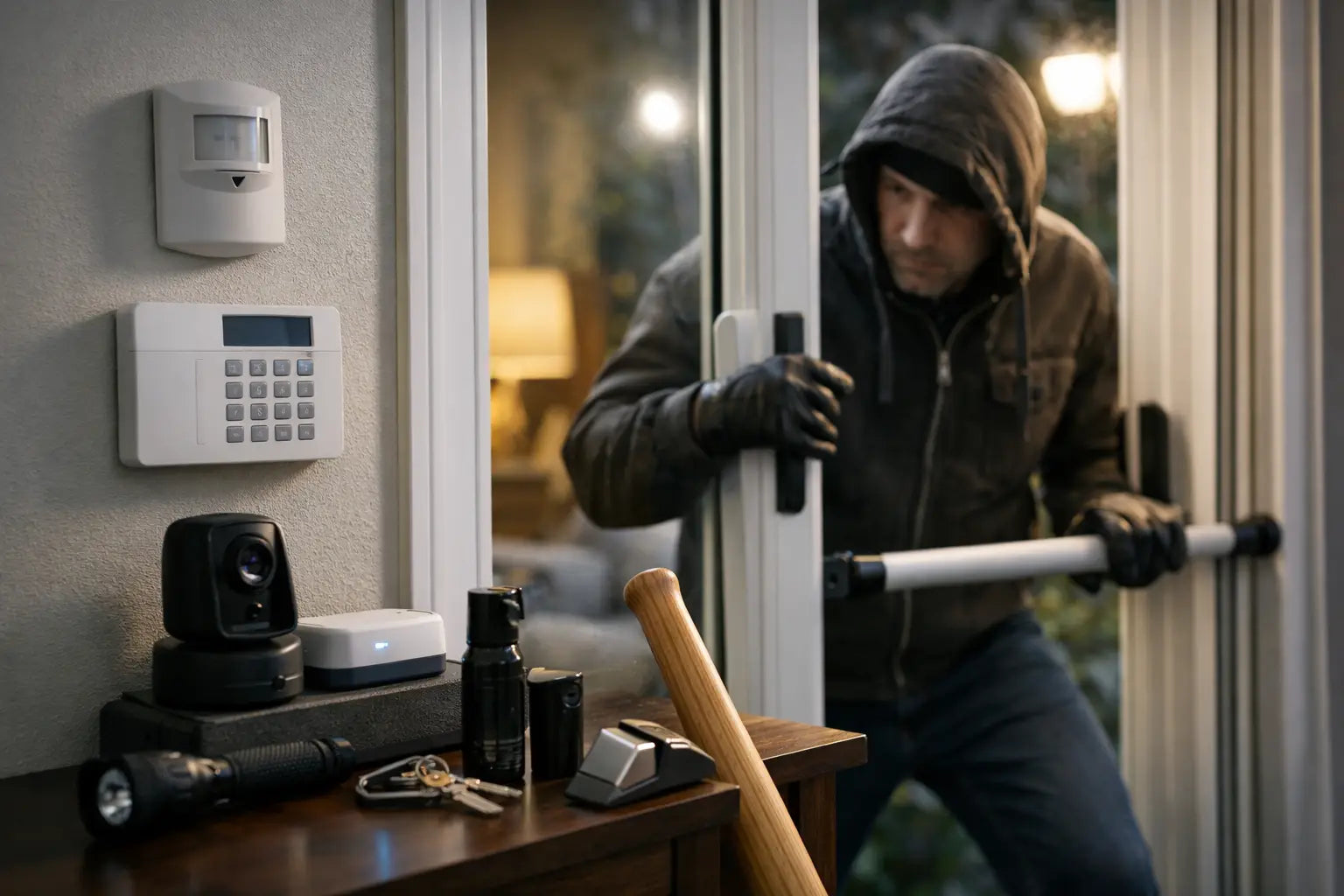
The sound that changes everything is usually small - a door handle moving at the wrong hour, glass where there should not be glass, footsteps that do not belong to anyone in your home. In that moment, most families are not looking for a debate. They want home invasion protection options when you don't want a firearm, and they want options that are practical, legal, and realistic to use under stress.
That is a very reasonable goal. Not every homeowner wants a gun in the house. Some have young children, some have personal or medical reasons, some simply do not want the responsibility. The good news is that a strong home defense plan does not start with a weapon. It starts with time, distance, noise, and a family that knows what to do.
Home invasion protection options when you don't want a firearm
If you take one idea from this article, let it be this: most non-firearm protection works best in layers. A reinforced door by itself helps. A monitored alarm by itself helps. A locked bedroom door, motion lights, a charged phone, and a rehearsed family plan help even more because they work together.
That layered approach matters because a home invasion is fast and chaotic. You may be waking up from sleep, trying to gather a child, or trying to understand whether the noise downstairs is a family member, a storm problem, or a real threat. Simple systems beat complicated ones every time.
Start with the doors, not the gadgets
Most people spend too much time thinking about what they would use during an intrusion and not enough time making entry harder in the first place. Exterior doors are the first place to invest.
A solid-core or metal exterior door is better than a hollow one. Longer hinge screws and a reinforced strike plate can make a major difference because many doors fail at the frame, not the lock itself. A quality deadbolt matters, but it is only as good as the wood and hardware around it.
Sliding doors deserve special attention. A basic lock is often not enough. Add a security bar or properly fitted track blocker so the door cannot be forced open easily. Ground-floor windows and side garage doors should get the same level of attention. Families often lock the front door carefully and forget the weaker entry points.
Make forced entry loud and slow
A lot of home security products are marketed like magic. They are not. Their real job is to buy you seconds, create noise, and increase the chance that someone gives up before reaching your family.
Door braces, portable door jammers, window alarms, and glass-break sensors all serve that purpose. They do not need to look dramatic to be effective. Even a simple wedge alarm on an interior bedroom door can create a critical warning if someone gets farther into the house than you expected.
This is especially useful for parents of older kids and for grandparents who may not move as quickly at night. If an outer layer fails, the inner layer still gives you a chance to react.
Build a safe room plan your family can actually use
For many households, the smartest response to a break-in is not to clear the house. It is to move everyone to one defensible room, lock or barricade the door, call 911, and stay put unless fire or another hazard forces movement.
For most families, that room is the primary bedroom. For others, it may be a nearby bedroom if children are young and need to be gathered quickly. The key is choosing in advance.
What belongs in that room
Keep it simple. You want a charged phone or backup battery, a bright flashlight, a loud personal alarm or panic button if you use one, and a door reinforcement option that can be deployed quickly from the inside. If you have pets that sleep with you or children who may panic, think through where they will stand or sit so nobody is blocking the door.
If your home has multiple floors, the plan may be different depending on where the intrusion starts. A first-floor entry while everyone sleeps upstairs is one problem. An intruder entering near first-floor bedrooms is another. This is where a short family conversation helps more than another gadget purchase.
Rehearse the boring parts
Nobody wants to role-play a break-in on a Saturday morning, but two or three calm walkthroughs can reduce panic later. Practice who grabs the phone, who gets which child, what phrase means this is real, and where everyone goes.
Keep it age-appropriate. Younger kids only need a few instructions. Teens should know more, including when not to investigate noises on their own. The point is not to scare your family. It is to remove confusion.
Non-firearm tools for close-range defense
This is the area where people often want one perfect answer. There usually is not one. There are trade-offs with every tool, especially under stress.
Pepper spray is one of the most common choices for a reason. It can be effective, compact, and easier for many adults to keep accessible than larger devices. But indoors, spray can affect everyone in the room, including you, your spouse, your kids, and your pets. If you choose it, practice with an inert trainer and think carefully about where it is stored.
Pepper gel is often marketed as a cleaner indoor solution because it has less airborne spread. That can be true, but it still requires accuracy and close enough distance to matter. A high-stress encounter in a dark hallway is not the same as target practice in daylight.
Stun guns and conducted-energy devices are another option some homeowners consider. Their effectiveness depends heavily on the model, the contact made, and the user's ability to deploy it quickly. They also require you to be very close to the threat, which is not ideal for most family-defense situations.
Personal safety alarms are underrated. A very loud alarm can create confusion, draw attention, and support your larger plan of noise and delay. It is not a stopping tool, but it can be a useful part of a layered setup.
Improvised tools are where many articles get unrealistic. Yes, almost any hard object can become a defensive tool. But if your plan depends on remembering where a random object sits in the dark, it is not much of a plan. Purpose and placement matter.
Use light, cameras, and alarms the smart way
The best security technology does not replace habits. It supports them.
Motion-activated exterior lighting is one of the simplest upgrades with real value. It removes darkness around doors, side yards, and garage approaches. That helps deter some intruders and gives cameras better footage if something does happen.
Visible cameras can help, especially at obvious approach points like front doors, driveways, and back gates. But cameras are not shields. Their biggest value is early notice, verification, and evidence. If your phone alert says someone is at the side gate at 2:11 a.m., that gives you a head start.
Monitored alarms add another layer, particularly for families who travel, split time between houses, or have older parents living alone. A siren by itself may cause someone to flee. Monitoring adds the possibility of faster emergency response if you cannot safely speak.
The downside is cost, false alarms, and the risk of thinking tech alone solves the problem. It does not. If your alarm goes off but nobody knows where to go, your weak point is still the plan.
The everyday habits that reduce risk
A surprising amount of home security comes down to ordinary routine. Lock doors even when you are home. Keep first-floor blinds and landscaping from creating perfect hiding spots. Do not leave ladders, tools, or heavy yard items where they can help someone get in.
If you have a garage, treat the interior garage door like an exterior door. Many families secure the front entry and forget that the garage gives direct access to the house.
It also helps to think about power outages. A lot of families first get serious about security after a storm or blackout, when streetlights are out, cameras go offline, and neighborhoods feel different. Battery backups for key security devices, charged power banks, and dependable flashlights are small preparedness steps that matter here. This is where a broader family-readiness mindset helps. Security is not separate from outage planning. It is part of it.
Choose what fits your household
The right setup depends on who lives with you and what kind of home you have. A retired couple in a ranch house may prioritize reinforced doors, monitored alarms, and a bedroom safe-room setup. A family with elementary-age kids may focus more on fast child retrieval, upstairs door security, and rehearsed communication. A rural homeowner may care more about longer response times and stronger perimeter awareness.
What matters most is not owning the most gear. It is reducing the number of decisions you have to make at the worst possible time.
If you do not want a firearm in your home, that does not mean you are helpless. It means your plan should be even more intentional. Harden the entry points. Create noise and delay. Build a room of safety. Pick tools you can actually use. Then walk through the plan until it feels ordinary, because ordinary is exactly what you want your family to feel when stress hits.