
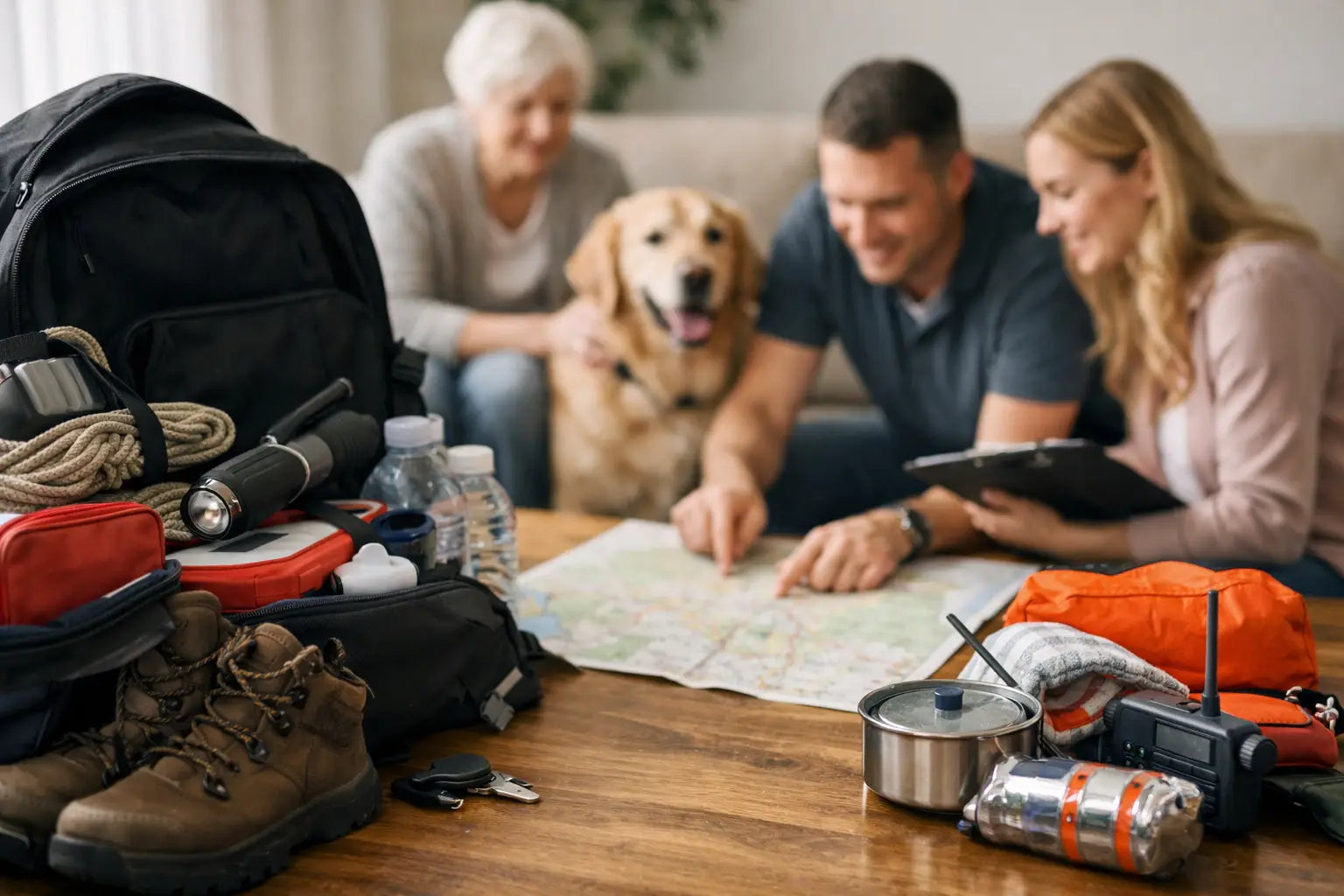
A family evacuation rarely begins with a calm announcement and plenty of time. It may begin with a school closure notice, smoke drifting over the neighborhood, a hurricane track shifting overnight, or a text from a county emergency office. This evacuation planning for households guide helps you make the key decisions before that stressful moment arrives, so your family can leave with purpose instead of scrambling.
The goal is not to predict every emergency. It is to build a simple plan that works when phones are busy, roads are crowded, and everyone is tired. A good plan accounts for your people, your pets, your medications, your vehicles, and the places you can realistically go.
Start With the Decision to Leave
Some emergencies move faster than others. A wildfire can turn a normal afternoon into a departure within minutes. Hurricanes usually offer more warning, but waiting too long can put your family into gridlocked traffic or leave you without fuel, lodging, and supplies.
Your household should understand three different triggers: an official evacuation order, a local warning that conditions may worsen, and your own common-sense threshold for leaving early. If officials order immediate evacuation, leave. Do not wait to finish chores, gather extra belongings, or see whether conditions improve.
For slower-moving events, leaving early can be the better trade-off. You may spend money on a hotel night you did not ultimately need. You may take time off work. Those are real considerations. But a less crowded route, more fuel options, and a calmer departure are often worth it, especially with children, older relatives, or pets.
Talk through who has authority to make the call if one adult is away. That single decision prevents the familiar problem of everyone waiting for someone else to say, “It’s time.”
Build an Evacuation Plan Around Real Life
A useful plan fits the household you have, not an imaginary survival scenario. Start by writing down where each person is likely to be during a weekday: home, work, school, daycare, practice, or a grandparent’s house. Then decide how each person will get home or to a designated meeting point if normal transportation is interrupted.
Choose two meeting places. The first should be close to home, such as a neighbor’s driveway or a mailbox at the end of your street. This is for a fire, gas leak, or other event that forces everyone outside quickly. The second should be outside your neighborhood, perhaps a library, grocery store, place of worship, or trusted friend’s home. Choose a location people can remember and reach from more than one direction.
Every household also needs an out-of-area contact. During a local emergency, a relative in another state may be easier to reach than someone across town. Each family member should know that person’s phone number, not just have it saved in a phone. A printed contact card in a wallet, backpack, and evacuation bag is a small step with a big payoff.
Decide Where You Will Go
Pick a primary destination and at least two backups. Your primary choice might be a relative’s home outside the likely impact area. Your second option may be a pet-friendly hotel in a different direction. A third could be a public shelter if other choices are unavailable.
Do not assume every shelter accepts pets, has private space, or can meet medical needs. Check local policies well before an emergency. If someone in your household uses oxygen, mobility equipment, refrigerated medication, or regular dialysis, make arrangements now with medical providers and local emergency management offices.
Your destination should also match the hazard. Driving farther inland may make sense for a coastal hurricane, while traveling crosswind or away from forested areas may be wiser during a wildfire. For a chemical spill or local fire, authorities may tell you to shelter in place instead. An evacuation plan should always leave room to follow current official instructions.
Know Your Routes Before Roads Close
Most families know one way out of their neighborhood. That is not enough. Identify at least two ways to leave your area and two major routes toward your likely destination. One may use highways; another may use state roads or surface streets.
Drive those routes on an ordinary weekend. Notice bridges, railroad crossings, narrow roads, construction zones, and places where traffic could bottleneck. If you live in a rural area, think honestly about whether heavy rain, snow, fallen trees, or wildfire activity could cut off your preferred route.
Keep paper maps in each vehicle and in your evacuation supplies. Navigation apps are helpful, but they depend on a charged phone, service, and usable roads. Mark destinations, meeting places, fuel stops, and alternate routes in advance.
Fuel is part of route planning. A practical household rule is to refill the tank when it reaches half full during severe-weather season or periods of elevated fire risk. Charging an electric vehicle early is equally important. Charging stations may be unavailable during outages, crowded during evacuations, or located along routes you can no longer use.
Pack Evacuation Bags That Your Family Can Carry
An evacuation bag is not a camping pack filled with gear you have never used. It is a ready-to-grab collection of basics that helps your family function for the first 24 to 72 hours away from home.
Each person should have a bag sized for their age and ability. Adults can carry more. A child’s bag might hold a change of clothes, comfort item, snacks, a water bottle, light, and a contact card. Do not overload children with essential items you cannot afford to lose.
Your household bags should cover these needs:
- Water, shelf-stable food, and a simple way to eat and drink
- Prescription medications, glasses, basic first aid supplies, and essential medical information
- Weather-appropriate clothing, sturdy shoes, blankets or warm layers, and hygiene items
- Phone chargers, battery packs, flashlights, batteries, cash, copies of documents, and spare keys
- Supplies for babies, older adults, and pets, including food, medications, carriers, leashes, and vaccination records
A family emergency kit can simplify this process, particularly when you are starting from scratch. Still, check every item against your actual household. Add prescription supplies, pet items, preferred snacks, and anything needed for a child, aging parent, or medical condition. Preparedness products are most useful when they match the people depending on them.
Protect Documents, Money, and Home Information
You do not need to take every file cabinet drawer. You do need the documents that help you prove identity, access care, make insurance claims, and manage money while displaced.
Keep copies of identification, insurance policies, medical information, property records, vehicle information, and emergency contacts in a waterproof pouch. Store secure digital copies as an additional backup, but do not rely on digital access alone. Include recent photos or video of your home’s rooms and major belongings. Update them once a year or after major purchases and renovations.
Keep a modest amount of cash in small bills. Card networks and ATMs can be unreliable when power and communications are down. The right amount depends on your budget and household needs, but enough for fuel, food, and a night or two of unexpected lodging is a sensible starting point.
Include Pets and Neighbors in the Plan
Pets are family, and they need a plan before the car is loaded. Keep carriers, leashes, food, water, bowls, waste bags, and medications together. Add a current photo of each pet and make sure identification tags and microchip details are current. During a fast evacuation, a frightened cat may hide and a dog may react to stress. Practice getting them into carriers or vehicles calmly.
It also helps to know who nearby may need an extra hand. An older neighbor, a friend who does not drive, or a relative with limited mobility may already have a plan. Ask instead of assuming. You may be able to help, but your first responsibility is making sure your own household can leave safely and on time.
Practice Without Making It Scary
A plan on paper is only a starting point. Twice a year, set aside 30 minutes to walk through it. Have everyone find their shoes, grab their bags, get into the vehicle, and review the route. Check whether the pet carrier fits, whether the bags are too heavy, and whether the flashlight batteries still work.
For children, keep the tone steady and matter-of-fact. Explain that practice is like a fire drill at school. You are learning what to do so everyone can stay together and get somewhere safe.
Review supplies at daylight saving time, before hurricane or wildfire season, and whenever your family changes. A new baby, new medication, new pet, aging parent, or move to a new home all change the plan. SHTF Prepper Club encourages families to start with the basics, then improve one practical gap at a time.
The best evacuation plan is not the thickest binder or the most expensive collection of gear. It is the one your family understands, can carry out, and has practiced before the weather turns or the alert arrives. Put the meeting places on the refrigerator tonight, then take one small step tomorrow. That is how readiness becomes real.