
Last Updated: November 21, 2026
Quick Summary
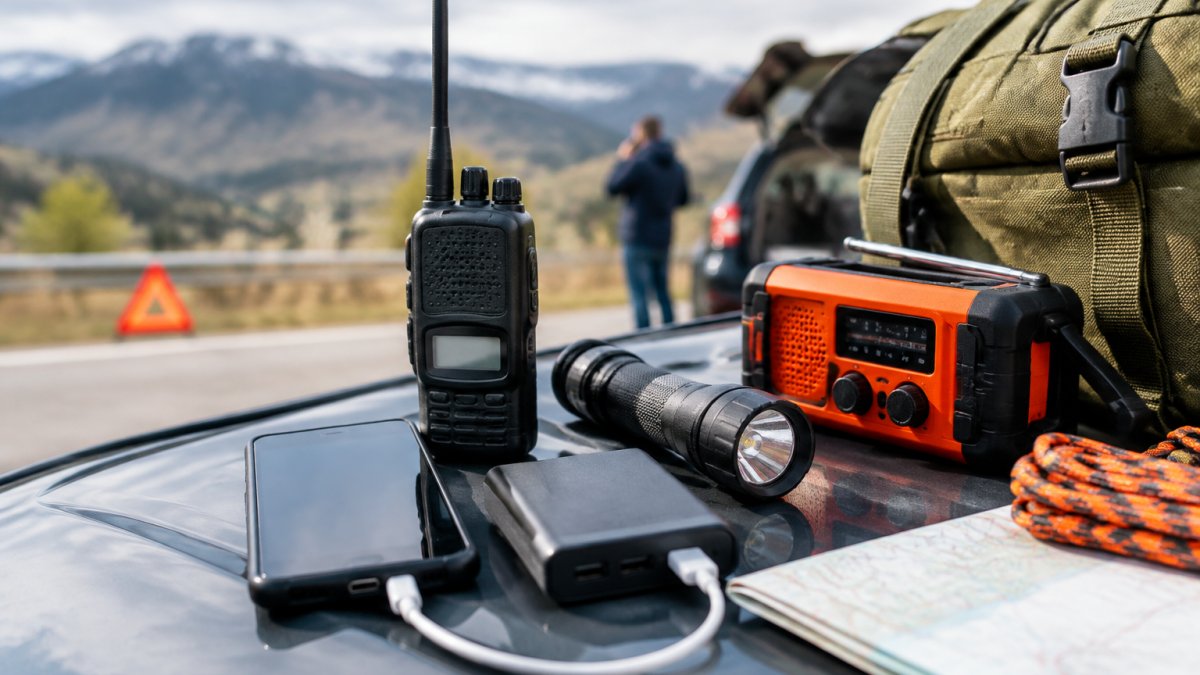
The best emergency communication setup for your car is a layered kit: a mobile phone for everyday coverage, a power bank or solar charger to keep it alive, an emergency radio for official alerts, two-way radios for local car-to-car contact, and a satellite messenger for off-grid SOS. Each layer covers the failure of the one beneath it.
- A portable battery with a solar panel covers both short outages and extended ones.
- FRS radios need no license and are a simple car-to-car option for family convoys.
- Signal boosters can extend weak coverage but cannot create coverage where none exists.
- Map your regular routes and note dead zones before buying any gear.
- Run a seasonal check to charge gear, test flashlights, and confirm radio channels.
Table of Contents
- Why Your Phone Alone Is Not Enough
- The Best Emergency Communication Devices for a Vehicle Kit
- Two-Way Radios for Emergencies: Ham, GMRS, and Family Channels
- When a Satellite Messenger for Emergencies Saves the Day
- Signal Boosters, Dead Zones, and Cellular Coverage
- Building an Emergency Communication Plan for Families
- A Step-by-Step Setup Guide for the Ordinary Driver
- Testing and Maintenance: Keeping Your Gear Ready
- Frequently Asked Questions
Why Your Phone Alone Is Not Enough
Your phone is the most capable emergency communication tool you own, right up until the moment it isn't. Cell towers lose power, rural stretches drop into dead zones, and a single dead battery turns a smartphone into a paperweight. The phone is best treated as the first layer of a kit, never the whole kit.
The stakes are real. The FCC's guidance on emergency communications makes clear that network congestion and outages routinely hit exactly when call volume spikes. Federal emergency managers at Ready.gov's build-a-kit guidance list a battery-powered radio and a backup charger as household essentials for the same reason.
Here's the part most guides get wrong: they list gear without explaining how the pieces work together. We'll show you exactly how to build a layered system, from the phone in your pocket to the satellite messenger on your dash. The seven tools below cover every realistic scenario an ordinary driver faces.
The Best Emergency Communication Devices for a Vehicle Kit
The best emergency communication devices for a car kit form layers, not a single gadget. Each layer covers the failure of the one beneath it: phone first, power second, radio third, satellite last. Build from the bottom up and you always have a fallback.
| Layer | Tool | Primary Job | Best For |
|---|---|---|---|
| 1 | Mobile phone | Calls and texts on live networks | Everyday coverage areas |
| 2 | Power bank / solar charger | Keeps the phone alive | Grid outages, long waits |
| 3 | Emergency radio | Receives official alerts | Storms, evacuation orders |
| 4 | Two-way radio | Local car-to-car contact | Groups, no cell service |
| 5 | Satellite messenger | Off-grid SOS | Remote travel, dead zones |
Power Banks and Solar Chargers
A dead phone ends your communication plan, so backup power comes first. A portable battery with a solar panel covers both short outages and extended ones.
The BLAVOR 20000mAh Solar Power Bank adds wireless charging, built-in cables, and a flashlight rated for up to 100 hours. A car charger keeps devices topped up while you drive.

Emergency Radios and Weather Alerts
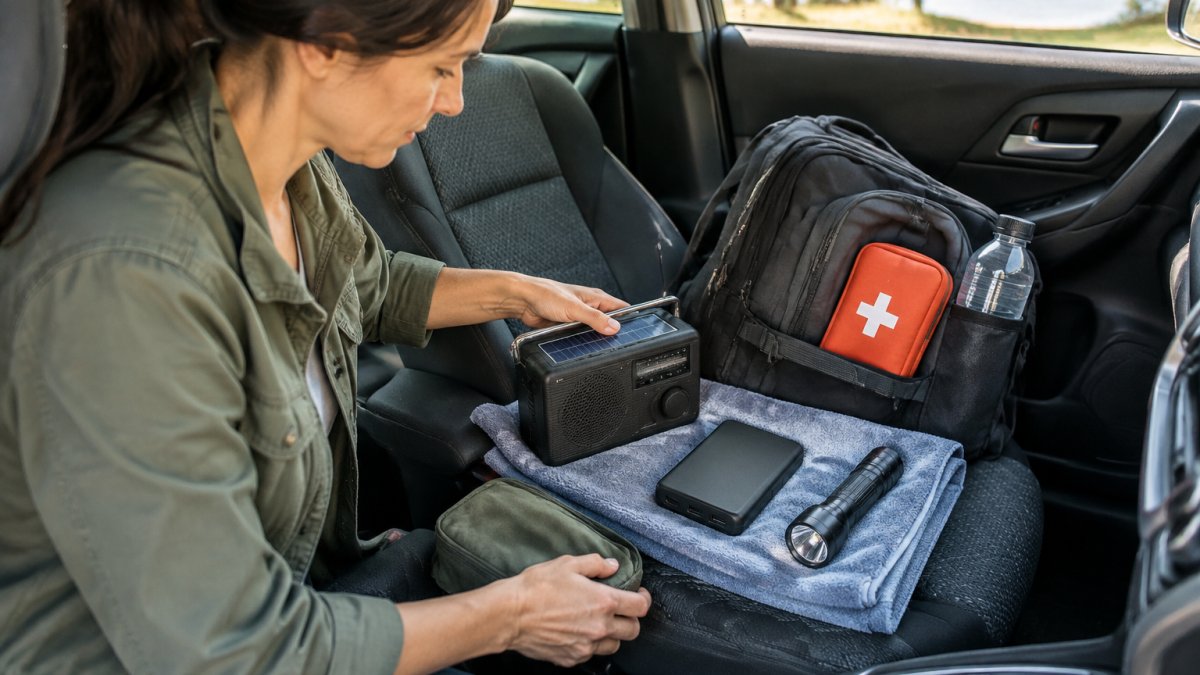
An emergency radio is your link to official information when the power and the internet are both down. Weather band reception can deliver evacuation orders and storm warnings straight from broadcasters. Look for a unit that covers weather band, AM, and FM, and that can be recharged by solar panel or hand crank.
For a deeper comparison of alert types and features, our emergency radio buying guide walks through what families actually need.
Two-Way Radios for Emergencies: Ham, GMRS, and Family Channels
Two-way radios for emergencies work when cell service does not, but the three main types serve different drivers and are not interchangeable. The single most common mistake is buying a radio without checking whether it can talk to the radios your family or convoy already owns.
| Type | License | Typical Real-World Range | Can Talk To | Best For |
|---|---|---|---|---|
| FRS | None | About 0.5-2 miles in a vehicle | FRS and GMRS | Family convoys, short trips |
| GMRS | FCC license required | About 1-5 miles, more with a good antenna | FRS and GMRS | Rural groups, larger convoys |
| Ham (amateur) | Technician license required | Miles to many miles, depending on band and antenna | Other ham operators, some emergency networks | Remote travel, practiced operators |
FRS radios need no license and are a simple car-to-car option.
Test any two-way radio with your group before relying on it.
Test your radios before you depend on them: have each vehicle drive to the far end of your normal route and confirm a clear check-in. Program and label shared channels so every family member knows which one to use. For a deeper look at alert features and family needs, our emergency radio buying guide walks through the receiver side of the kit.
When a Satellite Messenger for Emergencies Saves the Day
A satellite messenger is a layer intended for areas without cell coverage. Satellite messengers are generally suited to remote travel, and many require a subscription, so they are most useful if you drive beyond reliable coverage.
If you routinely leave coverage, a satellite messenger is the difference between calling for help and hoping someone drives by.
Signal Boosters, Dead Zones, and Cellular Coverage
Signal boosters can extend cellular coverage into weak spots by amplifying an existing signal, but they cannot create coverage where none exists.
Dead zones are predictable, and mapping them is the highest-value step most drivers skip. Before you buy anything, check your carrier's coverage map for your regular routes and note where calls drop. Then do a real test: drive your normal commute and weekend routes and mark the spots where a call fails or a text will not send. Those marks tell you where your radio and satellite layers actually matter, and whether a booster would help at all.
A practical coverage plan for an ordinary driver looks like this:
- Map your routes. Note dead zones on your commute, your errands, and any regular trips out of town.
- Check the fringe. If your drops happen at the edge of coverage, a booster is worth considering; if they happen in true dead zones, put the money into radios or a satellite messenger instead.
- Match the layer to the zone. Phone and booster for fringe coverage, two-way radio for group contact in dead zones, satellite messenger for remote stretches with no coverage at all.
- Recheck seasonally. Coverage and tower status change; a route that worked last year may not this year.
Building an Emergency Communication Plan for Families
An emergency communication plan for families answers three questions before a crisis: who do we call, where do we meet, and how do we check in? Write it down, because networks and memory both fail under stress.
- List emergency contacts, including one out-of-area contact who can relay messages.
- Pick two meeting points: one near home, one outside the neighborhood.
- Agree on a check-in time and method, such as a text to the group list.
- Print a contact card for every family member's wallet and car.
- Store a copy in the glove box with your paper map.
Our guide to an emergency communication plan for families includes a contact card template and kid-friendly steps.
A Step-by-Step Setup Guide for the Ordinary Driver
Building a working car communication kit takes about 30 minutes and no technical skill. Start with what you own, then add layers as your budget allows.
Total Time: 30 minutes Difficulty: Beginner
- Charge everything tonight. Top off your phone, power bank, and radio. [Time: 5 minutes]
- Stage the phone layer. Mount a car charger within reach of the driver.
- Add backup power. Place the power bank and cable in the glove box or console.
- Set up the radio. Store the emergency radio with spare batteries and learn the weather band button.
- Program your radios. Set family channels on every two-way radio and label them.
- Print the plan. Put the contact card and paper map in the glove box.
- Run a drill. Have each family member send a test check-in text.
Expected Result: A complete, tested kit that any driver in the household can use.
If you'd rather start from a curated list, our vehicle emergency essentials collection covers the core items. Add a compact EDC flashlight so you can read a map or signal for help in the dark.

Testing and Maintenance: Keeping Your Gear Ready
Gear that sits untested fails when you need it. The National Weather Service's wireless emergency alerts information is worth reviewing so you understand what your phone and radio will actually receive during an alert.
Run this check every season:
- Charge the power bank and radio to full
- Test the flashlight and replace weak batteries
- Confirm radio channels are still programmed
- Update the contact card with any new numbers
- Check the paper map for your current area
- Verify the satellite subscription is active, if you have one
Keep the Quadra-style solar power banks away from hot cars in direct sunlight, as the manufacturer warns that the battery may overheat.
Your family's safety shouldn't depend on a single bar of signal. SHTF Prepper Club curates vetted power, radio, and safety gear so your car kit is ready before you need it, with expert guidance to walk you through every step. Start with a solar radio and power bank, add a plan, and test it this month. Get started with SHTF Prepper Club and build a car communication kit your whole household can rely on.
Frequently Asked Questions
What is the single most effective safety device in your car?
A charged phone is a useful emergency communication device, but it only works with coverage. Pair it with a backup power source and a way to reach help when the signal drops. A solar power bank can help keep your phone charged, and a weather band radio receives official alerts. Add a satellite messenger if you travel remote routes.
Can a satellite messenger send an SOS from a vehicle?
Yes. Satellite messengers work from a vehicle as long as the device has a clear view of the sky. Mount it near the windshield or hold it outside if the roof blocks the signal. Many satellite messenger models can send SOS signals and short messages. Check the specifications of any model before you buy.
How can you contact emergency services if your phone has no signal?
Try 911 first, since calls may route through another carrier's tower. If that fails, use a satellite messenger or a two-way radio. A weather band radio keeps you informed of evacuation orders. Move to higher ground or an open area to improve coverage, and keep a paper map to navigate to help.
What communication equipment should be included in a vehicle emergency kit?
Start with a charged phone, a car charger, and a power bank or solar charger. Add a weather band radio, a flashlight, and extra batteries. A two-way radio set helps your group stay in touch if separated. Include a list of emergency contacts on paper. For remote travel, a satellite messenger adds a reliable SOS option. Test each device monthly and replace batteries as needed.