
Table of Contents
- Why a Family Emergency Communication Plan Is Non-Negotiable
- Step 1: Choose Your Emergency Meeting Point Ideas
- Step 2: Pick an Out-of-Area Emergency Contact
- Step 3: Fill Out Your Family Emergency Contact Card Template
- Step 4: Practice Emergency Preparedness for Kids of Every Age
- Communication Methods That Survive a Disaster
- Common Mistakes That Break Family Communication Plans
- Your Family Emergency Communication Plan Checklist
- Frequently Asked Questions
Last Updated: September 6, 2026
Why a Family Emergency Communication Plan Is Non-Negotiable
An emergency communication plan for families with children is a predefined system that ensures every household member knows how to reach each other and reunite when cell towers fail, networks jam, or you are separated. A written plan removes the panic and guesswork from those first critical minutes.
Many parents assume they will simply call or text their kids when something happens, but cellular networks routinely experience bandwidth congestion during regional emergencies. Having a documented emergency communication strategy is a highly effective step you can take for family safety.
The core goal is not complex gadgetry but a simple, practiced routine where every person, even a young child, knows exactly what to do. Below are the four essential steps to build your household emergency plan.
Step 1: Choose Your Emergency Meeting Point Ideas
The foundation of any reunification plan is a set of predetermined meeting locations. You need emergency meeting point ideas that are specific, walkable, and safe for a child to reach without adult help.
Select two meeting points and document both clearly. Your first should be immediately outside your home, such as a specific neighbor's front porch, covering sudden evacuations like a fire. Your second needs to be outside your immediate neighborhood, like a local library or community center, for scenarios where you cannot return home.
Write these locations on your emergency contact card and post them on the refrigerator. Walk the route with your children so they recognize landmarks; a meeting point is only useful if a child can identify it and navigate there safely on foot.
Step 2: Pick an Out-of-Area Emergency Contact
An out-of-area emergency contact is a trusted relative or friend who lives far enough away that they are unlikely to be affected by the same local disaster. This person serves as your family's central message relay.
Local calls often fail during a disaster, but long-distance texts and calls frequently still get through (fcc.gov). Instruct every family member to text or call this contact to check in, rather than trying to reach each other directly, preventing network overload and giving everyone one single point of contact.
Choose someone who is reliable, understands the role, and ideally speaks the same language as your children. Add this person's number to every family member's phone and write it on the family emergency contact card template. Practice a call to this contact during your drills so the routine feels familiar.
Step 3: Fill Out Your Family Emergency Contact Card Template
A family emergency contact card template is a physical, waterproof document that contains all critical contact information and meeting locations, small enough to fit in a child's pocket or backpack. You cannot rely on smartphones, which may be dead, lost, or damaged.
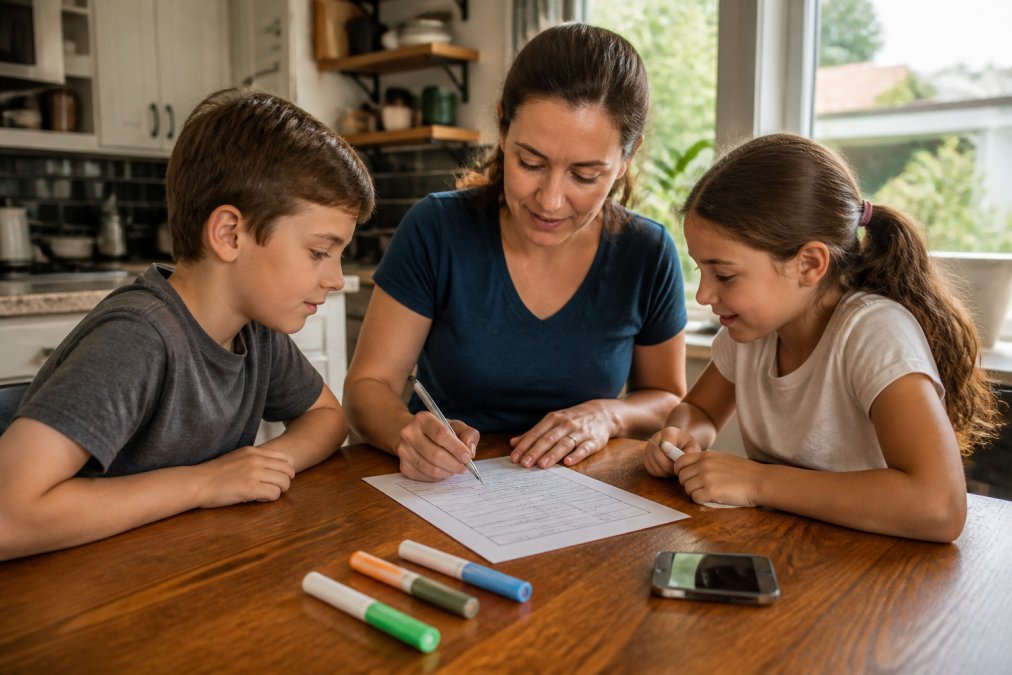
Your card should include the following essential details, as recommended by Ready.gov family communication planning resources:
- Full names of all immediate family members
- Home address and landline number if one exists
- The out-of-area contact's name and phone number
- The two designated meeting point locations
- Any critical medical information or allergies
- An emergency contact for your child's school
Create one card for each person. For younger children, laminate the card and safety-pin it inside their backpack or jacket. For older kids, take a photo of the card and save it in their phone's photo library so it is accessible even without a signal.
Step 4: Practice Emergency Preparedness for Kids of Every Age
Emergency preparedness for kids is not a one-time lecture but an ongoing skill built through short, low-pressure drills. Children absorb information differently based on their age and developmental stage, so tailor your communication training accordingly. Below are specific strategies for each age group.
Ages 3-7: Building the Foundation
For younger children, the goal is to build automatic, simple responses. Focus on their full name, their parents' first names, and one memorized phone number (the out-of-area contact is best). Use a song or silly rhyme to make the number stick, such as setting the digits to "Twinkle, Twinkle, Little Star." Practice identifying your designated meeting point by walking there during daylight and pointing out landmarks. Role-play a simple scenario like "If we get separated in the grocery store, where do we go?" The answer should be a physical location (e.g., "the checkout counter"), not "find a worker," as a child may not be able to identify a uniform.
Ages 8-12: Introducing the 'I'm Safe' Protocol
School-aged children can grasp the concept of a communication relay. Introduce the "I'm Safe" text protocol: in an emergency, their job is to send one simple text to the out-of-area contact, not to call you. Practice by having them compose and send a pre-written message like "I'm safe. I'm with [Name]." during a drill. Teach them how to read the physical emergency contact card and where it is located in their backpack. This is also the age to introduce checking in on a group chat with extended family, but only after the primary text is sent.
Teenagers: From Participants to Leaders
Teenagers can take on significant responsibility. Assign them a specific role, such as grabbing the emergency kit or helping younger siblings navigate to the meeting point. Teach them to use digital tools more resilient than standard cellular calls, like Wi-Fi-based messaging apps such as WhatsApp or Signal, and explain they should find a Wi-Fi hotspot if cellular data is down. They should also know their phone's built-in SOS feature (e.g., Apple's Emergency SOS via satellite or Android's Emergency Location Service) and understand the difference between a text message and a data-dependent message. Practice a scenario where they use a physical map to find an alternate route to the second meeting point.
A common mistake is drilling only once a year. Instead, hold a family drill every six months when you change the clocks. Keep the tone calm and matter-of-fact, never frightening, and frame it as a game or a mission. This repetition builds muscle memory so your children act without freezing in a real emergency.
Neurodivergent-Friendly Planning
Consider neurodivergent-friendly planning by using visual schedules and social stories to explain the steps clearly, which helps children with autism or anxiety process the routine. Create a simple, picture-based card showing the sequence: 1) Go to meeting point, 2) Show your ID card, 3) Send the text. For children with sensory sensitivities, practice with noise-canceling headphones or a weighted vest if that is part of their daily routine. The goal is to make the drill feel like a predictable, non-threatening routine so the actual event is less overwhelming.
Communication Methods That Survive a Disaster
When a disaster strikes, your default communication methods will likely fail. Text-first communication is the most reliable strategy because text messages require less bandwidth and often go through when voice calls cannot connect. The Federal Communications Commission guidance on wireless emergency alerts emphasizes that text messages are more likely to succeed during network congestion than voice calls. Teach every family member to send a simple "I am safe" text to the designated contact before attempting any other communication.
A truly robust plan goes beyond just texting. Here’s how to layer in modern tools and offline methods to ensure you can connect, even when the grid goes down.
1. Master Your Phone's Built-In SOS Features
Most modern smartphones have emergency features that do not rely on a standard cellular signal. Apple iPhones (iPhone 14 and later) have Emergency SOS via satellite, which allows you to text emergency services with no cellular or Wi-Fi coverage. Google's Android Emergency Location Service (ELS) automatically sends your location to emergency dispatchers when you call or text 911. Show your teenagers how to use these features and practice the button sequence, for example, on an iPhone, press and hold the side button and one of the volume buttons to trigger the SOS countdown.
2. Leverage Offline Messaging Apps
Standard SMS texts are the most reliable, but they can still fail. Offline messaging apps like Bridgefy or the goTenna Mesh (which requires a separate device) use Bluetooth or mesh networking to create a peer-to-peer network that can work without cell towers. While not a replacement for a primary plan, having one installed provides a backup channel if the network is completely jammed. The trade-off is their limited range (typically 100-300 feet for Bluetooth), making them most useful for coordinating within a neighborhood or at a large event, not for long-distance communication.
3. Use a Shared Cloud-Based Emergency Document
Create a single, shared document (e.g., a Google Doc or a note in a family-shared app) containing your entire plan: contact numbers, meeting point addresses, medical information, and a status update section. With internet access, family members can update their status in real-time, which is more efficient than a flurry of individual texts. Mark it as 'available offline' in the app so it remains readable if you lose connectivity.
4. The Power of a Solar-Powered or Hand-Crank Charger
All of these digital tools are useless if your phone is dead. A portable power bank is a wise addition to your emergency kit, but for a multi-day outage, consider a solar-powered or hand-crank charger. These are relatively inexpensive and ensure you can keep your phone charged for that critical check-in call. Keep a small, dedicated power bank in your family's emergency go-bag, checked and charged every six months during your family drill.
5. Sign Up for Local Alerts
Also, sign up for local emergency alerts through your county or city's notification system (often branded as CodeRED, Everbridge, or Nixle). These provide real-time information about evacuation orders and shelter locations. Social media can be useful for letting extended family know you are safe, but it should never replace your direct communication protocol with your out-of-area contact.
Common Mistakes That Break Family Communication Plans
Most plans fail not because of a lack of gear, but because of overlooked details. The most common error is creating a plan and never practicing it. A plan that lives in a drawer is useless; it must be a living document your family reviews and drills.
Another frequent mistake is relying solely on cell phones without a backup. You need a physical emergency contact card and a designated meeting point that does not require a call to coordinate. Many families also forget to include their children's school protocols. Ensure you know the school's emergency notification system and reunification plan, and confirm that your out-of-area contact is listed as an authorized pick-up person. Finally, do not ignore post-disaster mental health check-ins. After the immediate danger passes, talk to your children about what they saw and felt. Reassure them that they are safe. This emotional support is as critical as any physical preparation.
Your Family Emergency Communication Plan Checklist
Use this checklist to confirm your plan is complete and current. Review it every six months alongside your family drill.
| Task | Frequency | Status |
|---|---|---|
| Fill out family emergency contact card template | Once, update as needed | [ ] |
| Laminate cards and place in bags/backpacks | Once | [ ] |
| Program out-of-area contact into all phones | Once | [ ] |
| Review school and workplace emergency protocols | Annually | [ ] |
| Practice meeting point walk-through | Every 6 months | [ ] |
| Run a text-first communication drill | Every 6 months | [ ] |
| Check emergency kit and power bank charge | Every 6 months | [ ] |
| Hold a post-drill mental health check-in chat | Every 6 months | [ ] |
Building a reliable emergency communication plan does not require expensive equipment. It requires thoughtful preparation and consistent practice. Start with these steps today, and you will replace fear with confidence, ensuring your household stays connected and safe no matter what happens.
Preparing your family for the unexpected is a responsibility that weighs heavily on any parent. SHTF Prepper Club simplifies this process by providing expert guidance and a curated selection of essential survival gear, from reliable water filtration to long-term food storage with up to a 25-year shelf life. We help you build a comprehensive emergency preparedness strategy without the overwhelm, so you can focus on what matters most: keeping your family safe and secure. Get started with SHTF Prepper Club and build your family's confidence today.
Frequently Asked Questions
What should be included in an emergency communication plan?
A complete emergency communication plan covers three core elements: a designated out-of-area contact who can relay messages between separated family members, two pre-planned meeting points near your home and outside your neighborhood, and a printed emergency contact card for each person. Your plan should also specify text-first communication, since texts use less bandwidth than calls during a disaster. Include contact details for school, work, and emergency services, and practice the plan at least twice a year so everyone knows their role.
How do you teach children to use an emergency communication plan?
Start by teaching age-appropriate basics. Young children should memorize their full name, parents' names, and one out-of-area contact phone number. Practice dialing that number on a toy phone or an old cell phone without service. School-age kids can learn to send a pre-written text message like "I'm safe" to the out-of-area contact. Walk through your evacuation route and meeting point ideas as a family, then run a surprise drill. Keep the emergency contact card in their backpack and review it each school term.
Where should a family meet if they are separated during an emergency?
Pick two meeting points. The first should be immediately outside your home, such as a neighbor's driveway or a specific tree across the street, for sudden evacuations like a fire. The second should be outside your neighborhood, like a community center, library, or place of worship, for larger-scale disasters that force you to leave the area. Choose locations you can reach on foot and by car, and confirm they are accessible for all family members. Write these locations on your emergency contact card template so everyone carries the details.
How often should you practice your family emergency communication plan?
Run a full practice drill every six months and review your plan at the start of each season when risks change. During the drill, simulate a realistic scenario like a power outage or severe storm. Have each family member text the out-of-area contact, walk to both meeting points, and check that emergency contact cards are still accurate. Update your plan whenever you move, change schools or jobs, or if a child's schedule changes. Quick monthly check-ins on phone numbers and meeting spots keep the plan fresh without a full drill.