
Last Updated: October 24, 2026
Quick Summary
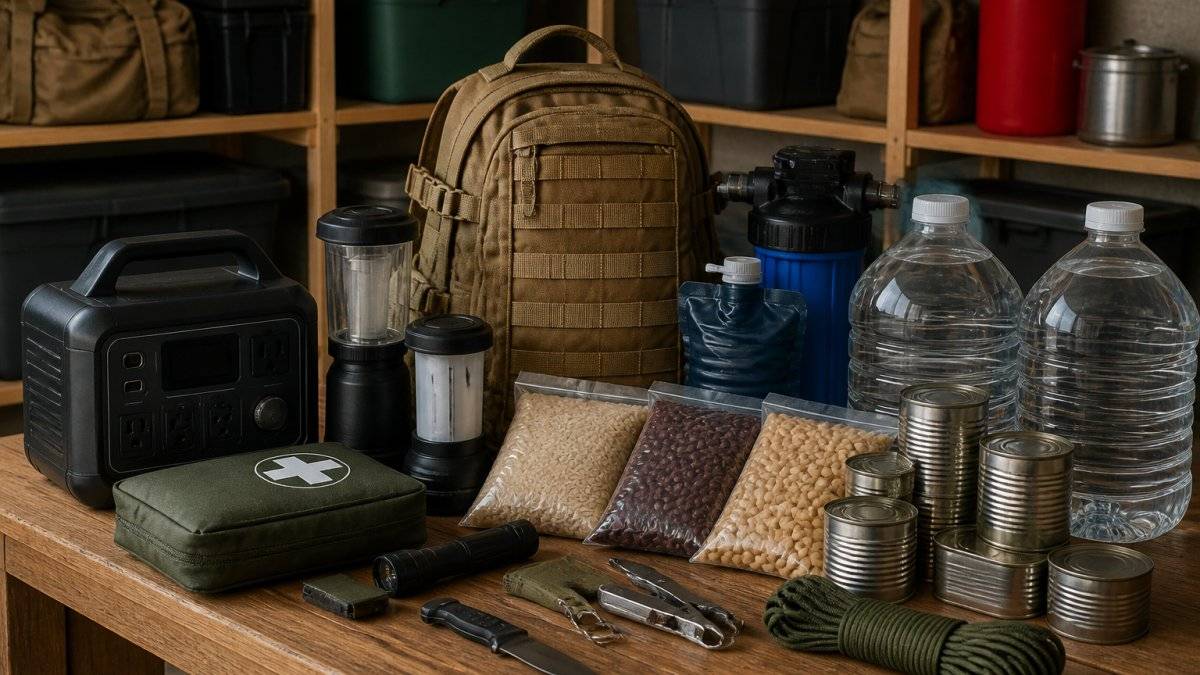
The best survival gear for long term grid down is built in layers: stored water and calories, off-grid power sized to your daily watt-hours, lighting and a NOAA radio, first aid and sanitation, then warmth. Buy for the longest outage you will plan for and test the kit twice a year.
- Budget roughly two gallons per person per day, so a family of four planning two weeks targets 56 to 112 gallons stored.
- Rotate stored water every six months and date each container, drinking the oldest first.
- Size a power station with at least a 30 to 50 percent buffer over your calculated watt-hour need.
- Budget two sunny days of solar charging to replace what you burn in one.
- Add one kit layer per month and run through the whole kit twice a year.
Table of Contents
- How to Choose Survival Gear for a Long-Term Grid Down
- 1. Long-Term Food Storage for Emergencies: Calories, Shelf Life, and Rotation
- 2. Emergency Water Filtration and Storage: Planning Gallons per Person
- 3. Off-Grid Power for Emergencies: Budgeting Watts and Charging Options
- 4. Lighting and Communication Gear That Works When the Grid Fails
- 5. First Aid, Sanitation, and Warmth Supplies Families Overlook
- 6. Building a Long-Term Emergency Preparedness Kit Step by Step
- 7. Maintenance, Testing, and Replacement Schedules for Your Gear
- Frequently Asked Questions
How to Choose Survival Gear for a Long-Term Grid Down
A grid-down event that lasts a few hours is an inconvenience. One that lasts two weeks is a different problem entirely. At SHTF Prepper Club, we build family kits around one question: what happens on day nine, when the novelty is gone and the supplies are half used?
Start with the family preparedness starter picks if you are building from zero.
Match Gear to Outage Duration, Climate, and Household Size
Three variables decide what you actually need: how long the power stays out, what the weather does while it is out, and how many mouths you feed.
- Duration: Three days calls for water, light, and a charged radio. Two weeks calls for stored calories, sanitation, and a way to cook. A month or more calls for rotation plans, fuel discipline, and redundancy.
- Climate: A winter outage adds warmth and carbon monoxide risk to the list. A summer outage adds heat illness and food spoilage.
- Household size: Count elderly relatives, infants, and pets. They change water volume, medication storage, and mobility needs.
A common mistake is buying for the average outage and hoping for the best. Buy for the longest outage you are willing to plan for, then scale down.
1. Long-Term Food Storage for Emergencies: Calories, Shelf Life, and Rotation
Long-term food storage for emergencies is a calorie budget, not a pantry hobby. Work out how many calories your household burns per day, multiply by the days you are planning for, and buy against that number.
Our rule: store what your family already eats, then add a shelf-stable layer on top. Food you will not touch in a crisis is wasted money. For a deeper walkthrough on quantities and rotation, see our guide to building an emergency food supply kit.
Cooking Without Utilities
Plan for cooking that needs no grid power. A camp stove with sealed fuel, a grill with a spare propane tank, or a rocket-style stove all work. Store fuel safely, never run a generator or camp stove indoors, and keep a carbon monoxide alarm in the room where you cook.
Watch out: storing a year of food with no rotation system means you discover expired stock the week you need it. Date everything and eat from the oldest first.
2. Emergency Water Filtration and Storage: Planning Gallons per Person
Emergency water filtration and storage starts with a number, but the number most guides stop at is too small for a long outage. The commonly cited baseline is one gallon per person per day for drinking and basic hygiene. For planning beyond a few days, most practitioners budget closer to two gallons per person per day once cooking, dish rinsing, and basic cleaning are counted. A family of four planning for two weeks should therefore target roughly 56 to 112 gallons stored, plus a way to make more.
How Much Water to Store and Where the Limits Are
Stored water is heavy and bulky: a gallon weighs about 8.3 pounds, so 100 gallons is over 800 pounds and needs a floor that can take it. That weight is the real storage limit, not shelf space. Practical options:
- Food-grade drums and barrels: 30- to 55-gallon containers are the common bulk choice. Keep them out of sunlight and on a stable, cool surface.
- Stackable water bricks and pouches: easier to move and rotate, but you need more of them to hit the same volume.
- Bottled water: convenient and sealed, but it degrades and takes up room; treat it as a rotating layer, not the whole plan.
Rotate stored water every six months. Date each container and drink the oldest first, the same discipline you use for food.
Filter Lifespan and Backup Purification Methods
A filter is only as good as its remaining capacity.
No single method covers every case, so plan two:
- Boiling: kills pathogens reliably but burns fuel you may need for cooking, and does nothing for chemical contamination.
- Gravity and pump filters: good for volume and particulates; check the micron rating and whether the model claims virus reduction.
- Chemical treatment (chlorine dioxide or unscented bleach): cheap and light, but needs contact time and does not remove sediment.
- Solar disinfection: a last resort that depends on clear containers and strong sun.
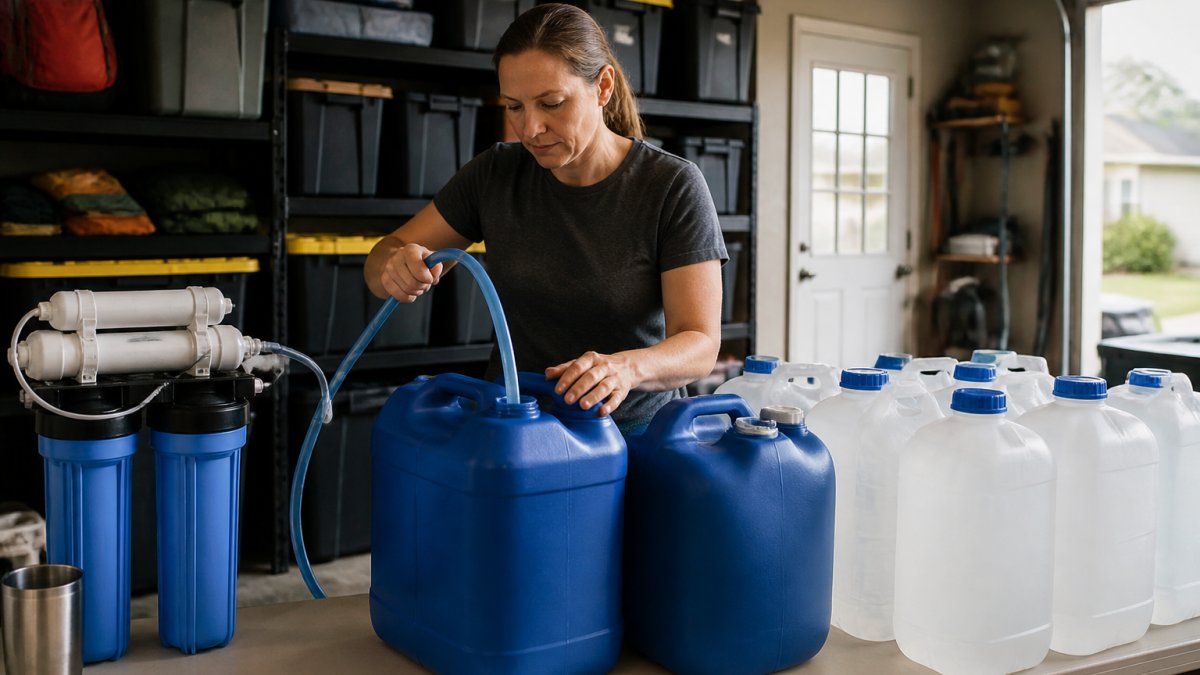
A portable water filtration straw belongs in every go-bag and every kitchen drawer. Pair it with a backup: two filtration methods beat one.
3. Off-Grid Power for Emergencies: Budgeting Watts and Charging Options
Off-grid power for emergencies is a math problem, not a shopping spree. The step most guides skip is converting your devices into watt-hours, because that is the number a power station is actually sized against.
Estimate Your Daily Watt-Hour Needs
For each critical device, multiply its watts by the hours you use it per day. A phone charger drawing about 5 to 10 watts for two hours is roughly 10 to 20 watt-hours; a small LED lantern at 3 to 5 watts for four hours is 12 to 20 watt-hours; a medical device's draw should be read off its label or power supply.
- Phones and radios: a small battery bank or folding solar panel covers this layer cheaply.
- Medical devices: size a power station with at least a 30 to 50 percent buffer over your calculated need, and keep a second charging path.
- Lights and fans: rechargeable LED lanterns plus a mid-size power station; fans are the hidden load in summer outages.
Solar Recharge Reality and Generator Trade-offs
Solar charging is slow and weather-dependent.
A generator solves recharge speed but introduces fuel storage, carbon monoxide risk, and noise. Never run one indoors or in an attached garage, and keep a carbon monoxide alarm where you sleep.
A ready-made power outage kit removes the guesswork on sizing, but check its watt-hour rating against your own math before you buy.
4. Lighting and Communication Gear That Works When the Grid Fails
Light and information are what keep a household calm. LED lanterns beat candles on safety and battery life, and a headlamp frees your hands for repairs. Keep at least one light source per person plus a room lantern.
For communication, a battery or hand-crank emergency radio receives weather alerts when cell towers fail. A NOAA weather radio is the standard. Charge all devices before a known storm and keep spare batteries in the original packaging.
5. First Aid, Sanitation, and Warmth Supplies Families Overlook
The gear families forget is rarely the gear on the store shelf.
Warmth matters too. Emergency blankets, sleep systems, and layered clothing handle a winter outage. For the medical side, our article on essential off-grid medical supplies covers what to stock and how to rotate it.
Sanitation deserves its own line item. Without running water, waste management becomes a health issue within days. Store bags, a bucket, and disinfectant before you need them.
6. Building a Long-Term Emergency Preparedness Kit Step by Step
A long-term emergency preparedness kit gets built in layers, not in one cart. Here is the order we recommend:
- Water and food for three days. The baseline every household needs.
- Light, radio, and batteries. Cheap, high-impact, easy to test.
- First aid and medications. Restock what you already use.
- Power and cooking. Size to your devices and fuel plan.
- Sanitation and warmth. The layer most kits skip.
- Rotation calendar. The layer that keeps the rest usable.
Add one layer per month. A kit built over six months gets tested and understood; a kit bought in one afternoon usually gets forgotten in a closet.
| Layer | What It Covers | Check Frequency |
|---|---|---|
| Water and food | 3 days to 2 weeks of calories and gallons | Every 6 months |
| Light and radio | Lanterns, headlamps, NOAA radio, batteries | Every 3 months |
| First aid | Kit, prescriptions, hygiene | Every 6 months |
| Power and cooking | Power station, solar, fuel stove | Every 3 months |
| Sanitation and warmth | Waste bags, blankets, layers | Every 6 months |
7. Maintenance, Testing, and Replacement Schedules for Your Gear
Gear you have not tested is gear you do not own. Put a recurring reminder on your calendar and run through the kit twice a year.
- Charge power stations and battery banks to full, then discharge and recharge
- Test the radio and replace batteries that read low
- Check water containers for leaks and rotate stored water
- Inspect food dates and pull anything expiring within six months
- Run a filter through a test pour and check the seal
Replace expired food, cracked containers, and swollen batteries immediately. The maintenance habit is what separates a real survival kit from a shelf of good intentions.
Frequently Asked Questions
What survival gear do you need for a long-term grid-down situation?
Start with the essentials that cover survival basics: stored food with a long shelf life, at least one gallon of water per person per day plus a filtration method, backup power for phones and medical devices, LED lighting, a battery or hand-crank radio, a first aid kit, and warmth supplies like emergency blankets. Build around your household size, climate, and how long you expect an outage to last. A written plan and a rotation schedule matter as much as the gear itself.
How much food should a household store for an extended emergency?
A common planning target is a 14-day supply to start, then building toward 30, 60, or 90 days as space and budget allow. Count calories rather than cans: most adults need roughly 2,000 calories per day, and children and elderly relatives have different needs. Choose shelf-stable staples like canned goods, dried foods, protein bars, and long-term food storage kits, then rotate them into regular meals so nothing expires unused. Store food you know your family will actually eat.
What gear can provide power when the electrical grid is down?
Off-grid power for emergencies usually combines a portable solar panel, a rechargeable power station, and a stock of batteries in the sizes your devices use. Budget watt-hours before you buy: list what you need to charge (phones, a radio, medical devices, flashlights) and how often. A generator can carry heavier loads but needs fuel storage and must never run indoors because of carbon monoxide risk. Solar charging is quieter and needs no fuel, which suits longer outages.
How do you store and purify water during a power outage?
Store water in food-grade containers away from sunlight and rotate it every six to twelve months. Plan at least one gallon per person per day for drinking and basic hygiene, with extra for pets and cooking. For purification, keep a filter rated for pathogens plus unscented bleach or purification tablets as a backup. If you rely on a well with an electric pump, store water in advance or plan a manual backup, since the pump will not run while the grid is down.
A grid-down event rewards the household that planned in layers and tested the plan. SHTF Prepper Club exists to make that planning simpler, with expert-vetted food, water, power, and safety gear, long-term food storage built for up to a 25-year shelf life, and preparedness guides that walk you through each step without the fear. You do not have to figure it out alone. Get started with SHTF Prepper Club and build a kit your family can actually rely on.
