
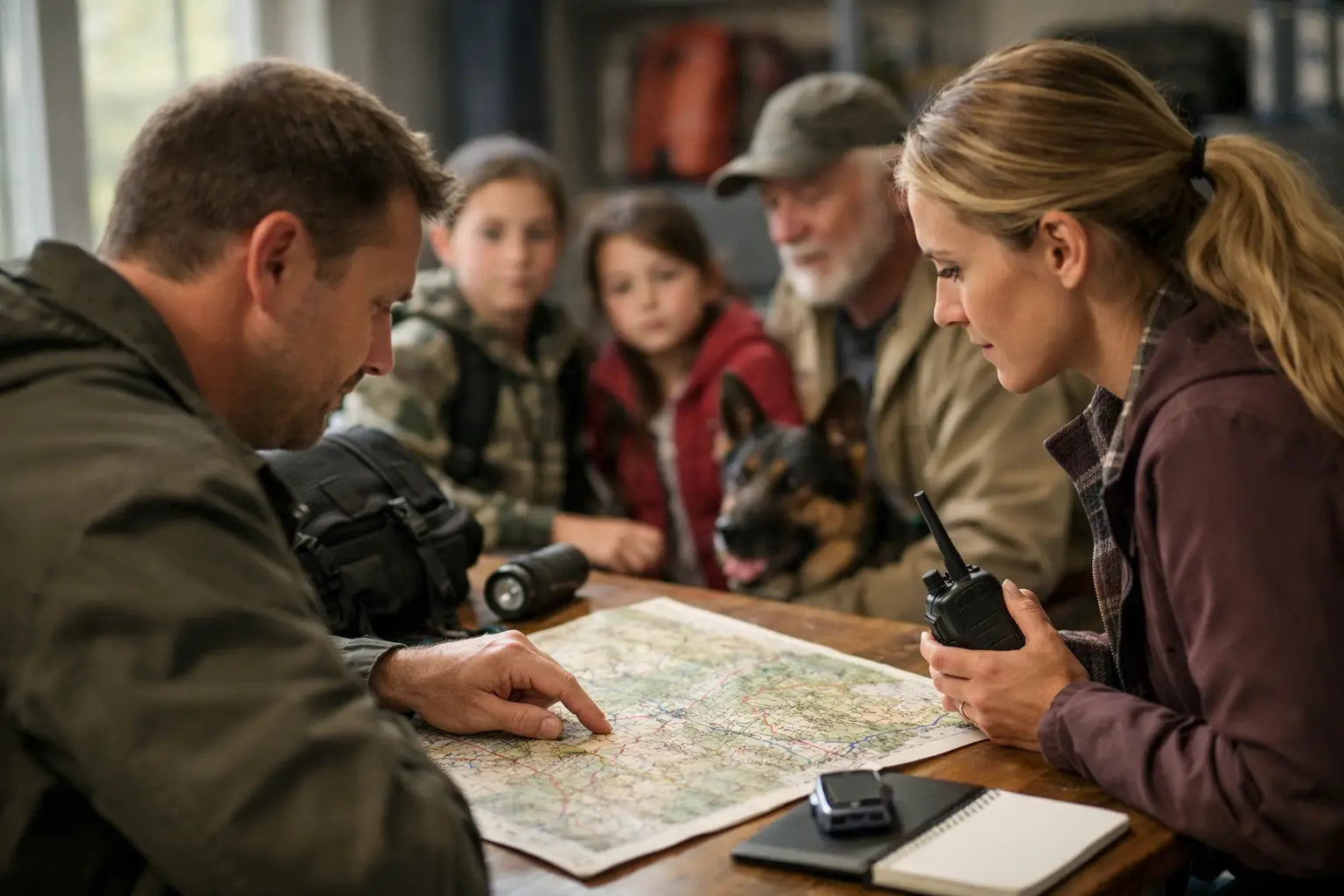
A school pickup gets delayed during a severe storm. Cell service is spotty. One parent is commuting home, a grandparent has the kids for the afternoon, and the usual group text will not send. This is why families need a meet up plan when SHTF - not because every emergency becomes a worst-case scenario, but because small disruptions get confusing fast when the people you love are in different places.
A family meet-up plan answers a simple question before stress takes over: Where will we go, and how will we know everyone is safe? It is one of the lowest-cost, highest-value parts of emergency preparedness. It works during a hurricane evacuation, a wildfire warning, a regional power outage, an earthquake, or a local emergency that closes roads and overwhelms phone networks.
Why a Family Meet-Up Plan Matters in an Emergency
Most families have routines, not plans. Everyone generally knows who picks up the children, where the spare key is, and which neighbor might be home. That is enough on an ordinary Tuesday. It may not be enough when roads are blocked, schools change dismissal procedures, or one family member cannot get home.
The hardest part of an emergency is often uncertainty. Is your child still at school? Did your spouse leave work? Should you wait at home, drive across town, or evacuate? A written plan reduces the number of decisions you must make in the moment. It gives every person a shared default rather than asking them to guess what everyone else will do.
A meet-up plan is especially useful because communication can fail even when the emergency is not dramatic. Networks become congested during severe weather. Batteries die. A phone left in a locker or vehicle is suddenly unreachable. Your plan should assume that a text or call may be delayed, not assume disaster movie conditions.
For parents, the plan also gives children a calming, age-appropriate answer: “If we cannot reach each other, follow the plan.” That certainty can make a frightening day feel more manageable.
Build a Family Meet-Up Plan That Works
Keep it simple enough to remember and specific enough to use. A complicated plan with six backup routes and a coded radio schedule is not practical for most households. Your family needs clear locations, clear roles, and one method for checking in.
Choose three meeting locations
Start with a location close to home. This could be a mailbox, a trusted neighbor’s front porch, or the end of your street. It is useful after a house fire, gas leak, or another event that requires everyone to leave the home quickly.
Next, choose a neighborhood location that is easy to reach on foot and unlikely to be affected by a problem at your house. A nearby park entrance, library parking lot, or community center can work well. Avoid places that may be locked, crowded, or inaccessible after dark.
Finally, choose an out-of-neighborhood location. This is the place to use if your subdivision is evacuated, roads into your area are closed, or returning home is unsafe. Pick a recognizable location outside your immediate area, such as a relative’s home, a place of worship, or a public building in a neighboring town.
The best location depends on your risks. Families in wildfire country may need a location that supports evacuation away from the fire zone. Families in tornado-prone areas may prioritize a nearby shelter or a relative’s sturdy home. In hurricane regions, your out-of-area location should be outside common evacuation routes whenever possible.
Name an out-of-area contact
Choose one trusted person who does not live nearby, preferably in another city or state. Each family member should know that person’s name and phone number. If local service is overloaded, a brief text to an out-of-area contact may go through when calls to nearby people do not.
That contact does not need to coordinate your rescue or make decisions for your household. Their job is simply to collect status updates and pass along messages. “We are safe at the library” is enough. This keeps relatives informed without forcing everyone to make dozens of calls during a stressful event.
Write the number on a paper contact card. Children should carry one in a backpack, and adults should keep one in a wallet, vehicle, and evacuation bag. Phone contacts are convenient until a dead battery makes them unavailable.
Decide who does what
A useful plan covers responsibilities without making anyone feel trapped by them. One adult may be responsible for school pickup, while the other checks on an older parent or gathers the pets. A teenager may know to bring the family’s emergency binder and medication pouch if there is time.
Be careful with rigid rules. “Dad always gets the kids” can fail if Dad is across town or roads are closed. Better wording is: “The closest safe adult follows the school’s release process, then updates our out-of-area contact.” The plan should give your family a direction while leaving room for real-world conditions.
Include pets from the start. Decide who loads carriers, leashes, food, and veterinary records. Families often plan for people and then lose time searching for a frightened cat or trying to find a dog leash as an evacuation notice arrives.
Plan for School, Work, and Adult Children
Your meet-up plan should match the places your family actually spends time. Review each child’s school emergency release policy. Know who is authorized to pick them up, what identification may be required, and whether the school uses an app, text alert, or a physical reunification site.
Do not tell children to leave school and walk home during an emergency unless that is specifically appropriate for their age, distance, and local conditions. Schools may be safer than the roads. Teach children to wait for instructions from school staff and to follow the family plan when released.
Adults need the same clarity. Discuss what happens if one person is at work during a major outage or evacuation. Is it safer to head home immediately, wait until traffic settles, or go directly to the neighborhood meeting point? The answer depends on distance, weather, fuel, and local guidance. The goal is not to promise everyone will get home quickly. It is to prevent everyone from driving in different directions without a shared purpose.
If you have adult children living independently, include them in the conversation. They may not come to your house in every emergency, and that is fine. Agree on a check-in method, a likely destination, and what help you can realistically provide. Grandparents should also know the plan for grandchildren who stay overnight or visit regularly.
Give the Plan a Communication Backup
Text messages usually require less network capacity than voice calls, so make texting your first choice when service is limited. Keep messages short: your name, your location, your condition, and your next move. For example: “Maya and I are safe at school. Waiting for release. Will update Aunt Renee.”
Every vehicle should have a charging cable, and your home should have backup power options for phones. A charged power station or smaller battery bank can keep essential communication available through an extended outage. But devices are only part of the solution. Paper matters too.
Store printed contact cards, a local map, and your meeting locations in your family emergency kits and evacuation bags. A map is valuable when your usual route is closed and navigation apps cannot load. Keep a permanent marker in the car so you can leave a simple note if you must depart a meeting point before everyone arrives.
Two-way radios can be useful for families who live close together, camp often, or regularly travel in separate vehicles. They are not a replacement for a plan, and range varies greatly with terrain, buildings, and weather. Think of them as an extra tool, not your only communications strategy.
Practice Without Making It Scary
A plan that has never been discussed is only an idea. Practice it twice a year, perhaps when you change clocks, refresh stored water, or review home insurance documents. Keep the conversation calm and brief.
Ask each person: What is our close meeting place? What is our out-of-neighborhood location? Who is our out-of-area contact? Where is your contact card? Younger children can practice saying their full name, address, and caregiver’s phone number. Older children can practice a short check-in text and learn how to use a paper map.
Then test the practical details. Drive to the out-of-neighborhood location from different directions. Confirm that the location is accessible and that the people there are comfortable being part of the plan. Update the plan after a move, a new school, a new job, a divorce, a medical change, or any shift in caregiving responsibilities.
Preparedness does not require predicting every emergency. It means giving your family a few dependable actions to take when normal life suddenly stops working. Put your meeting places and contact name on paper this week, hand each person a copy, and let that small decision make the next hard day a little clearer.