
Table of Contents
- Why Preschoolers Need Fire Safety Taught Differently
- Start With the Sound: Recognizing the Smoke Alarm
- Stop, Drop, and Roll Instructions That Stick
- How to Build a Fire Escape Plan for Families With Young Kids
- Practice Crawling Low and Feeling Doors for Heat
- Meeting Places, Firefighters, and Why Kids Hide
- Preschool Fire Safety Lesson Plans for Home Practice
- Conclusion: Make Fire Safety a Habit, Not a Lecture
- Frequently Asked Questions
Last Updated: September 8, 2026
Teaching fire safety to preschool children requires a completely different approach than teaching older kids or adults. Emergency preparedness starts with calm, repeated practice that fits a young child's understanding of the world. Below, we'll show you exactly how to build these skills at home, step by step, without frightening your child or turning drills into a battle.
Why Preschoolers Need Fire Safety Taught Differently
Preschoolers process danger through concrete experience, not abstract warnings. A three-year-old cannot grasp the physics of smoke inhalation, but they can absolutely learn that "the smoke alarm means we go to the door." Their brains are wired for routine and play, which makes repetition and physical practice far more effective than lectures.
The common mistake parents make is treating a fire drill like a serious conversation. Young children tune out fear-based warnings and remember what they physically practiced. This is why the National Fire Protection Association's education resources emphasize hands-on learning and repeated drills for early childhood. Your job is to be a coach, not a lecturer. Keep sessions short, playful, and consistent, and you will build genuine muscle memory rather than momentary compliance.
Start With the Sound: Recognizing the Smoke Alarm
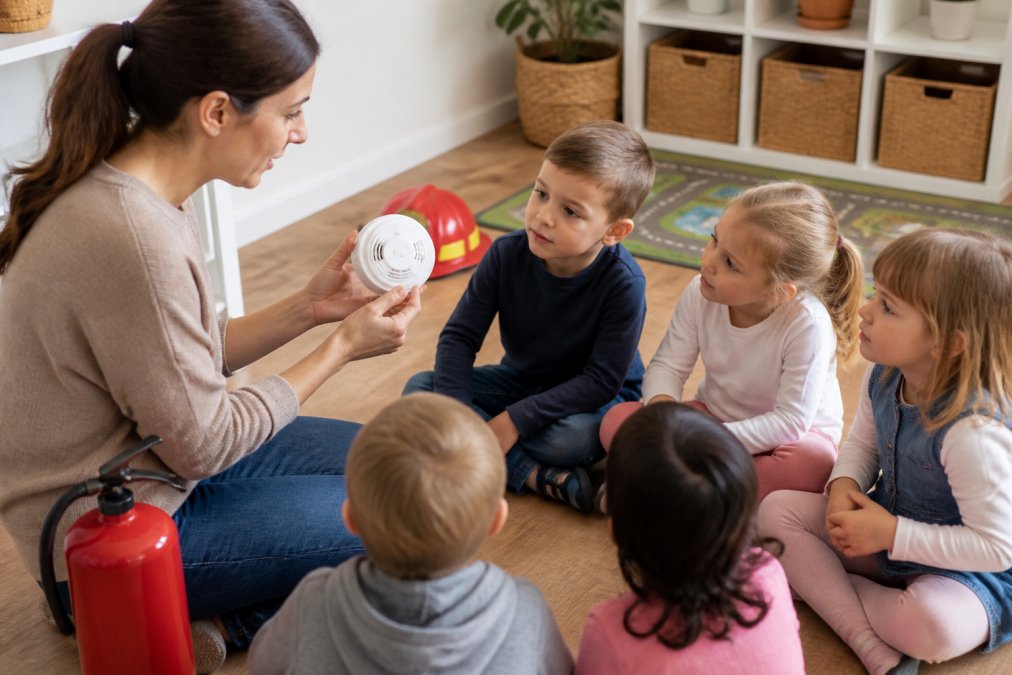
The smoke alarm sound is the single most important signal your child must recognize. Many young children have never heard the alarm from inside their home, and the noise can be startling or confusing. Play the actual sound for them, not a recording on a phone, so they associate it with their real environment.
Practice this recognition game: press the test button and immediately say, "That sound means we leave the house. Let's go!" Repeat this until your child moves toward the door without prompting. Make this a weekly ritual, not a monthly one. If your child covers their ears or cries, that is normal. Acknowledge the fear, hold their hand, and walk the route anyway.
Stop, Drop, and Roll Instructions That Stick
Stop, drop, and roll fails if taught as a vague instruction. Preschoolers need to practice the physical motion until it becomes automatic. The most effective way to teach this is through a game where you shout "Fire on your sleeve!" and demonstrate the motion yourself.
Break the skill into three distinct actions and practice each one separately before combining them. First, teach "stop" by freezing in place. Second, teach "drop" by sitting down quickly. Third, teach "roll" by lying flat and rolling back and forth. Use a soft rug or carpet for practice and make it fun by rolling alongside your child. What most guides miss is that you should also practice this while wearing different types of clothing, including a jacket or pajamas, so the skill transfers to real situations.
How to Build a Fire Escape Plan for Families With Young Kids
A fire escape plan for families with young kids must account for the fact that preschoolers cannot open heavy doors, reach window latches, or follow complex verbal directions under stress. Draw a map of your home with your child, marking the primary exit and a backup exit from each room.
Your plan should assign one adult to each child, because a preschooler will not reliably follow the plan alone. Practice the escape route until your child can lead the way during a drill, holding your hand. Include a clear rule that the escape plan is about leaving, not gathering belongings or finding pets. The Ready.gov family emergency plan guidance recommends practicing your escape plan at least twice a year, but for young children, monthly practice is far more realistic for building lasting recall.
Apartment and High-Rise Living: A Unique Angle Most Guides Miss
Most fire safety content assumes a single-family home. If you live in an apartment or high-rise, your escape plan is fundamentally different. The primary exit is a shared stairwell, and the backup exit might be a fire escape or a neighbor's unit. Here is how to adapt the standard advice for vertical living.
- Know Your Building's Alarm System: A single-family home has one alarm. A high-rise may have a zoned alarm system. The alarm sound may mean "evacuate" or it may mean "shelter in place," depending on where the fire is. Contact your building manager to understand what your specific alarm sounds mean. Teach your child that the sound is a signal to listen for a grown-up's instructions.
- Practice the Stairwell, Not the Hallway: Your practice should focus on the exit stairwell, not just the apartment door. Walk the route with your child, counting the flights of stairs. Teach them to hold the handrail and stay to the right. If you have a stroller, practice collapsing it quickly and carrying your child. Do not use the elevator, ever. Explain that the elevator is like a trap that could stop working.
- Identify Your 'Safe Area of Refuge': In some high-rise fires, the safest action is to stay in your apartment if the fire is not on your floor. Identify a room with a window and a phone. Practice going to this room, closing the door, and stuffing a towel under the door. This is a different skill than 'get low and go,' and it requires its own practice.
- The Fire Escape Ladder Question: For apartments above the ground floor, a portable fire escape ladder can be a backup option, but only if your window is accessible and you are physically able to deploy it. These ladders are not recommended for children to use alone. Your plan should be that an adult deploys the ladder and goes first, with the child following. Check your local fire code, as some jurisdictions restrict their use.
- The 'Neighbor Helper' Plan: In an apartment building, your neighbor across the hall can be a critical ally. Introduce yourself and agree to be each other's 'check-in' during an alarm. If you are home alone with your child and the alarm sounds, your plan is to grab your child and go. Your neighbor's role is to help you if you need it, or to confirm you have left your unit.
Practice Crawling Low and Feeling Doors for Heat
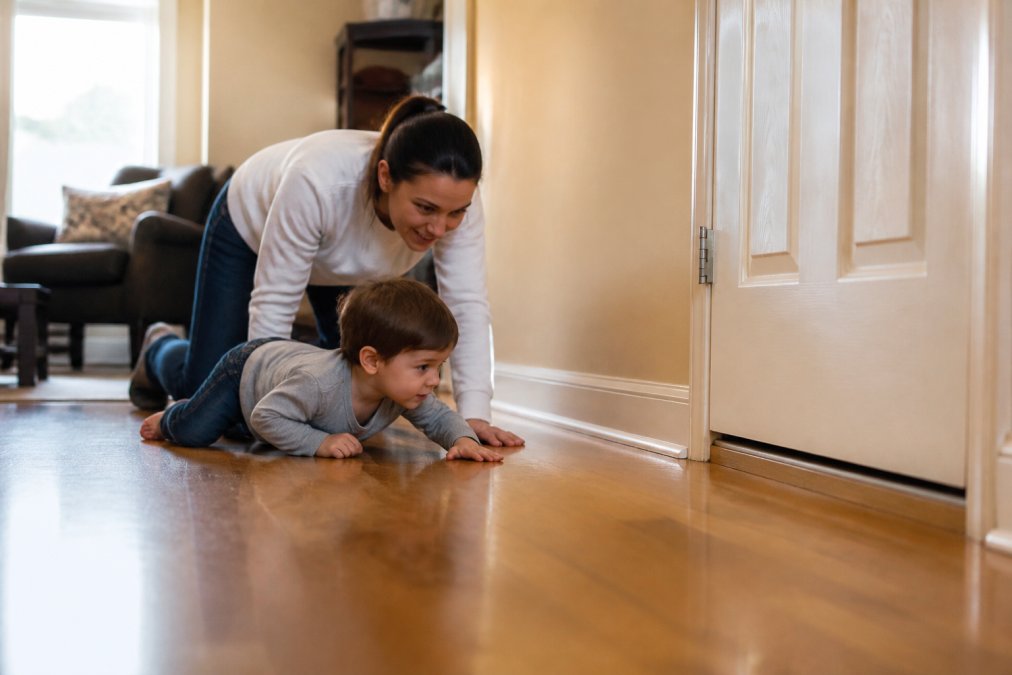
Crawling low under smoke requires physical practice, not just explanation. Smoke rises, and the air near the floor is clearer. Show your child how to get on their hands and knees and crawl toward the exit, keeping their head low. Make it a game by timing how fast they can crawl from their bedroom to the front door.
Feeling a door for heat is a more advanced skill, but you can teach a simple version. Show your child how to touch the door with the back of their hand before opening it. Explain that if the door feels hot, they must use their second exit. Practice this on a regular door and explain why the back of the hand is safer, since it is more sensitive to heat.
Meeting Places, Firefighters, and Why Kids Hide
Children often hide during fires because they are scared of the noise, the smoke, and the firefighters in bulky gear. Firefighters in full turnout gear can look like monsters to a small child, so you must introduce your child to that appearance before an emergency happens.
Contact your local fire department and ask if they offer station tours or community events where children can see the gear up close. If that is not possible, show your child pictures and videos of firefighters in full gear, explaining that these are helpers who are there to rescue them. Reinforce that they should never hide under a bed or in a closet, and that they should run toward a firefighter, not away from them.
The Sensory-Sensitive Child: A Unique Angle Most Guides Miss
Standard advice assumes a child's fear is based on the visual of a firefighter. But for a child with sensory processing disorder, autism, or simply a highly sensitive temperament, the fear is often triggered by the sound of the alarm and the feel of the gear. The high-pitched, intermittent beep of a smoke alarm can be physically painful, and the coarse, heavy fabric of turnout gear can feel overwhelming.
Most institutional guides ignore this. Here is how to adapt your practice for a child who is sensory-sensitive:
- Desensitize the Sound: Do not start with the full-volume alarm. Use a phone app or a recording to play the smoke alarm sound at a very low volume while engaging in a favorite activity. Over several days, gradually increase the volume. Pair the sound with something positive, like a special snack or a favorite song, to change the association from 'scary' to 'signal.'
- Create a 'Firefighter Friend' Social Story: Before a station tour, create a simple picture book at home. Use real photos of firefighters in gear, but break the introduction into steps. First, show a firefighter in a plain uniform. Next, show one holding the helmet. Then, show one wearing the coat but no mask. Finally, show the full gear. Narrate each step: "This is a helper. The coat is heavy and loud. The mask helps them breathe. They are here to help you."
- Practice the 'Helper Hand': For a child who is prone to hiding, teach them to respond to a firefighter's voice by raising their hand and shouting, "I'm here!" This gives them a concrete action that overrides the freeze-and-hide response. Practice this in a game where you call out from another room and they have to find you and raise their hand.
- Plan for the 'Second Alarm': For children who are overwhelmed by the initial alarm, consider a two-step plan. The first step is simply moving to the door. The second step is exiting. Do not combine these until the child is comfortable with the first. This breaks the task into smaller, less overwhelming pieces.
Preschool Fire Safety Lesson Plans for Home Practice
You do not need a formal curriculum to make fire safety a habit. A preschool fire safety lesson plan can be a simple 15-minute block once a week that rotates through the core skills. Structure your home practice around these five activities to keep skills fresh without overwhelming your child.
| Activity | What to Practice | Suggested Frequency |
|---|---|---|
| Alarm Recognition | Move to the door when the alarm sounds | Weekly |
| Escape Route Walk | Walk the primary and backup exits | Weekly |
| Crawl Low Practice | Crawl from bedroom to meeting place | Every other week |
| Stop, Drop, and Roll | Practice the full sequence on a soft rug | Every other week |
| Firefighter Introduction | Look at gear, talk about helpers | Monthly |
Many local fire departments and organizations like the American Red Cross home fire safety programs offer free educational materials designed specifically for early childhood. Use these resources to add variety to your practice. The key is consistency. A five-minute game on a Tuesday is worth more than an hour-long lecture once a year. Fire prevention for preschoolers is about building a habit, not delivering a lesson.
Conclusion: Make Fire Safety a Habit, Not a Lecture
Teaching fire safety to preschool children is not a one-time conversation. It is an ongoing practice that becomes part of your family's routine, like brushing teeth or buckling a seatbelt. You are building emergency preparedness into your child's instincts, so that when the smoke alarm sounds, their body knows what to do even if their mind is scared.
The challenge is consistency. Life gets busy, and drills feel repetitive, but that repetition is exactly what saves lives. SHTF Prepper Club simplifies family emergency preparedness by providing expert guidance and a curated selection of essential survival gear, helping you keep your household ready without the fear. Get started with SHTF Prepper Club and build the confidence that comes from knowing your family is prepared.
Frequently Asked Questions
What should a preschooler do if they hear a smoke alarm?
A preschooler should immediately stop what they are doing and go to the nearest adult. They should not try to find the source of the alarm. Parents should practice this response regularly so the child does not freeze or hide. The goal is for the child to associate the sound with moving toward a trusted adult and then following the family's fire escape plan.
How often should families practice a fire escape plan?
Practice your fire escape plan at least twice a year, and increase the frequency if your child is young or new to the routine. Practice once during the day and once at night. Young children need repetition to remember the steps, especially the outside meeting place. Each practice session should be calm and short to avoid creating fear.
How do you explain stop, drop, and roll to a 3-year-old?
Break it into three simple actions. Say: 'Stop means freeze. Drop means sit down fast. Roll means lie flat and roll back and forth.' Demonstrate it yourself and have the child copy you. Practice on a soft rug or grass. Remind them this is only for when their clothes catch fire, not for pretend play.
What are the most important fire safety rules for preschoolers?
The critical rules are: do not play with matches or lighters, tell an adult if you see smoke or fire, get out when the smoke alarm sounds, and never go back inside for toys or pets. Teach them the sound of the alarm and show them the outside meeting place. Keep messages short and repeat them often.