
Table of Contents
- Before You Teach: What Kids Can Safely Handle
- Age-Appropriate Fire Safety Lessons by Stage
- The PASS Method for Fire Extinguishers, Explained Simply
- Choosing the Best Fire Extinguisher for Home Use
- How to Run a Family Fire Drill With Simulated Practice
- When to Evacuate vs. When to Fight a Fire
- Maintenance, Inspection, and Ongoing Readiness
- Conclusion: Building Calm Competence, Not Fear
- Frequently Asked Questions
Last Updated: October 3, 2026
Before You Teach: What Kids Can Safely Handle
Teaching children how to use a fire extinguisher starts with an honest question: can your child actually handle one? Most kids under 13 cannot. A standard home extinguisher weighs between 5 and 15 pounds, and discharging it takes a firm, sustained grip. This guide from SHTF Prepper Club walks you through what each age can safely do, so you build skills without building false confidence.
The physical and mental demands matter more than most parents expect.
Physical Strength and Height Requirements
A child needs enough grip strength to pull the pin and squeeze the lever fully. They also need the height to aim at the base of a fire from a safe distance. Many adults struggle with this under stress. Children face a higher bar.
Test readiness with a simple check:
- Can your child hold the extinguisher steady with one hand for 10 seconds?
- Can they pull a locking mechanism with real force?
- Can they stand 6 to 8 feet from a target and aim low?
If the answer is no, they are not ready to fight a fire. That is fine. Their job is to get out and get help.
Psychological Readiness and Decision-Making
Fighting a fire requires a calm, fast decision. Kids under stress tend to freeze or hide. That is normal, not a failure.
Ask yourself one question: will your child run toward a small fire or toward the door? If you are not sure, teach escape only. A child who evacuates and calls for help has done everything right.
Age-Appropriate Fire Safety Lessons by Stage
Age-appropriate fire safety lessons change as kids grow. What works for a 5-year-old will not work for a teenager. Match the lesson to the stage, and repeat it often. The reason the stages differ is not just maturity.
A useful rule of thumb: a child is not ready to discharge an extinguisher until they can grip and hold a 5-pound weight at arm's length, pull a pin against spring tension, and aim at a target 6 to 8 feet away.
Ages 3-6: Awareness and Escape Only
Children this age cannot use an extinguisher. Not even close. Their hands are too small for the lever, and their only job is to leave the house and go to the meeting spot.
Teach them:
- The sound of the smoke alarm means "get out now"
- Never hide under a bed or in a closet
- Crawl low under smoke
- Go to the family meeting spot and stay there
Keep it simple. Practice the same route every time. At this stage, repetition builds the reflex, not explanation.
Ages 7-12: Observation and Assisted Practice
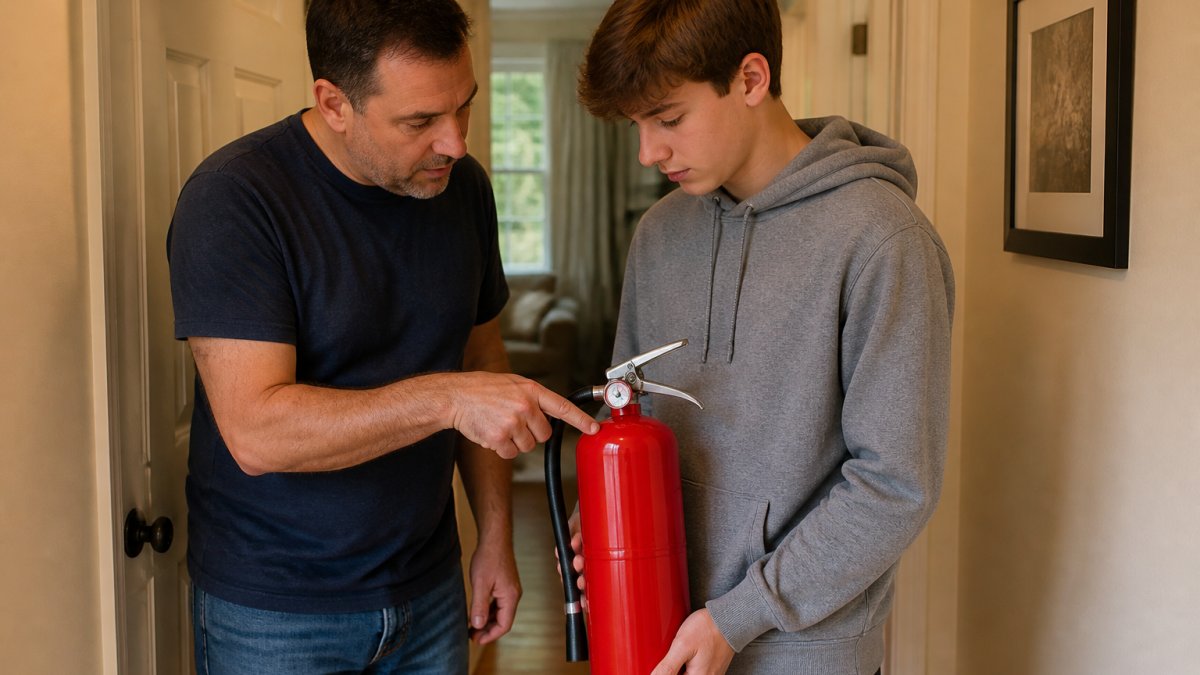
Kids in this range can learn the steps without fighting a real fire. Let them watch you point at the pressure gauge and name the parts. Then let them hold the unit and practice the motions with the pin in place.
They can also:
- Learn what the PASS method means
- Point out exits and smoke alarms in each room
- Test their own bedroom door for heat with the back of a hand
This stage builds knowledge. It does not build firefighting skill, and it should not try to. A child who can recite PASS but cannot physically pull the pin has learned a chant, not a skill.
Ages 13+: Supervised Hands-On Training
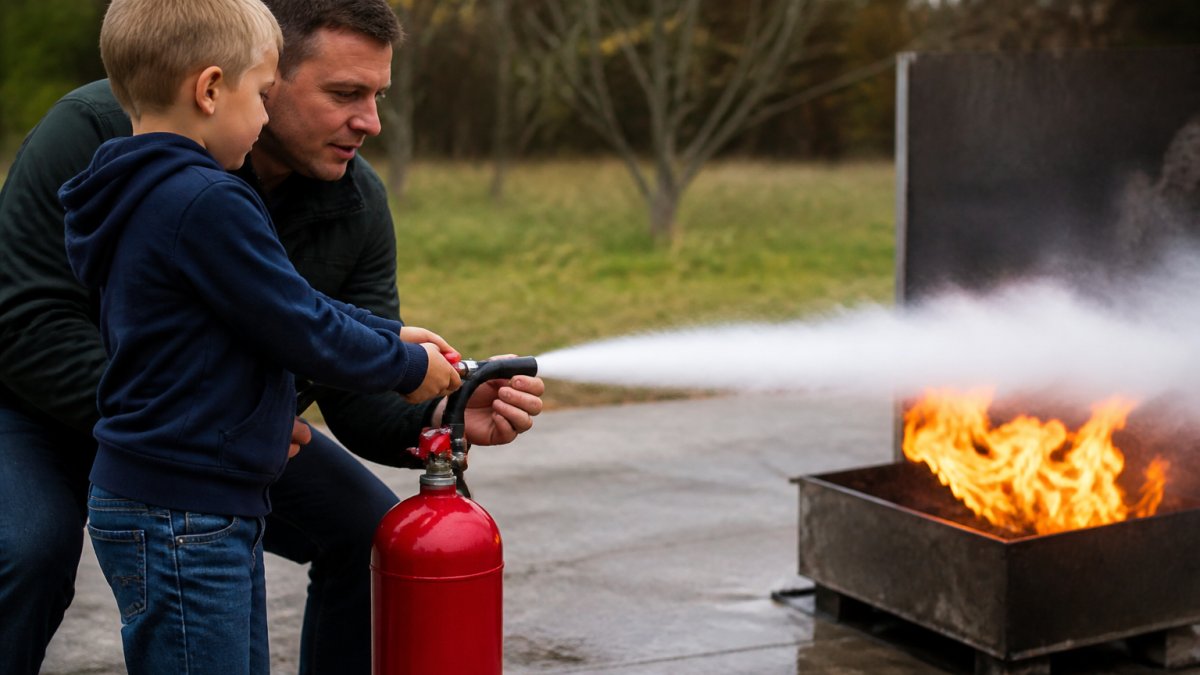
Teens can often handle a real discharge, with adult supervision. Take them outside to a safe area. Use a live-fire training pan or a controlled burn if local rules allow it.
Before any live practice, confirm the teen can:
- Lift and hold the extinguisher steady
- Pull the pin without fumbling
- Aim at the base of the fire, not the flames
- Sweep side to side until the fire is out
Always check with your local fire department about training options. Many run free or low-cost community programs.
The PASS Method for Fire Extinguishers, Explained Simply
The PASS method for fire extinguishers is a four-step sequence: Pull, Aim, Squeeze, Sweep. It is the standard technique taught by fire safety experts nationwide. Teach it as a chant so kids remember it under stress.
Here is what each letter means:
- Pull the pin. This breaks the locking mechanism and arms the unit.
- Aim low. Point the nozzle at the base of the fire, where the fuel burns.
- Squeeze the lever. Hold it steady to release the extinguishing agent.
- Sweep side to side. Move across the base until the flames go out.
According to the U.S. Fire Administration's home fire safety guidance, you should only attempt to use an extinguisher on a small, contained fire, and always keep your back to an exit.
A dry chemical extinguisher empties in about 8 to 15 seconds. That is not much time. Aim well from the start.
Choosing the Best Fire Extinguisher for Home Use
The best fire extinguisher for home use is a multipurpose ABC-rated unit.
| Rating | Handles | Common Home Source |
|---|---|---|
| Class A | Wood, paper, trash | Curtains, furniture, cardboard |
| Class B | Flammable liquids | Cooking oil, gasoline, paint |
| Class C | Electrical fires | Outlets, wiring, appliances |
| ABC combo | All three above | Best all-around pick |
Buy one extinguisher for the kitchen and one for the garage. Add another near any bedroom hallway if your home is large. Check the pressure gauge monthly. If the needle sits outside the green zone, replace or recharge the unit.
At SHTF Prepper Club, we stock vetted safety gear built for real household emergencies.
How to Run a Family Fire Drill With Simulated Practice
A family fire drill works best when it feels routine, not scary. Run one every six months. Keep it short and calm. But a drill that only practices walking out the door leaves the hardest skill untrained: the physical sequence of using an extinguisher.
The Two-Part Drill
Split each drill into an escape phase and a skills phase. The escape phase trains the whole family. The skills phase trains the teens and adults who might actually fight a small fire.
Escape phase:
- Pick a meeting spot outside, like the mailbox or a neighbor's driveway
- Sound the alarm and time how fast everyone gets out
- Practice crawling low under "smoke" using a blanket
- Have each child test a door for heat before opening it
Skills phase (teens and adults only):
- Walk through the PASS steps with a trainer unit
- Practice pulling the pin on an expired or empty extinguisher
- Aim at a floor target and sweep side to side
- Repeat until the motion is smooth without prompting
Run the drill twice a year. Change one variable each time, like starting from a bedroom instead of the living room.
How to Build a Safe Trainer Unit
You do not need a live fire to build muscle memory. A discharged or expired extinguisher makes a safe trainer. Confirm the pressure gauge reads empty, then mark the unit clearly with tape or paint so no one grabs it in a real emergency.
For the aim-and-sweep step, set a target on the ground, like a piece of cardboard or a chalk mark. Have the teen point the nozzle at the base of the target, not the top.
Psychological Preparation
A drill also trains the mind. Kids who have rehearsed a calm sequence are less likely to freeze. During practice, use steady language and avoid shouting. Afterward, ask what felt hard and what felt easy. That conversation does more for readiness than a perfect run.
When to Evacuate vs. When to Fight a Fire
Evacuate first, always. Only fight a fire if it is small, contained, and you have a clear exit behind you. The rule applies to adults and teens alike.
Evacuate if:
- The fire is bigger than a wastebasket
- Smoke fills the room
- The fire is between you and your only exit
- You are not sure what is burning
Fight only if:
- The fire is small and just started
- You have the right extinguisher for the fuel type
- You have a clear path out
- You have already called 911 or had someone else call
Kids should never make this call alone. Teach them that their job is to leave and let adults handle the rest.
Maintenance, Inspection, and Ongoing Readiness
An extinguisher that fails when you need it is worse than none at all. Check your units monthly and have them serviced by a professional once a year.
Monthly checks:
- Pressure gauge reads in the green
- Pin and tamper seal are intact
- No cracks, dents, or corrosion
- Nozzle is clear and unblocked
Also test your smoke alarms every month and replace batteries yearly. The National Fire Protection Association recommends replacing smoke alarm units every 10 years. A working alarm buys your family the seconds that matter most.
Store extinguishers where they are easy to reach, not buried behind boxes. Mount them on a wall bracket near an exit.
Conclusion: Building Calm Competence, Not Fear
The real goal is not to turn your child into a firefighter. It is to build calm competence.
At SHTF Prepper Club, we help families get ready without the fear. Our expert-vetted safety gear, family-focused preparedness guides, and ready-made emergency kits make it simple to build a real plan.
Get started with SHTF Prepper Club and give your household the calm, steady readiness that holds up when it counts.
Frequently Asked Questions
At what age should a child be taught to use a fire extinguisher?
Most children are not physically or psychologically ready to operate a fire extinguisher until their early teens. Before that, focus on age-appropriate fire safety lessons: recognizing the sound of a smoke alarm, knowing two ways out of every room, and practicing escape routes. A 7- to 12-year-old can learn to identify a fire extinguisher, understand what it is for, and watch a parent demonstrate the PASS method, but they should not attempt to fight a fire themselves.
What is the easy way to remember the steps for using a fire extinguisher?
The PASS method for fire extinguishers makes the sequence easy to recall under stress. Pull the pin to break the tamper seal. Aim low, pointing the nozzle at the base of the fire, not the flames. Squeeze the lever slowly and evenly. Sweep side to side across the base of the fire until it appears out. Teach children the phrase first as a memory tool, then walk them through each action with a real unit in hand so the words connect to physical movement.
How can I practice fire extinguisher safety with my family without a real fire?
Simulated practice drills build real skill without any flames. Use a training extinguisher or a discharged unit to rehearse the PASS sequence in the backyard. Place a target on the ground to represent the base of the fire, then have each family member pull the pin, aim low, squeeze, and sweep. Pair this with a full home fire drill: smoke alarm sounds, everyone meets at the evacuation point, and you confirm who is accounted for.
Which type of fire extinguisher is best for home use?
A multipurpose ABC dry chemical extinguisher handles the three most common household fire classifications: ordinary combustibles like wood and paper, flammable liquids like cooking oil and gasoline, and energized electrical equipment. For kitchen areas, some families add a Class K extinguisher specifically for cooking oil fires. Check the pressure gauge monthly, keep units mounted near exits rather than next to the stove, and replace or service any extinguisher that shows a dropped gauge reading.