
Table of Contents
- Why Starting a Survival Garden for Beginners Builds Real Food Security
- Step 1: Choose Your Site and Build Soil Health
- Step 2: Pick the Best Survival Garden Crops for Calories and Storage
- Step 3: Choose Easy Vegetables to Grow for Beginners
- Step 4: Build a Survival Garden Planting Plan and Monthly Calendar
- Step 5: Plan for a Year-Round Food Garden
- Common Mistakes That Kill a First Survival Garden
- Conclusion: Start Small, Then Scale Your Survival Garden
- Frequently Asked Questions
Last Updated: October 6, 2026
Why Starting a Survival Garden for Beginners Builds Real Food Security
Starting a survival garden for beginners is the most practical step a household can take toward food security.
Food security means reliable access to enough safe, nutritious food. A survival garden delivers that directly, even when store shelves empty out.
Store-bought food depends on supply chains, fuel, and weather you don't control.
Below: site selection, soil, crop choice, planting schedules, and the mistakes that sink most first gardens.
Step 1: Choose Your Site and Build Soil Health
The best survival garden site gets six to eight hours of direct sun and sits close to a water source. Everything else can be fixed; sun and water access can't be faked.
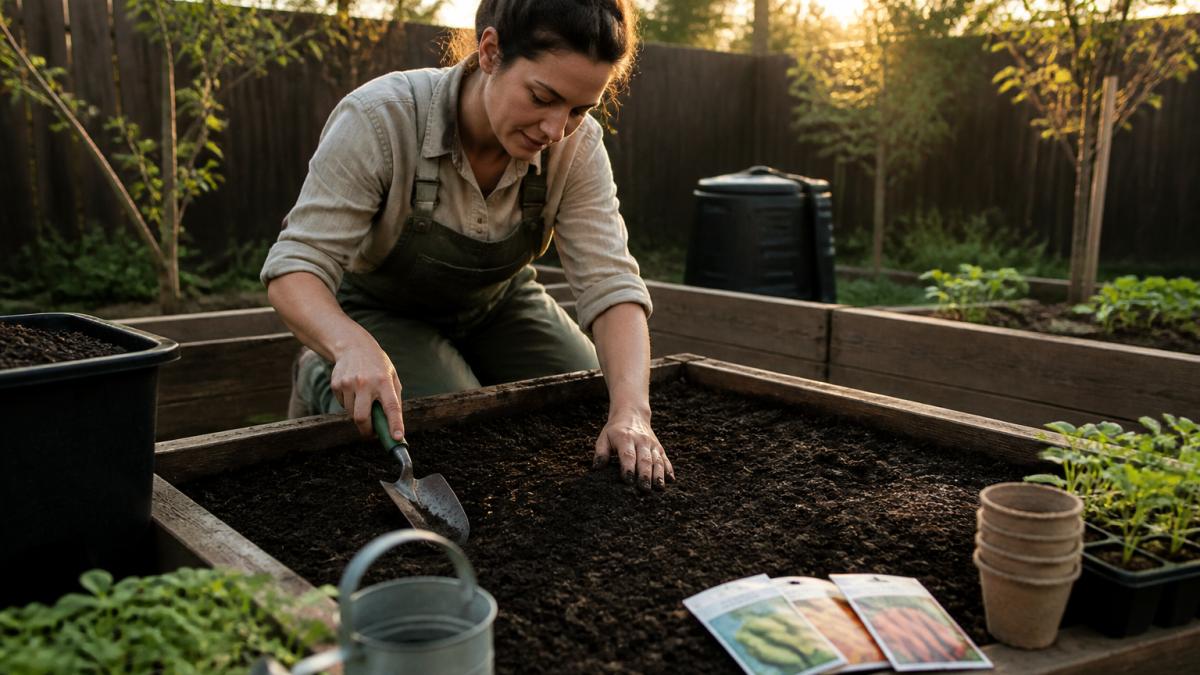
Watch your yard for a full day before committing. Morning sun, afternoon shade, low spots that flood after rain: all of it matters. Pick wrong and you'll fight the site all season.
Sunlight, Water Access, and Raised Beds
Sunlight drives everything. Leafy crops tolerate some shade; fruiting crops like tomatoes and squash do not.
Water access is the second pillar. Hauling buckets gets old fast, set your garden within reach of a hose, rain barrel, or drip line.
Raised beds solve several problems at once:
- They warm up faster in spring
- You control the soil mix
- They drain well after heavy rain
Soil health comes next. Good soil is dark, crumbly, and alive. Start with a soil test through your extension office, then add compost generously.
Step 2: Pick the Best Survival Garden Crops for Calories and Storage
The best survival garden crops are calorie-dense and store well: potatoes, corn, winter squash, and dry beans. These four carry a household through winter; leafy greens won't fill your pantry.
Think in calories, not variety. A garden full of lettuce feeds you for a week; a bed of potatoes feeds you for months. The part most guides skip is the math: how much food a plot produces and how many plants your household needs.
Calorie-Dense Storage Crops: Potatoes, Corn, Winter Squash, Dry Beans
Potatoes produce more calories per square foot than almost any garden crop.
Corn delivers dense calories and dries well for grinding into meal. Field corn stores better than sweet corn.
Winter squash keeps for months without refrigeration, one good harvest fills a shelf.
Dry beans are protein and calories in one package, storing for years when kept dry and sealed.
| Crop | Why It Matters | Storage Life | Space Needed |
|---|---|---|---|
| Potatoes | High calories per square foot | 3-6 months | Moderate |
| Corn | Dense calories, grinds to meal | 6-12 months dried | High |
| Winter squash | Stores without power | 3-6 months | High |
| Dry beans | Protein plus calories | 1-3 years | Moderate |
Realistic Yields and Garden-Size Math
A survival garden is a numbers problem before a gardening problem. A typical adult needs roughly 2,000 to 2,500 calories a day, or 730,000 to 900,000 a year.
Use these commonly cited yield ranges as planning estimates, not guarantees; results swing widely with soil, sun, water, and pest pressure.
| Crop | Approx. Yield per 10 ft Row or Plant | Calories per Pound (approx.) | What It Takes to Store |
|---|---|---|---|
| Potatoes | 10-20 lb per 10 ft row | ~350 | Cool, dark, humid; 40-50°F ideal |
| Dry beans (bush) | 1-2 lb per 10 ft row | ~1,500 | Fully dry, sealed, dark |
| Field corn | 10-15 ears per 10 ft row | ~1,600 (dry grain) | Dried to low moisture, sealed |
| Winter squash | 2-4 fruits per plant | ~150-200 | Cured, 50-55°F, dry air |
A practical beginner target: grow enough storage crops to cover one to three months of your household's calories, then expand yearly.
Match Crops to Your Growing Zone and Frost Dates
Crop choice is also a timing decision.
Two dates drive everything:
- Last spring frost: the earliest safe date to plant tender crops outdoors.
- First fall frost: the deadline to harvest or protect warm-season crops.
The gap between them is your growing season. Cool-season crops like potatoes, kale, and radishes tolerate light frost and go in weeks before the last spring frost.
Short season? Favor fast-maturing varieties and start seeds indoors. Long and hot? Plant storage crops early and use the back half of the year for a second round of cool crops.
A Simple Crop Rotation to Protect the Backbone
Growing the same crop in the same spot year after year invites disease and drains nutrients. A basic three- or four-year rotation keeps soil balanced and breaks pest cycles.
A workable pattern:
- Year 1: Potatoes (heavy feeders, loosened soil)
- Year 2: Beans (fix nitrogen back into the soil)
- Year 3: Corn or squash (heavy feeders again, but different pests)
Keep a simple garden map each season. It costs nothing and prevents the most common long-term failure: soil that quietly wears out.
Step 3: Choose Easy Vegetables to Grow for Beginners
Easy vegetables to grow for beginners include bush beans, zucchini, radishes, and leafy greens like kale, crops that forgive mistakes and reward you fast.
Start with crops that build confidence. A radish is ready in under a month, and that quick win matters when you're learning.
Good beginner picks:
- Bush beans (no trellising needed)
- Zucchini (nearly grows itself)
- Kale and chard (harvest for months)
Add these alongside your storage crops to round out meals while the big crops mature.
Step 4: Build a Survival Garden Planting Plan and Monthly Calendar
A survival garden planting plan maps what goes in the ground and when.
Work backward from your first frost date, which your extension office publishes for your area. Every planting decision flows from it.
Most guides give a vague seasonal list. Beginners need a month-by-month calendar tied to their zone and frost dates, plus succession intervals that keep food coming all season.
Find Your Zone and Frost Dates First
Before planting, get three numbers:
- Your USDA hardiness zone (from the USDA Plant Hardiness Zone Map).
- Your average last spring frost date.
- Your average first fall frost date.
Your extension office or the National Weather Service provides frost dates for your county. Write them on a calendar, everything below is anchored to those two dates.
Month-by-Month Planting Calendar (Adjust to Your Frost Dates)
The calendar below assumes a mid-length season. Shift each entry to match your frost dates; the pattern matters more than the exact month.
Late winter (6-8 weeks before last frost)
- Start tomatoes, peppers, and eggplant indoors under lights.
- Start onions and leeks if you're growing from seed.
- Order or inventory seed. Check stored potatoes and squash for rot.
Early spring (4-6 weeks before last frost)
- Direct-sow cool crops: radishes, spinach, lettuce, peas, kale.
- Plant potatoes once soil can be worked and is not waterlogged.
- Harden off indoor seedlings gradually.
Around last frost
- Transplant hardened tomatoes, peppers, and squash after the frost date passes.
- Direct-sow beans and corn once soil is reliably above 60°F.
- Keep row cover handy for a late cold snap.
Late spring to early summer
- Succession-sow beans, lettuce, and radishes every 2-3 weeks.
- Mulch everything to hold moisture and suppress weeds.
- Side-dress heavy feeders like corn and squash.
Midsummer
- Start a fall crop of kale, broccoli, and carrots 8-10 weeks before first frost.
- Water deeply 2-3 times a week rather than daily.
- Watch for pests on squash and beans.
Late summer to early fall
- Harvest and cure winter squash and dry beans.
- Dig potatoes after vines die back.
- Plant garlic for overwintering in many zones.
Fall
- Harvest the last warm-season crops before first frost.
- Plant a cover crop like crimson clover or winter rye on empty beds.
- Clean, dry, and store seed for next year.
Winter
- Eat from storage: potatoes, squash, beans, canned goods.
- Plan next year's rotation and order seed.
- Repair tools and beds.
Succession Planting Intervals That Actually Work
Succession planting turns a one-shot harvest into a steady supply: sow small amounts often instead of everything at once.
| Crop | Sow Every | Notes |
|---|---|---|
| Radishes | 10-14 days | Fastest confidence builder |
| Lettuce | 2-3 weeks | Bolt in heat; shade in summer |
| Bush beans | 2-3 weeks | Stop ~8 weeks before frost |
| Carrots | 3 weeks | Keep soil moist for germination |
| Spinach | 2-3 weeks | Cool weather only |
This spreads risk too, a late frost or pest outbreak hits one planting, not your whole crop.
Seed Starting Indoors and Transplanting
Seed starting indoors gives you a head start and saves money, a packet costs far less than nursery starts and often covers multiple seasons.
Start seeds six to eight weeks before your last frost. Use a light setup, keep soil evenly moist, and harden off seedlings by moving them outside a few hours a day, adding time over a week.
Transplant on a cloudy day or in the evening. Water well and mulch around each plant. New transplants hate direct afternoon sun.
Keep a Garden Journal
A cheap notebook is the most underrated tool in a survival garden. Record what you planted, when, what germinated, what failed, and the weather. After one season you'll have a personalized calendar more accurate than any generic guide, built from your soil, zone, and results.
Step 5: Plan for a Year-Round Food Garden
A year-round food garden uses succession planting and storage to keep food coming, grow in every season and preserve the surplus.
Preservation is the other half. Learn to can, freeze, and dry.
National Center for Home Food Preservation guidance covers safe canning and storage methods. Unsafe canning causes real illness (the CDC).
For water security alongside your garden, SHTF Prepper Club offers vetted water filtration and storage solutions.
Common Mistakes That Kill a First Survival Garden
The biggest first-garden mistake is starting too big. A huge plot overwhelms a beginner. Weeds win. Watering gets away from you. The garden dies by July.
Other common mistakes:
- Planting in poor soil without amending it
- Skipping mulch, then fighting weeds all summer
- Watering shallowly and often instead of deeply and less often
Mulch is the beginner's best friend. It holds moisture, blocks weeds, and feeds soil as it breaks down. Two to three inches of straw or shredded leaves does the job.
Conclusion: Start Small, Then Scale Your Survival Garden
Starting a survival garden for beginners works best when you start small and build.
Layer in storage crops, a planting calendar, and preservation methods over time. Each season teaches you something the last one couldn't.
SHTF Prepper Club supports that work with expert-vetted gear for food storage, water filtration, and long-term independence, so you can focus on growing.
Get started with SHTF Prepper Club and build a household that stays fed no matter what comes.
Frequently Asked Questions
What is the easiest crop to grow for survival purposes?
Potatoes are the most forgiving survival crop for a beginner gardener. They grow in poor soil, tolerate missed watering, and produce calorie-dense food you can store for months without electricity. Bush beans and zucchini come next for ease. If you want something nearly foolproof, radishes and leafy greens mature in under 40 days, so a failed planting costs you only a few weeks, not a whole season.
How much space do I need to start a survival garden?
A 10 by 10 foot plot can feed one person a meaningful share of their vegetables if you plant densely and focus on storage crops. In practice, most beginners start with two or three raised beds, roughly 4 by 8 feet each, and expand the following year. Container gardening works for renters and small yards: potatoes, peppers, and herbs all grow well in 5-gallon buckets or fabric pots on a patio.
What should I plant in a survival garden for year-round food?
Split your beds into three groups: storage crops for winter (potatoes, winter squash, dry beans), fast greens for spring and fall (lettuce, spinach, kale), and summer producers you eat fresh or preserve (tomatoes, peppers, zucchini). Add a cold-hardy crop like carrots or garlic that stays in the ground through winter. This mix gives you harvests in every season instead of a single August glut.
How can I preserve food from a survival garden?
Match the method to the crop. Dry beans and winter squash cure and store in a cool, dark room for months. Tomatoes and peppers water-bath can or freeze well. Potatoes need curing, then storage at 40 to 50 degrees Fahrenheit away from light. Leafy greens are best blanched and frozen. Dehydrating works for herbs, onions, and peppers. Label everything with the date, and rotate your oldest stock to the front.
A survival garden rewards patience, not perfection. The families who succeed are the ones who plant something, learn from it, and plant again next season. SHTF Prepper Club is here to help you cover the gaps a garden can't, with expert-vetted food storage, water filtration, and safety gear built for long-term readiness. Add to cart and take the next step toward real food independence.