
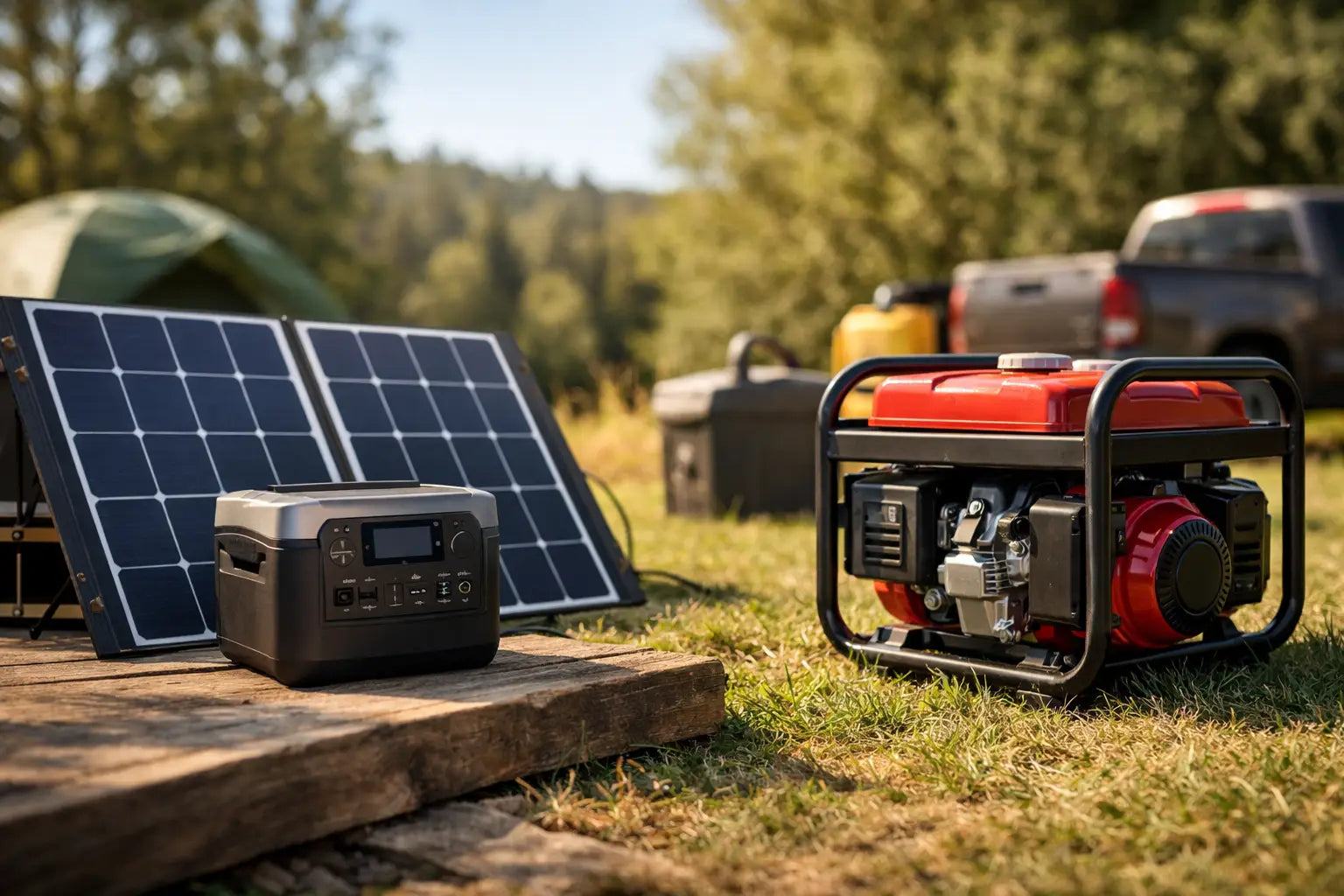
The power goes out at 7:40 p.m. Dinner is half-cooked, the fridge is full, and someone in the house is already asking how long the Wi-Fi will last. That is usually when the question gets real: solar generator vs gas generator - which one actually makes sense for your family?
The honest answer is that both can be useful, and neither is automatically better in every emergency. The right choice depends on what you need to run, how long outages usually last where you live, how much noise and maintenance you can tolerate, and whether you want a system that is ready with the push of a button or one that can keep going for days as long as you have fuel.
Solar generator vs gas generator: the real difference
A solar generator is usually a portable power station with a battery, inverter, and charging inputs for wall power, car charging, or solar panels. It does not create electricity from sunlight by itself unless you pair it with panels. Most families use one to run phones, lights, laptops, modems, CPAP machines, small appliances, and sometimes a refrigerator for limited periods depending on battery size.
A gas generator uses gasoline, propane, or sometimes dual-fuel systems to produce power through an engine. It is better suited for heavier loads and longer runtimes, especially when you need to power a refrigerator, freezer, sump pump, well pump, window AC, or multiple household circuits.
That distinction matters. If your main goal is keeping communication, lighting, and a few medical or food-storage essentials going during a short outage, solar can be excellent. If your goal is to keep large appliances running through a multi-day storm outage, gas usually has the advantage.
What solar generators do well
The biggest benefit of a solar generator is simplicity. You can keep it charged in a closet, pull it out during an outage, and use it indoors with no fumes, no engine noise, and very little setup. For families, that ease matters more than people expect. When the weather is bad and kids are anxious, quiet power is a real comfort.
Solar generators also require far less maintenance. There is no oil to change, no carburetor to gum up, and no fuel to rotate every few months. If you have ever tried to start a neglected gas generator after it sat in the garage for a year, you already understand why that matters.
They are also safer in some specific ways. Because there is no combustion, there is no carbon monoxide risk from operation indoors. That makes them a strong fit for apartments, garages used only for storage, elderly households, and anyone who wants backup power without managing fuel cans.
The trade-off is capacity. A smaller unit may keep phones, lanterns, and your internet up all night, but it will not run your whole kitchen. Even larger battery systems can drain quickly if you plug in power-hungry devices like space heaters, microwave ovens, coffee makers, or air conditioners.
Solar recharging sounds ideal, and sometimes it is. During a long sunny outage, panels can stretch runtime dramatically. But panel output depends on season, cloud cover, panel size, and placement. In a winter storm or hurricane aftermath with tree cover and overcast skies, charging may be much slower than families expect.
Where gas generators still win
Gas generators are louder, heavier, and less pleasant to manage. They are also extremely capable. If you need high wattage now, they remain one of the most practical options.
A good gas generator can start and run larger appliances that would overwhelm many portable battery units. That matters for families with chest freezers full of food, homes on well water, or basements that rely on a sump pump during storms. In those situations, backup power is not just about convenience. It prevents expensive damage.
Gas generators also have a clear advantage in extended emergencies if fuel is available. You can refill and keep going. With a solar generator, once the battery is depleted, you must wait for recharge from the grid, your car, or the sun. With gas, runtime is mostly a fuel-storage question.
Still, this comes with real downsides. Gas generators must be used outdoors and away from doors and windows because carbon monoxide can kill quickly and quietly. They are noisy enough to be disruptive, especially overnight in a neighborhood. They need regular test runs and maintenance. And fuel storage takes planning, money, and safe handling.
Cost is not as simple as the sticker price
Many families compare purchase price first, and that is fair. Smaller gas generators often cost less upfront than larger solar power stations. If you only care about dollars spent on day one, gas can look like the easy winner.
But total cost is broader than the box price. Gas generators need fuel, stabilizer, oil, filters, and occasional repair. If you do not maintain them, reliability drops right when you need them most. Solar generators cost more upfront in many cases, especially when you add panels, but they have lower ongoing costs and fewer maintenance headaches.
There is also the cost of sizing mistakes. A family that buys a small solar unit expecting whole-home performance will be disappointed. A family that buys a large gas generator without a safe fuel plan or transfer setup may also end up with something they rarely use correctly. The cheapest generator is often the one that actually matches your outage plan.
Which generator is better for your kind of outage?
If your outages are short and occasional, a solar generator is often the more comfortable choice. Think three to eight hours after a thunderstorm, rolling outages in summer, or overnight blackouts where your priorities are lights, phone charging, internet, fans, and medication refrigeration. It is fast, quiet, and easy to use without stepping outside in bad weather.
If your outages regularly last several days, gas becomes much more attractive. This is especially true in hurricane zones, ice storm regions, wildfire-prone areas with shutoffs, and rural areas where utility restoration can take time. In those cases, you may need enough output for refrigeration, cooking support, water systems, and heat-related equipment.
Medical needs matter too. For CPAP machines, refrigerated medications, mobility devices, and communication equipment, many families prefer battery power because it is quiet and indoor-safe. But if the outage could stretch for days, you may want a gas backup or a larger battery-plus-solar setup rather than relying on one small unit.
The best answer for many families is not either-or
For a lot of households, the smartest solar generator vs gas generator decision is actually both, used for different jobs.
A solar generator is excellent for daily readiness. It handles the first hours of an outage, powers your essentials indoors, keeps bedrooms quiet at night, and gives you a no-fuss backup for communication and medical gear. A gas generator covers the heavy lifting outside when you need more wattage or longer runtime.
That layered approach is especially practical for families who want to start small and scale smart. You might begin with a quality portable power station for lights, phones, Wi-Fi, and a CPAP. Later, if your risk profile supports it, you add a gas generator for refrigeration, pumps, or broader home backup. That is a much more realistic path than trying to solve every possible outage with one purchase.
How to choose without overbuying
Start with your must-run items, not generator marketing. Write down what your family truly needs for 24 to 72 hours: refrigerator, freezer, phones, internet, medical devices, a few lights, fans, maybe a microwave or coffee maker. Then look at both running wattage and startup wattage for anything with a motor.
Next, think about where and how you will use it. If you value quiet, live in a tighter neighborhood, or want something a grandparent can use without stress, solar has a strong case. If your home depends on pumps, larger appliances, or longer-duration outage support, gas is usually the more dependable workhorse.
Finally, be honest about your habits. A gas generator only helps if you maintain it and store fuel safely. A solar generator only helps if you keep it charged and understand its limits. Preparedness works best when it fits real life.
At SHTF Prepper Club, we see many families do best when they stop asking which option is universally better and start asking which problems they are solving first. That shift makes the decision clearer, less overwhelming, and a lot more useful when the lights actually go out.
If you are choosing for your household, favor the generator you will confidently use, maintain, and trust at 2 a.m. in bad weather. The best backup power plan is the one your family can count on without drama.