
Table of Contents
- Start With a Room-by-Room Safety Walkthrough
- Build a 72-Hour Emergency Kit Checklist for Seniors
- Emergency Power Backup for Medical Devices
- How to Keep a House Warm Without Power
- Set Up Communication, Alerts, and a Support Network
- Lighting, Fall Prevention, and Home Safety for Elderly at Night
- Plan for Pets, Isolation, and Digital Access
- Put Your Home Safety for Elderly Plan Into Action
- Frequently Asked Questions
Last Updated: September 26, 2026
Start With a Room-by-Room Safety Walkthrough
The fastest way to organize home safety for elderly during power outages is a room-by-room walkthrough. Note what fails when the lights go out.
Do this walkthrough in daylight. Check these rooms first:
- Bedroom: Is there a flashlight within arm's reach of the bed?
- Bathroom: Are there grab bars and non-slip mats?
- Kitchen: Where is the non-perishable food stored?
- Hallways: Can someone move safely without overhead light?
- Entry: Is there a paper map and a printed contact list?
Build a 72-Hour Emergency Kit Checklist for Seniors
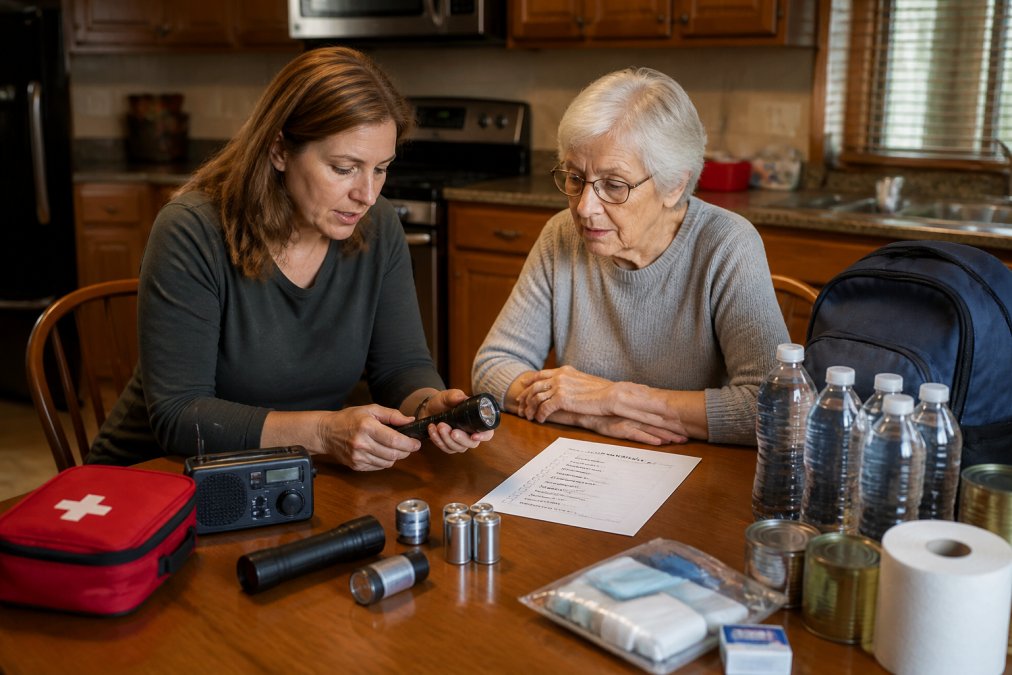
A 72-hour emergency kit checklist for seniors should cover three days of water, food, medications, and light. Build it around the person, not the disaster.
Your 72-hour kit should include:
- One gallon of water per person per day, for three days
- Non-perishable food that needs no cooking
- A seven-day supply of medications in a labeled pouch
- A battery-operated flashlight and extra batteries
- A battery-operated or hand-crank radio
- A first aid kit and a list of allergies
- Copies of insurance cards and ID in a waterproof bag
- Warm blankets and a change of clothes
- Cash in small bills
- A paper map and a printed emergency contact list
Emergency Power Backup for Medical Devices
A common pattern for home medical devices:
| Device | Typical Draw | Backup Option | Realistic Runtime Goal |
|---|---|---|---|
| CPAP (no humidifier) | 30-60 W | Portable power station | 8 hours per night |
| CPAP (with humidifier) | 90-150 W | Larger power station | 8 hours per night |
| Oxygen concentrator (continuous flow) | 300-600 W | Generator or large station | 4-8 hours |
| Oxygen concentrator (pulse dose) | 100-200 W | Portable power station | 6-10 hours |
| Insulin pump | Battery + spare | Spare batteries | 72 hours |
| Nebulizer | 100-200 W | Power station or manual alternative | Per treatment |
| Refrigerated medication | N/A | Chemical ice packs + cooler | 24-48 hours |
Register your parent as a medical baseline customer with the utility. Most investor-owned utilities offer a medical baseline or life-support discount: a physician signs a form confirming the device, and the household gets a lower rate tier plus, often, extra advance notice before a planned outage. Ask three things: Is there a medical baseline rate? How much advance notice before a planned shutoff? Does the household get priority restoration after a storm?
How to Keep a House Warm Without Power
To keep a house warm without power, trap heat in one room instead of heating the whole home. Pick a single room, close the doors, and focus warmth there.
Steps to keep one room warm:
- Choose a room with south-facing windows and good insulation.
- Close all doors and stuff towels under the gaps.
- Layer clothing: base layer, fleece, then a coat.
- Use sleeping bags and thermal blankets, not just sheets.
- Add chemical hand warmers inside pockets and socks.
Set Up Communication, Alerts, and a Support Network
A support network turns a solo emergency into a shared one. Line up three people who can check on your parent within an hour.
Build the network in three steps:
- Pick a primary contact who lives within 10 minutes.
- Pick a backup contact who can reach the home within an hour.
- Pick an out-of-area contact who can coordinate by phone.
Lighting, Fall Prevention, and Home Safety for Elderly at Night
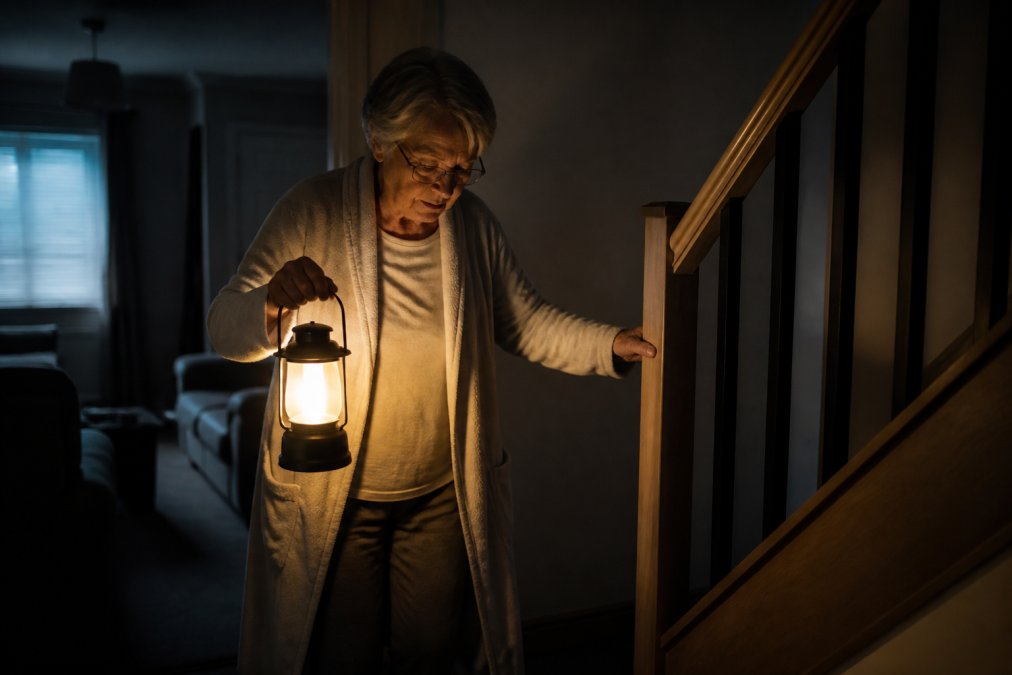
Fall prevention at night comes down to three things: light, clear paths, and reachable support. Most outage falls happen on the way to the bathroom.
Reduce fall risk with these fixes:
- Add non-slip mats to the bathroom and shower.
- Install grab bars near the toilet and tub.
- Keep mobility aids within arm's reach of the bed.
- Clear loose rugs and cords from walkways.
- Keep a phone or medical alert button on the nightstand.
Plan for Pets, Isolation, and Digital Access
Four gaps trip up most home safety plans for elderly during power outages: pets, isolation, digital access, and money. Address each before the outage, not during it.
Pet safety during outages
Seniors often prioritize a pet over themselves, so the pet plan is the human plan. Build it that way.
- Food and water: Store a seven-day supply of pet food and at least one gallon of water per medium dog per day. Canned food is easier for a senior to open than a heavy bag.
- Identification: Keep a current photo of the pet on the phone and a printed copy in the kit. If the pet bolts during a storm, the photo is what gets it back.
- Evacuation gear: Keep a leash, harness, carrier, and a copy of vaccination records in the waterproof bag. Many shelters do not accept pets, so identify one pet-friendly hotel or boarding facility within driving distance before storm season.
- Temperature: A pet in a cold house is a second body that needs warmth. A single small room with the senior and the pet holds heat better than two separate rooms.
Psychological impact of isolation
A dark, quiet house is its own hazard. Older adults living alone report higher anxiety during extended outages, often peaking at night when the phone is dead and the neighborhood silent.
What actually helps:
- A scheduled check-in, not a spontaneous one. Pick a fixed time, say 9 a.m. and 7 p.m., and assign a specific person to each slot. A scheduled call is a promise. A spontaneous call is a hope.
- A wind-up or battery radio tuned to a local station. Silence is the trigger. A human voice, even a stranger's, breaks it.
- A familiar routine. Keep the same morning coffee, the same chair, the same book. Familiarity lowers the sense of threat more than any gadget.
- A written note for the caregiver. Ask your parent to write down how they felt during the last outage. The answer usually reveals which fix matters most.
Digital accessibility for seniors
Most outage guides assume the user can read a small screen in the dark. Many older adults cannot, set up the phone before the storm.
- Turn on large-text mode and bold text. On both major phone platforms this is a single accessibility setting, not an app.
- Set up one-touch calling. Put the three network contacts on the home screen as photo buttons. A photo is easier to find than a name in a list.
- Enable voice dialing. "Hey Siri, call Maria" or "Hey Google, call Maria" works when hands are cold or shaky.
- Write passwords in a paper notebook kept with the kit. Password managers fail when the phone is dead.
- Test the phone in the dark. Hand your parent the phone with the lights off and ask them to call you. Whatever they fumble for is the fix.
Financial assistance for backup power
Backup power is expensive, and no single national program pays for it. But several paths exist, and most families never ask.
- Utility medical baseline programs. Most investor-owned utilities offer a lower rate tier for households with a documented medical device. Some include a bill credit that can be redirected toward a battery.
- State Medicaid waiver programs. When a physician documents medical necessity, some waivers cover backup power equipment. The rules vary widely by state.
- Area Agency on Aging. Every county has one. The Administration for Community Living maintains the national locator. Ask specifically: "What local funds cover backup power for a medical device?"
- Local utility hardship funds. Many utilities run a separate assistance fund, distinct from the medical baseline rate, that can cover a one-time equipment purchase.
Put Your Home Safety for Elderly Plan Into Action
A plan on paper does nothing until you practice it. Run a drill twice a year, once before storm season and once in winter.
Your action steps:
- Finish the room-by-room walkthrough and fix every gap.
- Build the 72-hour kit and store it where it is reachable.
- Set up emergency power backup for medical devices.
- Print the contact list and tape it to the fridge.
- Practice a lights-out night with your parent.
Frequently Asked Questions
What should I stock up on for a power outage if I care for an elderly parent?
Focus on the essentials your parent uses daily. That means at least a 7-day supply of medications, a battery-operated or hand-crank flashlight, extra batteries, non-perishable food that needs no cooking, bottled water (one gallon per person per day), and a portable power station for any medical device. Add a paper copy of emergency contacts, a first aid kit, and non-slip mats for hallways. Store everything in one accessible spot so you are not searching in the dark.
How do I set up emergency power backup for medical devices like oxygen concentrators or CPAP machines?
Start by calling the device manufacturer to confirm wattage and runtime requirements. For oxygen concentrators, most home units draw 300 to 600 watts, so a portable power station with at least 1,000Wh capacity gives you several hours of runtime. CPAP machines typically draw 30 to 60 watts, so a smaller unit works. Always keep a battery backup specific to the device if one is available, and test the setup every three months. Register with your utility company so you get priority restoration alerts.
How can caregivers keep an elderly person warm during a winter power outage?
Close off unused rooms and have everyone gather in one central space. Layer clothing and use blankets, sleeping bags, and thermal insulation on windows with plastic sheeting or heavy curtains. Never bring a gas generator, camp stove, or charcoal grill indoors because of carbon monoxide poisoning risk. If indoor temperature drops below 50°F, move to a warming center or a neighbor's home. Check on your parent every hour to watch for confusion, shivering, or cold skin, which are signs of hypothermia.
What is the most important thing to do before a storm hits?
Build a support network and make a written plan. Give a spare key to a trusted neighbor or family member, register your parent with the local utility company if they rely on powered medical equipment, and sign up for weather alerts. Charge all phones, power banks, and medical device batteries. Fill the bathtub and extra containers with water for flushing and washing. A paper map and a printed emergency contact list should be in the kit because cell service often fails during widespread outages.
Power outages test every household, but they hit older adults hardest. SHTF Prepper Club makes the preparation simpler with expert-vetted food, water, power, and safety gear built for real families. Our long-term food storage keeps for up to 25 years, and our kits need minimal prep when the lights go out. Get started with SHTF Prepper Club and give your household the tools to stay safe, warm, and connected when the power fails.