
Table of Contents
- Why Toddler Medication Storage Demands a Different Approach
- Where to Store Medicine at Home: A Room-by-Room Checklist
- Step 1: Choose the Right Locked Cabinet or Locked Container
- Step 2: Use Child-Resistant Medication Caps and Close Them Securely
- Step 3: Follow Label Instructions for Temperature, Refrigeration, and Storage Instructions
- Step 4: Put Medicine Away Immediately and Keep It in the Original Container
- How to Dispose of Expired Medication and Unused Medicine Safely
- Medication Poisoning in Children: What to Do After a Suspected Ingestion
- Building a Safer Home, One Habit at a Time
- Frequently Asked Questions
Last Updated: October 11, 2026
Why Toddler Medication Storage Demands a Different Approach
Toddlers climb, open, and taste first, then ask questions later. That is why learning how to store toddler medication safely is a critical parenting skill.
The stakes are real. According to the CDC child injury and poisoning prevention resources, poisoning is one of the leading causes of injury-related emergency visits for young children, and medicines are a common culprit. At SHTF Prepper Club, we think about household readiness the same way we think about emergency kits: small habits, set up once, protect your family every day.
Most parents assume a high shelf or closed drawer is enough. Toddlers are climbers and problem-solvers.
Below: a room-by-room plan, four steps, disposal rules, and what to do if a child swallows something they should not.
Where to Store Medicine at Home: A Room-by-Room Checklist
The best place to store medicine at home is a locked cabinet or locked container, placed high and out of sight, in a cool, dry spot away from heat and moisture. Use this checklist to sort your home:
- Kitchen: Only if you use a locked cabinet, away from the stove, sink, and dishwasher.
- Bathroom: Avoid the medicine cabinet over the sink. Heat and steam from showers degrade medicine.
- Bedroom: A good spot for a locked box on a high shelf or in a locked closet.
The common thread: locked, high, cool, and dry.
Kitchen and Bathroom: The Two Worst Rooms for Medicine
The bathroom brings moisture and heat swings from showers; the kitchen brings cooking heat and reachable countertops. If you must use either, keep medicine in a locked container on the highest shelf. Never leave a bottle on the countertop "for later", later is exactly when a toddler finds it.
Bedroom, Hall Closet, and Garage Storage Options
A bedroom or hall closet often wins: cooler, drier, and away from daily chaos. Garages bake in summer and freeze in winter, and both extremes weaken medicine.
Step 1: Choose the Right Locked Cabinet or Locked Container
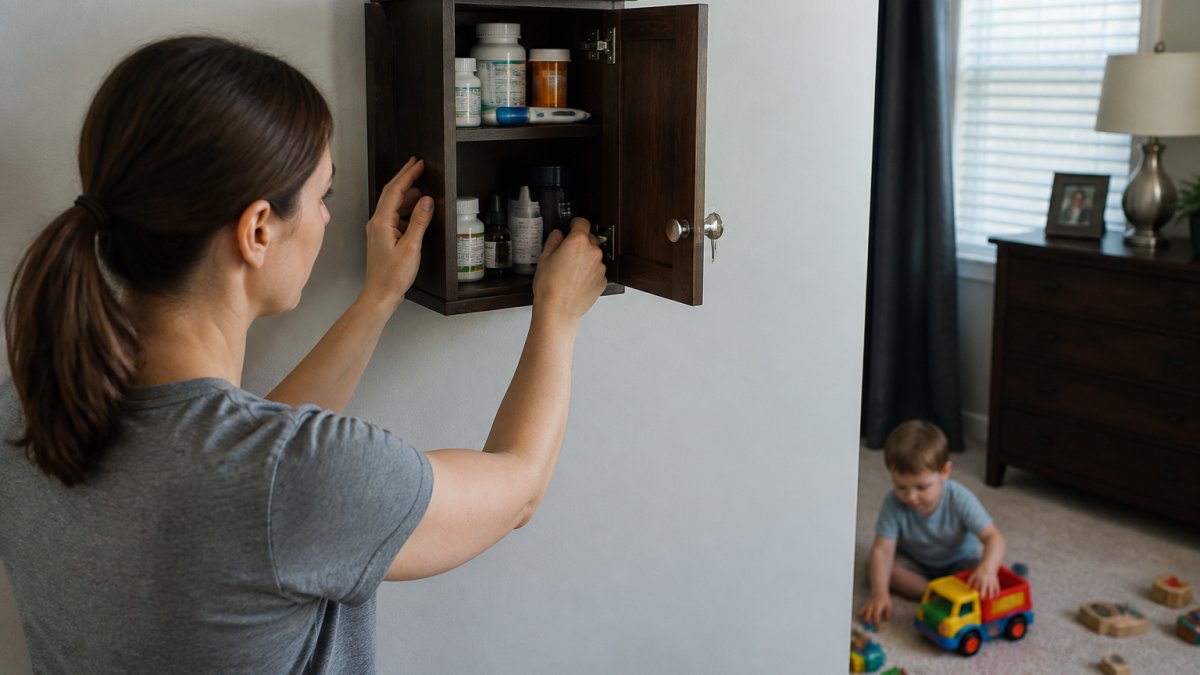
Pick a locked container first, then find its home. A small lockbox with a key or combination works for most families; a wall-mounted locked cabinet is better because it stays out of reach by design.
A few rules we give every family:
- Mount or place the container high, ideally above counter height and out of sight.
- Skip "hiding spots" like a sock drawer. Toddlers find those fast.
- Keep the key or code with adults only, never in the same room as the box.
Step 2: Use Child-Resistant Medication Caps and Close Them Securely
Child-resistant caps are a backup layer, not a replacement for locked storage. They slow a toddler down; they do not stop one. Twist until the cap clicks, then tug gently to confirm it is seated. If a cap is cracked, loose, or missing, move that bottle somewhere locked until you replace it.
Are Child-Resistant Caps Actually Toddler-Proof?
No. Child-resistant does not mean child-proof. The Consumer Product Safety Commission guidance on child-resistant packaging sets standards that make packaging harder for young children to open, but determined toddlers can still defeat some caps, especially if they watch you do it.
That is why the lock matters more than the cap. Caps buy you seconds. Locks buy you safety.
Step 3: Follow Label Instructions for Temperature, Refrigeration, and Storage Instructions
The label is the final word: refrigeration, temperature range, and how long it stays good after opening. Most medicines call for a cool, dry place at room temperature; some need the refrigerator, and a few need protection from light. Follow the storage instructions exactly, and never move a medicine into a different container "to save space."
- Keep daily medicines in a cool, dry, locked spot.
- Refrigerate only what the label says to refrigerate.
- Keep refrigerated medicine in a locked box inside the fridge, not the door.
Step 4: Put Medicine Away Immediately and Keep It in the Original Container
Put medicine away the moment you finish using it, not after you settle the toddler or answer the phone. The gap between "I'll do it in a minute" and "how did they get that?" is tiny.
Also think about visitors. A grandparent's purse, a guest's coat pocket, or a babysitter's bag can carry loose medicine into your home. Ask visitors to keep bags up high, and offer a locked drawer for their items.
How to Dispose of Expired Medication and Unused Medicine Safely
Clearing out old medicine is part of safe storage: if it is not in your home, a toddler cannot reach it. Empty your locked box every six months, or whenever you refill a prescription. Check every bottle for two dates: the expiration date on the package and, for liquids, the discard-after date your pharmacist wrote on the label. Many liquid antibiotics and some compounded medicines are good for only 7 to 14 days after mixing, even though the bottle carries a longer expiration date.
The Three Disposal Routes, In Order of Preference
- Drug take-back programs. This is the safest option because it keeps medicine out of the trash, the water supply, and your toddler's hands. The DEA drug disposal information and take-back locator lists permanent collection sites, and many pharmacies, hospitals, and police stations host them year-round. National Prescription Drug Take Back Day events are typically held twice a year, in spring and fall, and accept pills, patches, and liquids.
- Flushing, only when the label says so. A small number of medicines are so dangerous in a single dose that the instructions tell you to flush them rather than risk a child or pet finding them in the trash. Follow the label or patient information exactly. Do not flush anything the label does not specifically name.
- Trash, as a last resort. If no take-back site is nearby and the label does not say to flush, follow these steps.
How to Throw Away Medicine in the Trash
- Mix the medicine with something unappealing and hard to pick out, like used coffee grounds, cat litter, or dirt.
- Seal the mixture in a bag or a sturdy container with a lid.
- Remove or scratch out personal information on the label, including the patient name and prescription number.
What to Do With Old Medication Bottles and Prescription Bottles
Empty bottles still carry risk: a toddler can practice opening them, and residue can tempt a taste test. A few habits close that gap:
- Rinse liquid medicine bottles before recycling, and let them dry with the cap off.
- Scratch out or peel off labels with personal information before discarding.
- Recycle clean, empty plastic bottles if your area accepts them. Check your local rules, because some curbside programs reject medicine bottles.
A Simple Disposal Routine That Actually Happens
Pick two dates a year, such as when you change the smoke detector batteries, and make them your medicine audit days. On each date: empty the locked box, check every expiration and discard-after date, set aside anything expired, and either drop it at a take-back site or follow the trash steps above. Write the next audit date on a card inside the box.
Medication Poisoning in Children: What to Do After a Suspected Ingestion
Act fast and call for help. If you think a child swallowed medicine, call Poison Control right away at 1-800-222-1222. The line is open 24 hours a day, every day, and the call is free. You do not need to be sure something happened to call. Do not wait for symptoms: many medicines cause harm before a child looks sick.
What to Do in the First Five Minutes
- Move the child away from the medicine and take the bottle or package with you.
- Call 1-800-222-1222. If the child is unconscious, struggling to breathe, or having a seizure, call 911 instead.
- Stay on the line. Poison Control specialists will tell you whether to watch at home or go to the emergency room.
- Do not make the child throw up unless a medical professional tells you to. Vomiting can cause more harm with some medicines, especially caustic liquids and petroleum products.
- Do not give food, milk, or a home "antidote" unless Poison Control or a doctor tells you to.
What to Have Ready When You Call
- The medicine bottle or package, so you can read the label and active ingredients.
- Your best guess at how much was swallowed and when. Even a rough estimate helps.
- The child's age and weight. Weight matters because dosing and risk are calculated by body size, and a toddler's weight can change quickly.
What Not to Do
- Do not give syrup of ipecac or any home "antidote." It can cause more harm and delay real treatment.
- Do not wait to see if the child "seems fine." Many poisonings look fine at first.
- Do not assume a small amount is harmless. A single tablet of some medicines can be dangerous to a toddler.
After the Call
If Poison Control says to watch at home, follow their instructions exactly, including how long to watch and what symptoms to look for.
If the child was seen at a hospital, ask for a follow-up plan before you leave. Some medicines need a second check hours later, and some need a blood test. Write down the discharge instructions and the number to call with questions.
Preventing the Next Call
Every suspected ingestion signals a storage gap. After the emergency passes, find it: a purse on the floor, a bottle on the nightstand, a bag of gummies on the counter. Fix that spot first, then do a full room-by-room check. The goal is not guilt, it is closing the gap before it happens again.
Building a Safer Home, One Habit at a Time
Safe medicine storage is a small system that protects your family every day. Lock it, raise it, cool it, and put it away the moment you are done.
That same mindset drives everything we do at SHTF Prepper Club. Our expert-vetted safety gear, long-term food storage with up to a 25-year shelf life, and reliable water purification tools help you build a home that stays ready, without the fear.
Get started with SHTF Prepper Club and build a home that is ready for anything.
Frequently Asked Questions
Where are five safe places to store medicines around a toddler?
Five safe places include a locked cabinet mounted above counter height, a lockable toolbox in a hall closet, a high shelf inside a locked bedroom wardrobe, a dedicated locked drawer in the kitchen (away from the stove), and a lockable storage bin in a garage cabinet. Each spot must be out of reach and out of sight. Avoid medicine cabinets, countertops, purses, and nightstands, because toddlers climb and explore those areas constantly.
Are child-resistant medication caps actually toddler-proof?
No. Child-resistant medication caps meet federal safety standards, but they are designed to be difficult, not impossible, for a young child to open. Given enough time, some toddlers can defeat them. That is why a child-resistant cap is only one layer of protection. Always pair it with a locked container or locked cabinet, and close the cap securely after every use. Never leave a bottle with the cap off, even for a moment.
What should I do if I think my toddler swallowed medication?
Call Poison Control at 1-800-222-1222 immediately, even if your toddler seems fine. Do not wait for symptoms. Have the medicine bottle with you so you can read the label and estimate how much may have been taken. Do not induce vomiting unless a medical professional tells you to. If your child is unconscious, struggling to breathe, or having a seizure, call 911 right away. Fast action prevents serious medication poisoning in children.
How should I store toddler medication while traveling?
Pack all medicine in a locked travel container or lockable bag, and keep it in the trunk or a locked glove box rather than a carry-on within a toddler's reach. For air travel, keep prescription medicine in its original container with the pharmacy label. If a medicine needs refrigeration, use a small cooler with a thermometer and check the temperature regularly. When staying with relatives, ask for a high, locked spot before you unpack, since unfamiliar homes often have unlocked cabinets.