
Table of Contents
- Long-Term Food Storage Basics for Beans
- Shelf Life of Dried Beans and Storage Conditions
- Storing Dry Goods in 5-Gallon Buckets
- How to Use Oxygen Absorbers for Beans
- Preventing Pest Infestation in Stored Beans
- Ambient Temperature Storage and Rotation Methods
- Preparing Beans for Cooking Without Electricity
- Conclusion
Last Updated: August 16, 2026
Long-Term Food Storage Basics for Beans
Storing beans without electricity is one of the most practical and cost-effective ways to build food security for your household. Dried beans are shelf-stable pantry staples that your family already eats. At SHTF Prepper Club, we've helped thousands of families understand that long-term bean storage isn't complicated, it's about controlling three variables: moisture, temperature, and pests.
Beans are legumes packed with protein, fiber, and essential nutrients. They store far longer than fresh produce and require no refrigeration, making them ideal for emergency preparedness. Under optimal conditions, properly stored beans can remain edible for 20-30 years. Under poor conditions, they may become inedible in 12-18 months. The difference comes down to one fundamental principle: keep moisture, oxygen, and pests away from your beans.
Shelf Life of Dried Beans and Storage Conditions
Beans don't expire, they dry out. As long as moisture and oxygen are absent, beans remain safe to eat indefinitely, though their cooking time gradually increases.
How Moisture, Temperature, and Light Affect Bean Longevity
Moisture is the primary enemy of stored beans. When beans absorb water from the air, mold and bacterial growth become possible. A moisture content above 12% creates conditions where beans can spoil. This is why humidity control matters more than temperature in most home storage scenarios.
Temperature affects how quickly beans degrade nutritionally. Beans stored at 50°F retain nutritional value longer than beans stored at 70°F. Every 18-degree increase in temperature roughly halves the storage lifespan. However, beans stored at ambient room temperature (65-75°F) in properly sealed containers still last 10-15 years.
Light exposure causes minimal damage to beans themselves. Storing beans in dark locations, basements, closets, interior pantries, is a simple precaution that costs nothing.
The combination of these three factors determines real-world shelf life. A bucket of beans stored in a cool, dry basement with proper sealing will outlast the same beans stored in a warm garage exposed to humidity.
Storing Dry Goods in 5-Gallon Buckets
Five-gallon buckets are the gold standard for long-term bean storage because they're affordable, stackable, durable, and widely available. A single bucket holds approximately 35 pounds of dried beans.
Choosing Food-Grade Containers and Sealing Methods
Not all 5-gallon buckets are created equal. Food-grade buckets, typically marked with a recycling symbol containing the number 2 or 5, are manufactured without harmful chemicals. Never use buckets that previously held non-food items like paint or chemicals.
A standard plastic bucket with a loose-fitting lid provides some protection but isn't sufficient for long-term storage. The gap between the lid and bucket allows air circulation, meaning moisture can still enter over time.
Mylar bags create an airtight seal inside your bucket. When you line a bucket with a Mylar bag, you're creating a moisture barrier far more effective than the bucket alone. Fill the bucket with beans, fold the bag over the top, and seal with a heat sealer, clothes iron, or hair straightener on low heat.
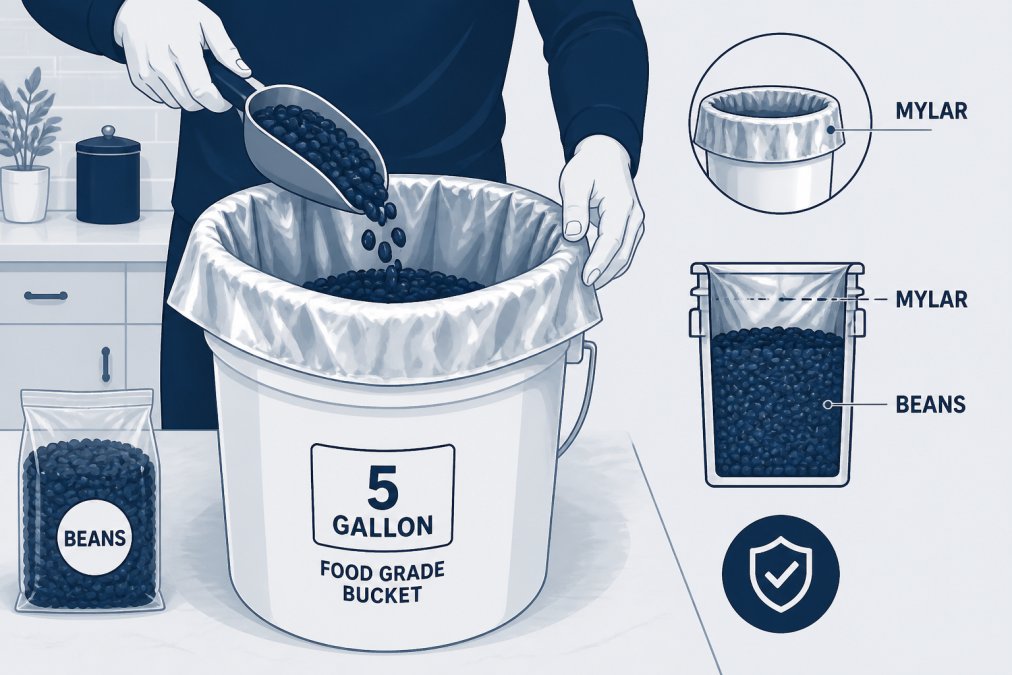
A proper seal creates an airtight barrier that prevents oxygen and moisture from entering. Test your seal by trying to separate the two layers of plastic, if they're bonded together, you've done it correctly.
Some people use gamma lids instead of standard bucket lids. A gamma lid screws onto the bucket with a gasket seal, creating an airtight closure without additional Mylar. Both approaches work; the choice depends on your budget and how many buckets you're preparing.
How to Use Oxygen Absorbers for Beans
Oxygen absorbers are small packets filled with iron powder that chemically react with oxygen in the air, removing it from your storage container. They're the single most effective tool for extending shelf life when you store beans without electricity.
Inside the packet is iron powder mixed with salt and clay. When exposed to air, the iron oxidizes and consumes the oxygen in your container. A single 2000cc oxygen absorber can remove oxygen from approximately 5 gallons of space. Once the oxygen is gone, aerobic bacteria and mold cannot grow, and the beans enter a state of dormancy where they're essentially preserved.
Oxygen absorbers are inexpensive, typically costing less than a dollar per packet when purchased in bulk. For a 5-gallon bucket of beans, use one 2000cc packet. Place it on top of the beans before sealing the Mylar bag.
Oxygen Absorbers vs. Vacuum Sealing for Maximum Protection
Vacuum sealing removes air from a storage container using a mechanical pump, while oxygen absorbers chemically consume the oxygen that remains. Both methods achieve the same goal, but they work differently.
Vacuum sealing is effective for smaller quantities and short-term storage (5-10 years). The advantage is speed; the disadvantage is that vacuum-sealed bags can develop micro-tears over time, allowing air to re-enter.
Oxygen absorbers are superior for long-term storage because they don't rely on a perfect physical seal. Even if your Mylar bag develops a tiny hole, the oxygen absorber will continue to consume any oxygen that enters. This redundancy is why oxygen absorbers are standard in commercial long-term food storage.
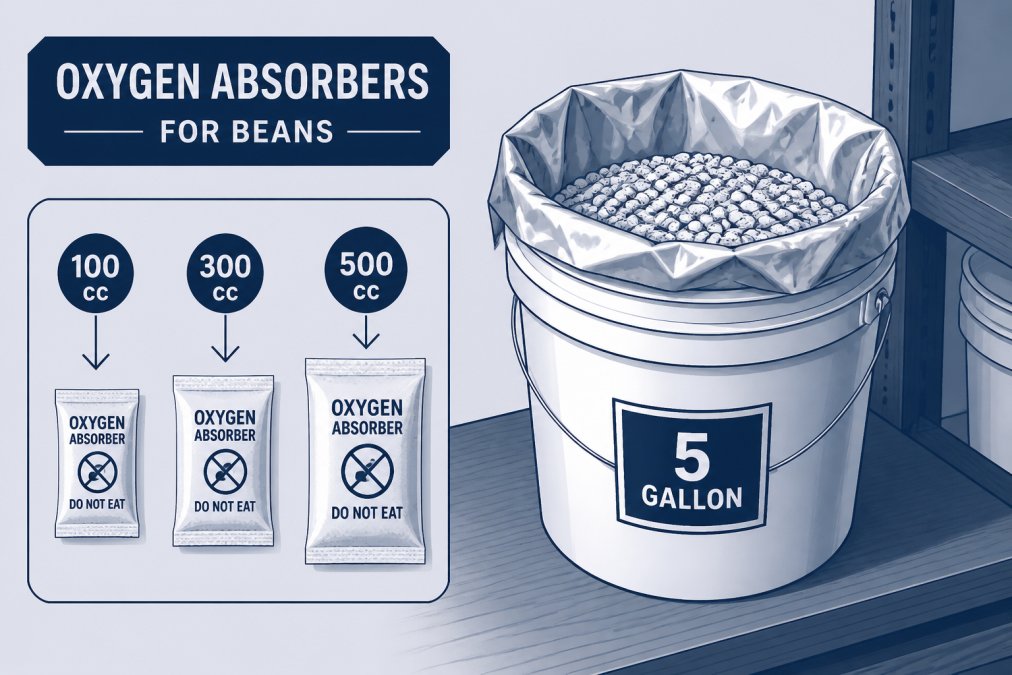
For maximum protection, use both methods together. Line your bucket with a Mylar bag, fill it with beans, add an oxygen absorber, and seal the Mylar with heat. This combination creates conditions where beans remain viable for 20+ years.
Oxygen absorbers work best in sealed environments. Always seal first, then place the absorber inside before final sealing.
Preventing Pest Infestation in Stored Beans
Pests are the second-most common reason stored beans become inedible. Weevils, moths, and beetles can infest beans before you store them or enter through gaps in your storage containers. Prevention is far easier than dealing with an infestation.
Identifying Common Bean Storage Pests
Bean weevils are small brown beetles about the size of a grain of rice. They lay eggs inside bean pods while beans are still in the field. The larvae eat the bean from the inside out.
Indian meal moths are larger insects with a wingspan of about half an inch. They can squeeze through tiny gaps in containers and reproduce quickly.
Flour beetles are flat, reddish-brown insects that thrive in warm storage environments and will infest beans if conditions are right.
The common factor across all these pests is that they require oxygen to survive. This is why oxygen absorbers provide dual protection: they preserve your beans and eliminate the environment where pests can thrive. A properly sealed bucket with an oxygen absorber is pest-proof because insects cannot breathe in an oxygen-free environment.
Pest-Proof Storage Techniques
The most effective pest prevention strategy is preventing infestation before it starts. Request that bulk beans have been treated for pests or stored in conditions that prevent infestation.
For beans you're transferring from store-bought bags to long-term storage, consider freezing. Spread beans on a baking sheet and place them in a standard freezer for 48 hours. This kills any eggs or larvae present. After freezing, the beans dry completely within a few hours at room temperature.
Food-grade diatomaceous earth is another option. This powder damages the exoskeletons of insects and is non-toxic to humans. Sprinkle a thin layer on top of your beans before sealing, a tablespoon per bucket is sufficient.
The sealed bucket itself is your primary defense. Once your Mylar bag is sealed and your bucket is closed, pests cannot enter. Store your buckets off the ground on shelves or pallets, not directly on concrete or dirt.
Ambient Temperature Storage and Rotation Methods
Most households cannot maintain ideal cool storage conditions without electricity. Beans stored at 65-75°F in properly sealed containers with oxygen absorbers will remain edible for 10-15 years, longer than most emergency scenarios require.
Rotation is important even for long-term storage. Use the FIFO method: First In, First Out. When you add new beans to your storage, place them behind existing stock. Consume the oldest beans first.
Mark your buckets clearly with the date, bean variety, and quantity using a permanent marker on the bucket lid. Include a small label inside the bucket as well, in case the lid becomes separated.
A rotation schedule of consuming one bucket per year keeps your storage fresh while building a reliable emergency food supply. If you store 10 buckets of beans, you're consuming one annually and replacing it with fresh stock.
Preparing Beans for Cooking Without Electricity
Storing beans is only half the equation. When you need to cook them, especially during a power outage or emergency, you need a method that doesn't rely on electricity.
Soaking and Cooking Methods for Emergency Situations
Dried beans require two steps: soaking and cooking. The traditional method is overnight soaking: place beans in a pot of water and let them sit for 8-12 hours.
The quick-soak method takes one hour. Bring water to a boil, add beans, boil for 2 minutes, remove from heat, cover, and let sit for one hour. This method is invaluable when you're cooking without knowing how long you'll have heat available.
Cooking beans without electricity requires a heat source: a camping stove with fuel canisters, a wood-burning stove, a propane grill, or a rocket stove. Store at least one backup fuel container for every heat source. A single #10 can of propane will cook hundreds of pounds of beans.
Cooking time depends on the bean variety and soaking method. Quick-soaked beans typically cook in 45 minutes to 1.5 hours over medium heat. Taste-test beans periodically; they're done when tender but not mushy.
Skim foam off the surface as beans cook. This step improves digestibility and reduces intestinal discomfort, which matters in an emergency.
Cook large batches of beans when you have fuel available. A single pot of 2-3 pounds of dried beans feeds a family of four for multiple days. Cooked beans without refrigeration remain safe for 24-48 hours, depending on temperature. In an actual emergency, consume them within 24 hours.
Preparing your household to store beans without electricity is one of the most practical steps you can take toward food independence. Use food-grade buckets, line them with Mylar bags, add oxygen absorbers, seal properly, and store in a cool, dark location. SHTF Prepper Club provides detailed guidance and curated storage solutions to simplify this process, ensuring your family has reliable protein storage that requires no electricity, no special equipment, and no guesswork. Start with a few buckets this month, and you'll build confidence in your ability to store beans effectively for years to come.
Frequently Asked Questions
What is the best way to store beans for long-term storage without electricity?
The most effective method combines food-grade 5-gallon buckets, Mylar bags, and oxygen absorbers. Place dried beans in a Mylar bag, add oxygen absorbers to remove air, seal the bag with a heat source or impulse sealer, then place it in a food-grade bucket with a hermetic seal. Store in a cool, dark location at ambient temperature between 50-70°F. This combination protects beans from moisture, pests, and oxygen degradation, extending shelf life to 20-30 years.
How long do dried beans last without refrigeration in proper storage?
Properly stored dried beans can last 20-30 years or longer when kept in airtight containers with oxygen absorbers at cool ambient temperatures. The shelf life of dried beans depends on storage conditions: moisture levels below 10%, temperatures between 50-70°F, and protection from light and pests all extend longevity significantly. Even without ideal conditions, beans stored in sealed buckets typically remain safe and nutritious for 5-10 years.
Do dried beans need to be sealed in Mylar bags, or can I just use buckets?
While 5-gallon buckets alone provide some protection, combining them with Mylar bags dramatically improves storage outcomes. Mylar bags create a hermetic seal that prevents oxygen from degrading beans and stops moisture infiltration. Buckets protect against physical damage and pests. Using both together, Mylar bag inside the bucket, is the gold standard for long-term food security and maximizes the shelf life of dried beans.
How do I know if my stored beans have gone bad?
Inspect stored beans for discoloration, visible mold, or off odors when opening containers. If beans show signs of pest infestation (small holes, webbing, or insect presence), discard them. Beans that have absorbed moisture will feel damp or clumped. Properly stored beans remain hard and uniform in appearance. When cooked, spoiled beans may have unusual taste or texture. Regularly rotate stock and check seal integrity on buckets and Mylar bags to catch problems early.
This article was written using GrandRanker