
Table of Contents
- Why Standard Emergency Advice Falls Short for Aging Parents
- Emergency Kit Checklist for Seniors: Beyond Bandages and Batteries
- Evacuation Plan for Elderly with Mobility Issues
- Disaster Communication Plan Template: Keeping Everyone Connected
- Power Backup for Home Medical Equipment
- Documenting Vital Records and Home Inventory
- Psychological Preparation and Home Modification
- Conclusion: Building a Plan That Actually Works
- Frequently Asked Questions
Last Updated: September 22, 2026
Why Standard Emergency Advice Falls Short for Aging Parents
Most emergency guides assume you can grab a bag and run. That collapses when you're helping a parent who uses a walker, takes eight daily medications, or can't hear a phone alert at 3 a.m. Knowing how to prepare elderly relatives for natural disasters means planning around their body, medications, and routines, not a generic checklist built for a 30-year-old. This guide from SHTF Prepper Club covers the steps that hold up when the power fails.
The gap is real. Standard advice covers three days of food and water; it rarely covers oxygen concentrators that need electricity, insulin that needs refrigeration, or a parent who no longer drives. FEMA's guidance on emergency preparedness for older adults acknowledges that older adults face higher risks during disasters and need tailored plans. That's the throughline here: preparedness for aging parents is a logistics problem, not a shopping problem.
Below, we'll show you how to build a kit, an evacuation plan, and a communication system for someone with limited mobility. Most guides get one thing wrong: they treat your relative as cargo to be moved rather than a person with medical needs, habits, and a support network worth keeping intact.
Emergency Kit Checklist for Seniors: Beyond Bandages and Batteries
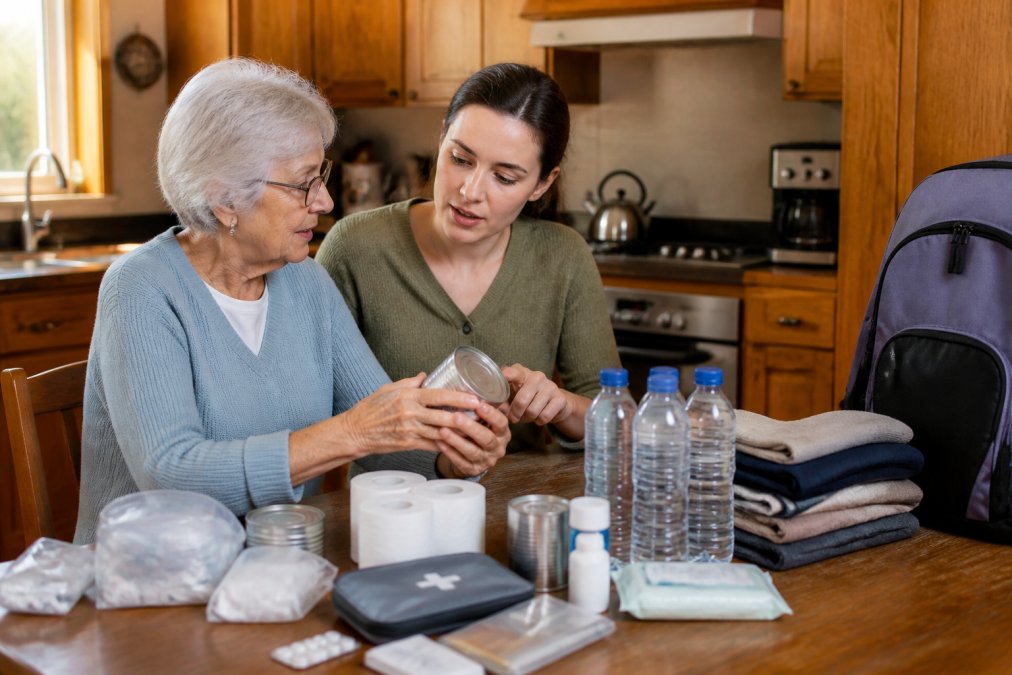
An emergency kit for a senior is a medical kit first and a survival kit second. Build it around their prescriptions, mobility aids, and conditions, then test it against the failure modes that actually happen during an outage.

Medical Supplies and Prescription Medications
The biggest failure point is medication. Packing a week of pills and calling it done is a common mistake. You want at least a 14-day supply of every prescription, rotated every few months so nothing expires.
- A written medication list with dosages, prescriber names, and pharmacy phone numbers
- A 14-day supply of each prescription in original labeled containers
- Over-the-counter basics: pain relievers, antihistamines, antidiarrheal medication
- Spare eyeglasses, hearing aid batteries, and denture supplies
- A first aid kit sized for two people, not one
Refrigerated Medications: Insulin and Beyond
Insulin, some biologics, and certain injectables lose potency when they warm up. A cooler with gel packs buys time, but gel packs freeze solid and can ruin insulin on direct contact. Wrap the medication in a cloth or towel, and keep a small thermometer inside to confirm the temperature stayed in range.
Mobility Aids and Durable Medical Equipment
Durable medical equipment is anything your relative relies on daily: walkers, wheelchairs, canes, shower chairs, or a CPAP machine. Keep a backup within fast reach, if the primary walker lives by the bed, store a folding spare in the car or a closet near the exit.
Hearing, Vision, and Cognitive Aids
Sensory and cognitive supports belong in the kit alongside bandages. Pack spare hearing aid batteries in the correct size, they are not interchangeable, plus backup glasses with the current prescription. If your relative has dementia or mild cognitive impairment, include a laminated card with their name, a familiar photo, emergency contacts, and a note on how to approach them calmly.
Evacuation Plan for Elderly with Mobility Issues
A working evacuation plan for elderly with mobility issues starts with one honest question: can your relative get out of the house in under five minutes without your help? If not, the plan has to account for that. The real work is transportation logistics, where plans quietly fall apart.
Transportation Logistics for Non-Drivers
Most emergency advice assumes everyone drives. Many seniors don't, and those who do may not be safe at night, in heavy rain, or after a medical event. Line up at least two transportation options before you need them, and treat this as a registration task, not a phone-number task.
Practicing Evacuation Drills with Your Relative
Run the drill twice a year and time it. Walk the actual route from bedroom to car, including stairs and doorways. You'll find friction points you'd never predict: a rug that catches a walker wheel, a door that's too narrow, a step that needs a ramp.
Sheltering in Place When Evacuation Isn't Possible
Sometimes the right call is to stay. If your relative has limited mobility and the event is short-duration, sheltering in place may be safer than a rushed evacuation. The plan then shifts to the interior room, backup power, and the communication check-in schedule. Decide in advance which conditions trigger evacuation and which trigger sheltering, and write both thresholds down so the decision isn't made mid-crisis.
Disaster Communication Plan Template: Keeping Everyone Connected
A disaster communication plan template is a one-page document telling everyone who to call, in what order, and where to meet if phones fail. Paper beats digital here.
Emergency Contacts and Support Network
Build a support network of at least three people within a short drive: a neighbor, a family member, and a friend or faith-community contact. Give each of them a copy of the plan. During a power outage, a neighbor knocking on the door is worth more than a text that never arrives.
Digital Asset and Password Management
This is the gap most guides skip. If your parent is hospitalized or evacuated, you may need access to their bank account, insurance portal, and medical records. Store login credentials in a sealed envelope or a shared password manager with a trusted family member, plus account numbers for utilities, Medicare, and supplemental insurance. Without this, you're locked out at the worst possible moment.
Power Backup for Home Medical Equipment
Power backup for home medical equipment is not optional if your relative depends on oxygen, a nebulizer, or a refrigerated medication like insulin. Plan for at least 72 hours, since widespread outages routinely outlast that window.
| Equipment Need | Backup Option | Runtime Consideration |
|---|---|---|
| Oxygen concentrator | Portable battery pack or backup tanks | Match battery to continuous-flow draw |
| CPAP machine | 12V battery with adapter | Test one full night before relying on it |
| Refrigerated medication | Cooler with gel packs or small power station | Monitor temperature, keep a thermometer inside |
| Phone and medical alert | Portable power bank | Charge fully before storm season |
Documenting Vital Records and Home Inventory
Vital documents and a home inventory make recovery possible. Store originals in a fireproof safe and copies in a go-bag or with a trusted relative out of the area.
- Photo ID, Social Security card, Medicare and insurance cards
- Advance directives, power of attorney, and a healthcare proxy
- Deed, mortgage, and property insurance policy
- A home inventory: photos or video of every room, plus receipts for high-value items
- A list of durable medical equipment with serial numbers
Psychological Preparation and Home Modification
Two things separate a plan that works from one that fails: how your relative feels about it, and whether the house cooperates. Both get ignored.
Home modification for disaster resilience is the other half. Simple changes make evacuation faster and sheltering-in-place safer:
- Install grab bars in the bathroom and along the main exit path
- Add battery-powered or hardwired emergency lighting on stairs
- Secure heavy furniture and water heaters to walls
- Clear a wheelchair-width path to at least two exits
- Keep a battery-powered NOAA weather radio tuned to local alerts
Conclusion: Building a Plan That Actually Works
The hardest part of preparing for a parent isn't buying gear. It's the ongoing work of rotating medications, running drills, and keeping documents current as their health changes. A plan built once and shelved will fail when it matters.
Frequently Asked Questions
What should be included in a senior-specific emergency go-bag?
A senior go-bag needs seven days of prescription medications in original bottles, a written medication list with dosages, spare eyeglasses and hearing aid batteries, mobility aids, and a copy of insurance cards. Add high-calorie snacks, two liters of water per day, a flashlight, and a battery-powered radio. Pack a change of clothes, sturdy shoes, and cash in small bills. Include a recent photo of your relative and contact information for their doctors.
How can caregivers assist seniors with limited mobility during an evacuation?
Assign a specific person to help your relative move, and practice the route together at least twice a year. Keep a lightweight wheelchair or walker near the exit. If your relative uses a power chair, have a manual backup. Identify a neighbor who can help lift or guide if needed. Know which shelters in your area have accessible facilities. If your relative cannot evacuate independently, register with your local emergency management office before disaster strikes.
How do you create an emergency communication plan for elderly relatives?
Write down three contacts: one local, one out-of-state, and one neighbor. Print the list in large font and tape it near the phone and inside the go-bag. Program those numbers into your relative's cell phone and show them how to use speed dial. Set a check-in schedule, such as a text every morning at 9 a.m. If phones fail, agree on a meeting spot. Share the plan with everyone on the list.
How to prepare for power outages when a senior relies on medical equipment?
First, ask your relative's doctor how long the equipment can run on battery and what to do if power is out longer. For oxygen concentrators, keep portable tanks as backup. For CPAP machines, buy a battery pack rated for at least eight hours. For refrigerated medications, keep gel packs and a cooler ready. A portable generator can power most home medical devices, but never run it indoors. Test all backup power sources every three months.