
Table of Contents
- Why Children React Differently to Disasters
- Explaining Natural Disasters to Children Without Causing Panic
- Step-by-Step: How to Calm Children During Natural Disasters
- Emergency Go-Bag Essentials for Kids
- Calming Activities for Emergency Shelters
- Signs of Trauma in Children After Disaster
- How to Calm Children With Sensory Needs During Disasters
- Conclusion
- Frequently Asked Questions
Last Updated: September 15, 2026
Why Children React Differently to Disasters
A child's brain processes a hurricane, wildfire, or earthquake differently than an adult's. Where you see a weather event with a known duration, a child sees a rupture in the predictable world they depend on, the same evacuation that feels manageable to you can leave a seven-year-old inconsolable for weeks.
This guide from SHTF Prepper Club covers how to calm children during natural disasters using developmentally tailored techniques. Children are not fragile, their coping mechanisms are still under construction. A preschooler cannot reason their way out of fear like a teenager can, and a teenager may hide distress behind silence or irritability.
The stress response in children shows up physically before it shows up verbally: stomachaches, clinginess, sleep disruption, and regression to earlier behaviors like thumb-sucking or bedwetting. These are not discipline problems, they are a nervous system asking for help.
Explaining Natural Disasters to Children Without Causing Panic
The goal is to give factual information without transferring your own anxiety. Children need honesty calibrated to their age, not a sanitized version that leaves gaps their imagination fills with something worse.
Younger children need shorter, more concrete answers. A four-year-old needs to know a storm is loud, that you are staying safe, and that you will be together. A ten-year-old can handle what causes the event and what the plan is. A teenager can discuss it directly and may want to help with preparations, which gives them a sense of control.
Avoid promising outcomes you cannot guarantee. Saying "nothing bad will happen" destroys trust if something does. Instead, say what you are doing to stay safe and what happens next.
Step-by-Step: How to Calm Children During Natural Disasters
This is the sequence that works, in order. A dysregulated child cannot process language until their nervous system has downshifted, so regulation comes before explanation, and explanation comes before planning.
Step 1: Regulate Your Own Stress Response First
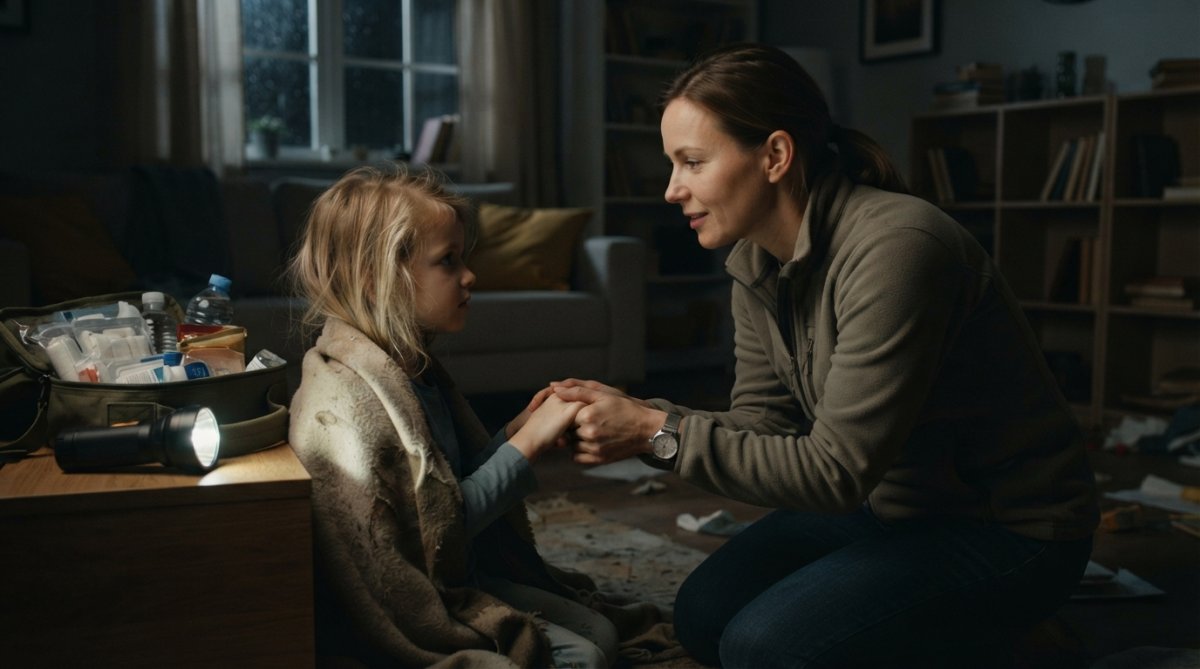
Children read your nervous system before they hear your words. If your voice is tight and your movements rushed, no amount of "we're fine" will land. This is the step most parents skip, and it determines whether everything else works.
Use a tool you can run in under 60 seconds, in front of your child, without leaving the room:
- Physiological sigh. Two short inhales through the nose, then one long exhale through the mouth. Repeat three times. The double inhale reinflates small air sacs in the lungs and the long exhale slows your heart rate faster than a standard deep breath (pubmed.ncbi.nlm.nih.gov).
- Box breathing. Inhale for four, hold for four, exhale for four, hold for four. Four rounds drops a racing pulse.
- Cold water on the wrists. Run cool water over the inside of your wrists for 15-20 seconds. The temperature change triggers a vagal response that pulls your body out of fight-or-flight (pubmed.ncbi.nlm.nih.gov).
- Feet-and-floor grounding. Press both feet flat, name the surface under you ("concrete," "carpet"), and describe the temperature.
Then lower your voice, slow your movements, and get down to your child's eye level. A calm adult at eye level reads as safety; one standing over a child reads as management.
Step 2: Use Physical Comfort and Grounding Techniques
Physical contact regulates a child's stress response faster than talking. Hold them, let them sit on your lap, keep a hand on their back. For older children who resist being held, sitting shoulder to shoulder gives the same co-regulation signal without the loss of autonomy a hug can feel like to a teenager.
Grounding techniques give a frightened child something concrete to focus on. The 5-4-3-2-1 method works, name five things you can see, four you can touch, three you can hear, two you can smell, one you can taste, but it fails with young children who cannot count backward under stress. Match the tool to the age:
- Ages 2-5: Skip counting entirely. Use touch and naming: "Find me something soft. Find me something blue." Hand them a single object to hold and describe.
- Ages 6-10: 5-4-3-2-1 works well, but lead it yourself and let them answer. Do not quiz them.
- Ages 11-14: Offer a choice of two tools so they keep some control, the 5-4-3-2-1 scan or a body scan from feet to head.
- Ages 15+: Give them a job. Handing a teenager a flashlight, a radio, or a task to monitor restores a sense of agency, which is what actually reduces their anxiety.
Deep breathing works better when you make it visible. Blowing up an imaginary balloon, holding a pinwheel, or blowing on a cup of hot cocoa gives the child a concrete target and a reason to lengthen the exhale. The exhale is the part that calms, a long, slow out-breath activates the parasympathetic response, so any game that stretches the exhale does the real work (pubmed.ncbi.nlm.nih.gov).
Step 3: Validate Feelings and Restore Predictability
Validation means naming the feeling without correcting it. "You're scared, and that makes sense" lands far better than "There's nothing to be scared of." The second tells a child their read on the situation is wrong, forcing them to argue or shut down.
Use short scripts you can say without thinking:
- "That was loud and scary. You're safe right now, and I'm right here."
- "It's okay to feel scared. Lots of grown-ups feel scared too."
- "You don't have to be brave right now. You just have to stay with me."
Once the feeling is acknowledged, move to predictability. Tell them exactly what happens next: where you are sleeping tonight, who is with you, what the morning looks like.
| Step | What You Do | Why It Works |
|---|---|---|
| Regulate yourself | Physiological sigh, box breathing, cold water, feet grounding | Children mirror adult nervous systems; a calm body is the signal |
| Physical comfort | Hold, touch, sit side by side | Touch regulates the stress response faster than language |
| Grounding | Age-matched sensory or counting task | Interrupts spiraling anxiety by occupying attention |
| Validate | Name the feeling, use a script | Reduces distress and prevents shutdown or argument |
| Restore routine | Predictable next steps, repeated rituals | Rebuilds psychological safety through sameness |
Emergency Go-Bag Essentials for Kids
Calming Activities for Emergency Shelters
Signs of Trauma in Children After Disaster
How to Calm Children With Sensory Needs During Disasters
Reduce Input Before You Try to Reason
Match the Tool to the Sensory Profile
Pack the Sensory Kit Before the Disaster, Not During
Plan for the Specific Failure Points
Know When to Seek More Support
Conclusion
Frequently Asked Questions
What is the 3-3-3 rule for children's anxiety?
The 3-3-3 rule is a grounding technique: name 3 things you can see, 3 things you can hear, and 3 things you can touch. It pulls a child's attention back to the present moment when anxiety spikes. During a disaster, guide your child through it slowly, one sense at a time. This works best when you practice it during calm moments first, so the technique feels familiar when you need it most.
How do you explain a natural disaster to a child without scaring them?
Use simple, factual language and focus on what your family is doing to stay safe. For young children, keep explanations to two or three sentences. For older kids, invite questions and correct misinformation directly. Avoid graphic details about destruction or casualties. Emphasize that the adults in their life have a plan, and that their job is simply to stay close and follow directions. Honesty builds trust; exaggeration builds fear.
What comfort items should go in an emergency go-bag for kids?
Pack a small stuffed animal, a favorite blanket, a familiar book, and a photo of the family. Include a flashlight they can hold themselves, a comfort snack, and a simple card game or coloring book. For children with sensory needs, add noise-reducing headphones, a weighted lap pad, or a preferred fidget tool. Let your child help choose one or two items so the bag feels personal rather than clinical.
How long does it take for children to recover from disaster-related stress?
Most children return to their usual behavior within a few weeks once routines stabilize and they feel safe. Some may show behavioral changes for a month or longer, especially if the disaster caused displacement or loss. If sleep problems, regression, or anxiety persist beyond four to six weeks, or if your child withdraws from activities they used to enjoy, reach out to a pediatrician or a mental health professional who works with children.