
Last Updated: November 8, 2026
Quick Summary
To calculate your household water footprint, add your direct water use from taps and appliances to your indirect virtual water use from food, energy, and goods. Pull daily use from your bill and meter, measure fixtures room by room, then add outdoor irrigation and per-pound food figures. Keep direct, indirect, and total as separate numbers.
- Direct water use is what enters through your meter; indirect virtual water hides in food, energy, and goods.
- Read your meter twice 24 hours apart to get actual daily use and catch leaks.
- Beef carries roughly 1,800 gallons of virtual water per pound, more than a week of showers.
- Normalize results to gallons per person per day so months and households compare fairly.
- Rank categories by impact; for most homes food or outdoor irrigation tops showers.
Table of Contents
- What a Household Water Footprint Actually Measures
- Step 1: Pull Your Baseline Data From the Water Bill and Meter
- Step 2: Measure Indoor Water Use Room by Room
- Step 3: Estimate Outdoor Water Use and Irrigation
- Step 4: Add Virtual Water From Food With a Water Footprint Food Calculator
- Step 5: Cross-Check Your Numbers With a Water Footprint Calculator
- Reading Your Results on a Water Footprint Chart
- Choosing a Household Water Usage Calculator That Fits Your Data
- Frequently Asked Questions
What a Household Water Footprint Actually Measures
A household water footprint is the total volume of water your home consumes, both directly from taps and appliances and indirectly through the food, energy, and goods you buy.
Most people guess their water use from their bill and stop there. That misses half the picture. The direct water you can see, showers and sprinklers, is only part of your consumption pattern.
We built this walkthrough because knowing your real number matters for two reasons: cutting waste and planning stored water for emergencies. A household that understands its daily water use can size an emergency supply with confidence instead of guesswork.
Direct, Indirect, and Total: Setting the Boundaries
Direct water use is water that enters your home through the meter and leaves through drains or irrigation. Showers, toilets, faucets, laundry, dishwashing, and leaks all count.
Indirect water use, also called virtual water, is the water used to produce what you consume. It takes water to grow food, generate electricity, and manufacture home goods.
Total water footprint = direct use + indirect use. Keep these three numbers separate in your notes. Mixing them is the most common mistake we see, and it makes results impossible to compare month to month.
Step 1: Pull Your Baseline Data From the Water Bill and Meter
Start with the two records you already have: your water bill and your meter.
Your bill usually shows usage in gallons or cubic feet per billing period. Find the unit, then divide by the number of days covered.
Next, read your meter directly. Write down the number, wait 24 hours without changing habits, and read it again. The difference is your actual daily use.
One adjustment: exercise raises personal water use through sweat loss and extra showers. If anyone in the home trains hard, see how exercise changes your daily water needs before you set your baseline.
Step 2: Measure Indoor Water Use Room by Room
Now break the total into rooms. You do not need perfect precision. Close estimates reveal where the gallons go.
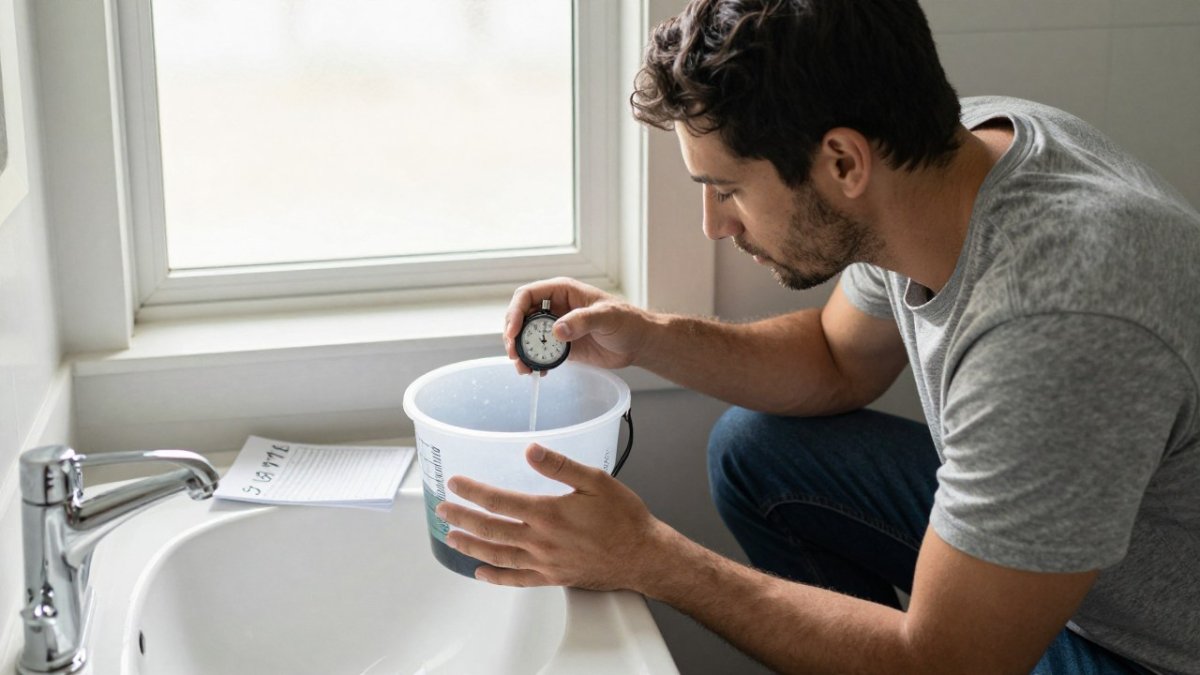
Use a stopwatch and a marked container. Run the shower for ten seconds, measure the catch, and multiply by six to get gallons per minute. Do the same at each faucet. For toilets, check the flush rating stamped near the tank hinge.
Showers, Toilets, Faucets, Laundry, and Leaks
- Showers: flow rate x minutes x people per day
- Toilets: flush rating x average flushes per person
- Faucets: flow rate x minutes of daily use
- Laundry: gallons per cycle x loads per week, divided by seven
- Dishwashing: hand washing or machine cycles, counted separately. Our guide on how much water a dishwasher uses per cycle helps you refine the kitchen figure
- Leaks: read the meter with every fixture off. Any movement is a leak
A running toilet can waste more than everything else in the house. Fix leaks before you calculate, or your water-use estimate will stay inflated.
Step 3: Estimate Outdoor Water Use and Irrigation
Outdoor water is the swing factor in most households. It can double your total in summer and vanish in winter.
Check your irrigation timer for minutes per zone per week. Multiply by the flow rate of each zone, which you can time at the spigot with a bucket. Add hose use for car washing, pets, and garden beds.
If you water by hand, estimate minutes per week and apply the same flow-rate math. Keep a separate summer and winter figure.
Step 4: Add Virtual Water From Food With a Water Footprint Food Calculator
Food usually dominates the indirect side of the ledger, and it is the part most households get wrong because they never convert groceries into gallons. A water footprint food calculator does that conversion for you, but you can also do the math by hand with a short list of per-pound virtual water figures. The numbers below are widely cited planning averages, not precise measurements for your specific farm or region, so treat them as estimates with real uncertainty.
Per-Pound Virtual Water Figures to Start With
These are commonly used planning values for virtual water per pound of food. They vary by growing region, irrigation method, and season, often by a factor of two or more.
- Beef: roughly 1,800 gallons per pound
- Pork: roughly 600 gallons per pound
- Poultry: roughly 500 gallons per pound
- Eggs: roughly 400 gallons per pound
- Milk: roughly 120 gallons per gallon
- Cheese: roughly 600 gallons per pound
- Wheat and grains: roughly 130 gallons per pound
- Rice: roughly 250 gallons per pound
- Fruits and vegetables: roughly 40 to 80 gallons per pound
- Coffee: roughly 35 gallons per cup brewed
A common pattern is that a single pound of beef carries more virtual water than a week of showers for one person. That is why diet swaps move the total faster than fixture upgrades.
A Worked Example: One Week of Food
Suppose a two-person household eats the following in a normal week:
- 3 pounds of beef: 3 x 1,800 = 5,400 gallons
- 4 pounds of poultry: 4 x 500 = 2,000 gallons
- 2 gallons of milk: 2 x 120 = 240 gallons
- 1 pound of cheese: 600 gallons
- 10 pounds of grains: 10 x 130 = 1,300 gallons
- 20 pounds of fruits and vegetables: 20 x 60 = 1,200 gallons
- 14 cups of coffee: 14 x 35 = 490 gallons
Total virtual water for the week: about 11,230 gallons, or roughly 1,600 gallons per person per day. Divide by seven to get a daily household figure, then divide by household size for a per-person number you can compare month to month.
How to Gather the Inputs Without Guessing
Track one normal week of food consumption. Weigh or estimate quantities in pounds and gallons, note beverages separately, and keep restaurant meals in a separate column because portion sizes are harder to pin down.
For households building stored food supplies, the same logic applies to shelf-stable goods. Our guide to food storage calculation shows how to turn food quantities into water-needs planning, which keeps your pantry and your footprint numbers consistent.
Virtual water per pound of food
Step 5: Cross-Check Your Numbers With a Water Footprint Calculator
An online household water usage calculator is a sanity check, not a replacement for your own math. Enter your household size, zip code, and usage data, then compare the output to your manual total.
Expect a gap. Calculators rely on regional averages, and your home is not average. A difference of a few gallons per person per day is normal.
If you keep backup purification on hand, our portable water purification rules for medical use pair well with this step, since safe backup water belongs in any honest readiness plan.
Reading Your Results on a Water Footprint Chart
A water footprint chart splits your total into categories so you can see what to attack first. Plot direct indoor, direct outdoor, food, energy, and goods as separate bars, all in gallons per day so the bars are comparable. The unique angle here is that you should read the chart in two passes: first as a raw total, then as a normalized per-person figure with an uncertainty range, because a single number implies precision your inputs do not support.
Normalize Before You Compare
Divide each category by household size to get gallons per person per day. Then divide by the number of days in your measurement period.
A common pattern in household data is that direct indoor use lands somewhere between 40 and 80 gallons per person per day, outdoor use swings from near zero in winter to well over 100 gallons per person per day in peak summer irrigation, and food-related virtual water often runs several hundred gallons per person per day.
Show a Range, Not a Single Number
Every input in your calculation has error. Meter reads are exact, but fixture flow estimates, irrigation minutes, and per-pound food figures are not. A practical approach is to calculate a low, middle, and high estimate for each category using the range of your inputs, then plot the middle bar with a thin line showing the low-to-high span.
Watch out: comparing your consumption-based total, which includes virtual water, against a utility's direct-use benchmark will make your household look wildly inefficient when the two numbers measure different things.
Rank by Impact, Then Act
Order the bars from largest to smallest using the middle estimate. The top bar is your priority. For most homes it is food or outdoor irrigation, not showers. That surprises people, and it should change how they save water.
Once you know your stored-water target, our safe room supplies guide covers the containers, sanitation, and comfort items that turn a number into a workable plan.
Choosing a Household Water Usage Calculator That Fits Your Data
Pick a calculator that matches the data you actually have. That single rule prevents most frustration.
| Calculator Type | Data You Need | Best For | Watch Out For |
|---|---|---|---|
| Bill-based estimator | Utility bill, billing days | Quick baseline | Ignores virtual water |
| Room-by-room tool | Fixture flow rates, habits | Finding leaks and waste | Time to gather inputs |
| Food footprint calculator | Weekly grocery quantities | Diet impact | Rough averages per food |
| Full footprint tool | All of the above | Total picture | Regional assumptions baked in |
Start simple, then add detail as your records improve. A calculator you will actually finish beats a perfect one you abandon.
Calculating your footprint is the easy part. Acting on it before an emergency is where most households stall. Taking the next step toward a household water plan your family can rely on starts with the numbers you have just gathered.
Frequently Asked Questions
What is the difference between direct and indirect water use?
Direct water use is what comes out of your taps, toilets, and outdoor spigots, and it shows up on your water bill in gallons or cubic feet. Indirect, or virtual, water is embedded in the food, electricity, and consumer products you buy. A pound of beef, for example, carries a far larger water footprint than a pound of vegetables because of the water used to grow feed. Your total water footprint is the sum of both, which is why a household can use 150 gallons a day directly but thousands indirectly.
How do I calculate my household's water use from a utility bill?
Find the consumption line on your bill, usually listed in gallons or cubic feet, and note the billing period in days. Divide total gallons by the number of days to get gallons per day, then divide again by the number of people in the home for per-person use. If your bill reports cubic feet, multiply by 7.48 to convert to gallons. Compare two or three consecutive bills to smooth out seasonal spikes from irrigation before you treat the figure as your baseline.
How much water does a 10-minute shower use?
It depends on the showerhead. A standard 2.5 gallon-per-minute head uses about 25 gallons in 10 minutes, while a WaterSense-labeled 1.75 gallon-per-minute model uses roughly 17.5 gallons. To get your real number, hold a bucket under the shower for exactly one minute, measure the water in gallons, and multiply by 10. Multiply that by the number of showers your household takes each week to see how much of your indoor use showers account for.
What everyday foods have the largest water footprint?
Animal products generally carry the heaviest virtual water load. Beef, lamb, and dairy require large volumes of water for feed and pasture, while nuts and pulses sit lower per gram of protein. Processed foods add water from manufacturing on top of the farm stage. A water footprint food calculator lets you enter servings per week and returns an estimate in gallons, which is far more useful than guessing. Small shifts, such as replacing two beef meals a week, often move the total more than swapping showerheads.
