
Table of Contents
- Start With the Formula: Calories per Person per Day Emergency
- Adjusting Daily Requirements by Age, Size, and Activity
- Using an Emergency Food Supply Calculator for Your Household
- How Much Food to Store for Emergencies: From Calories to Portions
- Building an Emergency Food Supply for 3 Days
- Calories Are Not Enough: Water, Nutrition, and Storage Constraints
- Adding a Contingency Buffer and Updating Your Plan
- Frequently Asked Questions
Last Updated: October 19, 2026
Start With the Formula: Calories per Person per Day Emergency
Here is the core formula for how to calculate calories for emergency food planning: daily calories per person × number of people × number of days = total calories needed.
At SHTF Prepper Club, we use this formula as the starting point for every household plan we help build. It is simple on purpose: a plan you can recalculate on the back of an envelope beats a spreadsheet you cannot find.
Calories per person per day emergency targets vary by age and activity, but most adults need a working baseline of roughly 2,000 calories daily. The Dietary Guidelines for Americans publish age- and sex-based calorie ranges if you want a more precise starting number.
So the base math looks like this:
- Step 1: Pick a daily calorie target per person (2,000 is a safe adult baseline)
- Step 2: Multiply by the number of people in your household
- Step 3: Multiply by the number of days you are planning for
- Step 4: Add a buffer (more on that below)
A Worked Example for a Family of Four
Two adults and two children, seven days, using 2,000 calories for adults and 1,500 for kids:
- Adults: 2,000 × 2 = 4,000 calories per day
- Children: 1,500 × 2 = 3,000 calories per day
- Daily household total: 7,000 calories
- Seven-day total: 49,000 calories
That is the number you shop against. A 25-year shelf-life kit labeled with its total calorie count makes this math instant: check the label, divide, and know how many days your family is covered.
Adjusting Daily Requirements by Age, Size, and Activity
Not everyone in your house burns fuel at the same rate.
Most calorie tables are built for normal life.
Use these adjustments as a rough guide:
| Person | Normal Daily Target | Temporary Emergency Minimum | Notes |
|---|---|---|---|
| Adult, low activity | ~1,800-2,000 | ~1,400-1,600 | Baseline sedentary needs; minimum assumes rest and mild stress |
| Adult, active or working outdoors | ~2,400-2,800 | ~1,800-2,000 | Higher burn; do not ration active adults as hard as sedentary ones |
| Teenager | ~2,000-2,600 | ~1,600-2,000 | Growth plus activity; teens are often under-prioritized in family plans |
| Child (6-12) | ~1,400-1,800 | ~1,200-1,400 | Smaller body mass; keep regular meals to limit behavior issues |
| Toddler (2-5) | ~1,000-1,400 | ~900-1,200 | Small portions, frequent meals; do not stretch meals for small children |
| Pregnant or nursing | Higher, consult a provider | Do not ration below normal | Increased nutrient demand; treat as a protected group |
How to prioritize when supply is short. Protect children, pregnant or nursing people, and anyone with a medical condition first, then active adults doing physical work, then sedentary adults.
Why the minimum is temporary. A temporary emergency minimum assumes rest, mild stress, and a short disruption measured in days, not weeks.
Individual factors that override the table. Pregnancy, nursing, chronic illness, medications, and eating disorders all change the picture. The USDA Food and Nutrition Service also publishes practical guidance on meeting nutrient needs during disruptions.
A common mistake is planning everyone at the same number. That overbuys for small kids and underbuys for active adults. Break the household into groups, total each one, and mark which people are protected in a shortfall.
Using an Emergency Food Supply Calculator for Your Household
An emergency food supply calculator does the arithmetic for you: it takes household size, daily calorie targets, and supply duration, then returns total calories and estimated food weight, the same formula above, just automated.
Run the calculation by hand once. When you understand the inputs, you can sanity-check any calculator's output instead of trusting it blindly.
Here is how we would set one up:
- Enter each household member's daily calorie target
- Set your supply duration in days
- Add your buffer percentage
- Review the total calories and food weight estimate
- Compare that total against what you actually have on the shelf
The calculator is a planning tool, not a shopping list. It tells you the target. You still decide which foods fill it.
How Much Food to Store for Emergencies: From Calories to Portions
Knowing how much food to store for emergencies means converting your calorie target into real portions you can count, stack, and rotate. Calories are abstract. A can of beans is not.
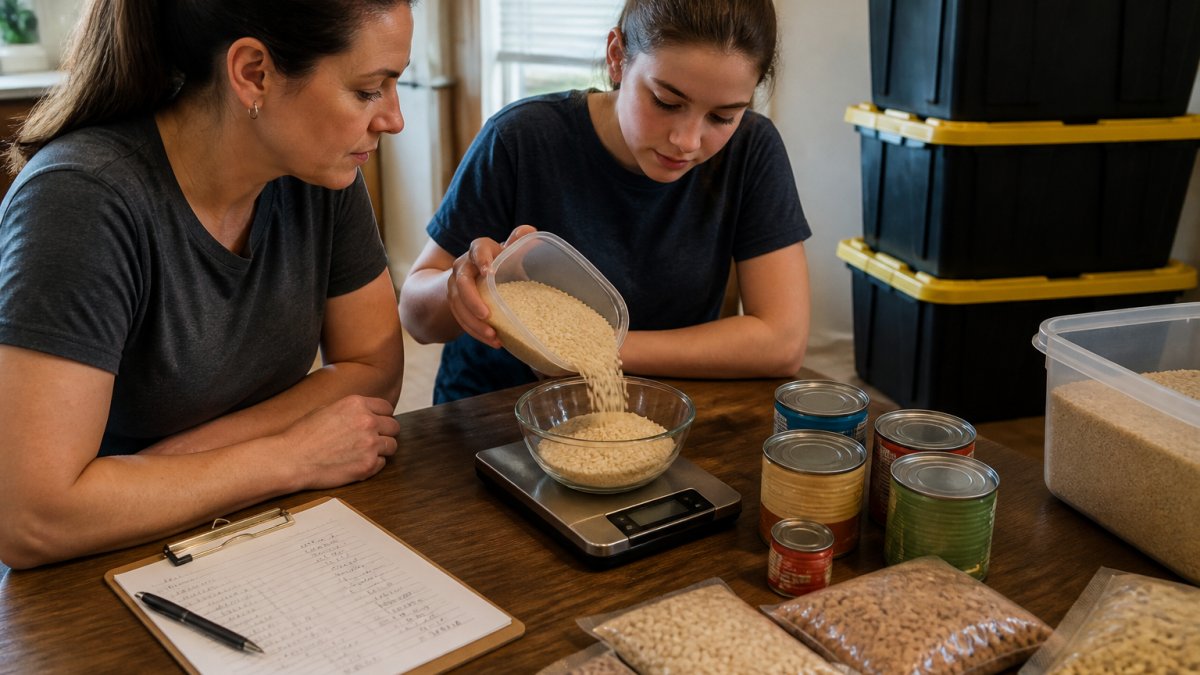
Start with the calorie count on each item, then divide your household total by it. If your family needs 49,000 calories for the week, and a case of calorie-dense meal bars provides a known total, you can see at a glance how many cases close the gap.
Break your supply into food groups so the plan holds up nutritionally:
- Carbohydrate base: rice, pasta, oats, crackers
- Protein: canned meat, beans, lentils, freeze-dried meals
- Fats: nut butters, oils, nuts, seeds
- Snack bars and quick items: for stress eating and short gaps
- Comfort items: coffee, cocoa, hard candy
Food-Label Math and Mixed Inventory
Mixed inventory is where people get lost: half a case of one thing, three cans of another, and a bucket of rice. How do you total it?
Use calories per gram when labels are inconsistent. Kilojoules can be converted to calories by dividing by roughly 4.2. Then:
- Divide each item's total calories by servings to get calories per serving
- Multiply servings by calories per serving for the item total
- Add all item totals for your inventory number
- Compare against your household target
Write the totals on a clipboard and update it as you shop. A running inventory beats a one-time count.
Building an Emergency Food Supply for 3 Days
An emergency food supply for 3 days is the minimum most agencies suggest households keep on hand for short disruptions, the gap between a storm hitting and normal supply chains resuming.
For a family of four at roughly 7,000 calories a day, that is about 21,000 calories. Here is how that total breaks down into real food, using common calorie counts you can check on any label:
| Food | Typical Calories | Quantity for 3 Days | Approx. Calories |
|---|---|---|---|
| Rice (dry) | ~1,600 per lb | 4 lb | ~6,400 |
| Canned beans | ~350 per can | 8 cans | ~2,800 |
| Peanut butter | ~2,500 per 16-oz jar | 2 jars | ~5,000 |
| Canned tuna or chicken | ~150 per can | 6 cans | ~900 |
| Oats | ~1,700 per lb | 2 lb | ~3,400 |
| Meal bars | ~250 per bar | 12 bars | ~3,000 |
| Hard candy / comfort items | ~50 per piece | as needed | ~500 |
| Total | ~22,000 |
That list is illustrative, not a prescription. The point is the method: pick foods you will actually eat, read the label, multiply, and add until you clear your household target with a small buffer.
Plan the three days by cooking requirement, not just calories.
- Day 1: Shelf-stable meals plus snacks, no cooking required. Assume the power is out and fuel may be limited.
- Day 2: Simple cooked meals if power and fuel allow. Keep a no-cook backup in case they do not.
- Day 3: Rotate in comfort foods to keep morale up. Stress eating is real, and morale affects how well the plan holds.
Water is separate. Keep water out of this calorie count, it is its own calculation and storage problem.
Check the fuel and cooking constraint before you buy. If your three-day menu depends on boiling rice or heating canned meals, you need a way to cook that does not rely on grid power.
Calories Are Not Enough: Water, Nutrition, and Storage Constraints
Calories keep the engine running. They do not keep the body functioning well on their own. A plan built purely on calorie totals can leave you short on water, protein, and micronutrients.
Water is the first constraint: at least one gallon per person per day for drinking and basic hygiene. That is separate from food calories and often the real limiting factor in a shelter-in-place scenario.
Nutrition is the second. The CDC's emergency preparedness guidance covers water and food safety basics worth reviewing before you stock up.
Storage is the third. Heat, moisture, and pests destroy food quietly. Keep supplies cool, dry, and off the floor.
Cooking fuel and food safety round it out. If you cannot boil water or heat a meal, your menu shrinks fast. Plan foods that work without cooking for at least the first day.
Adding a Contingency Buffer and Updating Your Plan
Add a buffer. Ten to twenty percent extra calories covers guests, a longer disruption, or a miscalculation. Our rule of thumb: round up, never down.
Then revisit the plan. Households change. Kids grow, guests arrive, diets shift. A plan built two years ago may no longer match the people it protects.
Put a reminder on your calendar to:
- Recount inventory and replace what you used
- Check expiration dates and rotate older items forward
- Recalculate calories if household size changed
- Recheck water stores
- Update your written plan
SHTF Prepper Club builds long-term food storage solutions designed to make this easier, with kits that carry up to a 25-year shelf life and minimal preparation.
The hard part of preparedness is not buying gear. It is doing the math once, writing it down, and keeping it current as your household changes.
SHTF Prepper Club simplifies that process with expert-vetted food storage, water filtration, and family-ready kits. Get started with SHTF Prepper Club and build a plan your family can trust when it counts.
Frequently Asked Questions
How many calories per person per day should you plan for emergency food?
Most emergency plans use a baseline of about 2,000 calories per person per day for an average adult, which matches common food-label reference intake. That number is a starting point, not a rule. Larger adults, teenagers, and people doing heavy manual work during a disaster may need closer to 2,400 to 2,800. Children under 12 often need 1,200 to 1,800, and adults over 70 may need around 1,600 to 1,800. Set your own calories per person per day emergency figure by adjusting the 2,000 baseline for each household member, then multiply by the number of days you are planning for.
How many calories should you store for a 3-day emergency supply?
For an emergency food supply for 3 days, multiply each person's daily calorie target by three. A household of four adults at 2,000 calories each needs 24,000 calories total for three days. Add a 10 to 20 percent buffer, which brings the target to roughly 26,400 to 28,800 calories. In practical terms, that is about 12 to 14 large cans of a calorie-dense staple or a comparable mix of shelf-stable foods. Check the nutrition label on every item you store and total the calories rather than counting cans or meals.
How do you calculate the total calories in your emergency food supply?
Read the nutrition label on each item and note the calories per serving and the number of servings per container. Multiply those two numbers to get the total calories in that container, then add up every container in your storage. For bulk staples, weigh the amount you have and use the calories-per-gram figure on the label. For example, a 5-pound bag of rice at roughly 1,600 calories per pound provides about 8,000 calories. Repeat this for each food category, then compare the total against your household's daily target multiplied by your supply duration in days.
Should emergency food calorie plans account for children and older adults?
Yes. Children and older adults have different energy needs than working-age adults, and planning everyone at 2,000 calories overstates what you need for some household members while understating it for others. Use lower daily targets for young children and many seniors, and higher targets for teenagers and adults doing physical work. Also account for pregnancy, which raises calorie needs, and for medical conditions that affect diet. Build the plan person by person, then add the totals together so your stored food matches your actual household.