
Table of Contents
- Step 1: Gather Your Household Contact Information
- Step 2: Build an Emergency Contact List for Family Members
- Step 3: Pick a Family Emergency Meeting Place
- Step 4: Decide How Your Family Will Communicate
- Step 5: Write It Down With a Family Communication Plan Template
- Real-World Emergency Communication Plan Examples
- Plan for Family Members With Disabilities, Pets, and Medical Needs
- Practice, Review, and Update Your Family Communication Plan
- Frequently Asked Questions
Last Updated: October 20, 2026
Step 1: Gather Your Household Contact Information
A family communication plan is a written set of instructions that tells every household member who to contact, where to meet, and what to do during an emergency.
Here is what every household needs on hand before you build anything else:
- Full legal names and nicknames for each family member
- Each person's cell phone number
- Home address with a written landmark for younger kids
Write these on paper first. Screens fail, and a printed copy always works.
The Ready.gov family emergency plan guide recommends keeping this information in a waterproof container. We agree. A ziplock bag works fine.
Step 2: Build an Emergency Contact List for Family Members
An emergency contact list for family members should include at least three people per person: one local, one out-of-town, and one backup.
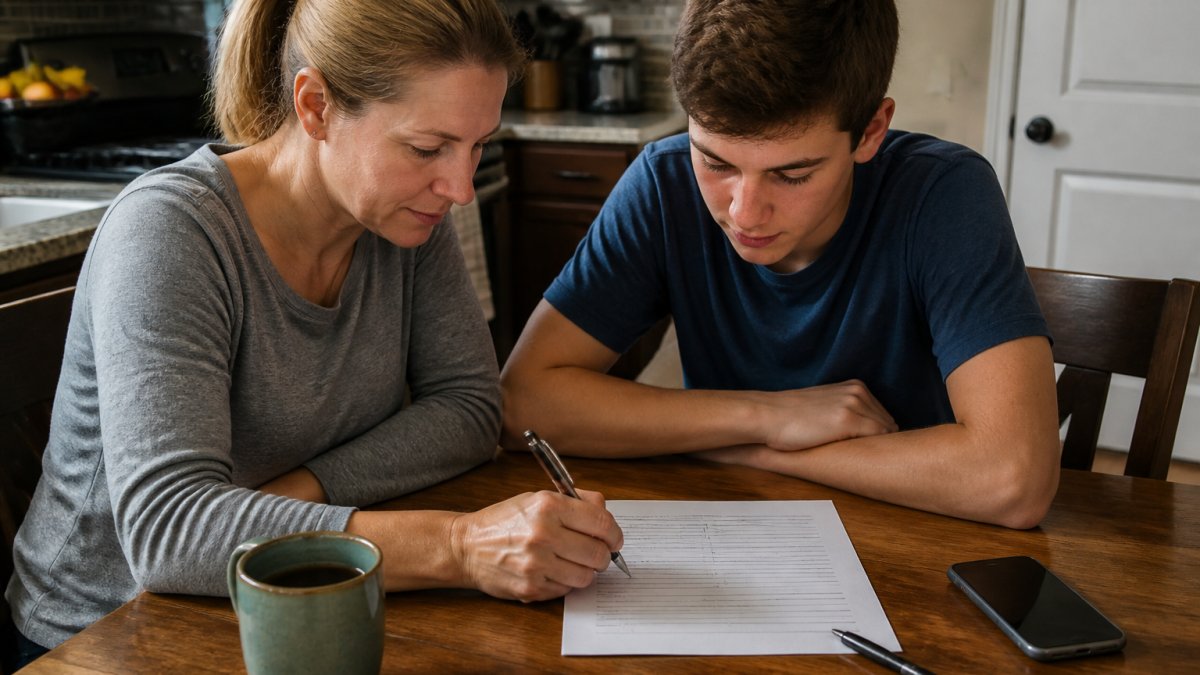
Most guides skip a critical detail: list contacts in order of likely reachability. A neighbor two doors down is often easier to reach than a cousin across the state during a regional event.
Choosing an Out-of-Town Contact
An out-of-town contact is a trusted person who lives far enough away that the same disaster won't affect them. This person becomes the relay point when local calls fail.
Pick someone at least 100 miles away. Confirm they agree to the role before you write their name down. Then make sure every family member has that person's number memorized.
Step 3: Pick a Family Emergency Meeting Place
Pick two family emergency meeting places: one right outside your home, and one outside your neighborhood. The first gets everyone together fast. The second covers the case where you can't return home.
For the near spot, choose a fixed object: the big oak tree at the corner, the mailbox, the neighbor's driveway.
Write both addresses down. Make sure kids can describe them without looking.
Step 4: Decide How Your Family Will Communicate
Communication methods need a set order, not a vague "call me when you can." We recommend a three-tier system: text first, call second, and check in on a set schedule.
Text First, Call Second
Text messages should be your first move in almost every emergency. Texts use less network bandwidth than calls, so they get through when voice lines are overloaded.
Here is the order we recommend:
- Send a short text: "I'm safe at [location]."
- Wait 10 minutes.
- If no reply, make a phone call.
- If the call fails, try the out-of-town contact.
- Check in every hour until everyone is accounted for.
Keep messages under 10 words. Short texts send faster.
Step 5: Write It Down With a Family Communication Plan Template
A family communication plan template turns all your decisions into one page that everyone can read. Most guides hand you a blank form and stop there. A blank form is not a plan, it is homework. What actually works is seeing a completed example first, then adapting it to your household size and living arrangement.
A Completed Worked Example
Here is a filled-in plan for a two-adult, two-child household. Use it as a model, not a script.
FAMILY COMMUNICATION PLAN, Rivera household Home address: 1420 Maple Ridge Dr. (blue house, second from the corner, mailbox marked RIVERA)
Contacts 1.
Notice what the example does that a blank form does not. The home address includes a landmark a child can repeat.
Adapt the Template to Your Household
A single-page plan works for most households, but the fields change with your living arrangement. Adjust as follows:
- Single adult: list two local contacts and one out-of-town contact. Name a person who can make medical decisions if you are incapacitated, and write that authority down.
- Multigenerational household: add a line for each elder's medications, mobility aids, and primary caregiver, plus a backup caregiver. Note who holds power of attorney and where the document is kept.
- Roommates or shared housing: treat each roommate as a household member, but list separate out-of-town contacts. Agree in advance who takes the pet and who locks up.
Make the Plan Work Offline
A plan stored only on a phone is not a plan. Do these three things:
- Print at least three copies: one on the fridge, one in each vehicle's glove box, and one in the emergency kit.
- Take a photo of the completed sheet and set it as a favorite or pinned image on every phone, so it opens without a network connection.
- Store a copy in a sealed plastic bag or waterproof document sleeve. Paper survives a wet backpack; a phone does not.
Browse our [product category] to see options. Pricing depends on kit size, so check the site for current details.
Real-World Emergency Communication Plan Examples
Emergency communication plan examples show how the same plan adapts to different disasters.
Scenario: A Wildfire Evacuation
A wildfire gives you minutes, not hours. Your plan should already have the far meeting place written down. When the alert hits, text the out-of-town contact first with your route. Then call the near meeting place contact to confirm pickup. Grab the printed contact sheet from the fridge and go.
Scenario: A Regional Power Outage
A power outage knocks out cell towers within hours. Your plan should include a radio check-in time. Text before the towers fail. Then use a battery-powered radio to listen for local updates. The out-of-town contact becomes the family's message board.
Plan for Family Members With Disabilities, Pets, and Medical Needs
Standard plans leave out the households that need them most. A generic contact sheet assumes everyone can hear a phone ring, walk to the meeting place, and carry their own bag. If you care for someone with a disability, a pet, or a medical condition, the plan has to be built around their actual needs, not adapted after the fact.
Accessible Communication Methods
Match the communication method to the person, not the other way around.
- Deaf or hard of hearing: agree on a text-first chain and name a video relay service number on the sheet. Do not rely on a voice call as the fallback step; replace it with a second text or a relay call.
- Blind or low vision: keep a large-print copy of the plan and a phone with a screen reader enabled. Record a voice memo of the contact list so it can be played without reading.
- Speech or cognitive disabilities: pre-write short scripts ("I am safe, I am at the library") that the person can send or show to a first responder. Laminate a card with the person's name, condition, and an emergency contact.
Medication and Equipment Needs
Write down what the person takes, how much, and where it comes from, then plan for a refill gap.
- List every medication, dose, and the pharmacy phone number. Include a written list in the go-bag, not just on a phone.
- Note equipment that requires power (oxygen concentrator, nebulizer, insulin cooler) and plan a backup power source or a destination with power.
- Pack a three-day supply of medication if your prescriber and insurer allow an early refill; ask about emergency refill rules before you need them.
- Record the name and number of the prescribing doctor for each medication.
Caregiver Coordination
If more than one person provides care, the plan needs a handoff protocol.
- Name a primary caregiver and a backup for each dependent, with phone numbers for both.
- Agree on a single check-in time when caregivers confirm who has the dependent.
- Write down where the dependent's records are kept (a folder, a binder, a shared drive) so a backup caregiver can find them without a phone call.
- Tell the backup caregiver they are on the list, and confirm they accept the role.
Pets and Service Animals
Pets are family, and service animals are not optional equipment. Plan for both.
- Identify a pet-friendly meeting place. Many public shelters do not accept animals, so confirm in advance which nearby locations do, or arrange a caregiver who will take the pet.
- Name a pet caregiver and a backup, and give both a key or access instructions.
- Microchip each pet and list the vet's phone number on the plan. Keep a photo of each pet with the records.
- Pack a pet go-bag: food, medication, leash, carrier, and a copy of vaccination records. Shelters and boarding facilities often ask for proof of rabies vaccination.
Evacuation Check-Ins
Build a check-in step specifically for the person who needs assistance.
- The assisting adult confirms the dependent is out of the home and texts the out-of-town contact.
- The out-of-town contact records the time and location.
- If the assisting adult is separated from the dependent, the out-of-town contact becomes the coordination point and calls the backup caregiver.
The FEMA guidance on emergency preparedness for people with disabilities covers additional accessibility steps. Print that page and add it to your binder so the plan and the guidance live in one place.
Practice, Review, and Update Your Family Communication Plan
Run a family emergency drill twice a year. Test the actual steps: text the contacts, walk to the meeting place, and check the go-bags.
Then update the plan. Phone numbers change. Schools change. Kids grow up. A plan that's six months old is already out of date.
| Task | How Often | Time Needed |
|---|---|---|
| Test text and call chain | Every 6 months | 20 minutes |
| Walk to both meeting places | Every 6 months | 30 minutes |
| Update contact numbers | Every 3 months | 10 minutes |
| Check go-bags and meds | Every 6 months | 15 minutes |
| Full plan review with family | Once a year | 45 minutes |
A family communication plan only works if everyone knows it cold. Practice until the steps feel automatic.
Frequently Asked Questions
What should be included in a family emergency communication plan?
A complete family communication plan includes a written emergency contact list for family members with names, phone numbers, and addresses; an out-of-town contact who can relay messages; two meeting places (one near home, one outside the neighborhood); a text-first communication rule; and copies stored in wallets, backpacks, and on phones. Include school and workplace numbers, a trusted neighbor, and any medical details for family members who need them. Review the plan every six months.
How can family members communicate if phone service is unavailable?
Text messages often get through when voice calls fail because they use less network capacity. If texts fail too, try the out-of-town contact, since long-distance calls sometimes connect when local lines are jammed. Keep a charged phone and a backup battery pack in your kit, and agree in advance on a check-in window, such as every hour on the hour, so no one burns battery trying repeatedly. A written contact sheet ensures you still have numbers if your phone dies.
Where should family members meet during an emergency?
Choose two family emergency meeting places: one right outside your home, such as a specific tree or mailbox, for sudden events like a fire, and one outside your neighborhood, such as a library or relative's house, for evacuations. Both should be easy for every family member to reach on foot or by a short drive. Walk the routes with your kids, show them the spots in person, and print the addresses on your contact sheet.
How often should a family communication plan be reviewed and practiced?
Review your family communication plan every six months and after any major change, such as a new school, job, phone number, or move. Run a short practice drill twice a year: have everyone text the out-of-town contact and meet at your nearby meeting place. Update phone numbers, addresses, and medical notes as needed, and replace any printed copies that are outdated. Regular practice turns the plan into a habit instead of a document nobody remembers.
Emergencies don't wait for perfect timing. The families who stay connected are the ones who wrote it down, practiced it, and kept it current. At SHTF Prepper Club, we build gear that supports that plan: waterproof document holders, long-shelf-life food kits, and reliable water filtration for when the taps stop. Add to cart and get your household ready this week.