
Table of Contents
- Define Your Caloric Foundation for a 3 Month Food Supply
- Select Essential Food Categories for Long-Term Storage
- Water Storage Requirements for Emergencies
- Build Your Emergency Food Storage Checklist
- Implement a Food Rotation System to Prevent Spoilage
- Budget-Friendly Emergency Food Supply Strategies
- Prepare for Cooking Without Electricity and Address Common Concerns
- Conclusion
Last Updated: August 7, 2026
Define Your Caloric Foundation for a 3 Month Food Supply
Building a 3 month food supply starts with calculating the specific caloric foundation that will sustain your family through an extended emergency. An average adult needs roughly 2,000 calories per day, but this shifts based on age, activity level, and special dietary needs. Children require fewer calories; pregnant women and nursing mothers need more.
Calculate Daily Caloric Needs
Determine your household's baseline caloric requirement by multiplying the number of people by their individual daily needs. Use 2,000 calories for most adults, 1,200-1,400 for children aged 4-8, 1,400-1,600 for children 9-13, and 2,200-2,800 for teenagers and active adults. Multiply your daily total by 90 days to find your target. A family of four with an average of 2,000 calories per person per day needs 720,000 total calories for three months. Write this number down and post it somewhere visible.
Account for Activity Levels and Special Needs
The 2,000-calorie baseline assumes sedentary living. During an actual emergency, activity levels typically increase due to clearing debris, gathering water, and managing property. Add 20-30% to your baseline if you expect elevated activity. A family that calculated 720,000 calories should aim for 864,000-936,000 calories instead.
Account for special dietary needs now. If anyone has food allergies, religious restrictions, or medical conditions requiring specific foods, build your supply around what people will actually eat and can safely consume.
Select Essential Food Categories for Long-Term Storage
Not all shelf-stable foods are created equal. Build your supply on bulk staples, rice, pasta, oats, flour, and dried beans, which store well, deliver consistent calories, and form the basis of actual meals.
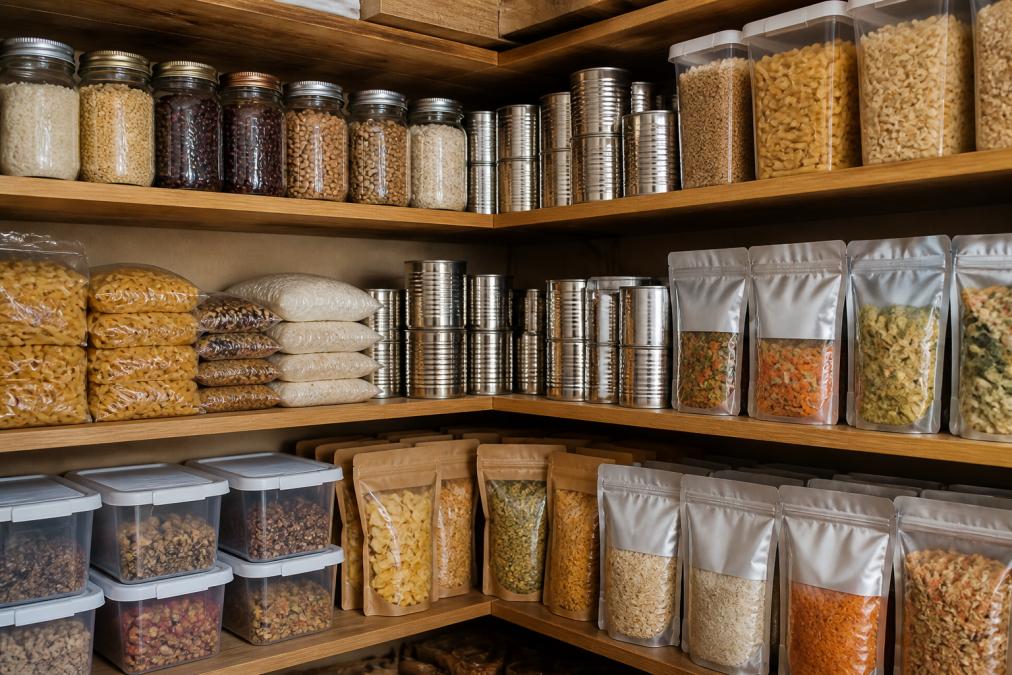
Bulk Staples and Carbohydrate Foundation
White rice stores indefinitely in proper conditions and should form a significant portion of your supply. A family of four should store 50-75 pounds of rice. Dried pasta lasts 8-10 years, oats last indefinitely if moisture is controlled, and flour lasts 6-8 months unprotected but 10+ years in vacuum-sealed containers. Dried beans and lentils store for 10-30 years and are extraordinarily cost-effective, with one pound yielding roughly 6-7 cups of cooked beans. These bulk staples should form roughly 50-60% of your caloric foundation.
Protein Sources and Fats and Oils
Canned meats, tuna, chicken, salmon, beef, provide shelf-stable protein lasting 3-5 years at room temperature. Store a variety to prevent meal fatigue. Powdered eggs and powdered milk extend your options, and peanut butter is calorie-dense, shelf-stable, and palatable. A family of four should store 10-15 jars for a 3 month supply.
Fats and oils are critical but often overlooked. They deliver more than twice the calories per gram as carbohydrates or protein and make food taste better during extended stress. Store 2-4 liters of cooking oil for a three-month supply.
Shelf-Stable Vegetables, Fruits, and Seasonings
Canned vegetables and fruits provide vitamins, minerals, and psychological comfort. Freeze-dried options retain more nutrients and take up less space, making them ideal for apartment-based supplies. Seasonings matter more than most guides acknowledge, salt, sugar, honey, vinegar, and basic spices transform bland emergency food into something your family will actually eat. Store at least one large container of salt, several pounds of sugar or honey, and a full spice rack.
Water Storage Requirements for Emergencies
Water serves drinking, cooking, hygiene, and sanitation purposes during an emergency. The standard recommendation is one gallon per person per day. For a family of four over 90 days, that's 360 gallons. However, if you're sheltering in place during a power outage or water system failure, you'll also need water for washing dishes and sanitation. Aim for 1.5 gallons per person per day as a more realistic baseline if you're entirely dependent on stored supplies.
Storage Containers and Moisture Control
Food-grade plastic containers are the standard for water storage. Five-gallon buckets with tight-fitting lids are affordable and stackable. A family of four needing 360 gallons requires 72 five-gallon buckets, or use smaller containers like two-liter bottles for easier rotation and transport.
Add a food-safe water storage additive (like unscented bleach at the recommended concentration) to prevent algae and bacterial growth. Store water in cool, dark locations away from direct sunlight. A basement, interior closet, or shaded garage is ideal.
Build Your Emergency Food Storage Checklist
An emergency food storage checklist transforms abstract planning into concrete action. Start with bulk staples purchased in bulk from warehouse stores or online retailers. Next, add protein sources, then fats and oils, then shelf-stable vegetables and fruits, and finally seasonings and flavor enhancers. Document everything as you purchase: item, quantity, purchase date, and expiration date.
Organize by Food Category and Shelf Life
Group supplies by category: grains, proteins, vegetables, fruits, fats, and seasonings. Within each category, organize by shelf life, shortest-lived items in front, longest-lived items in back. Create separate storage zones if possible, with a dedicated shelf for items approaching expiration. Label everything clearly with waterproof labels or permanent markers, including item name, purchase date, expiration date, and quantity.
Implement a Food Rotation System to Prevent Spoilage
A food rotation system prevents spoilage and ensures your supply remains edible. FIFO (First In, First Out) is the standard method: place new purchases behind existing supplies, and take items from the front when needed. This only works if you actually use your emergency food supply regularly. Many preppers integrate their emergency supply into their regular grocery rotation.
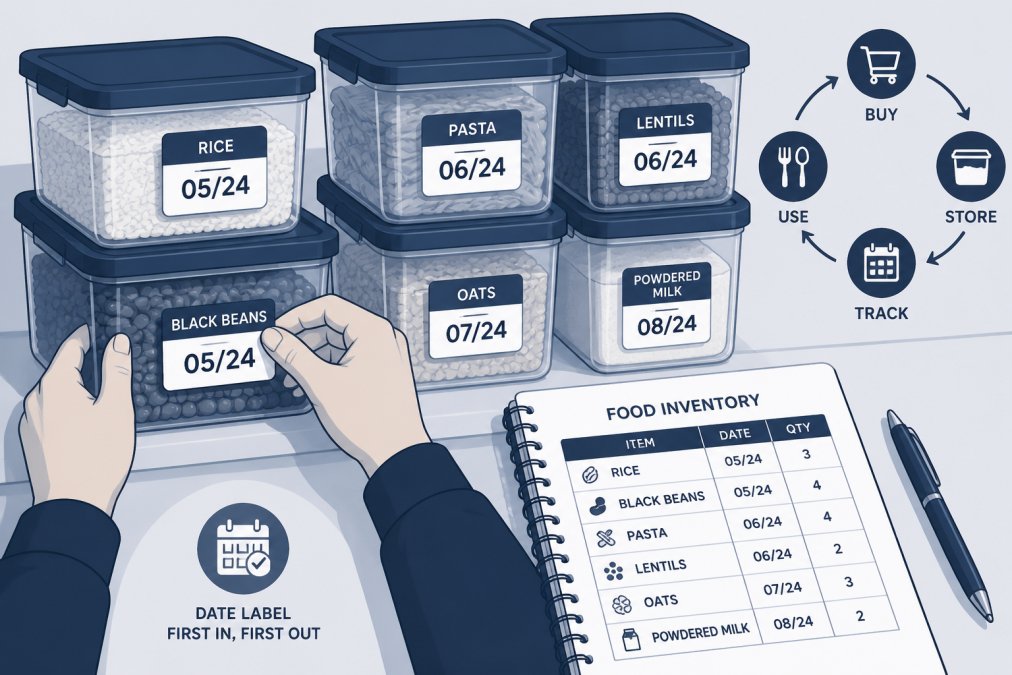
Create a Food Storage Inventory Spreadsheet
A simple spreadsheet tracks everything: item name, category, quantity, purchase date, expiration date, storage location, and rotation status. Update it every time you add to or remove from your supply. Share the spreadsheet with family members who might need to access your supply during an emergency.
Budget-Friendly Emergency Food Supply Strategies
Building a 3 month food supply doesn't require unlimited spending. Buy staples in bulk from warehouse stores, rice, beans, pasta, and oats cost significantly less per pound in large quantities. Purchase store-brand items rather than name brands. Buy seasonal items when prices are lowest. Integrate emergency supply purchases into regular grocery shopping by buying an extra can of beans, an extra pound of rice, or an extra jar of peanut butter with each trip.
Consider buying freeze-dried meals and emergency ration bars from SHTF Prepper Club. These concentrated options take up far less space and require no preparation, making them ideal for apartment dwellers or those with severe space constraints.
Storage Conditions and Environment Setup
Proper storage conditions dramatically extend shelf life. Temperature stability matters more than absolute temperature. A cool basement that stays 50-60°F year-round is better than an attic that swings from freezing to 100°F. Darkness is essential, light degrades stored food, particularly oils and fats. Use desiccant packets in sealed containers to control moisture. Store food in sealed containers to prevent rodents and insects from devastating your supply. A garage or basement works well if temperature and moisture are controlled.
Prepare for Cooking Without Electricity and Address Common Concerns
An emergency food supply means nothing if you can't actually cook the food. A camp stove with fuel canisters provides reliable cooking capacity during extended outages. Store extra fuel canisters, at least 4-6 for a family of four planning to cook regularly for 90 days. A manual can opener is non-negotiable; store at least two. Keep matches, lighters, and fire-starting materials in waterproof containers with your cooking equipment.
Many emergency meals require only boiling water: instant noodles, dehydrated meals, instant rice, instant oatmeal. These become invaluable when cooking capacity is limited.
Managing Food Fatigue and Dietary Restrictions
Food fatigue is psychologically real during extended emergencies. Seasonings, sauces, and flavor variety combat this directly. Store multiple types of seasonings, hot sauce, salsa, soy sauce, and condiments.
Dietary restrictions don't disappear during emergencies. If family members are vegetarian, vegan, gluten-free, or have food allergies, your emergency supply must accommodate them. If someone is diabetic, store foods appropriate for blood sugar management. If someone has celiac disease, include gluten-free staples. If someone is vegetarian, ensure adequate plant-based proteins.
Building a 3 month food supply feels overwhelming until you break it into steps. Start with your caloric foundation, select foods your family will actually eat, establish a rotation system, and commit to gradual purchasing. At SHTF Prepper Club, we've helped thousands of families move from anxiety about emergencies to genuine confidence that they're prepared. Our expert-vetted emergency food kits and comprehensive storage solutions are designed to take the guesswork out of preparedness. Start with your baseline calculation today, and you'll have a functional emergency supply built within months.
| Step | Timeline | Priority |
|---|---|---|
| Calculate household caloric needs | Week 1 | Critical |
| Select bulk staples | Week 1-2 | Critical |
| Purchase water storage containers | Week 2 | Critical |
| Buy initial protein and fat sources | Week 2-3 | High |
| Establish rotation system | Week 3 | High |
| Add vegetables, fruits, seasonings | Week 4+ | Medium |
| Create inventory spreadsheet | Week 2 | High |
| Set up storage location | Week 1 | Critical |
Frequently Asked Questions
How much does it cost to build a 3 month food supply? Cost depends on your sourcing strategy and dietary preferences. Bulk staples from warehouse stores are most affordable. Integrating emergency purchases into regular grocery shopping spreads costs over time. Many families find that purchasing gradually makes the expense invisible rather than requiring a large lump-sum investment.
Can I store a 3 month food supply in an apartment? Yes, though space requires creativity. Freeze-dried meals and emergency ration bars take minimal space compared to bulk staples. Store supplies under beds, in closets, and in pantries. Water storage is the biggest challenge; consider storing smaller quantities in multiple locations. SHTF Prepper Club offers space-efficient emergency kits specifically designed for apartments and small homes.
How often should I rotate my emergency food supply? If you're using FIFO rotation with regular grocery integration, rotation happens naturally. If you're maintaining a separate emergency supply, conduct formal rotation twice yearly. Check expiration dates, use items approaching expiration in regular meals, and replace them with fresh stock.
What if family members won't eat the emergency food I've stored? Build your supply around foods your family already eats. An emergency supply nobody will eat is worthless.
Do I need special equipment to cook emergency food? A camp stove with fuel is the most reliable backup. A manual can opener is absolutely essential. You can cook many emergency foods with minimal equipment by boiling water in a pot over a camp stove.
FEMA emergency preparedness guidelines
CDC food safety during emergencies
American Red Cross emergency water storage recommendations
Frequently Asked Questions
How much water do I need for a 3 month food supply?
The CDC recommends 1 gallon per person per day for drinking and sanitation. For a family of four over three months (90 days), that's 360 gallons total. Store water in food-grade containers in a cool, dark location. Rotate every six months to maintain freshness. Account for cooking needs and hygiene beyond just drinking water.
What's the most cost-effective way to start a food stockpile?
Buy bulk staples like rice, beans, oats, and pasta from warehouse stores. Purchase canned goods on sale and add gradually to your pantry. Dehydrated meals and freeze-dried options cost more upfront but last 25+ years, making them economical long-term. Combine discount shopping with a structured rotation system to avoid waste and spoilage.
How do I rotate a 3 month food supply to prevent spoilage?
Use the FIFO (First In, First Out) method: place newer items behind older ones. Maintain an inventory spreadsheet tracking purchase dates and expiration dates. Consume and replace items before they expire during regular meal planning. Rotate every three to six months depending on storage conditions. Check temperature and moisture levels in your storage area monthly.
What are the best shelf-stable foods for long-term storage?
Focus on nutrient-dense, shelf-stable options: canned proteins (tuna, chicken, beans), dried pasta and rice, oats, peanut butter, canned vegetables and fruits, powdered milk, oils, and seasonings. Include dehydrated meals and freeze-dried fruits for variety. Avoid foods with high moisture content or those requiring refrigeration. Ensure a balance of carbohydrates, proteins, and fats for nutritional security.
This article was written using GrandRanker